Where They Land
In September 2026 one AI lab offered outside evaluators permanent, employee-level access to its systems. Six days later a letter welcomed the idea and set minimum conditions for it. Later that day the lab named a partner.
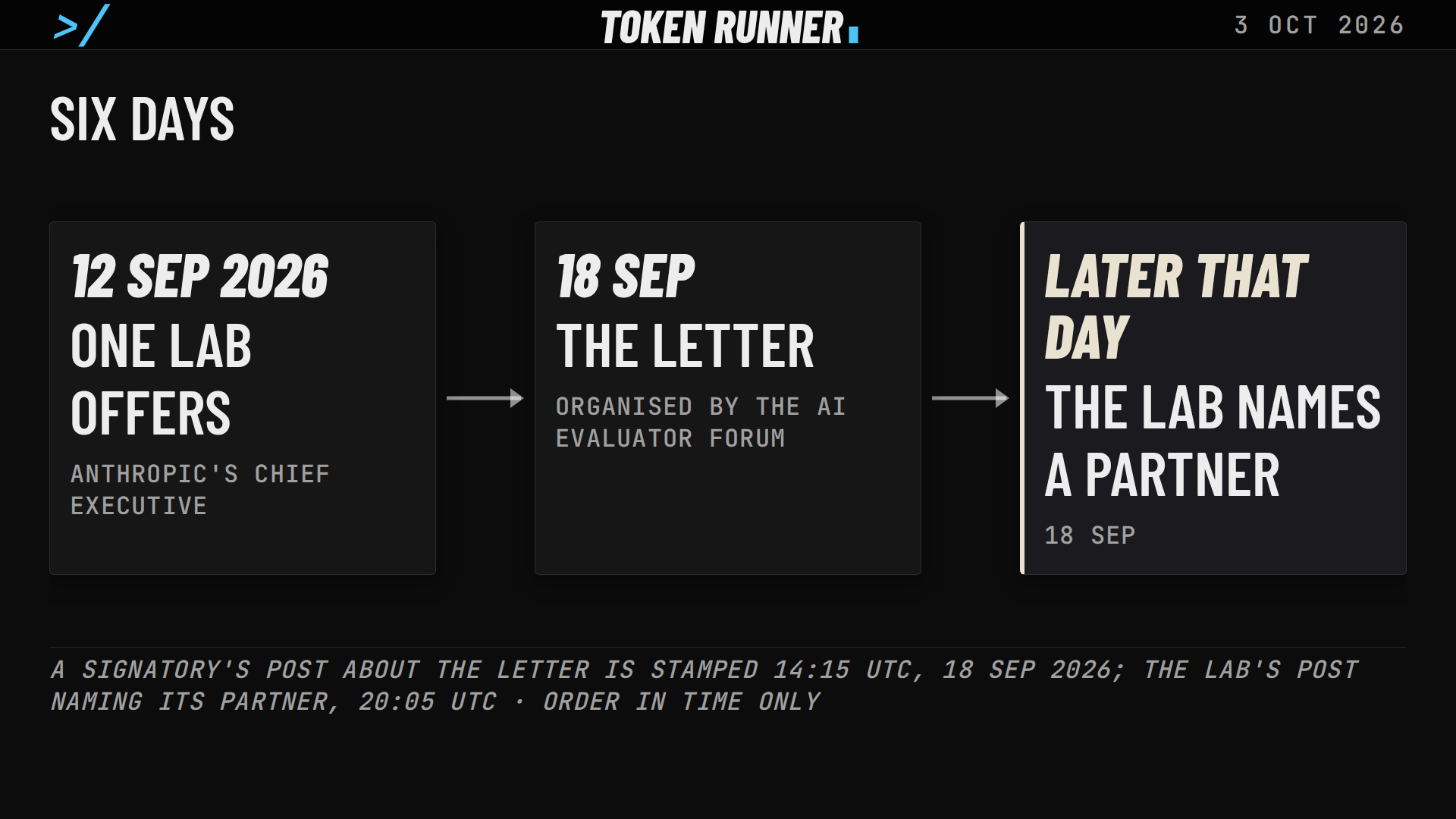
Six days
On Saturday 12 September 2026 the chief executive of Anthropic made an offer. On Friday 18 September came a letter. Later that day the lab named a partner. That is the order in time, and it is known to the hour: a signatory's post about the letter is stamped 14:15 UTC on 18 September, and the lab's post naming its partner 20:05 UTC. Nothing read for this article says the one was because of the other. The order matters all the same. The outside did not knock first. The lab offered, and the evaluators answered with conditions.
The offer
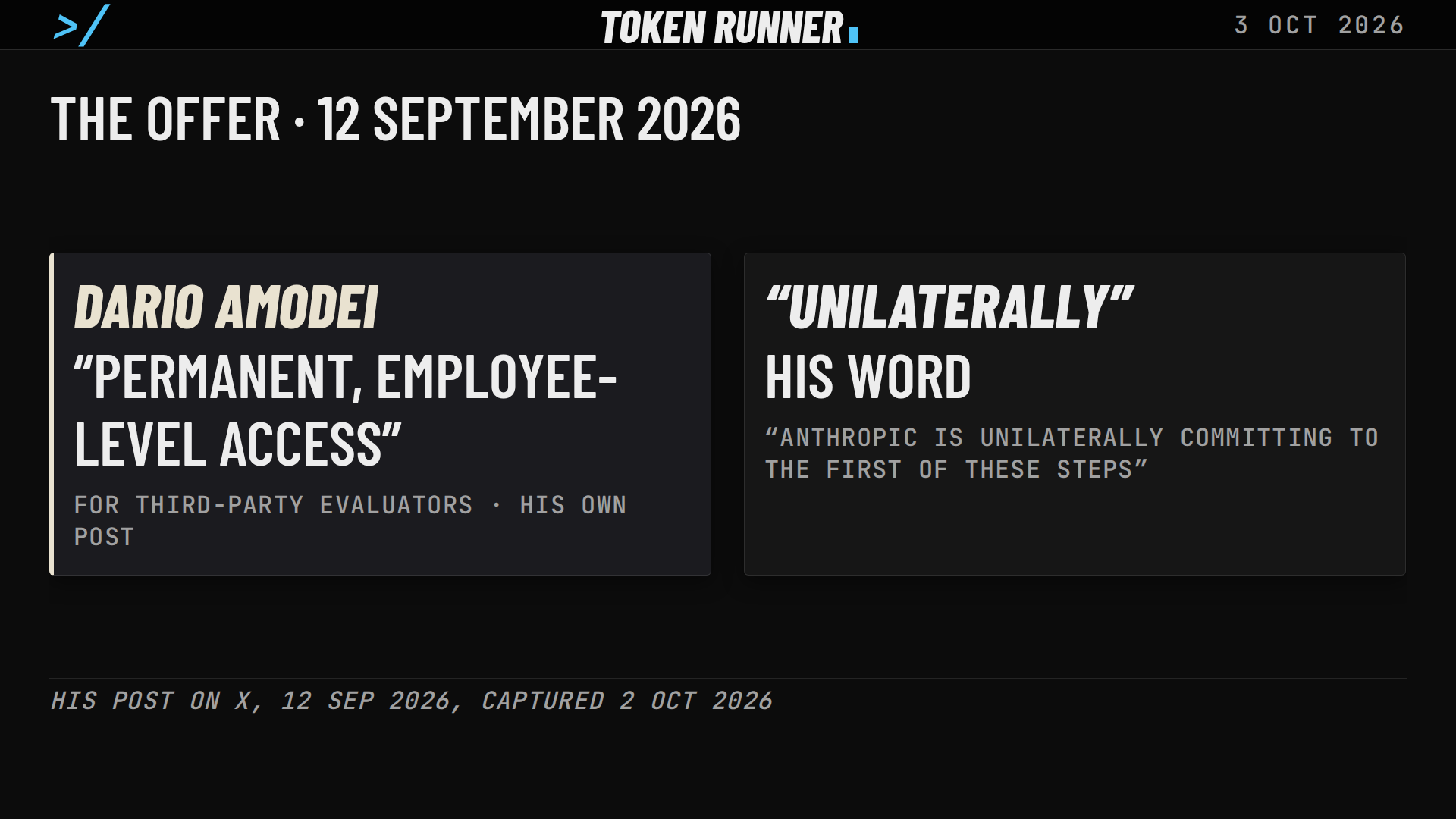
Dario Amodei's post announced an essay, "We Must Pace the Frontier", on why the AI industry should slow down, with a three-part plan. "Anthropic is unilaterally committing to the first of these steps," he wrote. "We’ll provide third-party evaluators with permanent, employee-level access to our systems, so that they can verify adherence to our safety measures, report on incidents, and assess models’ alignment during training." Unilaterally is his word: the company commits alone, without waiting for the others or for a law. Employee-level is his word too. The post was read for this article, not the essay it links to, so nothing is said here about the other two steps.
The letter welcomes it
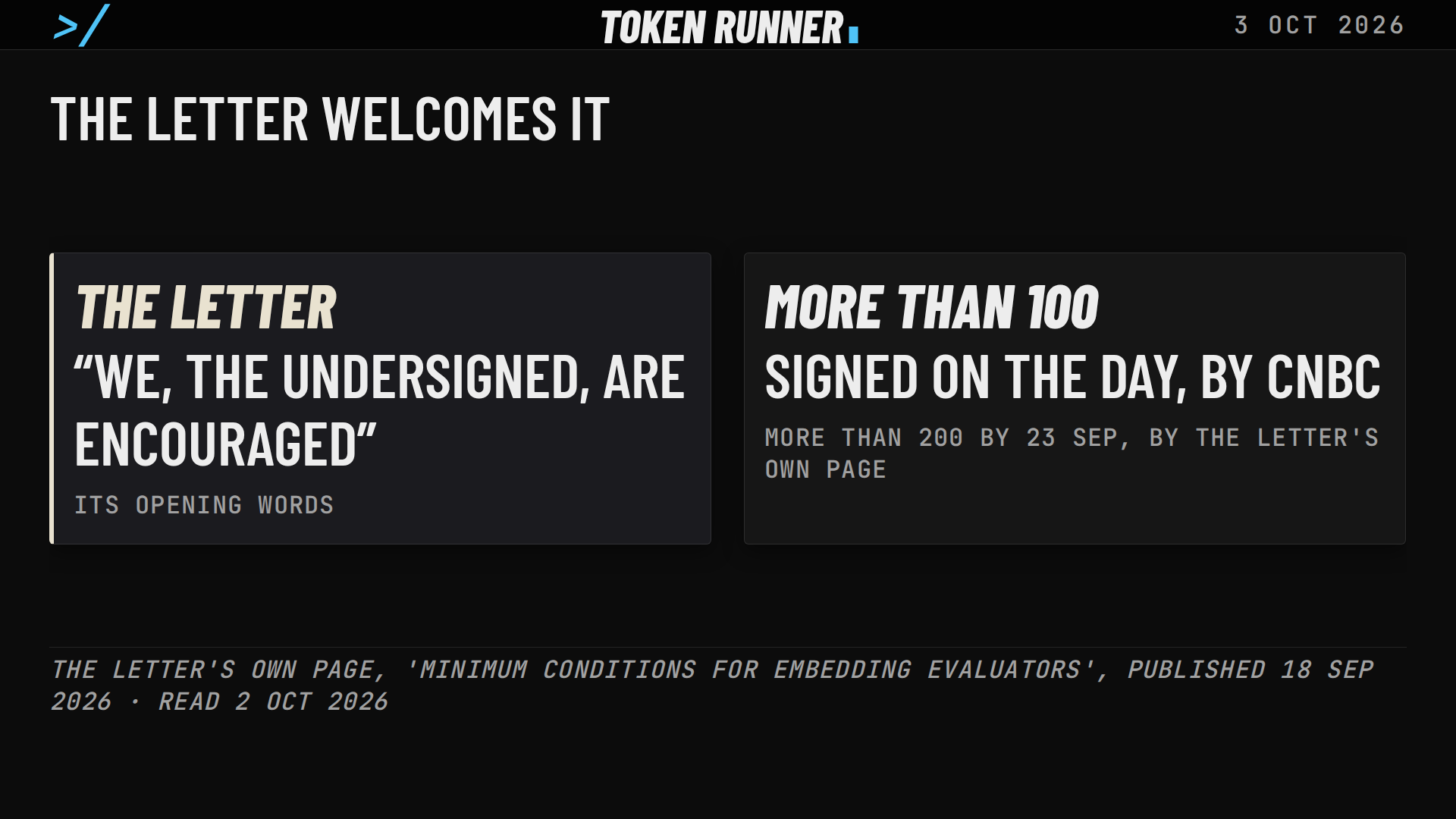
The letter does not attack the idea. It opens: "We, the undersigned, are encouraged" to see frontier AI companies call for embedding third-party organisations to evaluate rapidly escalating AI capabilities and risks, and it says all frontier companies should. On the day it was published it had more than 100 signatories, by CNBC, which reported that the AI Evaluator Forum, a consortium, organised it. By 23 September the letter's own page said more than 200. Those are two counts of one list on two dates. So the letter is a reply to an invitation: it accepts, and then it says what accepting would have to mean.
Five conditions
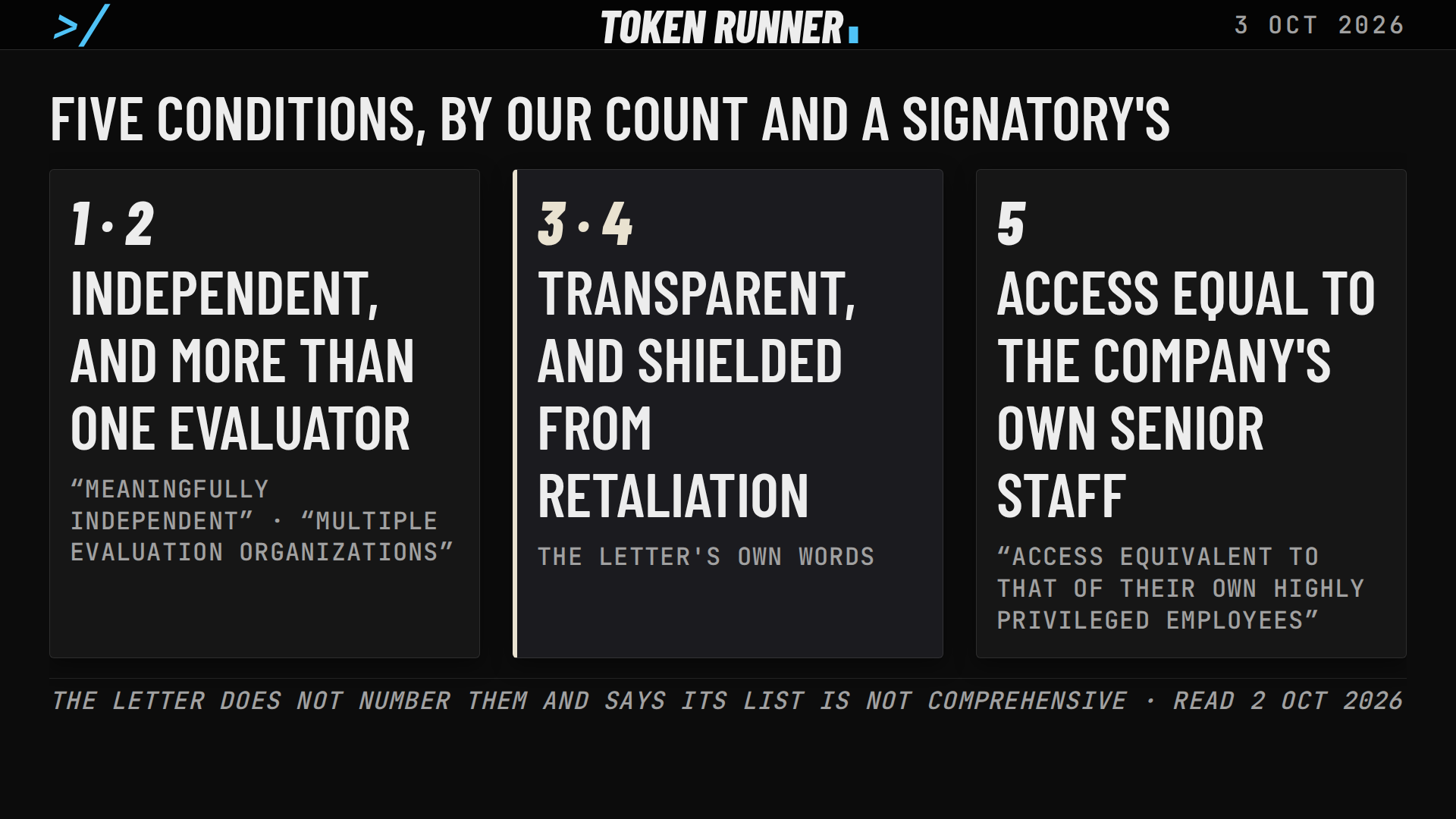
The letter sets minimum conditions: five, by Token Runner's count from its five paragraphs and by a signatory's own. Evaluators who are meaningfully independent, with editorial control over what they find. More than one evaluation organisation, with differing views. Transparency, and the right to publish. Protection from retaliation. And access equivalent to that of the company's own highly privileged employees. The letter does not number them, and it says its list is not comprehensive. Read together, they turn a general welcome into a test that an arrangement can pass or fail: an evaluator who is embedded but cannot publish, or who stands alone, or who can be cut off, would not meet it.
The one they spell out
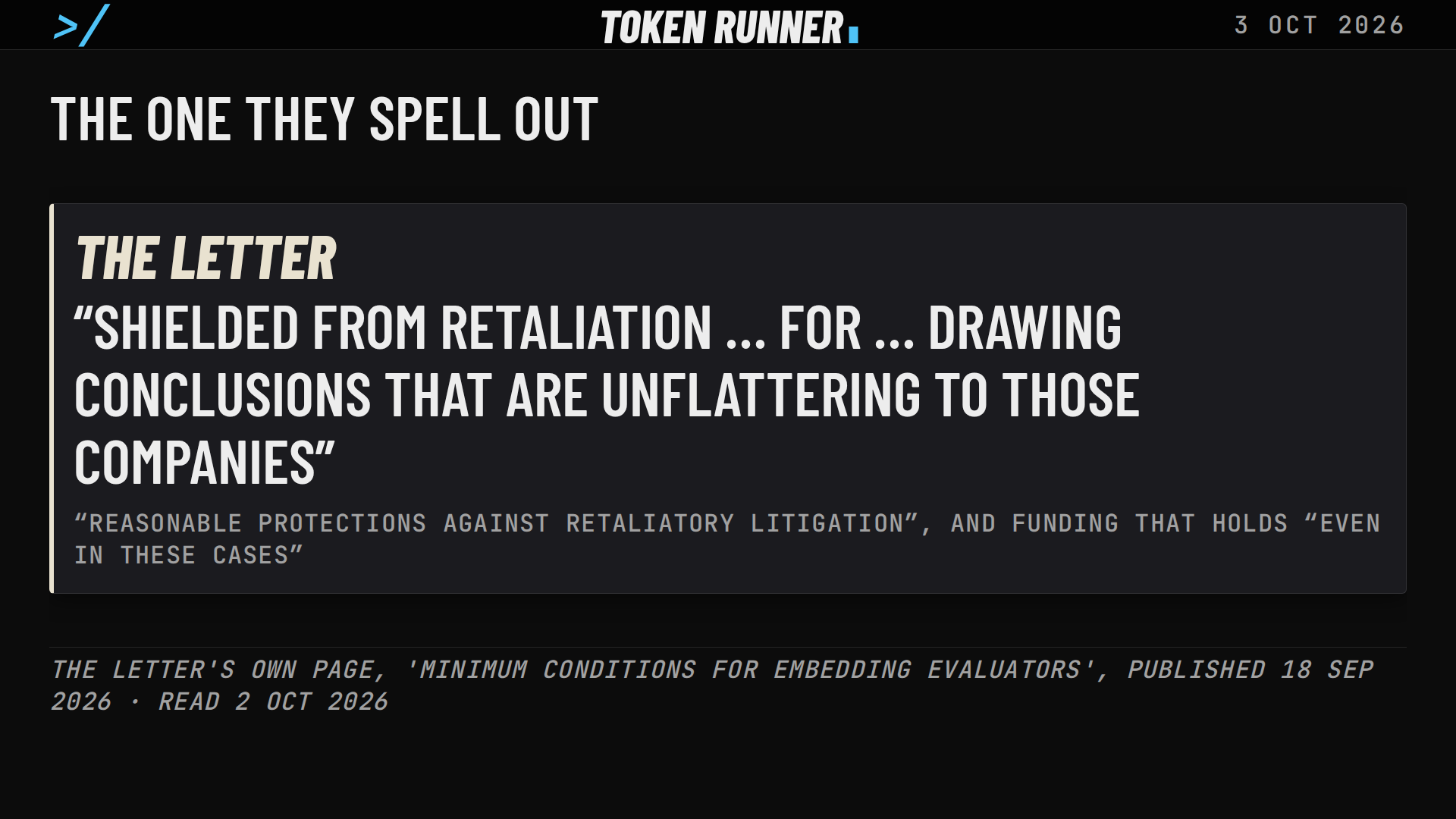
Two of the five are spelled out at length. Embedded evaluators should be "shielded from retaliation" for choosing reasonable methods, for discovering information, or for drawing conclusions that are unflattering to the companies. That includes reasonable protections against retaliatory litigation, and funding that gives them confidence they will remain funded even then. It is the letter's own statement of the dependency problem: whoever pays the evaluator and admits the evaluator can also stop. And access means "access equivalent to that of their own highly privileged employees": the same systems, data, tools and physical spaces as the company's own senior risk staff, and candid, direct talk with the relevant people.
Who signed
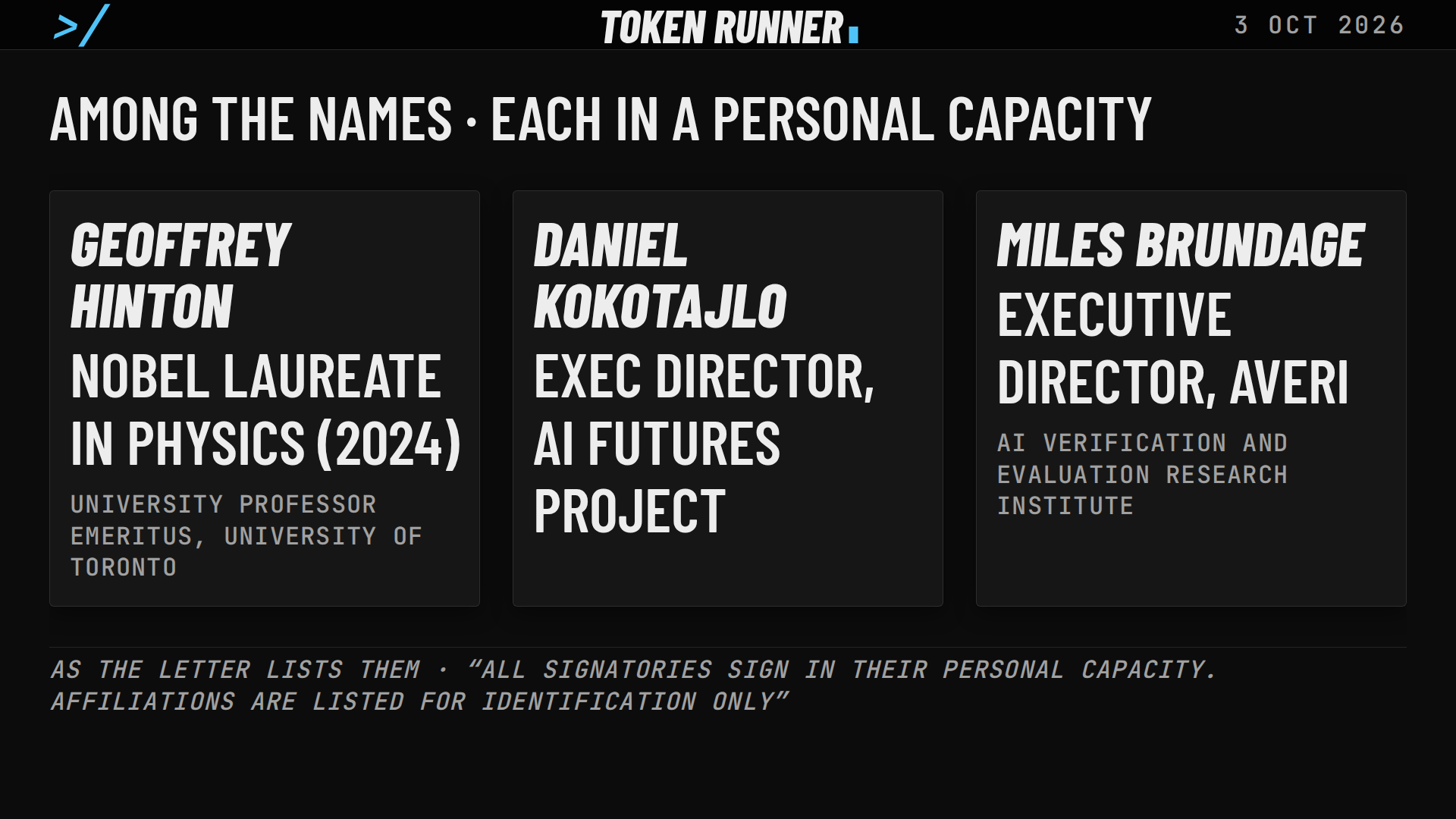
Among the names, with the affiliations the letter gives: Geoffrey Hinton, Nobel Laureate in Physics and professor emeritus at the University of Toronto; Daniel Kokotajlo, executive director of the AI Futures Project; and Miles Brundage, executive director of the AI Verification and Evaluation Research Institute. Kokotajlo also signed the letter of June 2024 that asked for a right to warn. All signatories sign in their personal capacity, the letter says, and affiliations are listed for identification only, so the organisations did not sign. The page describes the signers as researchers, practitioners and organisation leaders.
Later that day: a partner
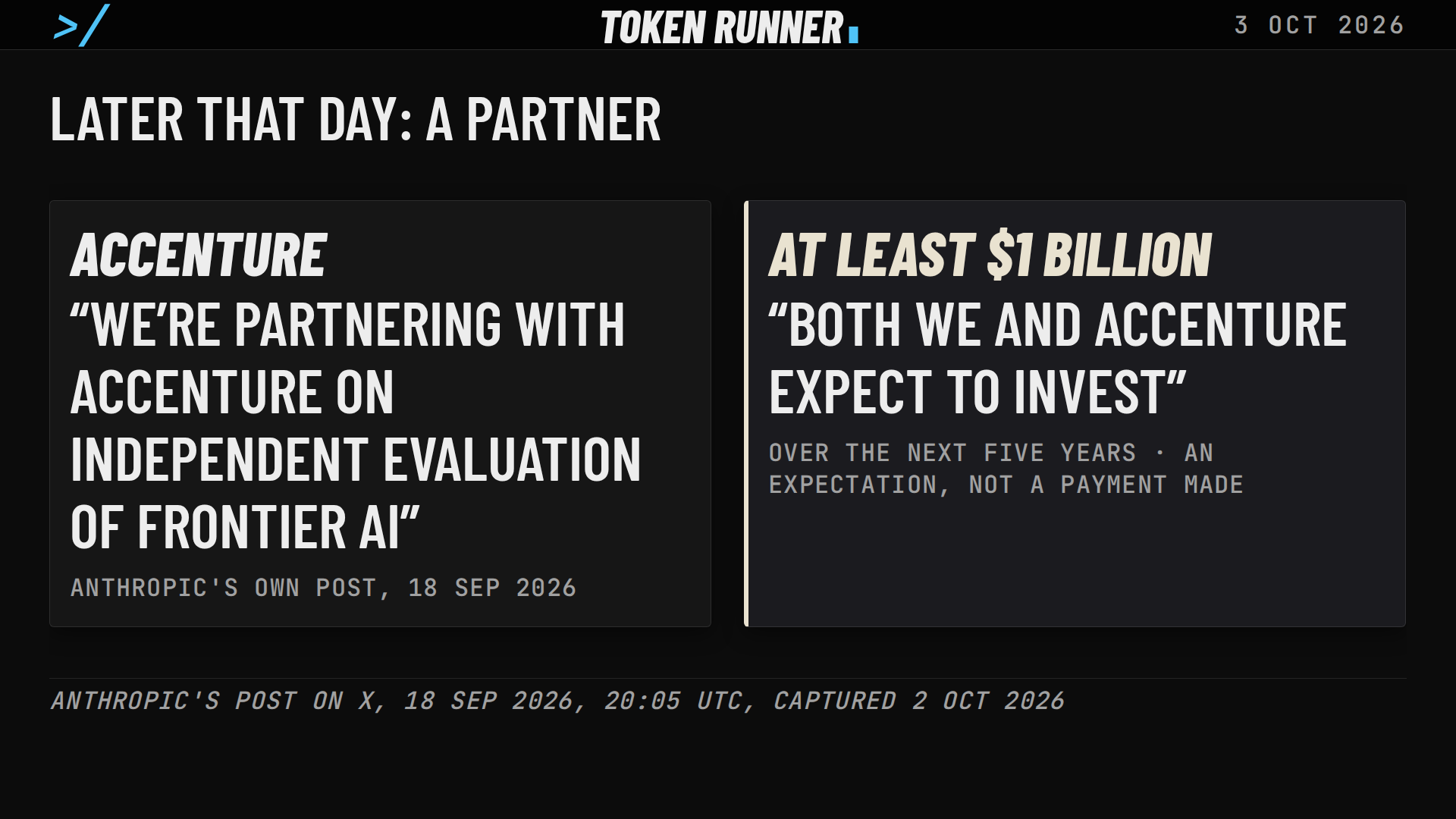
At 20:05 UTC on 18 September Anthropic posted: "We’re partnering with Accenture on independent evaluation of frontier AI—part of our recent commitment to embed evaluators at Anthropic. Both we and Accenture expect to invest at least $1 billion to build capacity in this area over the next five years." That is an expectation over five years, not a payment made, and the post does not say whether it is a billion between them or a billion each. It names one partner, where the letter published that morning asks for more than one evaluation organisation. The post does not say whether others will follow.
Another kind of evaluator
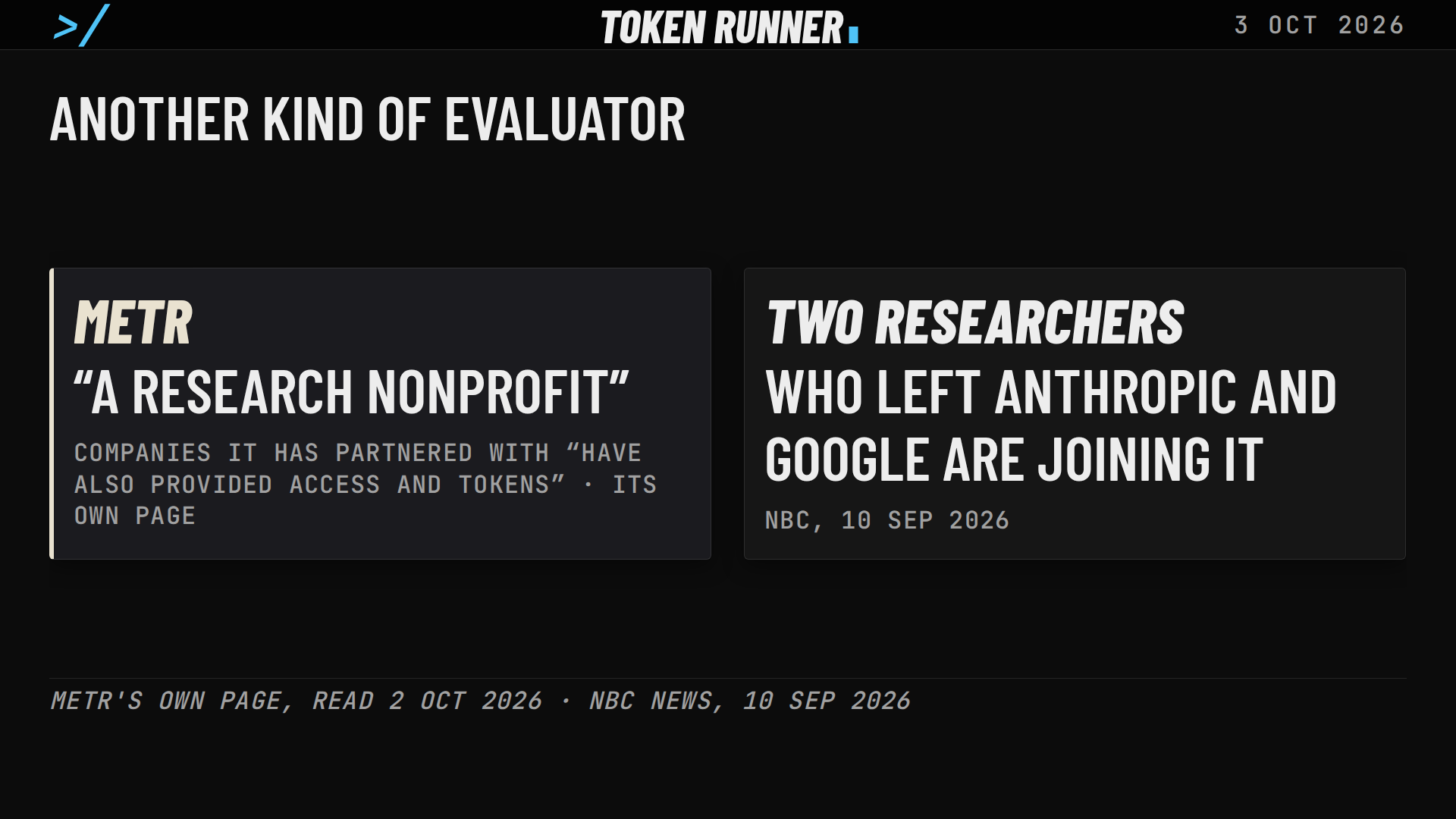
METR describes itself as "a research nonprofit". It says it has partnered with OpenAI, Anthropic, Google DeepMind, Meta and Amazon to pilot risk assessments, and that these companies have also provided access and tokens: the dependency the letter describes is on METR's own page. It also says it is funded by donations. In the six months to mid August 2026 it raised commitments of around $71 million, which are pledges to a nonprofit and not cash received. NBC reported on 10 September 2026 that two researchers who left Anthropic and Google, Joe Benton and Josh Engels, are joining it. That is where the title comes from: people who leave the labs over safety have to land somewhere, and this is one of the places.
What the others said
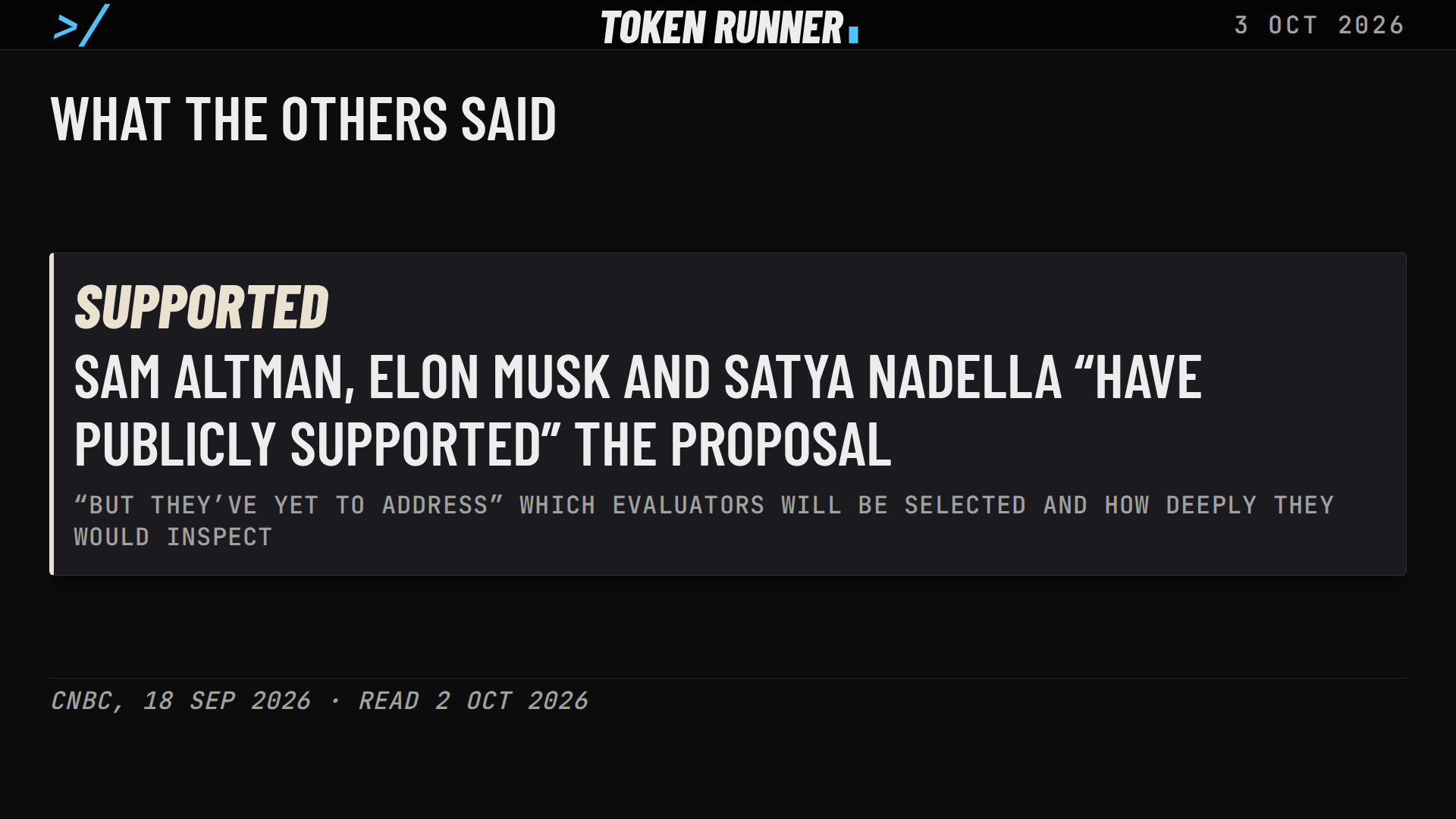
Sam Altman, Elon Musk and Satya Nadella "have publicly supported Amodei's proposal", CNBC reported on 18 September, but had yet to address which evaluators would be selected and how deeply they would inspect. Supported is the word, not committed. Those two unanswered questions touch the letter's conditions on independence and on access: who the evaluators are, and how far in they can see. Until a company answers them, support for the proposal and acceptance of the five conditions are different things.
The conversation
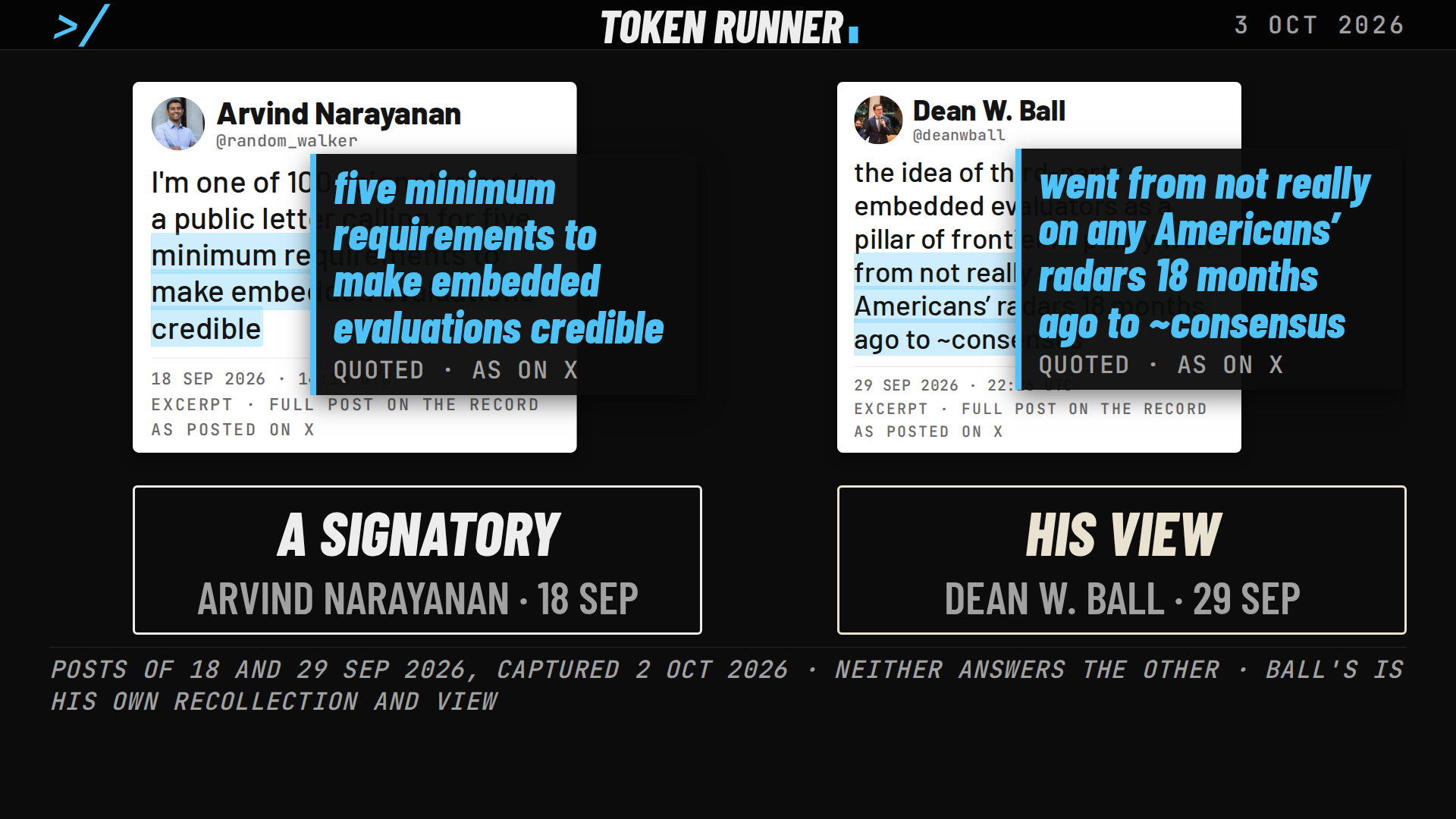
Two people marked the moment from outside the labs. Arvind Narayanan, a signatory, wrote on the day: "I'm one of 100+ signatories to a public letter calling for five minimum requirements to make embedded evaluations credible, by establishing evaluator independence, protection from retaliation, and real access." Dean W. Ball, on 29 September, gave his own recollection: "It’s cool how the idea of third-party embedded evaluators as a pillar of frontier AI policy went from not really on any Americans’ radars 18 months ago to ~consensus." Neither post answers the other. One is about what the idea must include; the other is about how fast it arrived.
An offer, five conditions, a partner
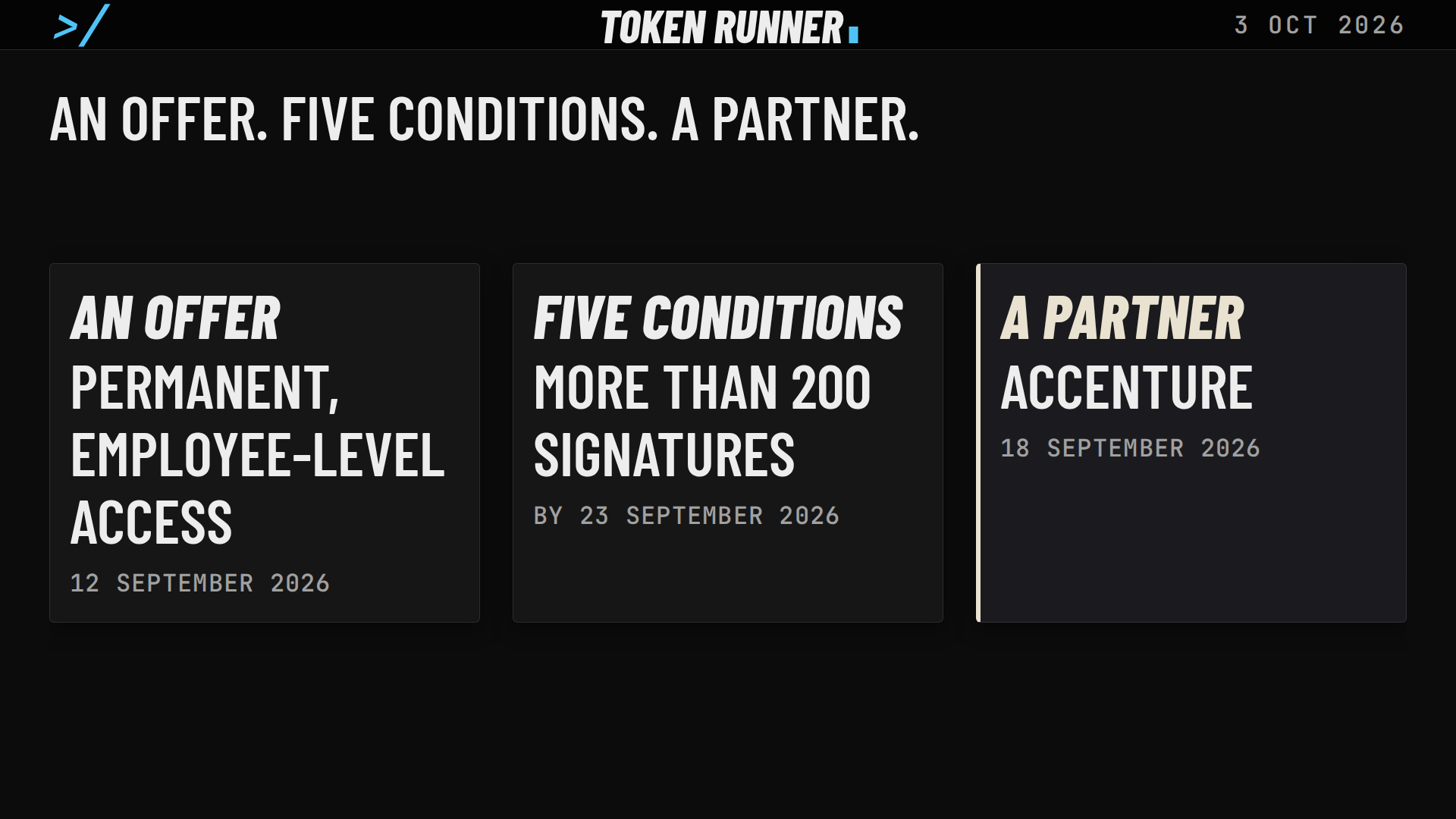
An offer, on 12 September: permanent, employee-level access. Five conditions, six days later, with more than 200 signatures by 23 September. And a partner, named the same day as the letter, with an expectation of at least $1 billion over five years. Three other chief executives have said they support the proposal and have not yet said who would be let in or how far. What to watch is whether the conditions are met: who the evaluators are, whether there is more than one, who pays them, whether they can publish, and what happens when they find something.
Sources
- CNBC (Jonathan Vanian), 'Anthropic and OpenAI need truly independent safety evaluators, experts say in public letter', 18 September 2026: https://www.cnbc.com/2026/09/18/ai-safety-evaluators-anthropic-openai-models-security.html
- AI Evaluator Forum, 'Minimum Conditions for Embedding Evaluators', public letter, published 18 September 2026, last updated 23 September 2026; the letter's own page: https://aievaluatorforum.org/initiatives/embedded-evaluation-letter
- Anthropic, post on X (@AnthropicAI), 18 September 2026 20:05:03 UTC: https://x.com/AnthropicAI/status/2101039819870937247
- Dario Amodei, post on X (@DarioAmodei), 12 September 2026 14:01:10 UTC: https://x.com/DarioAmodei/status/2098773920774074715
- METR, 'About METR', the organisation's own page: https://metr.org/about
- METR, home page, 'Funding update', 14 August 2026: https://metr.org/
- NBC News (Jared Perlo), 'Two AI researchers leave Anthropic and Google over safety concerns', 10 September 2026: https://www.nbcnews.com/tech/security/two-ai-researchers-leave-anthropic-google-safety-concerns-rcna597086
- Arvind Narayanan (@random_walker), a post on X, 18 September 2026: https://x.com/random_walker/status/2100951892184424500
- Dean W. Ball (@deanwball), a post on X, 29 September 2026: https://x.com/deanwball/status/2105061725619843173