The Silence Contracts
In May 2024 a reporter described the agreement OpenAI asked departing staff to sign: no criticism of the company, for life, with their equity at stake. Within seven days of the report the company had written to its staff that no vested units had been or would be cancelled. Then came a letter, and a law narrower than the letter.
The clause
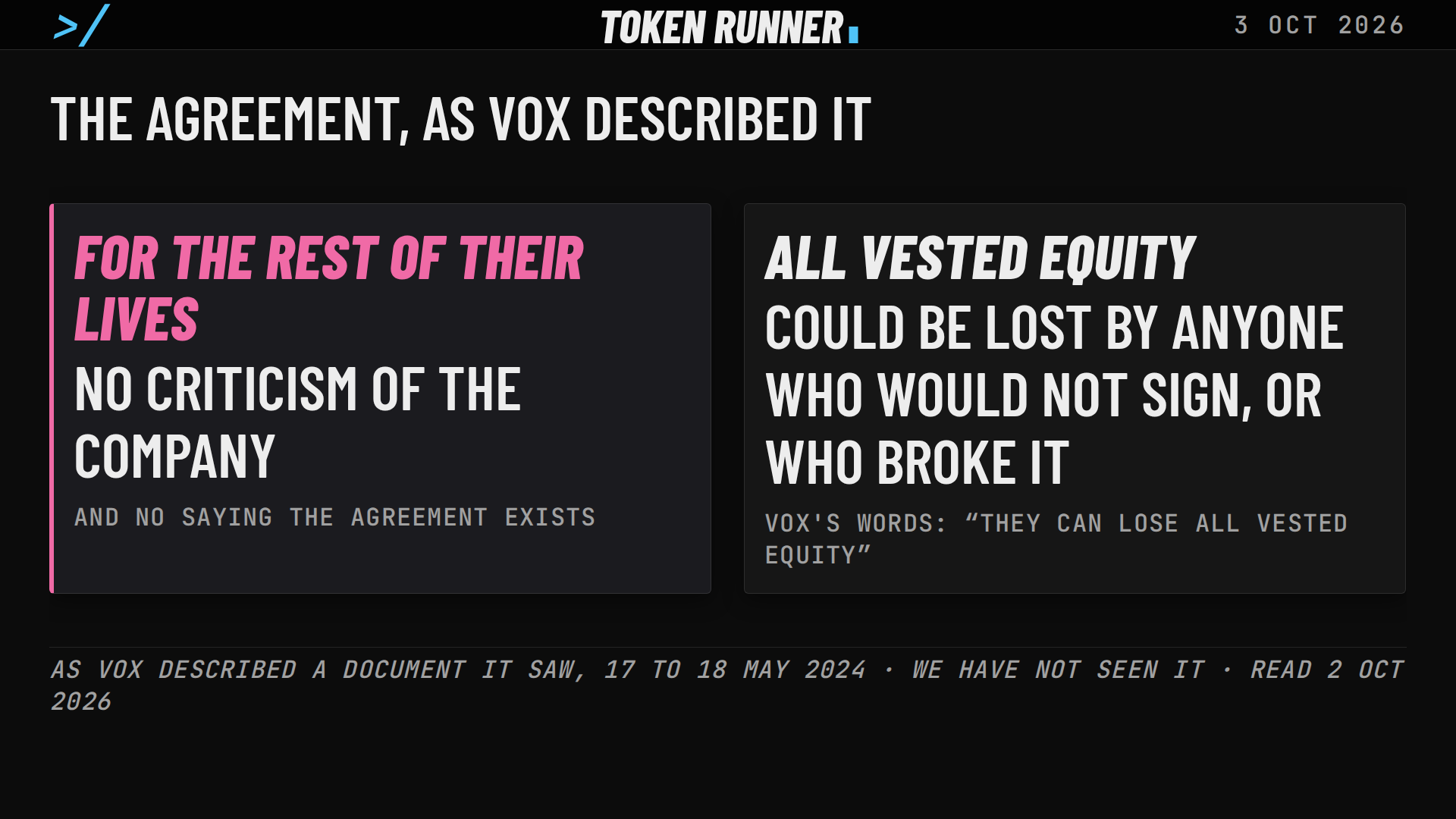
In May 2024 Vox described the agreement OpenAI asked departing staff to sign. The reporter had seen it. It forbade former employees, for the rest of their lives, from criticising the company, and even saying that the agreement existed broke it. The lever, in Vox's words, was that if a departing employee declined to sign, or later broke the agreement, "they can lose all vested equity": pay already earned, which Vox estimated as likely worth millions. The document itself was not seen for this article; this is the reporter's description of it. And it describes what the paper allowed. Nobody is recorded as having lost equity under it, which is why the company's reply belongs beside the claim wherever the claim is printed.
The reply
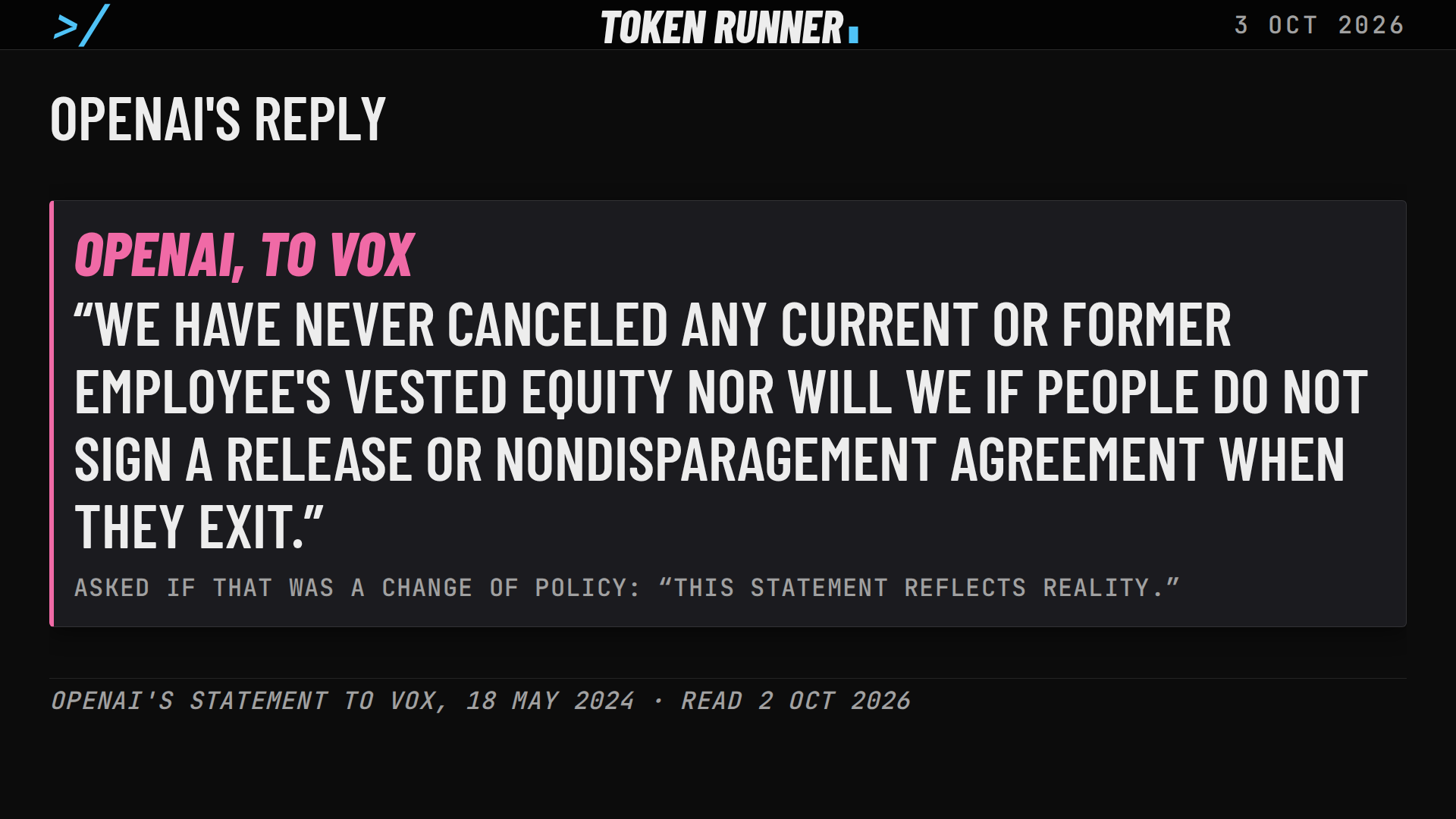
OpenAI's reply to Vox was flat: "We have never canceled any current or former employee's vested equity nor will we if people do not sign a release or nondisparagement agreement when they exit." Vox added that sources close to the company took this as a change in policy. Asked whether it was one, the company's spokesperson said: "This statement reflects reality." The two statements do not contradict each other. A clause can stand in a contract and never be used, and a promise not to use it can be made on the day it becomes public. What the reply did not say is why the clause was there.
One who would not sign
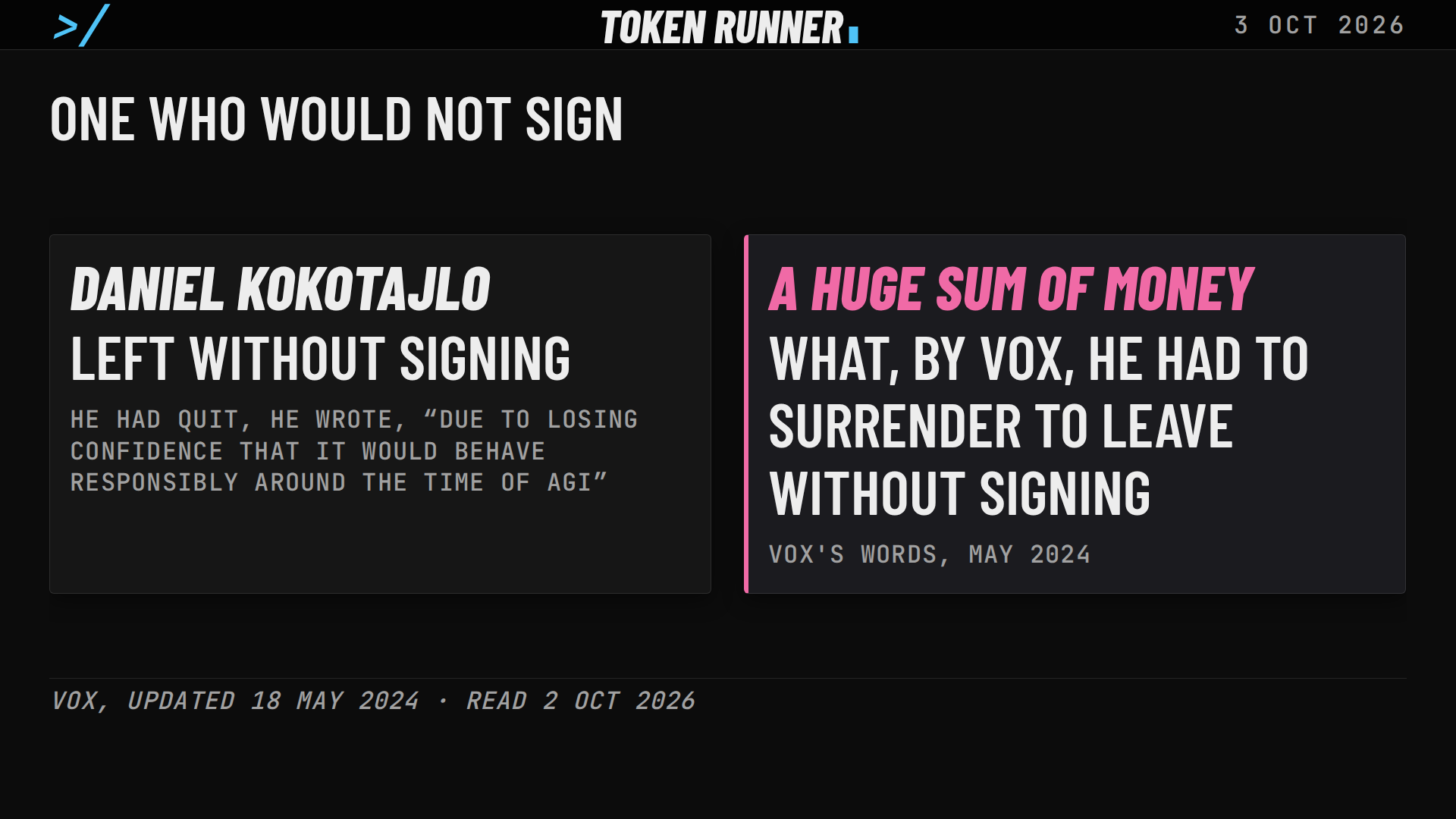
Daniel Kokotajlo left without signing. He had quit, he wrote, "due to losing confidence that it would behave responsibly around the time of AGI". By Vox's report that month, he "had to surrender what would have likely turned out to be a huge sum of money in order to quit without signing the document". No sum is printed here, and this article does not say he lost it. No source it prints from says what became of the money, and the company's own statement is that no vested equity was ever cancelled. The Register says of him only that he did not take on any more obligations on his way out. What is certain is the choice as it stood in front of him: sign and keep quiet, or refuse and risk it.
Seven days
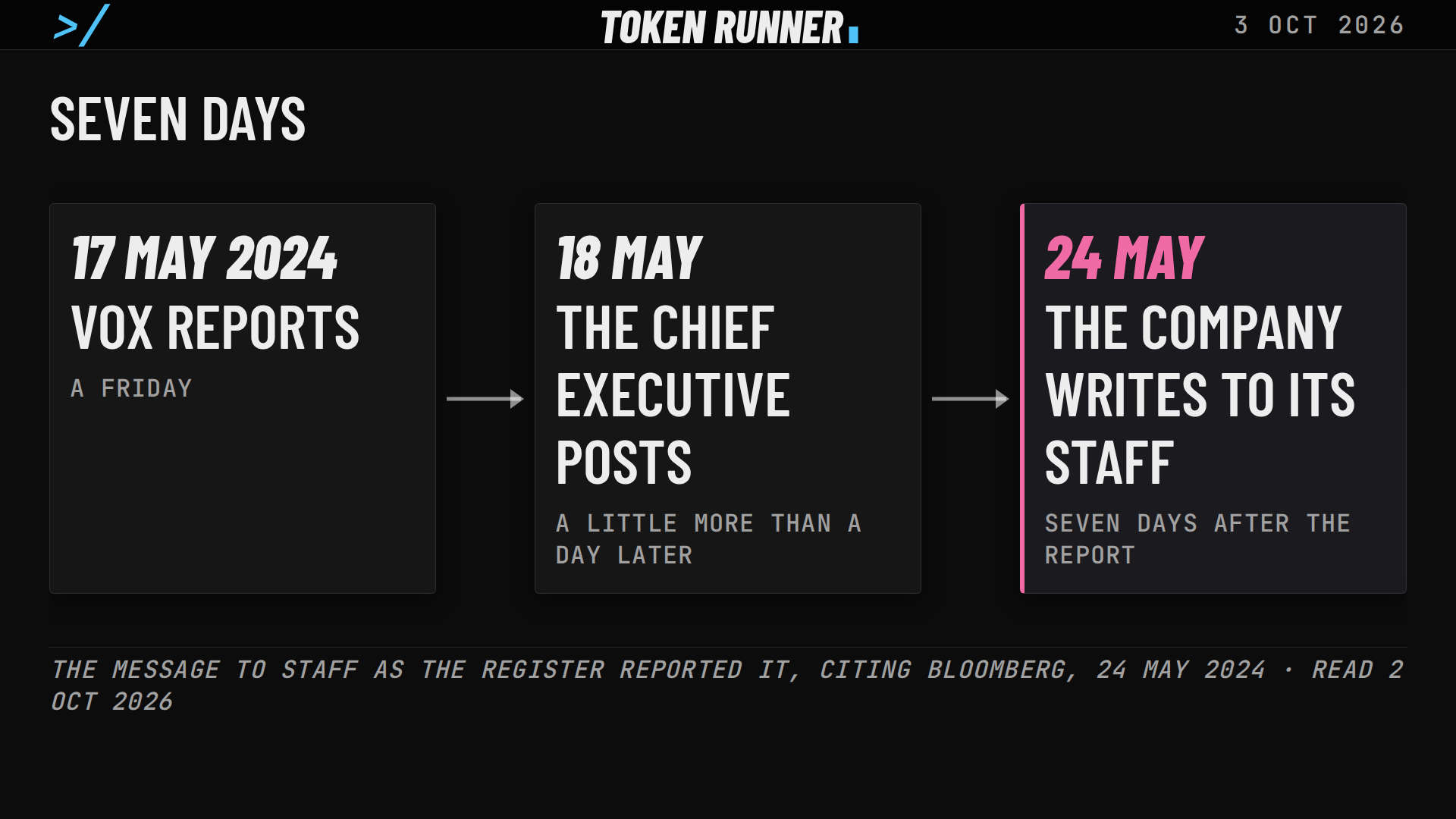
Vox published on Friday 17 May 2024. On Saturday 18 May, a little more than a day later by Vox's own count, the chief executive posted about it. By 24 May the company had written to current and former staff that it has not cancelled, and will not cancel, any vested units. That is seven days after the report, by subtraction of the two dates, and six after the post. The message is known here through the Register, which was reporting Bloomberg, and whose opening line was that the company "won't enforce nondisparagement agreements that could have cost employees dearly". The message as quoted speaks of vested units. It is not printed here as a release of everyone from every such agreement.
The post
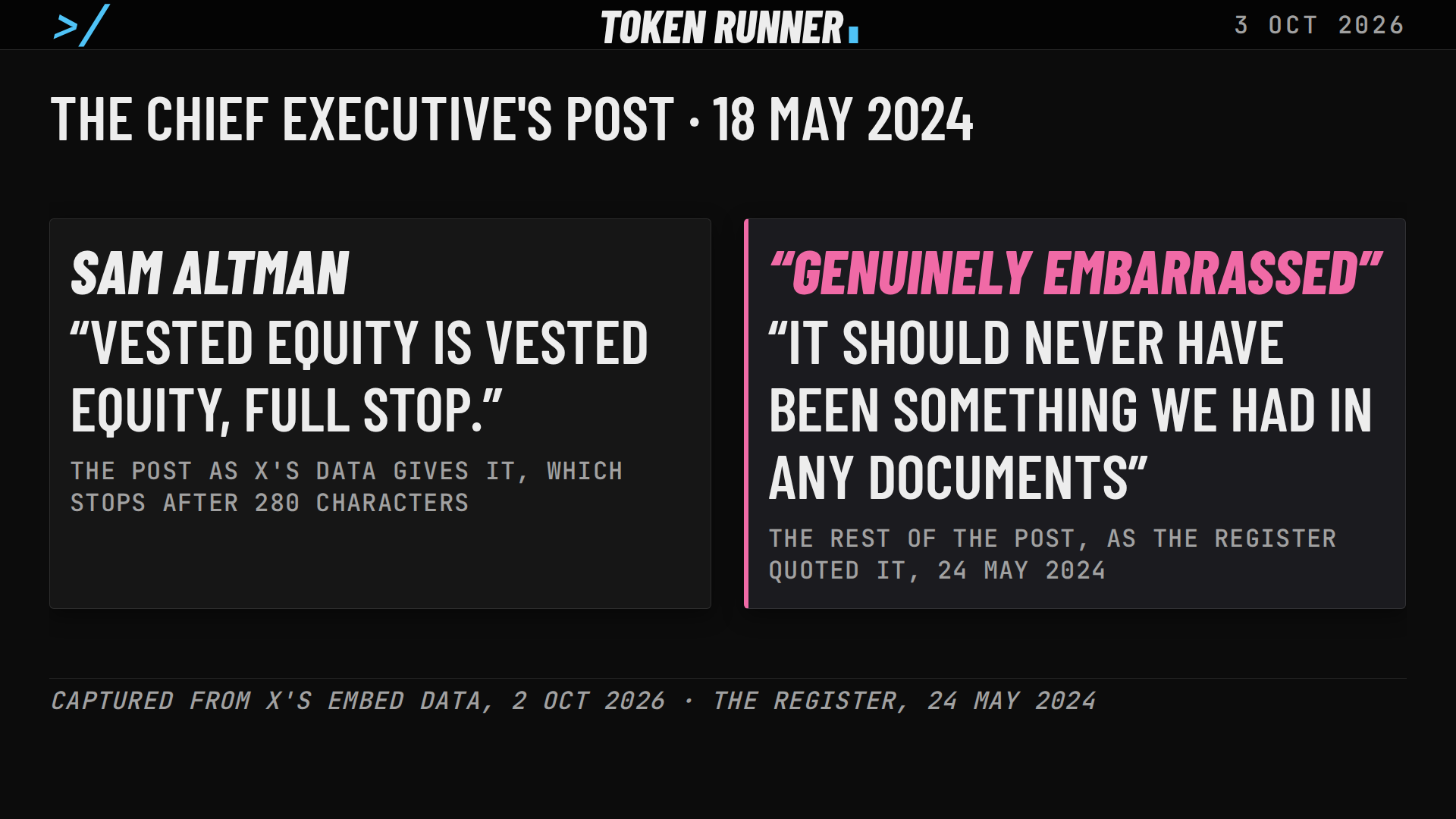
Sam Altman's post of 18 May, as X's data gives it, stops after 280 characters. In that part he writes: "we have never clawed back anyone's vested equity, nor will we do that if people do not sign a separation agreement (or don't agree to a non-disparagement agreement). vested equity is vested equity, full stop." The rest is held only as the Register quoted it: that the provision existed, was never used and should never have been in any documents, and that it was one of the few times he had been "genuinely embarrassed" running the company. He also wrote that he did not know it was happening. The Register notes, citing documents seen by Vox, that he "might have had a little more knowledge" than that. That second report was not read for this article, and the doubt is the Register's.
The letter
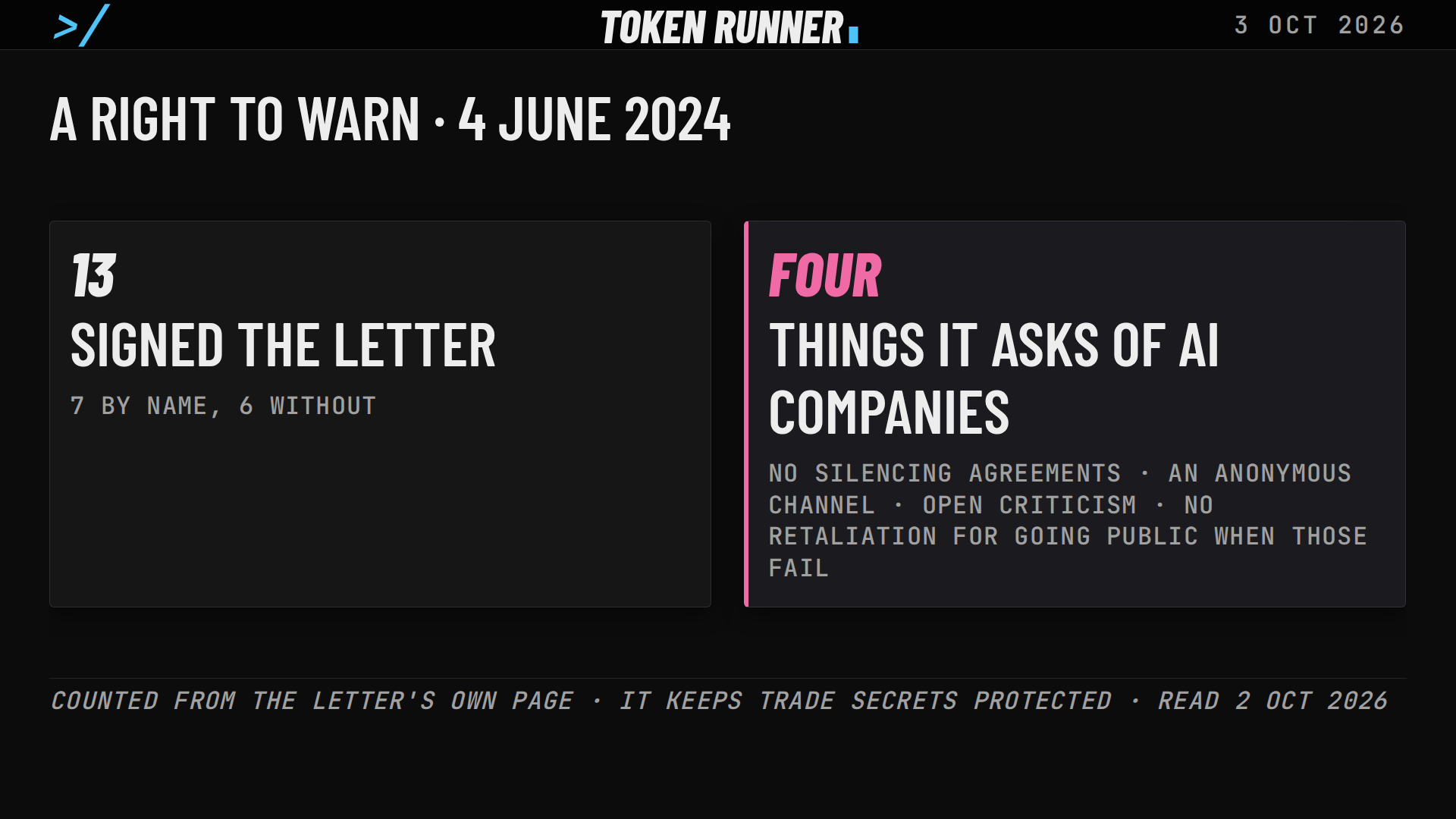
Eleven days after the message to staff, on 4 June 2024, a letter with 13 signatories, seven by name and six without, asked AI companies for four things: no agreement that prohibits criticism over risk; a verifiably anonymous way to raise concerns with the board, with regulators and with an independent organisation; a culture of open criticism; and no retaliation against those who go public after other routes have failed. The letter accepts limits. Trade secrets stay protected, and once an anonymous process exists, concerns go through it first. It does not ask for a right to say anything at all. It asks for a right to warn, and its fourth ask is the one that reaches furthest: that someone who has tried the inside routes can speak outside.
The law
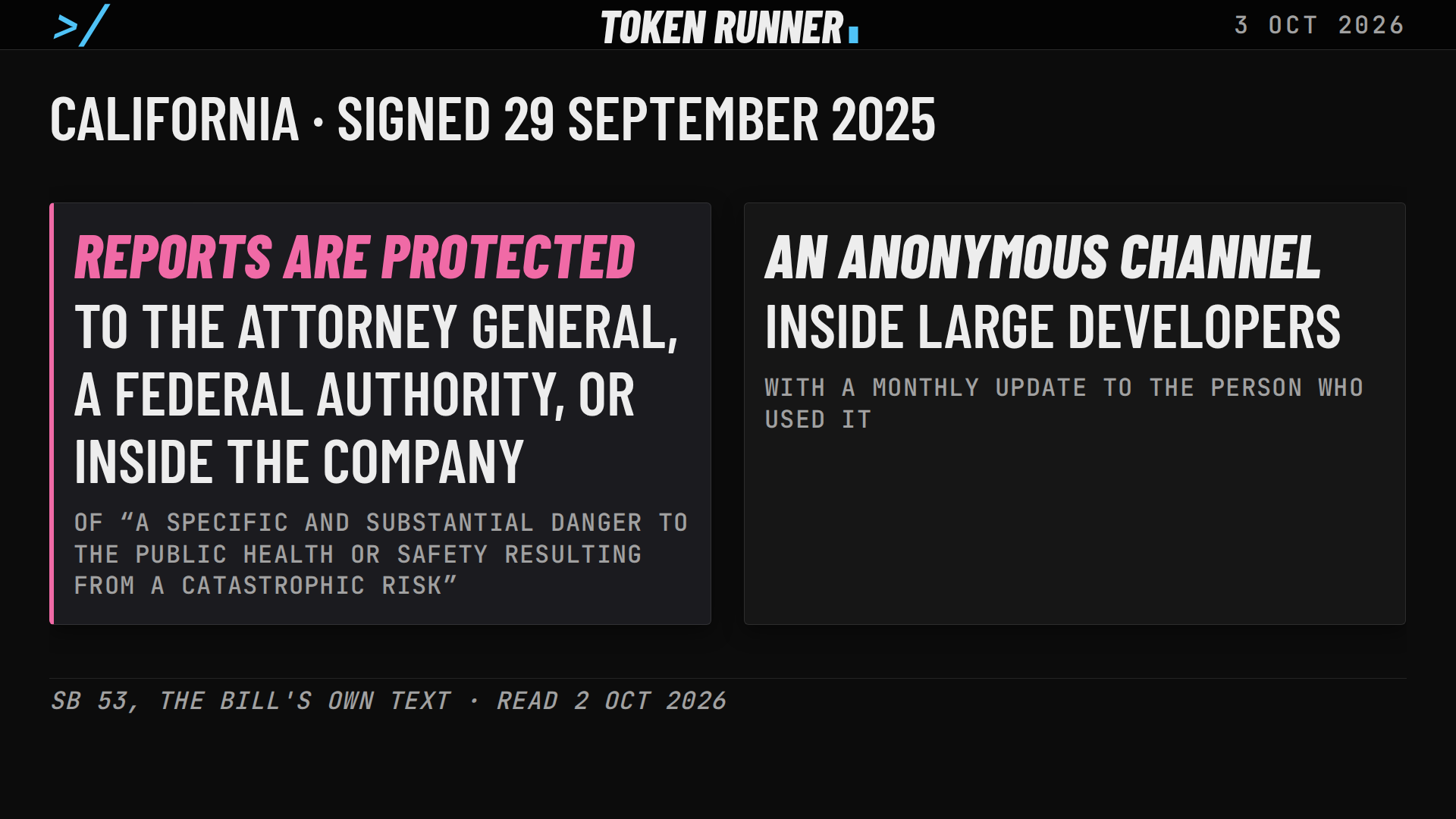
California's SB 53 was signed on 29 September 2025. Under it a frontier developer may not make a rule or a contract that stops a covered employee from reporting "a specific and substantial danger to the public health or safety resulting from a catastrophic risk", or a violation of the act, to the Attorney General, to a federal authority, or to someone inside the company with authority over them or over the matter. It bars contracts, the very instrument this article is about. A large frontier developer must also provide an internal process through which a covered employee "may anonymously disclose", with a monthly update to the person who used it. The bill's text, as read, gives no start date for this chapter.
Narrower than the letter
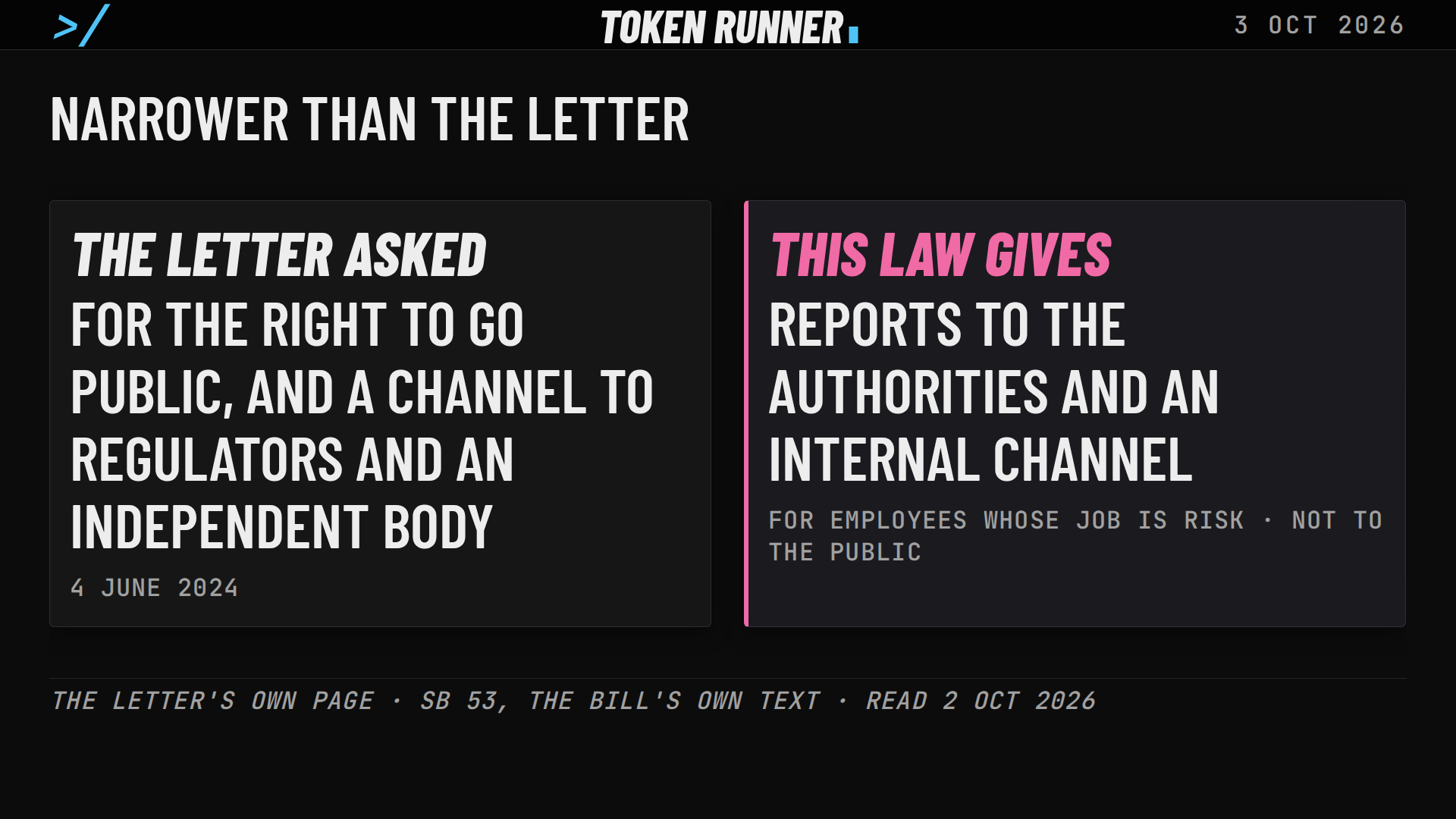
The law is narrower than the letter in three ways. First, who: a covered employee is "an employee responsible for assessing, managing, or addressing risk of critical safety incidents", not every employee. Second, to whom: the law protects reports to the authorities and inside the company, not to the public or the press, which is what the letter's fourth ask is about. Third, the channel: the law's anonymous channel runs inside the developer itself, where the letter asked for one to the board, to regulators and to an independent body. So the law answers the first ask for some employees and the second ask in part. It should not be printed as meeting the letter.
A clause, a reply, a law
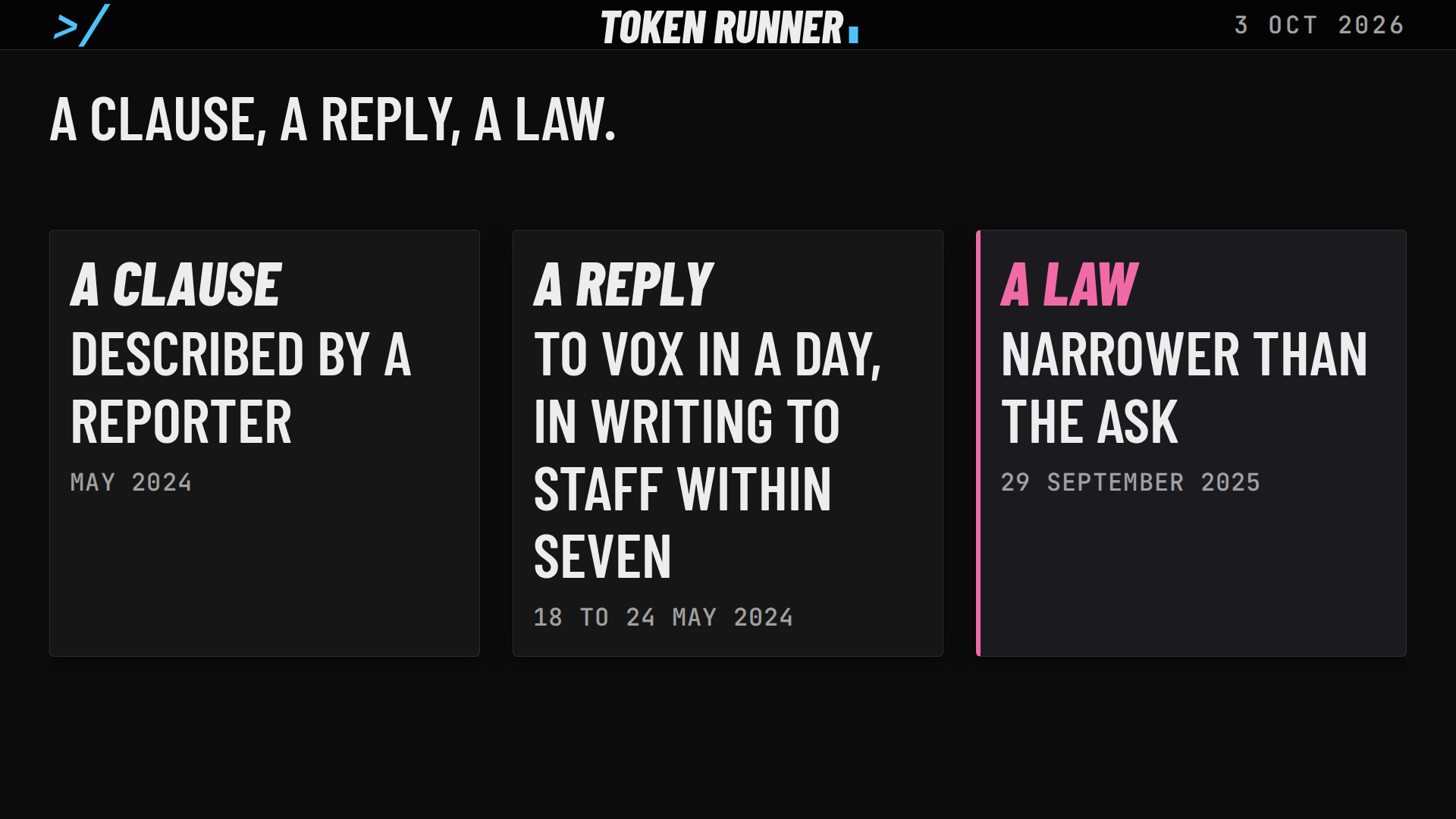
A clause, described by a reporter who saw it. A reply: to Vox within about a day, and in writing to staff within seven. A letter, eleven days after that, with four asks. A law, sixteen months later, narrower than what was asked: it covers the employees whose job is risk, protects what they report to the authorities or inside the company, and leaves the public and the press where they were. The company's chief executive says the clause was never used and should never have been there. What to watch is whether anyone is given what the letter asked for last: the right to say it in public.
Sources
- The Register (Richard Speed), 'OpenAI tells employees it won't claw back their vested equity', 24 May 2024: https://www.theregister.com/2024/05/24/openai_contract_staff/
- 'A Right to Warn about Advanced Artificial Intelligence', the open letter's own page, dated 4 June 2024: https://righttowarn.ai/
- California Legislature, SB 53 (Wiener), Chapter 138, Statutes of 2025, bill text as chaptered: Labor Code chapter 5.1, 'Whistleblower Protections: Catastrophic Risks in AI Foundation Models': https://leginfo.legislature.ca.gov/faces/billTextClient.xhtml?bill_id=202520260SB53
- Vox (Kelsey Piper), 'ChatGPT can talk, but OpenAI employees sure can't', first published 17 May 2024, updated 18 May 2024: https://www.vox.com/future-perfect/2024/5/17/24158478/openai-departures-sam-altman-employees-chatgpt-release
- Sam Altman, post on X (@sama), 18 May 2024 21:00:14 UTC (X's embed data cuts the post after 280 characters): https://x.com/sama/status/1791936857594581428