The Small Print
Five weeks before Spain's election, the main opposition party, the Partido Popular, posted a video.
The video.
Made with AI: the likenesses and cloned voices of real people linked to Spain's governing Socialists. On X alone, more than one point three million views. More on Instagram and TikTok.
The post's own video-view count on X, 1,383,910 as read on 28 October 2026; Instagram 'more than 500,000' and TikTok 'more than 200,000' as Europa Press reported on 22 October, drawn at those floors. The election is on 29 November. What the AI voices say about real people is never repeated, quoted or paraphrased here; no frame of the video is shown.
Source: The party's own X post; Europa Press, 22 October 2026 (Instagram and TikTok, 'more than')
The label.
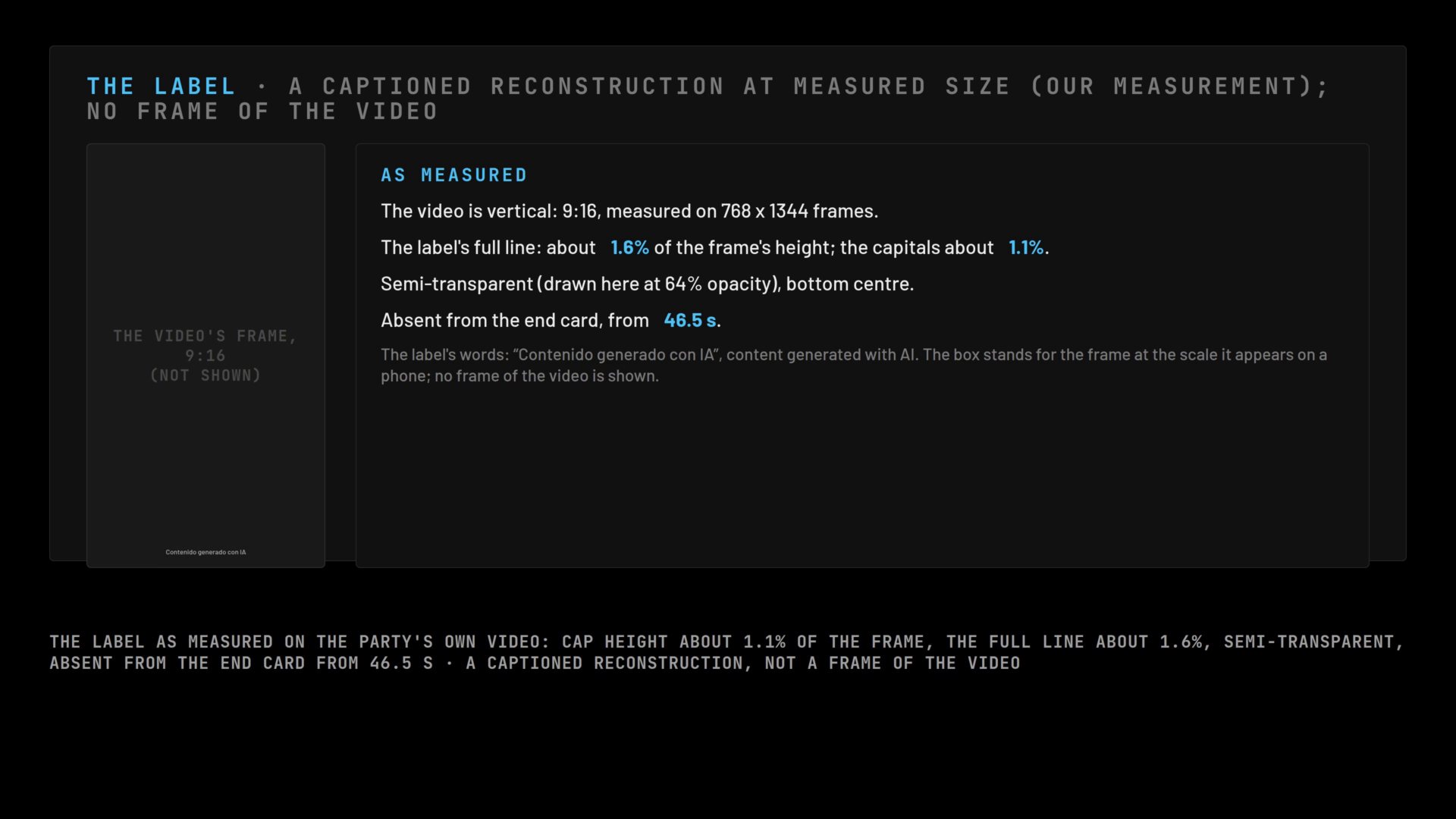
It did carry a label. "Contenido generado con IA": content generated with AI. In type about one percent of the screen's height. Semi-transparent. And absent from the final card.
Our measurement on the party's own video (768x1344 frames, vertical): the label's full line about 1.6% of the frame's height, its capitals about 1.1%; semi-transparent; absent from the end card from 46.5 s. The film shows a captioned reconstruction at that size in a 9:16 box, not a frame of the video.
Both sides.
Spain's digital minister, Óscar López, on the state broadcaster TVE: "It's very easy for anyone who isn't used to AI to confuse that video with reality." The party's Borja Sémper: "If there had been malicious intent to make people believe… we'd have a problem."
TVE is RTVE's channel, the state-owned public broadcaster. López's English words are The Guardian's rendering; RTVE's own Spanish: "muy fácil que una persona confunda ese vídeo con una realidad". Sémper's words as elDiario.es reported them, 22 October.
The law.
Europe's AI Act now applies to exactly this. Since August, anyone who uses AI to publish a deepfake must say so "in a clear and distinguishable manner." For satire, the duty is lighter, but disclosure is still required.
Article 50(4) of Regulation (EU) 2024/1689, in application since 2 August 2026, binds 'deployers': whoever uses the AI system to publish. Where the content is evidently artistic, creative, satirical, fictional or analogous, the duty is limited to a disclosure that does not hamper the display or enjoyment of the work.
The question.
So is one percent "clear and distinguishable"? More than half a dozen lawyers El País consulted said free-speech and satire protections are wide enough to cover it. No regulator or court has ruled on whether it's lawful.
El País's lawyers ("más de media docena") agreed on wide margins for satire; the paper did not say the video was 'not illegal'. On 27 October the Audiencia Nacional refused a related complaint on jurisdiction, not on the merits, as elDiario.es reported on 27 October (Javier Lillo).
The size of the type.
The rule now exists. Its first test is the size of the type.
What we couldn't confirm: Whether any regulator will take the case up before the election. The Instagram and TikTok counts beyond Europa Press's floors.
Every quote from the party's own post, the law's own text, and the reporters who covered it. Token Runner dot A I.
Sources
- The Partido Popular's own X post (@ppopular) of 21 October 2026, 22:18 CEST: 1,383,910 video views as read on 28 October 2026 (2,362,272 impressions on 27 October). The video's likenesses and cloned voices are of real people linked to Spain's governing Socialists; no frame of it and none of its lines are reproduced here. The label as measured on 768x1344 frames (9:16): the full line about 1.6% of the frame's height, the capitals about 1.1%, semi-transparent, absent from the end card from 46.5 s.
- Europa Press, 22 October 2026: more than 500,000 views on Instagram and more than 200,000 on TikTok (as reported; drawn at those floors).
- El País, 22 October 2026: the party's video, its reach ('casi dos millones') and the people it depicts, as the paper reported it.
- The Guardian, 23 October 2026: the video seen nearly 2 million times across platforms, and its English rendering of Óscar López's words, "It's very easy for anyone who isn't used to AI to confuse that video with reality."
- Óscar López, Spain's digital minister, on TVE (RTVE, the state-owned public broadcaster), in his own words: "muy fácil que una persona confunda ese vídeo con una realidad" (RTVE, 23 October 2026).
- Regulation (EU) 2024/1689, the AI Act, Article 50(4) and 50(5), in application since 2 August 2026: deployers of an AI system that generates or manipulates a deepfake "shall disclose that the content has been artificially generated or manipulated" … "in a clear and distinguishable manner"; where the content is evidently artistic, creative, satirical, fictional or analogous, the duty is limited to a disclosure that does not hamper the work.
- El País, 23 October 2026: more than half a dozen lawyers it consulted ("más de media docena") said the free-speech and satire protections are wide enough to cover it; it did not say the video was 'not illegal'. No regulator or court has ruled on whether it is lawful (elpais.com refuses scripts; read through the search index and a syndicated copy that links to it).
- Borja Sémper, Partido Popular, as elDiario.es reported him on 22 October 2026: "If there had been malicious intent to make people believe… we'd have a problem" (in Spanish, 'intención espuria').
- elDiario.es (Javier Lillo), 27 October 2026: the Audiencia Nacional refuses a related complaint against the party over the video, on jurisdiction and as a personal matter outside the judge's case; the judge's words: "no figuran entre los supuestos tasados atribuidos a la competencia de la Audiencia Nacional". No ruling on the video's lawfulness.