The Missing Junior
Every AI company says its tools make people more productive. One of them published what happened inside its own walls.
The source.
Anthropic, the company that makes Claude, released a study of its own staff this month. A disclosure: Token Runner is built with Claude.
Anthropic, 'How employment is changing at Anthropic', published 16 October 2026 with a full report: a study of its own staff, from its own internal data. Anthropic makes Claude. A disclosure: Token Runner is built with Claude. Every figure below is Anthropic's own: self-reported, not independently verified. No employee is named in it.
The report: "the share of junior-level employees in technical departments at Anthropic slipped from 21% to 14% since early 2025. The proportion of junior technical hires fell even faster, from 27% to 9%. Postings for juniors have fallen particularly sharply since December 2025." Inside the company, it says, the talk of a decline in demand for junior technical staff "emerged in core technical functions in January 2026", and "By April, engineering and research teams had deemphasized hiring for lower band technical positions." These are shares, not counts: the company "has tripled in size in the last year", and "technical hiring has continued growing in absolute terms, but intensive hiring in sales, finance, and recruiting has outpaced it". The technical share of its staff fell from 61% to 56%.
Source: Anthropic, 'How employment is changing at Anthropic' (16 October 2026), Figure 1 and its text; its own internal data, self-reported, not independently verified; read 28 October 2026
The managers.
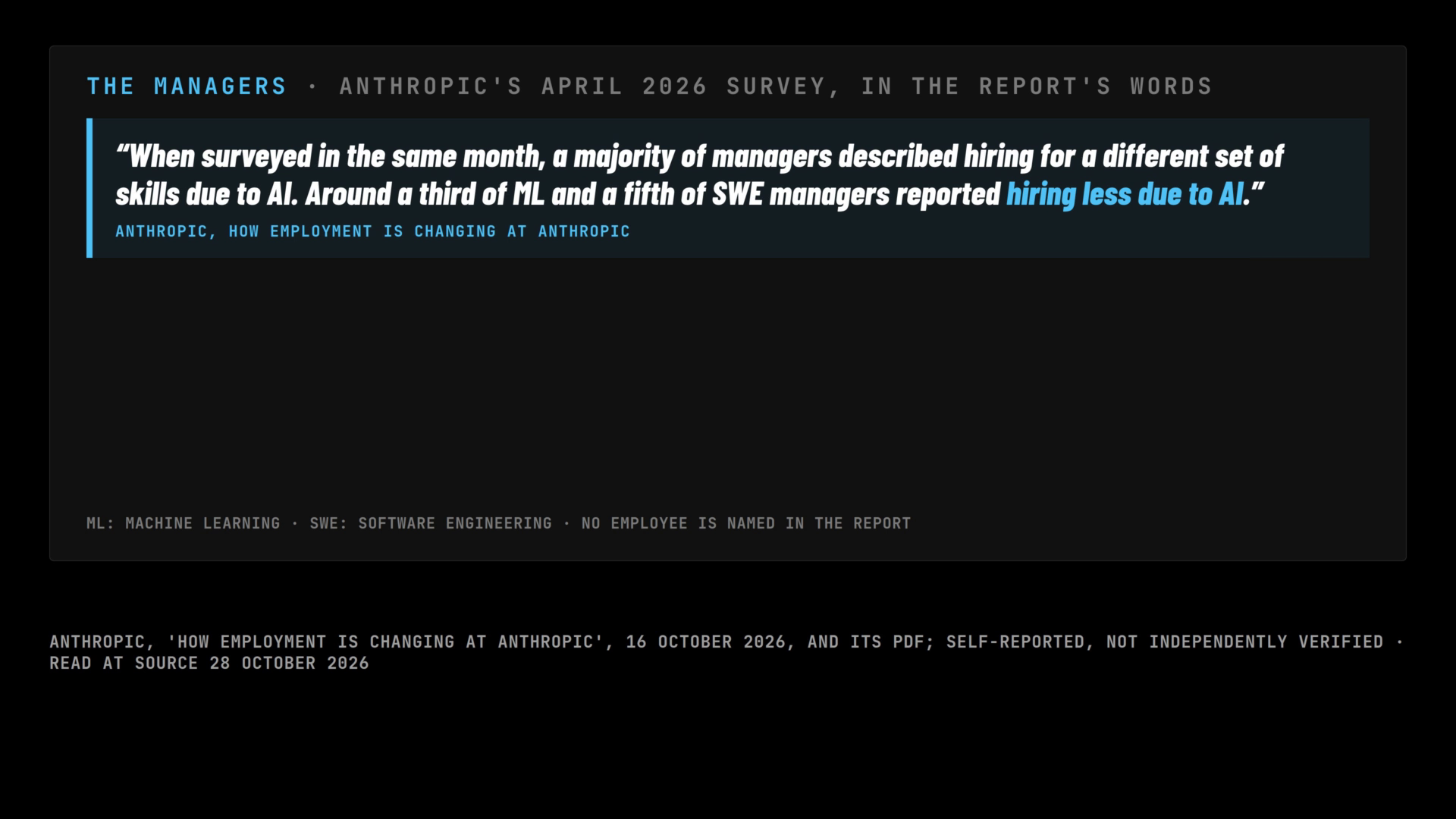
Its own managers explain it. Around a third of machine-learning managers, and a fifth of software managers, said they were "hiring less due to AI".
The report, on its April 2026 survey: "When surveyed in the same month, a majority of managers described hiring for a different set of skills due to AI. Around a third of ML and a fifth of SWE managers reported hiring less due to AI." In the same survey, asked an open-ended question about how AI has changed their day-to-day work, 20% of the answers described a role "shifting from actually doing work to managing Claudes": a fifth of the answers, not a fifth of the staff. By calendar data, the median employee spends 20% more time in meetings than a year ago; among technical individual contributors, meeting time is up 16%.
The hours.
By August, the company says, its AI agents were logging six hours for every hour its people worked.
Figure 2's method: the agent runtime of employee-directed interactive sessions, excluding any wait longer than 30 minutes, against headcount at an assumed 40 hours a week. The report: "by August the agents worked 6 times as many hours as their human handlers." On output, it says code commits per engineer are "coming in at 5x their velocity as 6 months ago", and adds its own cautions: "More code does not necessarily mean better code or business impact", and "tool adoption is not random".
Source: Anthropic, 'How employment is changing at Anthropic' (16 October 2026), Figure 2; self-reported, not independently verified; read 28 October 2026
In its own words.
Anthropic lists what it's doing for its staff: stock ownership, an early warning system, and moving staff into new roles. Then it says plainly: "none directly address the slowdown in junior hires." And: "Employment protections for incumbents will not benefit those not hired to begin with."
The measures, in the report's words: "widespread stock ownership gives employees a strong interest in the company's success"; "an early warning system to track jobs at risk of disruption"; "the company has prioritized internal redeployments". Then: "None of these actions will prevent powerful AI from disrupting jobs. And indeed none directly address the slowdown in junior hires documented in this report. Employment protections for incumbents will not benefit those not hired to begin with." Its next sentence: "Private action on the part of employers must come alongside farsighted government policy around retraining and income support."
Beyond its walls.
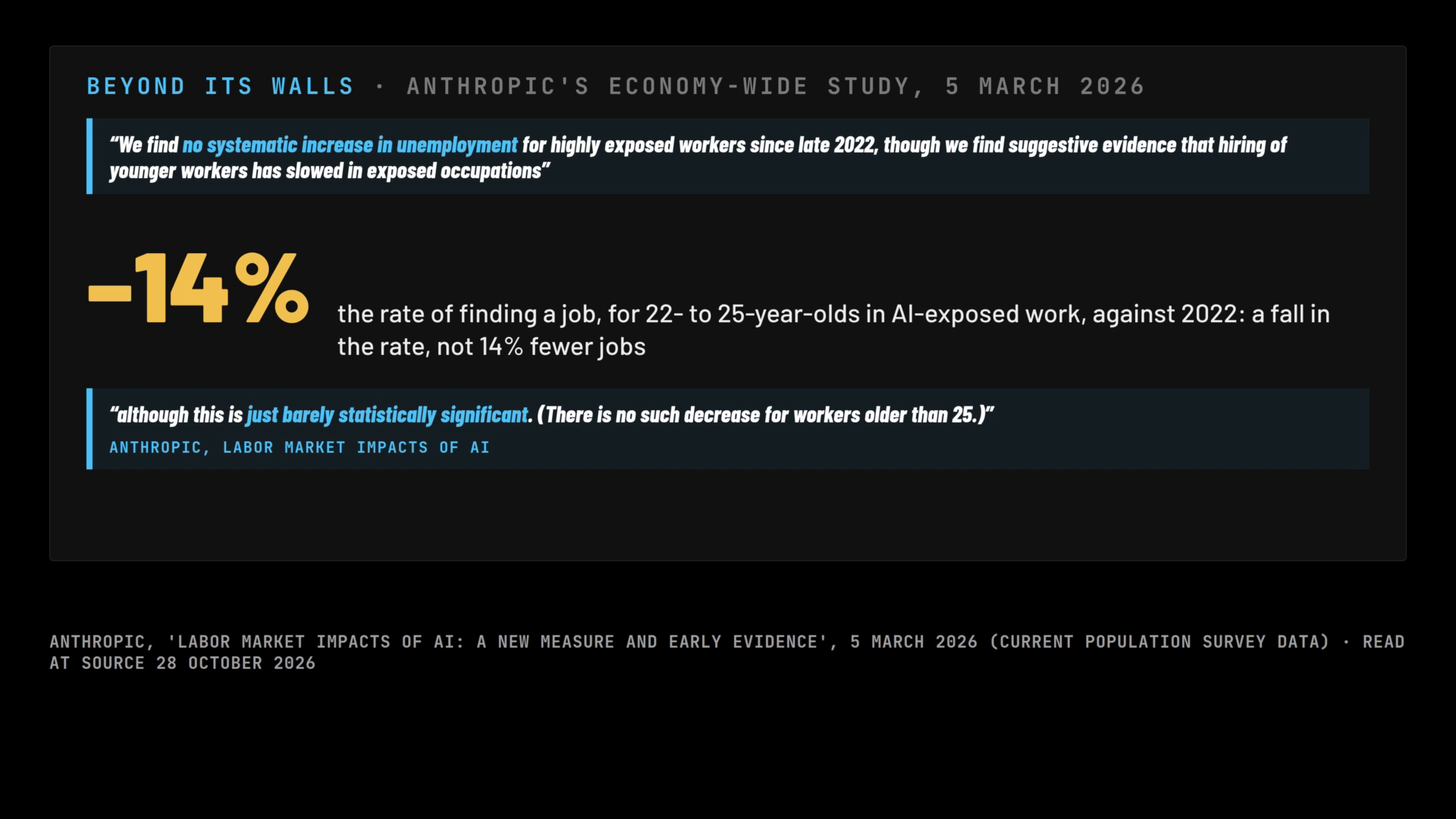
Is it happening outside? Anthropic's own economy-wide study, from March, found no systematic rise in unemployment among the most AI-exposed workers. But for twenty-two to twenty-five-year-olds, the rate of finding a job in AI-exposed work fell fourteen percent. Its words: "just barely statistically significant."
The March study: "We find no systematic increase in unemployment for highly exposed workers since late 2022, though we find suggestive evidence that hiring of younger workers has slowed in exposed occupations." And: "The averaged estimate in the post-ChatGPT era is a 14% drop in the job finding rate compared to that in 2022 in the exposed occupations, although this is just barely statistically significant. (There is no such decrease for workers older than 25.)" A fall in the rate of finding a job, not 14% fewer jobs. Its own caveat: "But there are several alternative interpretations. The young workers who are not hired may be remaining at their existing jobs, taking different jobs, or returning to school."
From outside the company, Stanford's Digital Economy Lab (our piece Two Answers) puts employment among 22- to 25-year-olds in the most AI-exposed jobs about 19% below where it would otherwise be, and says "These are descriptive patterns, not causal estimates of the effect of AI." Anthropic's chief executive, Dario Amodei, warned in May 2025, as Axios reported him, that AI could wipe out half of all entry-level white-collar jobs.
The first rung.
This is the company that builds the tool, measuring itself. The first rung it measured was the one getting smaller.
The report's own limits: "There are many parts of Anthropic's employment practices that cannot be replicated across the economy." At five years old, it says, Anthropic "takes in between 2–4 times as much revenue per employee as Meta and Google as they crested in their own rapid growth." What we couldn't confirm: The month of Figure 1's last point. It sits just after the May 2026 mark, unlabelled, so we call it mid-2026.
Every figure from Anthropic's own reports: self-reported, not independently verified. Token Runner dot A I.
Sources
- Anthropic, 'How employment is changing at Anthropic', 16 October 2026, the web page: "By August interactive AI agent hours outnumbered employees' six to one." Read at source 28 October 2026.
- Anthropic, 'How employment is changing at Anthropic', 16 October 2026, the full report (PDF): Figure 1 (the junior shares), Figure 2 (agent hours), the April 2026 survey, the measures for staff and the closing section, quoted above. Anthropic's own internal data, self-reported, not independently verified. Read at source 28 October 2026.
- Anthropic, 'Labor market impacts of AI: A new measure and early evidence', 5 March 2026 (Current Population Survey data): "We find no systematic increase in unemployment for highly exposed workers since late 2022"; "a 14% drop in the job finding rate"; "just barely statistically significant"; "But there are several alternative interpretations." Read at source 28 October 2026.
- Stanford Digital Economy Lab (Erik Brynjolfsson, Bharat Chandar and Ruyu Chen), 'No Widespread Displacement, but the AI Employment Gap for Young Workers Has Widened to 19%', 12 August 2026: "These are descriptive patterns, not causal estimates of the effect of AI." Read at source 28 October 2026.
- Axios, 28 May 2025, its interview with Dario Amodei: Axios's own sentence, "AI could wipe out half of all entry-level white-collar jobs — and spike unemployment to 10-20% in the next one to five years, Amodei told us", a paraphrase, not his direct words.