What people fear, and the words they use
WATCH THE FILM ON ITS OWN PAGE →
The layoff count fell. The fear didn't. Seven in ten Americans expect fewer jobs. The fear isn't following the layoffs. It's following something else.
In short
The fear held while the count fell: the cuts companies tied to AI dropped by nine-tenths between May and September 2026, and the fear did not fall with it.
The count fell partly because the word did: by autumn the largest employers had stopped saying "AI," and a graduate who cannot get hired is in no layoff count.
The fear deserves better numbers than it gets: the most-seen claims about AI layoffs on X cite no source, or a figure the company never disclosed.
The verdict is in
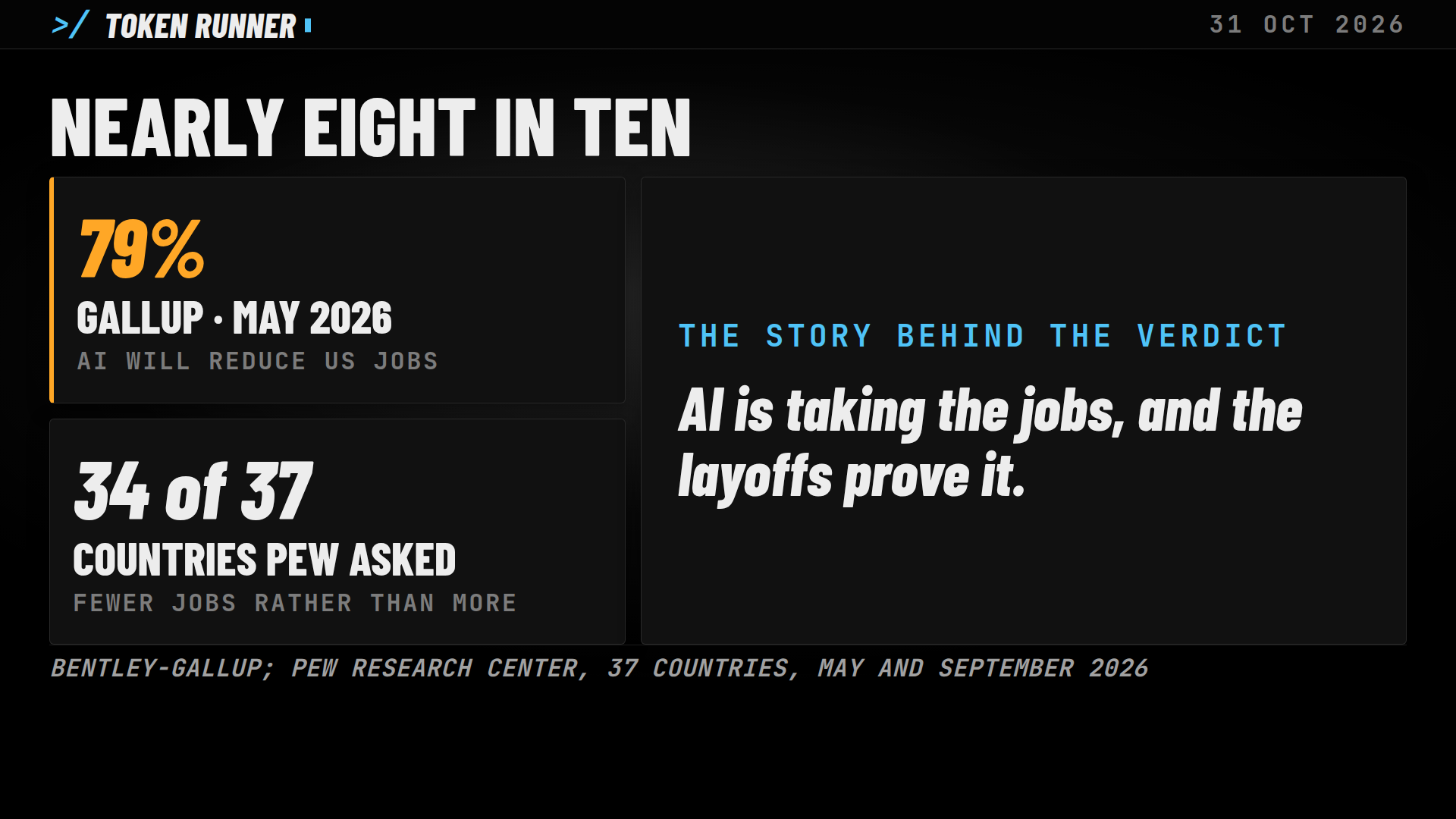
Ask Americans about AI and jobs, and they have already decided. In Pew's survey, fielded in June 2026, 71 percent expected fewer jobs in twenty years because of AI. Two years earlier it was 64 percent. A Bentley-Gallup survey, fielded in May, found, as Gallup reports, 79 percent, nearly eight in ten, expected AI to reduce American jobs over the next ten years. Across the 37 countries Pew asked, the United States among them, people in 34 tended to expect fewer jobs rather than more.
The story behind that verdict is the one everyone has heard: AI is taking the jobs, and the layoffs prove it.
So we went looking for the layoffs the fear is following. We set the polls beside the cuts companies themselves tie to AI, and read a week of what people were saying.
Here is what we found. The count rose to a record and then fell by nine-tenths. The fear did not fall with it. It is following something else: the hiring freeze, the forecasts, and numbers nobody can source.
The count that fell
The outplacement firm Challenger, Gray and Christmas, which helps laid-off workers find new work, counts the reasons companies give when they announce cuts.
In May 2026, cuts that companies tied to AI reached a record: 38,579. By September they were down to 3,961, and AI had fallen from the first reason given to the fifth.
That is a fall of nine-tenths in four months. The fear did not fall with it: every poll asked again this year came back higher than its last wave. To understand this moment, you have to understand that gap.
Source: Pew Research Center, Gallup and Reuters/Ipsos polls on AI and jobs (each row names its page); Challenger, Gray & Christmas, monthly Job Cuts Reports, January to September 2026
Source: Pew Research Center, Gallup and Reuters/Ipsos polls on AI and jobs (each row names its page); Challenger, Gray & Christmas, monthly Job Cuts Reports, January to September 2026
What people are saying
We counted one week of posts on X: the seven days to 29 October, in English, leaving out reposts. It is a rough measure, a signal rather than a fact, but it shows which fears have taken hold.
In that week, 4,805 posts talked about AI and layoffs. The phrase "replaced by AI" came up 1,569 times. There were 905 posts about new graduates and entry-level work.
Universal basic income, the idea of a regular payment to everyone with no conditions, came up 1,116 times. "Learn to code," the advice a generation was given, appeared 1,106 times, much of it now said with bitterness.
The most common pairing of all, in 1,897 posts, was the trades with AI: the electrician, the plumber and the welder, held up as the work a machine cannot take.
The fears, one by one
The first job. The strongest fear, and the best evidenced, is that AI takes the tasks juniors learned on, so the career ladder loses its bottom rung. Our piece on the bottom rung sets out the data.
Too old to start over. At the other end, mid-career workers cut in a restructuring find no way back in. Older candidates describe being screened out by systems they never meet. A Greenhouse survey, as Fortune reported it, found nearly four in ten job candidates had walked out of a hiring round because it required an AI interview.
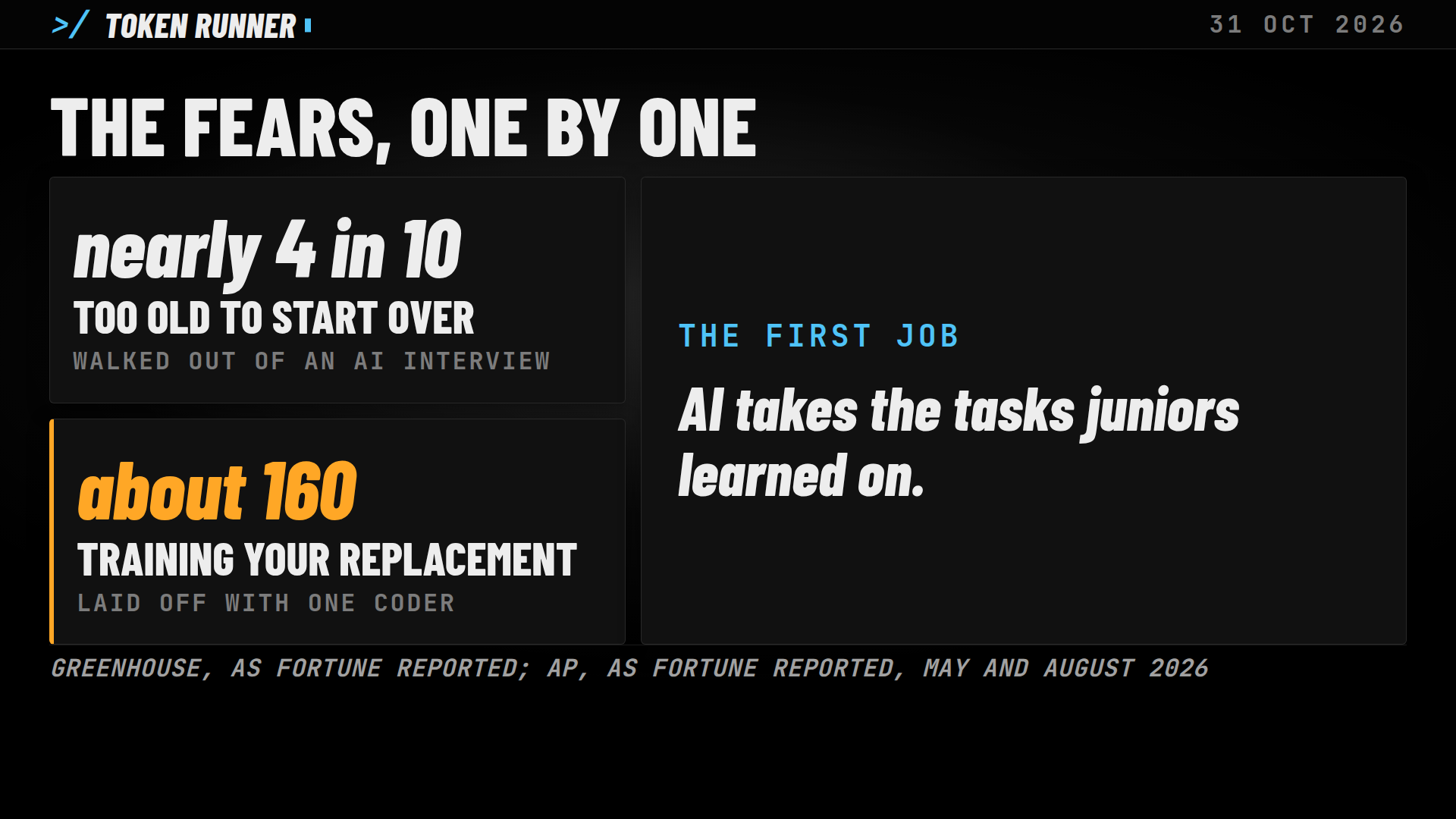
Training your replacement. Workers describe documenting their work, or being watched, so a system can learn it. Then they are let go. In Beijing, AP reported, a coder's boss asked whether AI could replace human coders. Two weeks later the coder and 160 colleagues were laid off.
The ones who stay. The survivors absorb the work. A former Oracle manager told TIME: "'Easier' was a euphemism for less people doing more work."
Women's jobs. Clerical, administrative and customer-service work, where women are over-represented, sits at the top of the measures of which jobs AI could most easily automate. In rich countries, by the International Labour Organization's figures, 8.5 percent of women's jobs have the highest automation potential, against 3.9 percent of men's. That is about twice the rate.
The invisible jobless. About seven in ten unemployed people who had recently worked never applied for unemployment benefits, by the Bureau of Labor Statistics' last count, in 2022. So the claims data, the count of people drawing unemployment benefit, understates the harm. White-collar losses fall outside a safety net built for factory closures.
The words
A fear needs words, and this one has found them.
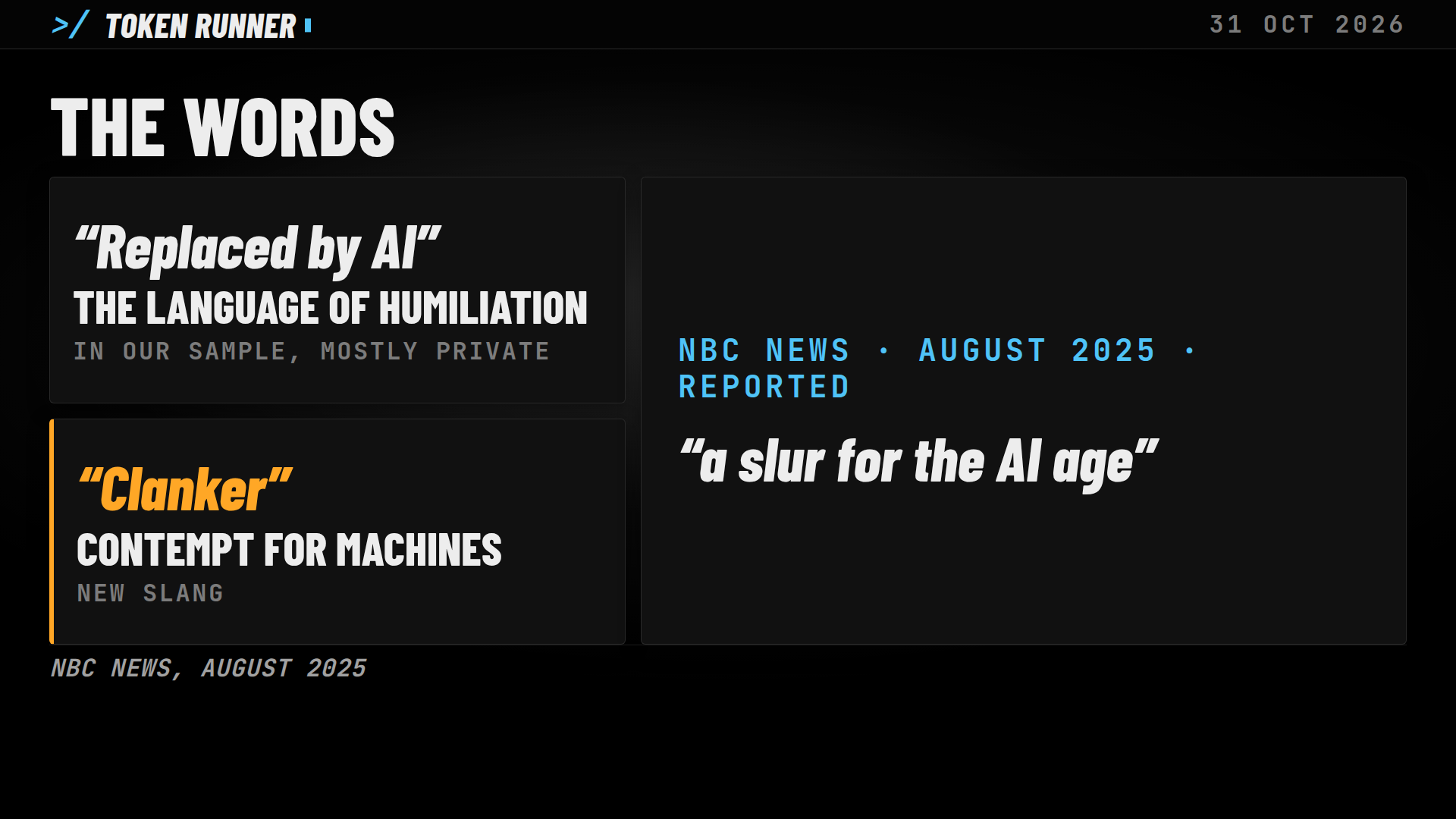
"Replaced by AI" is the language of humiliation. In our sample, the most-liked post using it said some people deserve to be replaced. It came from a private account, so we do not name or quote it. The shame and the mockery live mostly in private accounts.
"Clanker" is new slang of contempt for machines. NBC called it "a slur for the AI age." The anger reaches Hollywood too. When agents circled an AI "actor," the actors' union, SAG-AFTRA, said it was "opposed to the replacement of human performers by synthetics."
"AI-washing" is the charge that companies blame AI for cuts made for other reasons, because investors like it. Challenger's own July report noted that naming AI in a layoff announcement can win over investors. On the day Block announced cuts it tied to AI, its shares rose as much as 24 percent in trading after the market closed, CNBC reported.
The word itself is rare on X: 45 posts in our week. But the argument is everywhere. Hiring slowed before ChatGPT. A buyout is not a layoff. Read the numbers before the headline.
"Learn to code" has turned. By Anthropic's own measure of how its AI is actually used at work, computer programmers now top the list of 756 jobs. (Token Runner is built with Claude, which is made by Anthropic.) Salesforce's chief executive told an interviewer, "I need less heads."
Why the fear outran the count
Three things explain the gap, and each is in the record.
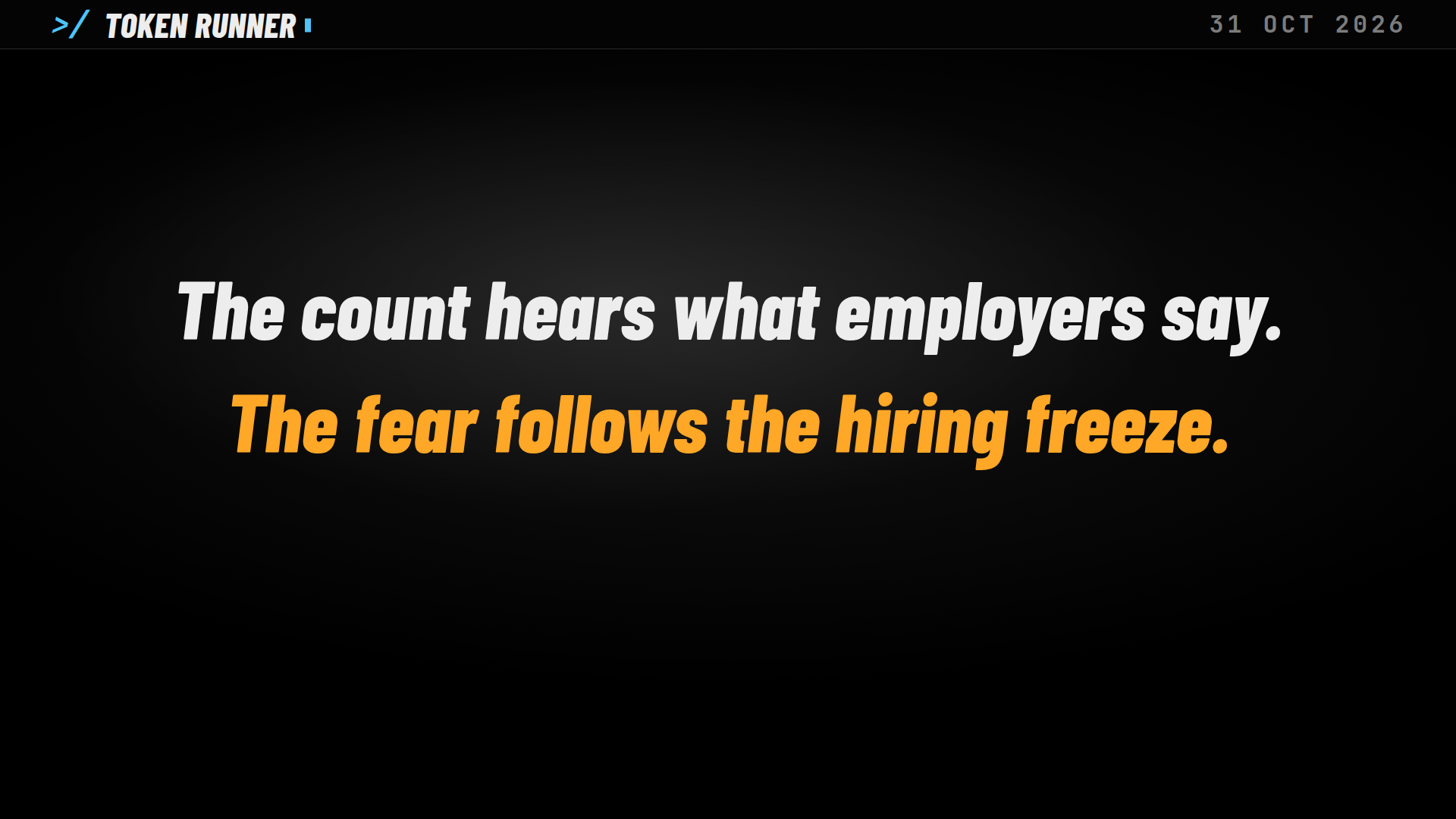
The count hears only what employers choose to say. Challenger counts announcements, and the reasons given in them. By autumn the largest employers had stopped saying "AI." Microsoft and HubSpot both said their cuts were not driven by it; our piece on what the companies say sets out their words. Challenger warned that companies would be "even more careful," making the count more opaque. The count fell partly because the word did.
The fear follows the hiring freeze, not the layoff. A graduate who cannot get a first interview is not in any layoff count.
The loudest voices are the people selling the machines. The warnings that set the frame came from AI chief executives. The Anthropic chief executive's warning about white-collar jobs, to Axios in May 2025, was one of them. The forecasts arrived before the evidence. Then the evidence, on the bottom rung, began to arrive too.
Disclosure: Token Runner is built with Claude, which is made by Anthropic.
The unverified post
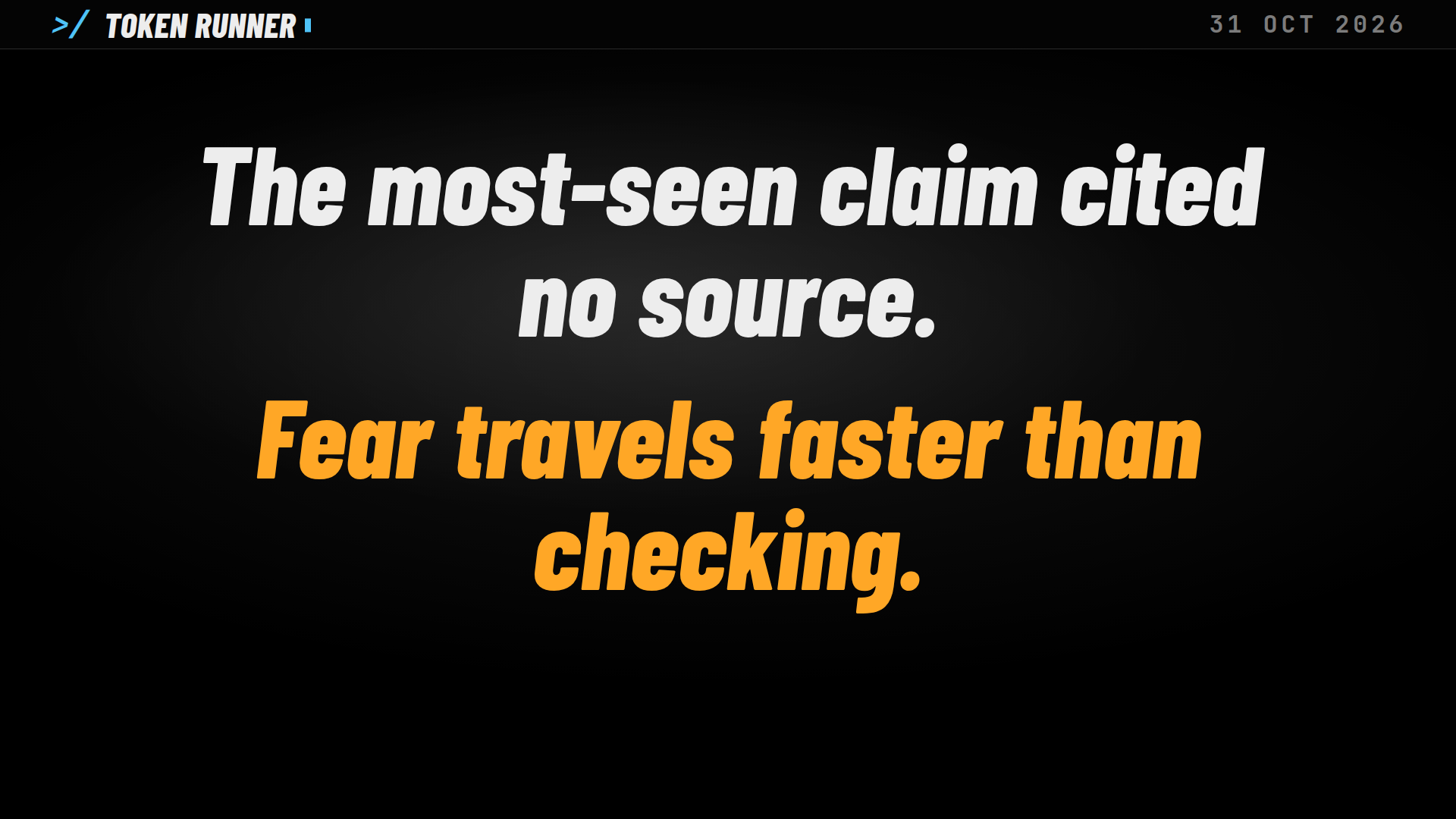
The gap has a cost. Fear travels faster than checking.
The most-seen claim on X that AI was doing the work at Oracle reached about 1.56 million views. Nobody who replied could point to a source. It is a signal of what people believe, and a rumour, not a record.
The most-seen ranked list of 2026's AI layoffs had passed a million views when we read it on 30 October. It carries a Cisco figure that Cisco's own filing never disclosed.
Why it matters
There are two ways to read the gap, and the evidence supports both.
The first is that the fear has run ahead of the facts. The AI-cited count fell by nine-tenths, the loudest warnings came from the people selling the machines, and some cuts blamed on AI may never have been about AI. On this reading, people fear a forecast.
The second is that the fear sees what the count cannot. Employers stopped saying the word. The graduate never interviewed, the older worker screened out and the jobless who never claim all fall outside the numbers. On this reading, people are ahead of the count, not of the facts.
Either way, the fear is real and, on the bottom rung, justified. It deserves better numbers than the ones it is being fed.
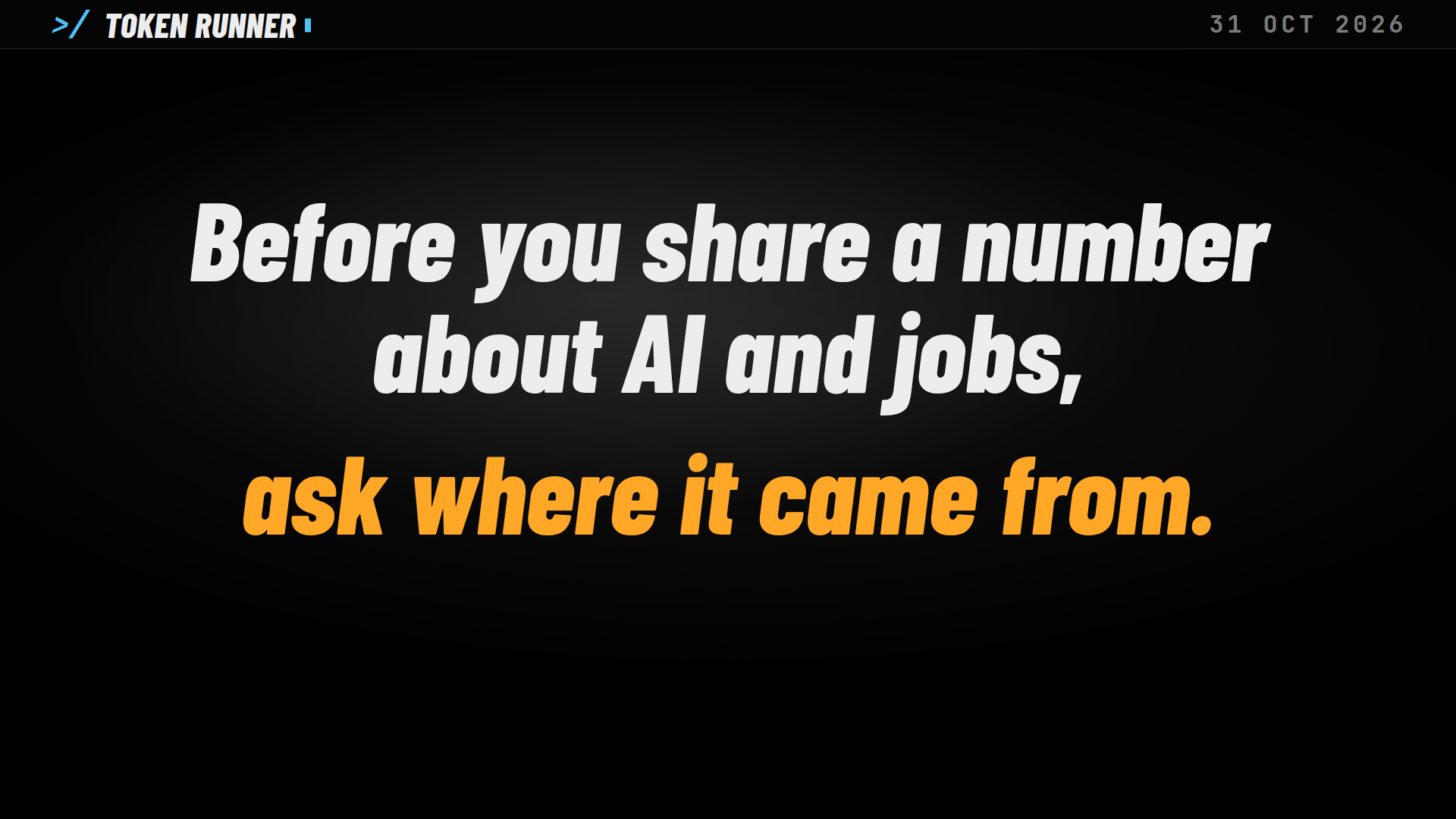
Our ask is simple. Before you share a number about AI and jobs, ask where it came from, and ask what the count leaves out.
Sources
- Pew, June 2026, and its 36-country survey
- Gallup, May 2026
- Challenger, Gray & Christmas, May, July and September 2026
- Our own count of posts on X, in English, not counting reposts
- Fortune on the Greenhouse survey
- AP from Beijing, via Fortune
- Fortune on SAG-AFTRA
- Fortune on Salesforce
- TIME, 30 April 2026
- NBC, 5 August 2025
- ILO working paper 96
- Microsoft and HubSpot, as our piece on what the companies say sets out
- Axios, 28 May 2025
- Token Runner is built with Claude, which is made by Anthropic.