The bottom rung
WATCH THE FILM ON ITS OWN PAGE →
AI isn't taking everyone's job. It's taking the first one. The averages look calm. Look at who's 22 and trying to get hired, and they don't.
In short
The young are being shut out, not the whole workforce: payroll records put workers aged 22 to 25 in the most exposed jobs about 19 percent behind people their age in less-exposed jobs, while older workers in the same jobs show no comparable gap.
The damage is in hiring, not firing: people in work are mostly keeping their jobs, while graduate intakes shrink and entry-level postings ask for mid-level experience.
Nobody counts the first job that is never posted, and the one AI company that counted its own saw junior technical hires fall from 27% to 9%.
The job you start with
Every career starts somewhere near the bottom. The junior analyst who builds the spreadsheet. The trainee who checks the contract. The new programmer who fixes the small bugs. Those jobs pay less than they are worth, because they are where you learn the work.
The loudest version of the AI story says the machines are coming for every job. You have heard it on the news, from chief executives, from people you know.
So we went looking for who is actually losing work, and where. Not the average across the whole economy, but the people at each step of the ladder.
Here is what we found. The economy as a whole is not shedding jobs to AI. The young, in the jobs AI can do most of, are being shut out of them. The bottom rung of the ladder is the one going missing.
What the payroll records show
The best evidence comes from payroll records, not surveys. Stanford's Digital Economy Lab follows the pay slips of millions of American workers through ADP, the payroll company.
In August 2025 its authors published a paper called "Canaries in the Coal Mine." Fortune reported the finding: workers aged 22 to 25, in the jobs most exposed to AI, had seen a 13 percent relative fall in employment. The lab's revised figures later put it at 15.
A year on, the gap has widened in every update. In payroll data to June 2026, those young workers sat about 19 percent behind people their age in less-exposed jobs. Workers with more experience, in the same jobs, show no comparable gap.
Source: Stanford Digital Economy Lab and ADP Research, Canaries Dashboard, 'By age and exposure' data file, https://storage.googleapis.com/aviary-del-public/release_memos/latest/downloads/canaries_age_by_exposure_results.zip (read 31 October 2026; the page states no reuse licence, the citation it asks for is 'Stanford Digital Economy Lab and ADP Research')
Source: Stanford Digital Economy Lab and ADP Research, Canaries Dashboard, 'By age and exposure' data file, https://storage.googleapis.com/aviary-del-public/release_memos/latest/downloads/canaries_age_by_exposure_results.zip (read 31 October 2026; the page states no reuse licence, the citation it asks for is 'Stanford Digital Economy Lab and ADP Research')
The same authors write, in plain terms: "We do not see widespread, economy-wide job displacement associated with AI." Both things are true at once. The averages hold. The young, in the exposed jobs, fall away.
Source: U.S. Bureau of Labor Statistics, Job Openings and Labor Turnover Survey, through the BLS public API v1 (no key); raw answer raw/bls-jolts/2026-10-29T122018.json, sha256 2e44b8ebf403651459f1e5fdd6272f202a47e89afa7023ed96b61e314b660cfe
Source: U.S. Bureau of Labor Statistics, Job Openings and Labor Turnover Survey, through the BLS public API v1 (no key); raw answer raw/bls-jolts/2026-10-29T122018.json, sha256 2e44b8ebf403651459f1e5fdd6272f202a47e89afa7023ed96b61e314b660cfe
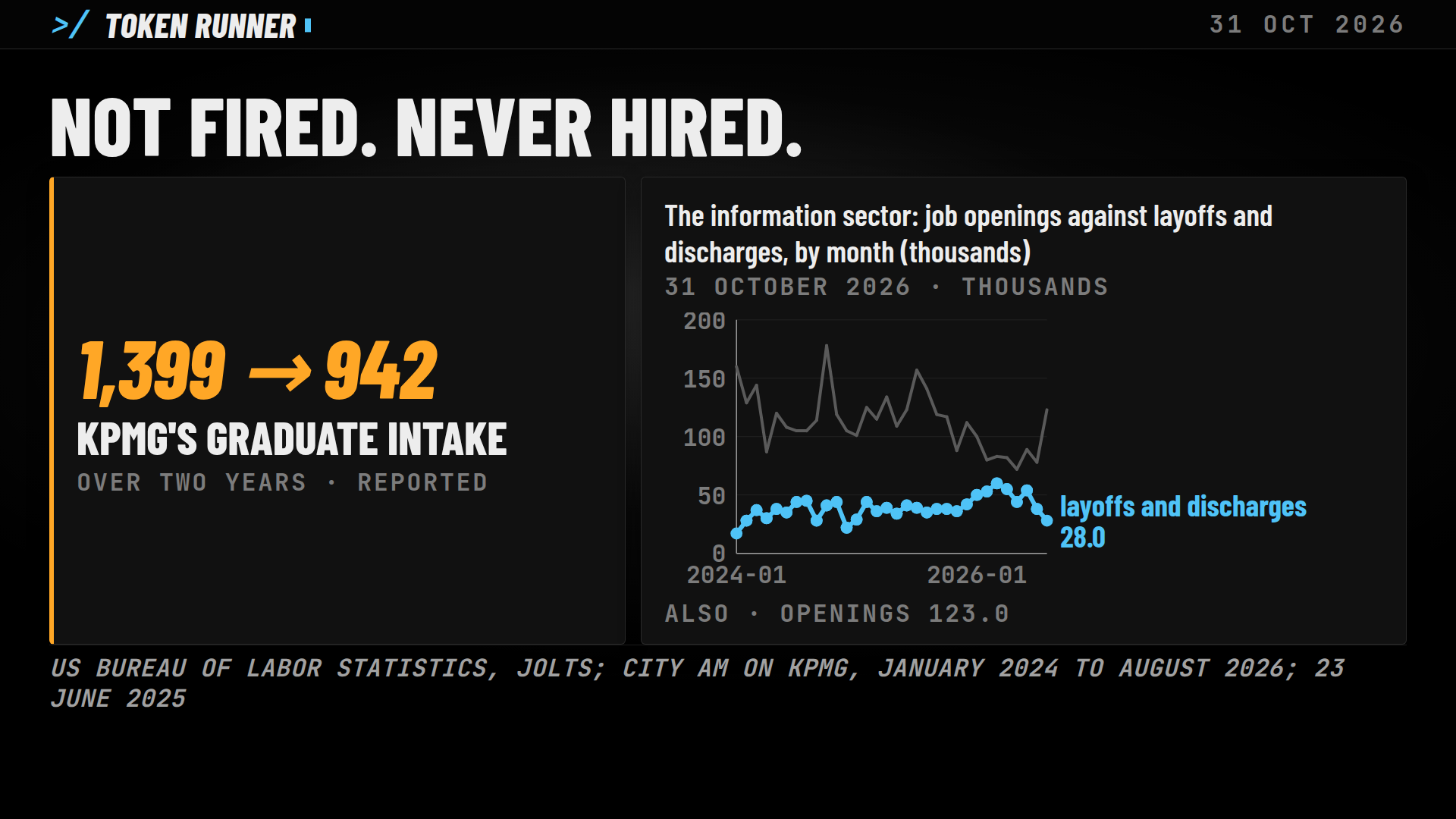
Not fired. Never hired.
Census researchers, looking at who gets hired, put it in one line, as Fortune reported: "the decline in hires is the primary cause." People already in work are mostly keeping their jobs. What is falling is the number of people let in.
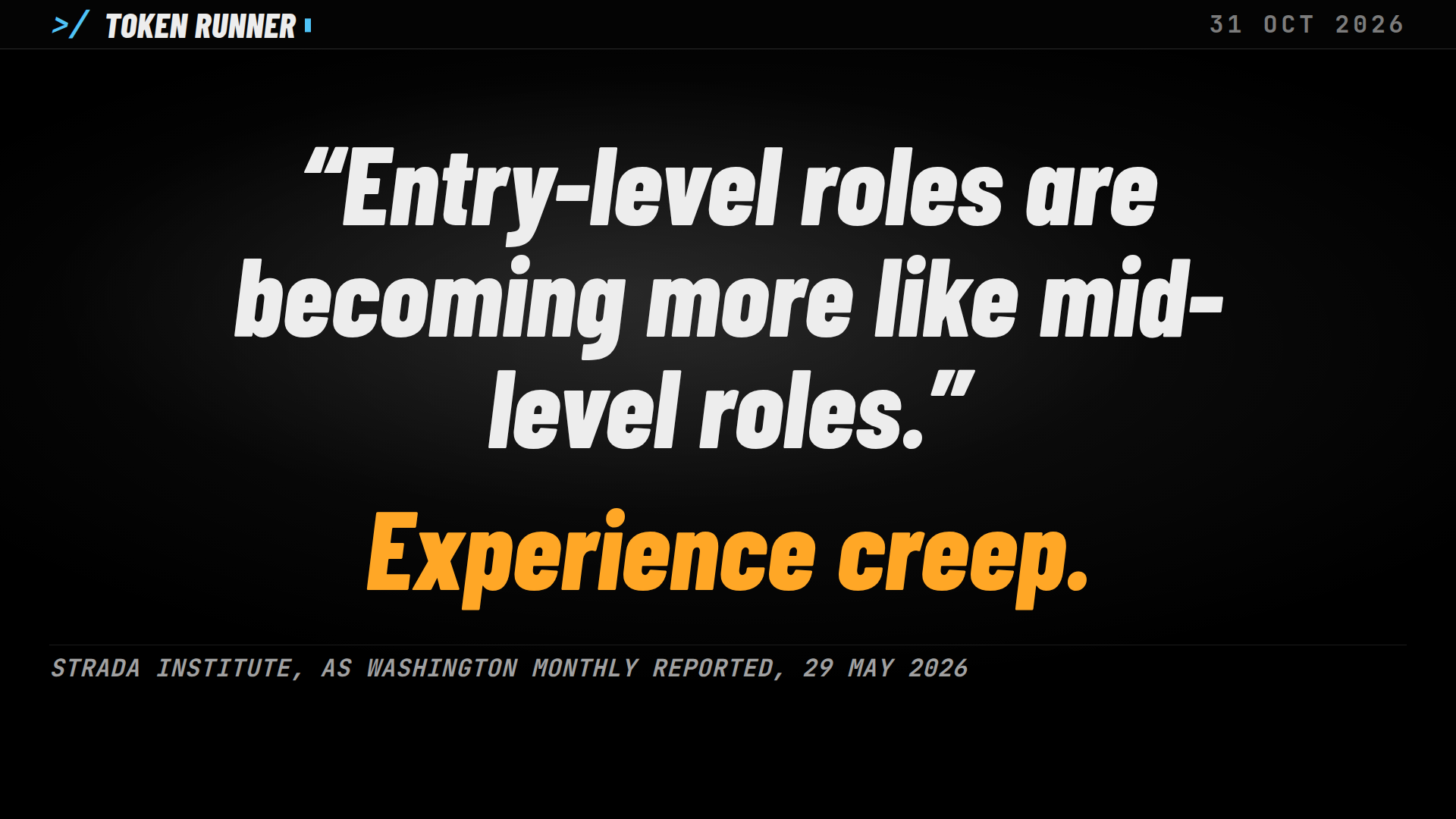
Recruiters have a name for it: experience creep. It means entry-level postings now ask for the experience that used to belong to mid-level jobs. As one research group put it, "Entry-level roles are becoming more like mid-level roles."
In Britain the big accounting firms said it out loud. KPMG cut its graduate intake from 1,399 to 942 over two years. Deloitte, EY and PwC cut theirs too. A recruiter quoted by City AM put the firms' thinking plainly: they "are looking at AI very seriously to replicate junior work."
The safe degree that wasn't
A few years ago, computer science was the safe bet. In the New York Fed's latest table, it ranked fourth-worst of 74 majors for unemployment among recent graduates, at about 7 percent. Computer engineering ranked second-worst.
Census working papers find graduates of the most exposed majors starting on lower pay, and ending up in retail and food service.
The company that makes the machine counted itself
There is one employer whose numbers here are hard to wave away, because it builds the technology. Anthropic, the company that makes Claude, reported on its own hiring in October 2026: "The proportion of junior technical hires fell even faster, from 27% to 9%."
Read that carefully. The company gives no time period for those two figures. It does not define a junior technical hire.
Its chief executive went further in public. On 60 Minutes in November 2025 he warned that AI could wipe out half of entry-level white-collar jobs. That is a forecast, not a count. On CNN in May 2025 he said the alarm needed raising. Both are his claims, as those programmes carried them.
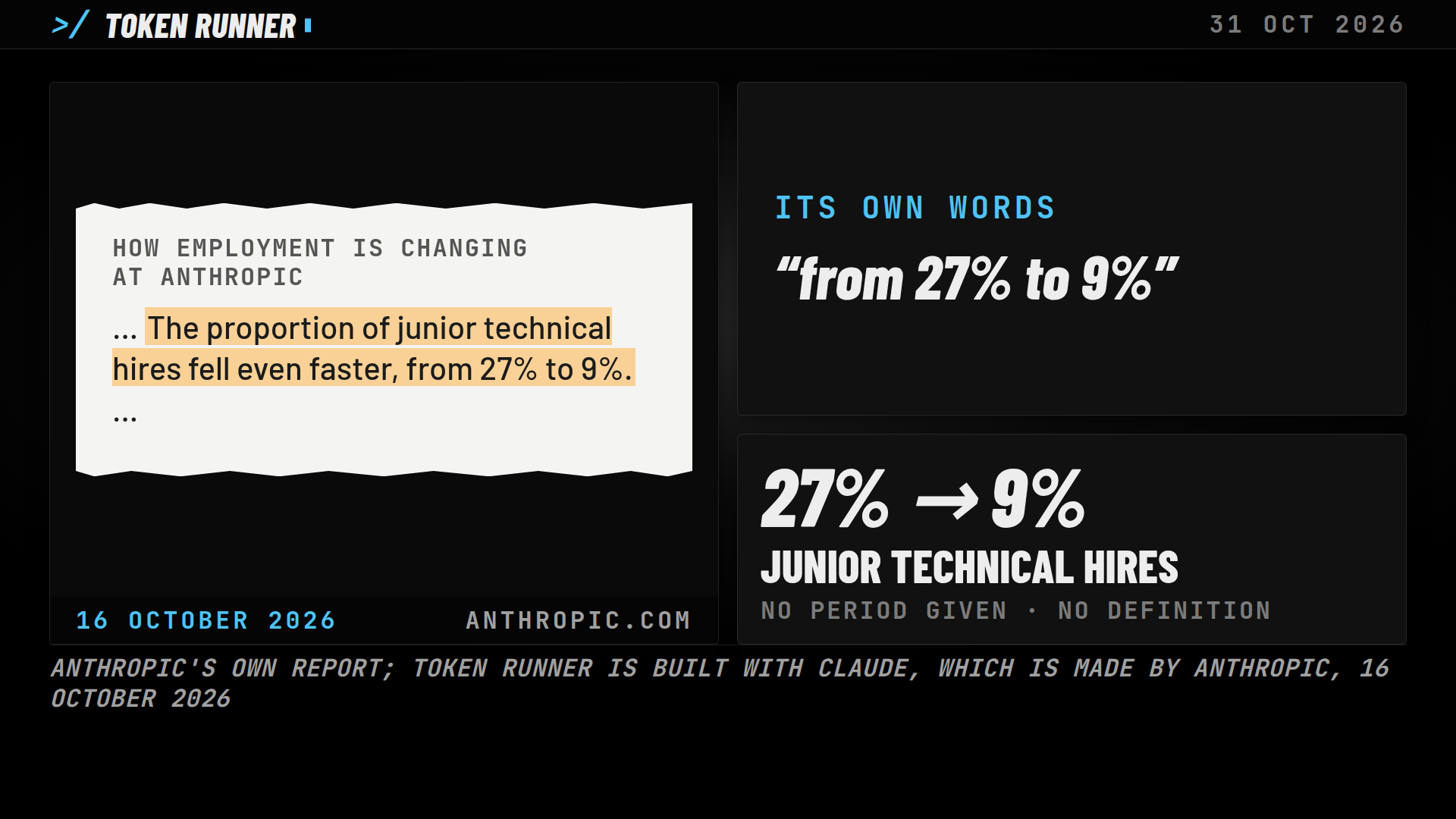
Disclosure: Token Runner is built with Claude, which is made by Anthropic.
Not everyone agrees
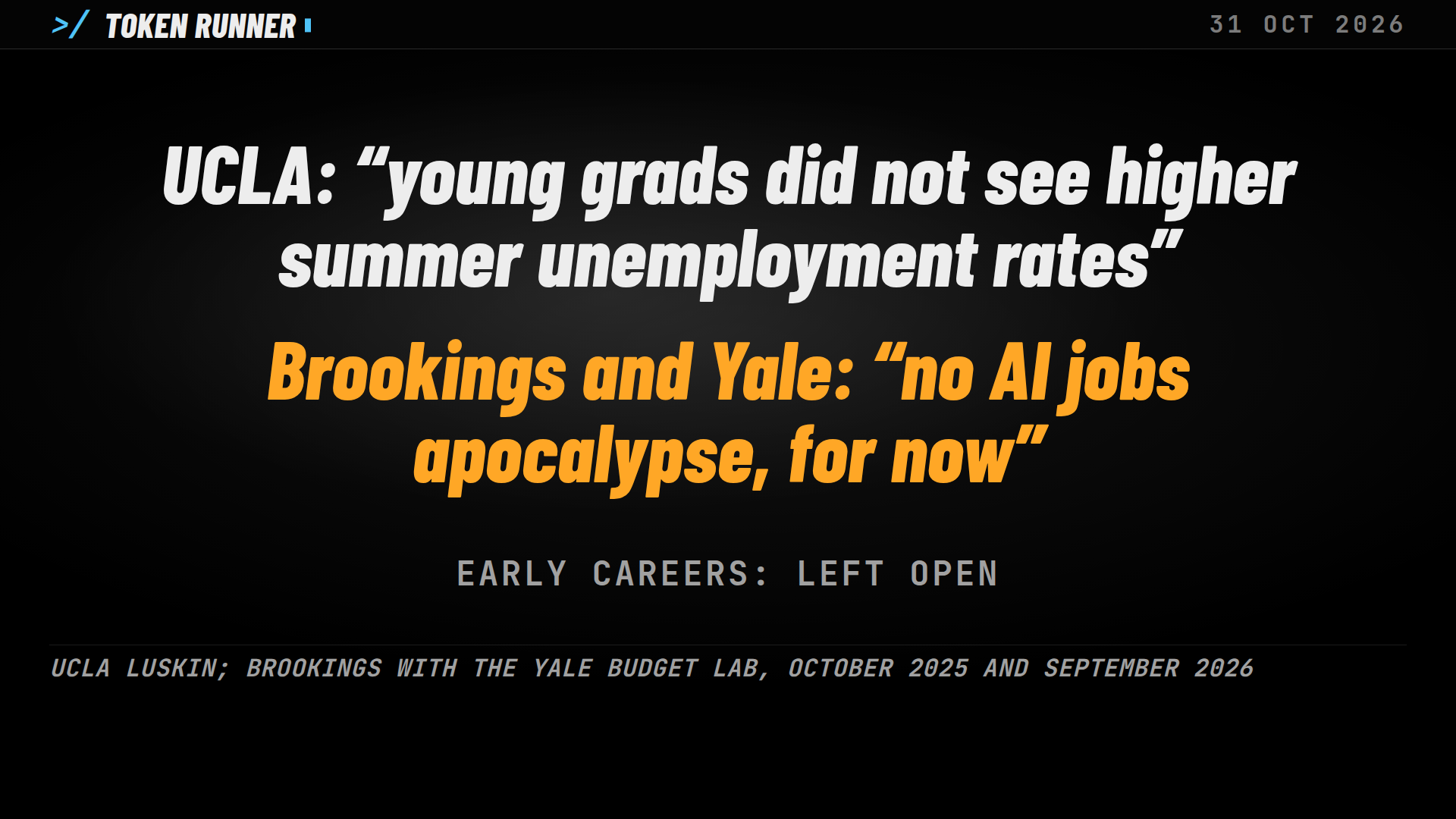
A UCLA study in September 2026 found that "young grads did not see higher summer unemployment rates." Federal data on recent graduates, read one way, shows no shock yet.
Brookings, with the Yale Budget Lab, found "no AI jobs apocalypse, for now." Its own words leave the damage to early careers an open question.
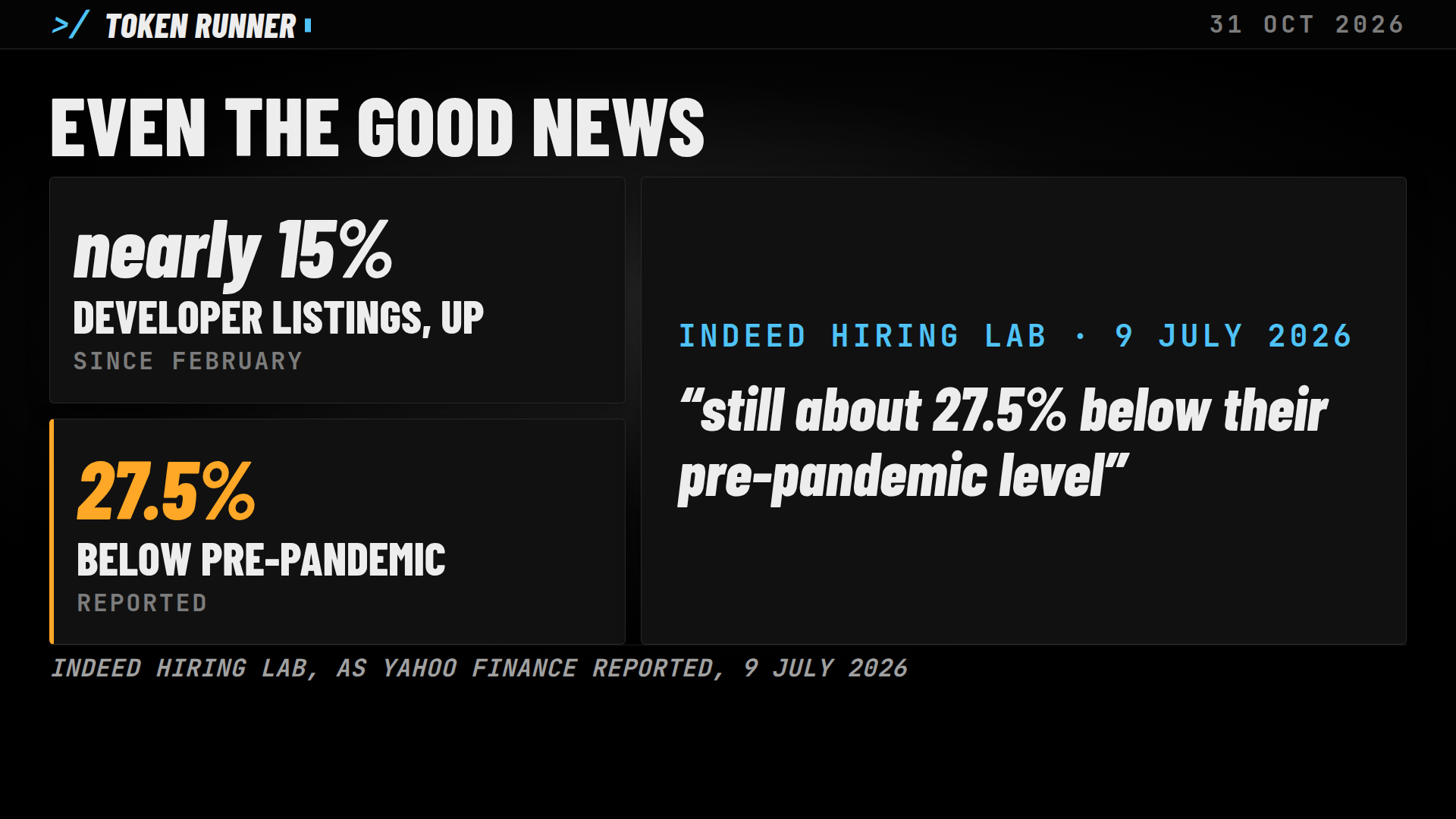
Even the good news points the same way. Indeed, the job site, found US software developer listings up 15 percent from February to July 2026, while all postings fell. But they were still about 27.5 percent below their level before the pandemic. And the growth was in senior roles.
What the public already believes
The public is not waiting for the economists. Pew found that the share of Americans expecting AI to mean fewer jobs rose from 64 percent in 2024 to 71 percent in 2026.
Employers' own stated reasons for cuts tell a strange story beside that. AI was the top reason given in the spring of 2026, peaking in May. By September it had fallen to fifth place. The fear kept rising anyway.
That is because the fear follows the hiring freeze, not the layoff count. A parent whose graduate has sent two hundred applications does not need a chart.
Source: Challenger, Gray & Christmas, Inc., monthly Job Cuts Reports for February and April to September 2026 (each row names its report's address and sha256), read 2026-10-30
Source: Challenger, Gray & Christmas, Inc., monthly Job Cuts Reports for February and April to September 2026 (each row names its report's address and sha256), read 2026-10-30
What a missing rung costs
A layoff is counted on the day it happens. A missing first job is never counted at all. It shows up years later. It is the experienced worker who was never trained, the team with no one to promote, the career that starts at 26 instead of 22, on lower pay, in a different field.
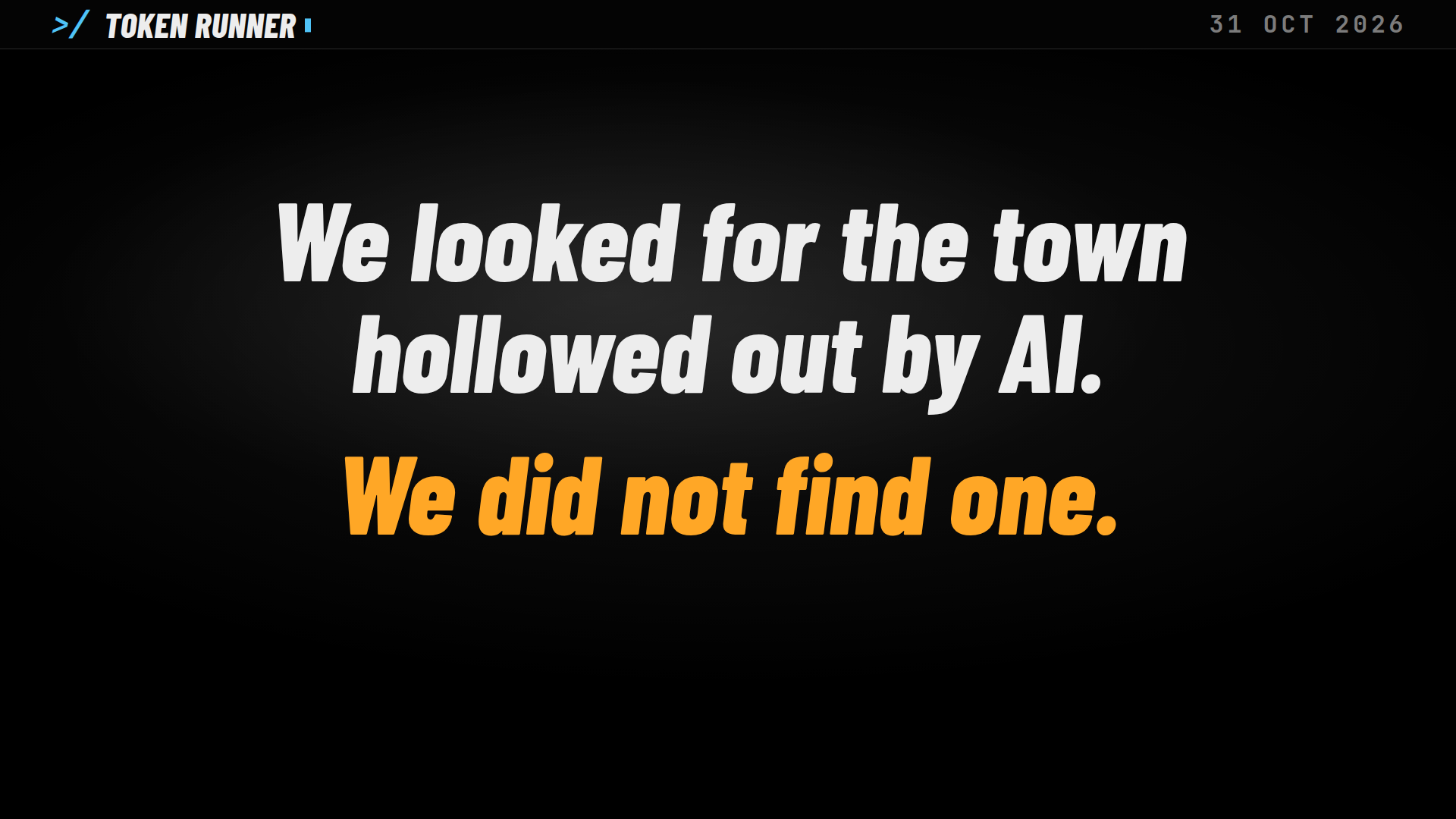
We looked for the town where this has already happened: a place hollowed out by cuts its employer blamed on AI. We did not find one.
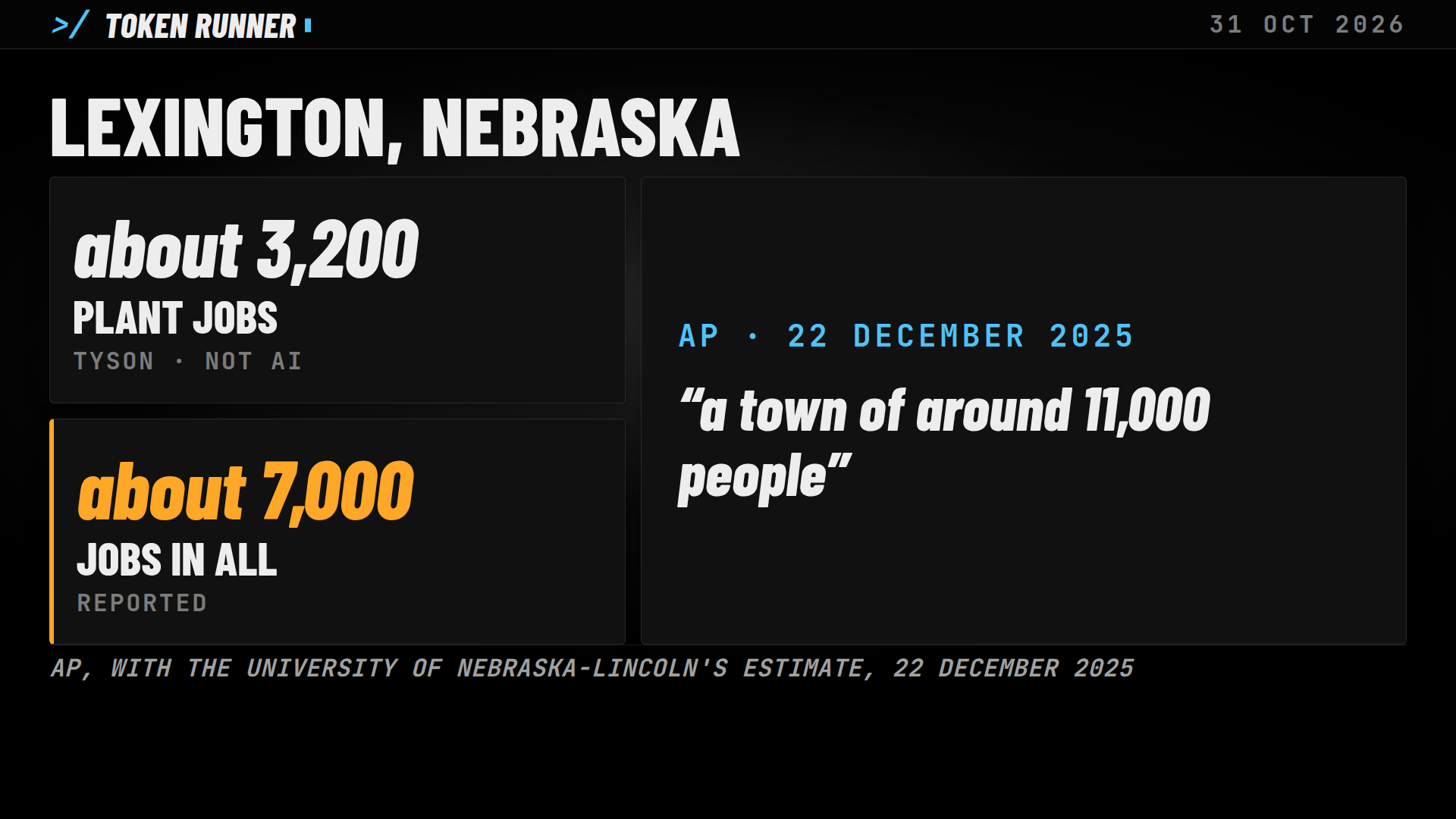
We know what one looks like, because of a closure that had nothing to do with AI. When Tyson shut its beef plant in Lexington, Nebraska, in January 2026, about 3,200 jobs went in a town of around 11,000, as AP reported. Counting the knock-on effects, the University of Nebraska put the total loss at about 7,000 jobs. School officials estimated that nearly half the students had a parent who worked there.
The bottom rung will not disappear like that, in one announcement. It disappears one unposted job at a time. That is why it needs counting now.
Why it matters
There are two ways to read this, and the evidence supports both.
The first is that AI is already closing the bottom rung. The payroll gap for the young has widened in every update. The accounting firms say they are using AI for junior work. The company that makes Claude counted its own junior technical hires falling.
The second is that something else is closing it, or nothing is yet. UCLA finds no rise in young graduates' unemployment, and federal data on recent graduates shows no shock. Economists at the New York Fed point to remote work, not AI, as what leaves younger workers sidelined. On this reading, AI arrived at the same moment as an older slowdown and is taking the blame for it.
Either way, the usual numbers cannot settle it. Unemployment counts people who are looking and have not found work. It does not count the job that was never posted. That is why nobody is acting: when the averages stay calm, a collapse on the bottom rung is easy to miss.
Three things would settle it. Companies could report their entry-level hiring, including the positions they chose not to fill. A New York bill would require that; it has passed both houses but is not yet signed. The government's surveys could break out hiring by age and by exposure to AI every month. And the companies building AI could publish, as one has, what it did to their own junior hiring.
Our ask is simple. Look past the averages, and ask who is 22, and who is getting hired.
Sources
- The Stanford Digital Economy Lab's Canaries paper as Fortune reported it, 26 August 2025, and its August 2026 update
- Fortune, 17 September 2026, on the Census working papers
- Washington Monthly, 29 May 2026, for the Strada Institute
- City AM, 23 June 2025, on the accounting firms
- The New York Fed's table for recent graduates, released 4 February 2026
- Anthropic, "How employment is changing at Anthropic", 16 October 2026
- CBS 60 Minutes, 16 November 2025, and CNN, 30 May 2025
- UCLA Luskin
- Federal data on recent graduates as PsyPost reported it
- Brookings with the Yale Budget Lab, 1 October 2025
- Indeed Hiring Lab via Yahoo, 8 July 2026
- Pew, 18 August 2026
- Challenger, Gray & Christmas monthly reports, 2026
- The University of Nebraska-Lincoln, December 2025,
- AP via Yahoo on Lexington
- The Bureau of Labor Statistics job openings survey, the information sector
- The New York Fed, Liberty Street Economics, June 2026
- New York bill A9581-B
- Token Runner is built with Claude, which is made by Anthropic.