Detectors Out
Software that says it can tell when a student used AI to write an essay. Some of America's best-known universities are turning it off.
The universities.
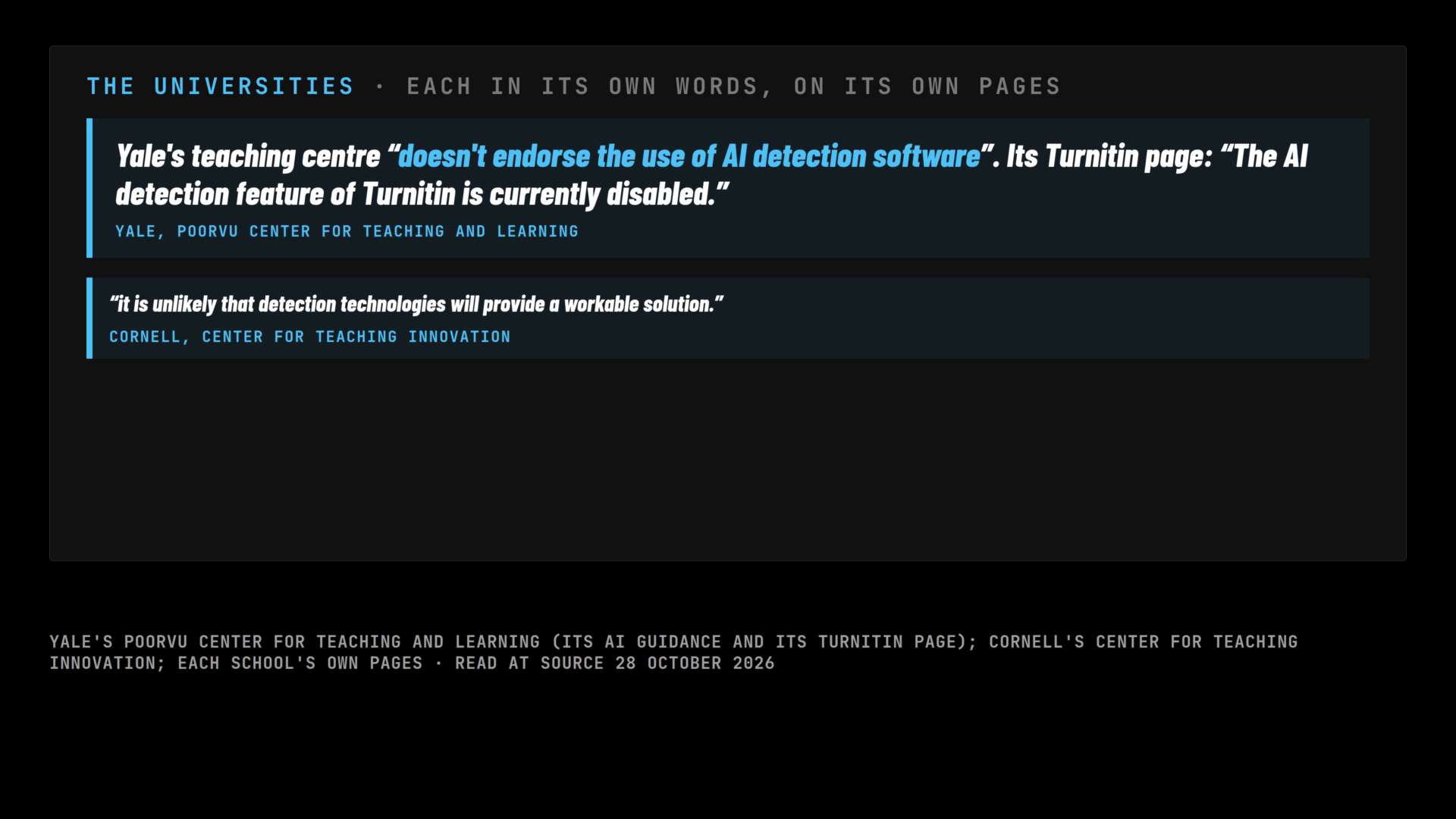
Yale's teaching centre: it "doesn't endorse the use of AI detection software". On its Turnitin page: "The AI detection feature of Turnitin is currently disabled." Cornell: "it is unlikely that detection technologies will provide a workable solution."
Each in its own words, on its own pages. Yale's sentence whole: "…the Poorvu Center doesn't endorse the use of AI detection software or enable such features in Canvas." Cornell's whole: "Unfortunately, it is unlikely that detection technologies will provide a workable solution to this problem." Vanderbilt, in August 2023: "Vanderbilt has decided to disable Turnitin's AI detection tool for the foreseeable future." (its own estimate then: of 75,000 papers submitted in 2022, "around 750 student papers could have been incorrectly labeled"). UW-Madison: it "decided not to offer an enterprise tool for AI detection".
One university's numbers.
Washington State University cancelled its AI-detection contract in February. Its own memo explains why. In one term, the detector checked nearly a hundred and fifty thousand assignments. At a one percent false-positive rate, the university's own memo estimates almost fifteen hundred were likely flagged when they weren't AI. And between 2023 and 2025, a third of the AI cases that reached its hearing boards ended "not responsible", because the detector was the only evidence.
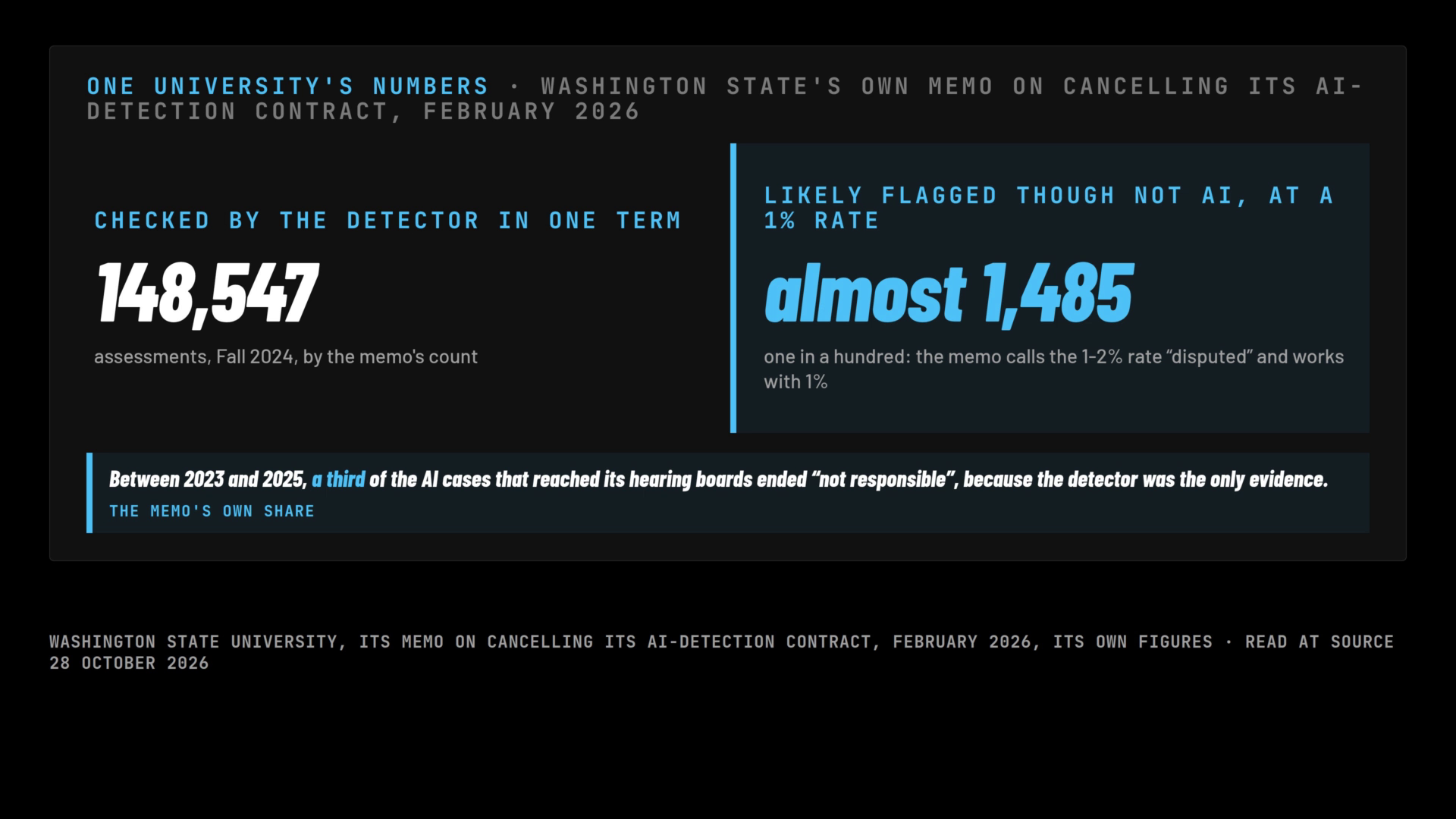
The memo's own figures: 148,547 assessments in Fall 2024; at a 1% false-positive rate, which the memo calls disputed ("Although disputed, Turnitin claims that they have a false positive detection rate… of 1-2%") and works with, "almost 1,485 assessments were likely flagged… when they were not"; a third of the hearing-board AI cases, 2023 to 2025. The 1-2% is the memo's reading of Turnitin's claim, not Turnitin's own current figure; Turnitin's 2023 blog gave "less than 1%" at the document level and "around 4%" at the sentence level. The memo also says "other studies placed this value higher, especially for students who are neurodivergent or have English as a second language", and that "even experts can have false positive detection rates of 4% or more".
Source: Washington State University, its memo on the AI-detection contract (February 2026), read at source 28 October 2026
The maker.
Even the maker says so. Turnitin's own guide says its AI detection "should not be used as the sole basis for adverse actions against a student."
Turnitin's current guide, quoted exactly. Scores of 1 to 19% now show as an asterisk.
The schools.
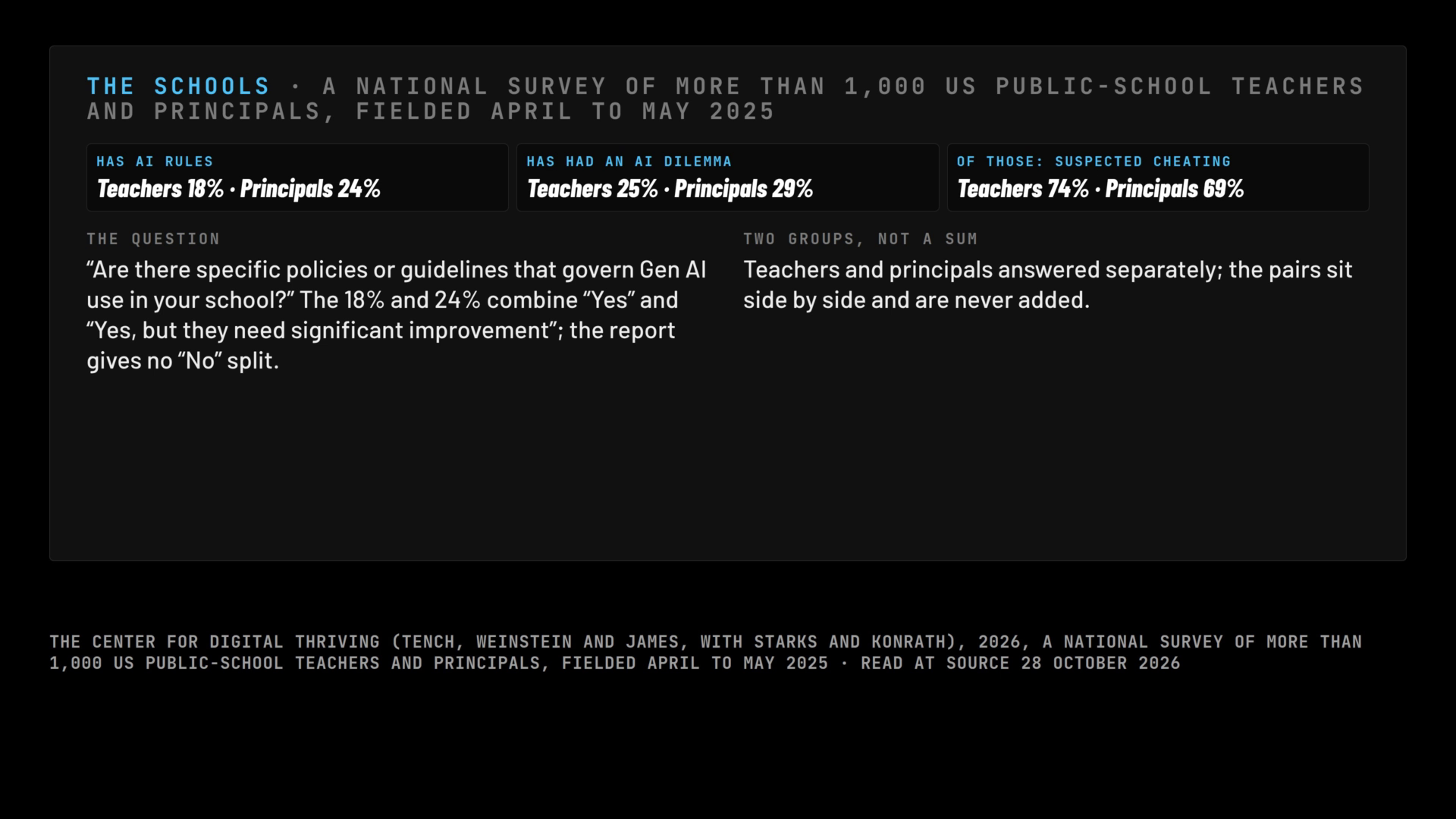
And in America's schools? A national survey of more than a thousand public-school teachers and principals: only eighteen percent of teachers say their school has specific rules on AI.
The Center for Digital Thriving's survey, fielded April to May 2025: 18% of teachers and 24% of principals answered "Yes" or "Yes, but they need significant improvement" to "Are there specific policies or guidelines that govern Gen AI use in your school?" (the report gives no "No" split); 25% and 29% report an AI dilemma; of those, 74% and 69% describe suspected cheating. Two groups, never summed.
Source: Center for Digital Thriving (Tench, Weinstein and James, with Starks and Konrath), 2026, the report's own figures, read at source 28 October 2026
A teacher's hunch.
The tool that promised to catch AI is being switched off. In America's schools, what's left, for now, is what researchers call "AI-dar": a teacher's hunch.
"AI-dar" is the researchers' term for K-12; Washington State's memo says suspicion alone "is not sufficient". What we couldn't confirm: How many universities have switched detection off in all (five named here, in their own words).
Every figure from the universities' own pages, Turnitin's own guide, and the survey's own report. Token Runner dot A I.
Sources
- Yale, the Poorvu Center for Teaching and Learning, its AI guidance and its Turnitin page: "…the Poorvu Center doesn't endorse the use of AI detection software or enable such features in Canvas."; "The AI detection feature of Turnitin is currently disabled." The AI guidance page: poorvucenter.yale.edu/teaching/teaching-resource-library/ai-guidance-for-teachers/ai-course-assignment-design/academic.
- Cornell, Center for Teaching Innovation: "Unfortunately, it is unlikely that detection technologies will provide a workable solution to this problem."
- Washington State University, its memo on cancelling its AI-detection contract, read at source: "As of February 2026, WSU has cancelled its contract with Turnitin for its AI Detection software."; "In Fall 2024, Turnitin was used at WSU to analyze 148,547 assessments… almost 1,485 assessments were likely flagged… when they were not." (WSU's own arithmetic at 1%; the memo: "Although disputed, Turnitin claims that they have a false positive detection rate… of 1-2%"); a third of the AI cases at its hearing boards, 2023 to 2025, ended not responsible because the detector was the only evidence; suspicion from the detector alone "is not sufficient".
- Turnitin, its current guide to AI writing detection, read at source: its AI detection "should not be used as the sole basis for adverse actions against a student." Its June 2023 blog: "less than 1%… for documents with 20% or more AI writing"; "sentence-level false positive rate is around 4%"; scores of 1 to 19% now show as an asterisk. The 2023 blogs: turnitin.com/blog/understanding-false-positives-within-our-ai-writing-detection-capabilities and …/understanding-the-false-positive-rate-for-sentences-of-our-ai-writing-detection-capability.
- The Center for Digital Thriving (Tench, Weinstein and James, with Starks and Konrath), 2026, a national survey of more than 1,000 US public-school teachers and principals, fielded April to May 2025, read at source: to "Are there specific policies or guidelines that govern Gen AI use in your school?", 18% of teachers and 24% of principals answered "Yes" or "Yes, but they need significant improvement" (no "No" split published); 25% and 29% report an AI dilemma; of those, 74% and 69% describe suspected cheating; the researchers' term "AI-dar" is for K-12.
- Vanderbilt, 16 August 2023 (live 28 October 2026): "Vanderbilt has decided to disable Turnitin's AI detection tool for the foreseeable future."; "Vanderbilt submitted 75,000 papers to Turnitin in 2022… around 750 student papers could have been incorrectly labeled as having some of it written by AI."
- UW-Madison, its guiding principles for generative AI in teaching: it "decided not to offer an enterprise tool for AI detection".
- The Center for Digital Thriving's summary page, 'An AI policy isn't a playbook', and Harvard GSE's Usable Knowledge piece on the survey (October 2026).