Who's Holding the Controller?
The robots are coming home. At least, that's what the videos say.
The views.
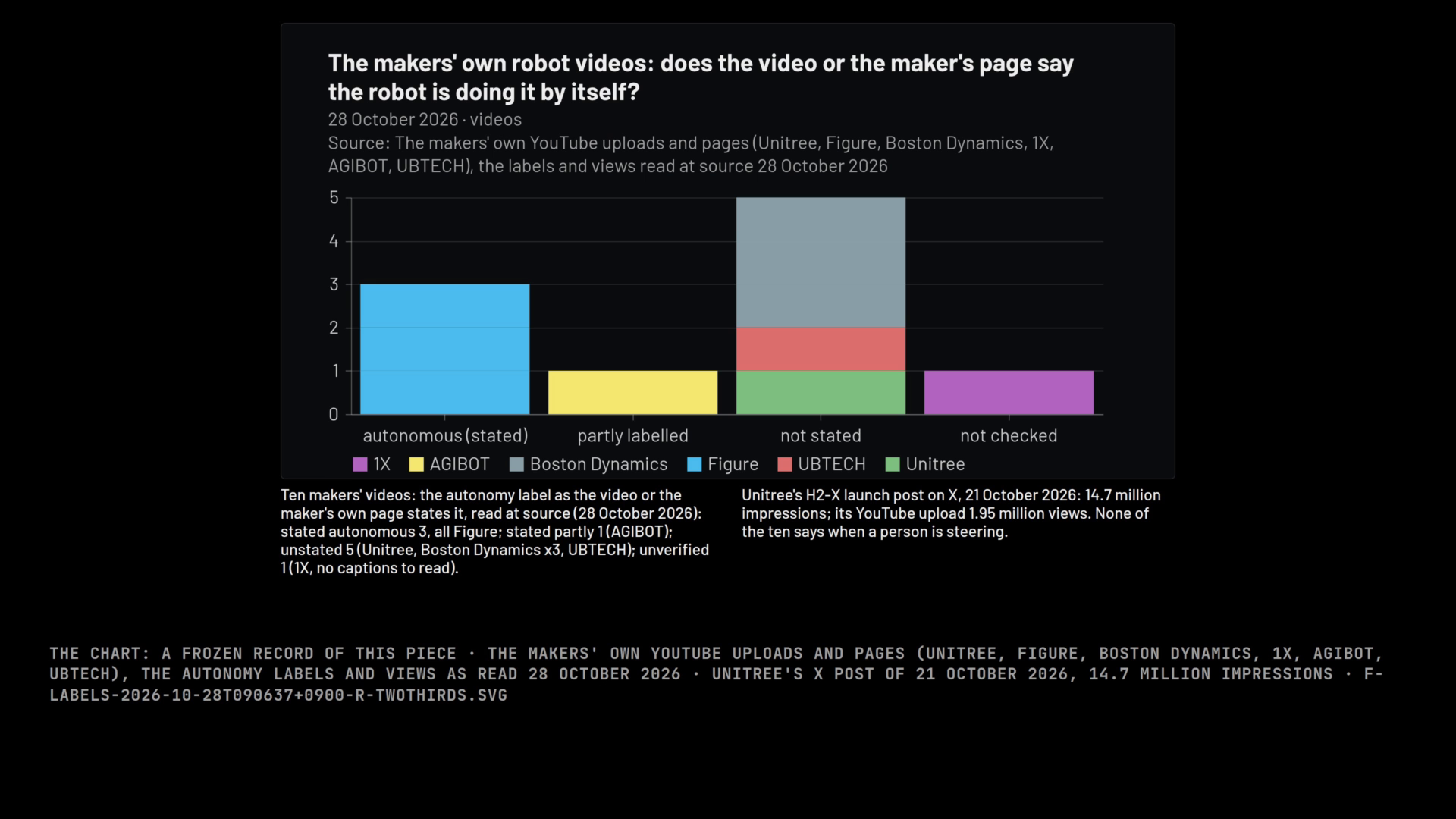
The makers' most-watched videos have millions of views. Unitree's newest robot, launched on X this month: over fourteen million impressions. Half of them don't say whether the robot is doing it by itself. None says when a person is steering.
Ten makers' videos, the autonomy label as the video or the maker's own page states it, read at source on 28 October 2026: autonomous (stated) 3, all Figure; partly labelled 1, AGIBOT; not stated 5 (Unitree, Boston Dynamics three times, UBTECH); not checked 1 (1X, no captions to read). Only four of the ten top a million YouTube views (Atlas Hands 2.6 million, Atlas Airborne 2.4 million, Unitree 1.95 million, 1X 1.9 million); Unitree's launch post on X had 14.7 million impressions. A label is what the video or its page says, not what the robot did. 1X's own X post of its NEO launch video has 69,293,417 impressions, with no label in its text; Unitree does label some posts ('Fully Autonomous', 7 September 2026, 5.94 million impressions), it just did not label the H2-X launch.
Source: The makers' own YouTube uploads and pages (Unitree, Figure, Boston Dynamics, 1X, AGIBOT, UBTECH), the labels and views read at source 28 October 2026
The test.
When the Wall Street Journal tested a home robot, 1X's NEO, a voice explained who was really in charge: "I am a remote operator in a different room in the building."
The Journal's video of 28 October 2025, at 3:49; its narration: "this operator with a VR headset and controllers was the one actually operating Neo." Linked above at its time; no clip in the film. Watch: The Wall Street Journal (its own channel), 'I Tried the First Humanoid Home Robot. It Got Weird.', 28 October 2025, at 3:49 (3:49 to 4:00).
The reviewer.
Marques Brownlee, reacting to the Journal's test of the same robot: "Yeah, all of this is teleoperated." But, he said, the company did label the two scenes where it wasn't: getting the door, and putting away the dishes.
At 4:15 to 5:20 of his video of 29 October 2025. He did not test NEO himself; he reacted to the Journal's video. 1X's own page, in full: "NEO works autonomously by default. For any chore it doesn't know, you can schedule a 1X Expert to guide it, helping NEO learn while getting the job done."; the Expert can "remotely supervise its actions at scheduled times"; and "Remote Control: Pilot your NEO from anywhere in the world through your Mobile App & VR device."
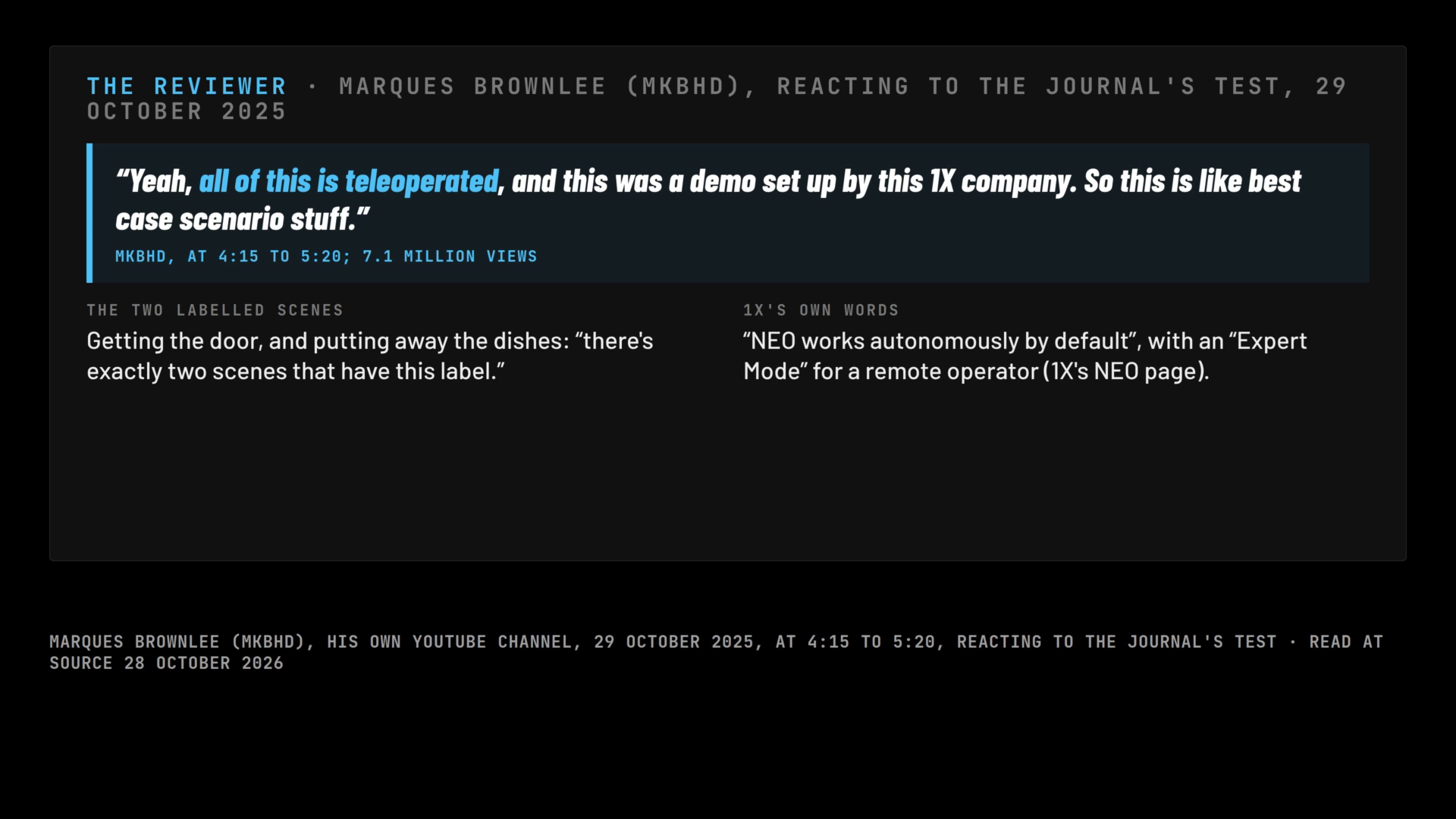
1X's Bernt Børnich replied to him on X the same day, in full: "@MKBHD Just to clarify, all actions portrayed as AI in the video (text layovers from the AI planner) is 100% autonomous. We hope to ship a mostly fully autonomous robot in 2026, but chose to not promise anything that does not already works today. Hopefully breaking with the trend." Watch: Marques Brownlee, MKBHD (his own channel), 29 October 2025, 4:15 to 5:20 (4:15 to 5:20).
Why.
Why the person behind it? Because that's how the robot learns. The Journal again: "The videos of the robot doing things via tele-operation become the training data to make the AI model smarter."
At 4:39 of the Journal's video. The Verge's piece of January 2026 (linked above) has Zeroth's CEO saying tele-operation in the home will be necessary for safety. Watch: The Wall Street Journal (its own channel), at 4:39 (4:39 to 4:50). Watch: The Verge (its own channel), 'Are humanoid robots the next smart home gadget?', 10 January 2026, 3:23 to 3:56 (3:23 to 3:56).
The claim.
And Figure, which does claim autonomy, says how it measures it. Pretraining its newest model on human video, it says, lifted success in homes it had never seen from nine percent, for the same robot trained from scratch, to fifty-six. Its own rule: if a human has to step in for safety, that try counts as failed. And its own caveat: "The point is not that general humanoid robotics is solved." Figure's page of 17 September 2026: "Holding task-specific data, architecture, training, and evaluation fixed, Index pretraining alone increased zero-shot success from 9% to 56%." Thirty homes it had never seen; "Each task used a single fixed checkpoint across all 30 homes." The rule: "If a human intervention is necessary for safety, that rollout is aborted and failed." A maker's claim, by its own measure.
Source: Figure, 'Helix 2.5: Zero-Shot 30-Home Generalization', 17 September 2026, figure.ai/news/helix-2-5-zero-shot-30-home-generalization
One question.
None of this is a trick. But every robot video should answer one question. Who's holding the controller?
What we couldn't confirm: Whether Unitree's launch film was teleoperated is not stated by the maker and not claimed here. 1X's launch video could not be checked (no captions). Whether any 1X customer has taken delivery.
Every quote from the makers' own pages and the reviewers' own videos. Token Runner dot A I.
Sources
- The makers' own YouTube uploads and pages, the autonomy label as the video or the maker's own page states it, read at source on 28 October 2026: stated autonomous 3 (all Figure: "Zero-shot whole-body autonomy", "fully autonomous", "a single learned Vision-Language-Action policy"); stated partly 1 (AGIBOT: the table-tennis part "with no remote control or scripts"); unstated 5 (Unitree's H2-X launch; Boston Dynamics' Atlas Airborne, Atlas drink and New Hands for Atlas; UBTECH's Walker S2); unverified 1 (1X's NEO launch video: no captions, the on-screen labels could not be read). None says a person is steering.
- Unitree, its X post of 21 October 2026 introducing the H2-X: "Powerful performance to serve and guard you, with a maximum endurance of approximately 8 hours. Please use the robot safely and in a friendly manner." 14,704,610 impressions as read 28 October 2026; the YouTube upload 1,952,487 views.
- 1X's own X post of its NEO launch video, 69,293,417 impressions, with no label in its text; Unitree does label some of its posts ('Fully Autonomous', 7 September 2026, 5.94 million impressions), it just did not label the H2-X launch.
- The Wall Street Journal (Joanna Stern), "I Tried the First Humanoid Home Robot. It Got Weird.", the Journal's own YouTube channel, 28 October 2025; 3,012,789 views. At 3:49, the operator: "I am a remote operator in a different room in the building." The narration: "this operator with a VR headset and controllers was the one actually operating Neo." At 4:39: "The videos of the robot doing things via tele-operation become the training data to make the AI model smarter." (Stern has since left the Journal; the clip is the Journal's, 2025.)
- Marques Brownlee (MKBHD), his own YouTube channel, 29 October 2025, reacting to the Journal's test (he did not test NEO himself); 7,070,524 views. At 4:15 to 5:20: "Yeah, all of this is teleoperated, and this was a demo set up by this 1X company. So this is like best case scenario stuff." and "they actually are very careful to label exactly when the robot is doing something autonomously and not teleoperated… there's exactly two scenes that have this label." The two labelled scenes: getting the door, and putting away the dishes.
- 1X, its NEO page, in full: "NEO works autonomously by default. For any chore it doesn't know, you can schedule a 1X Expert to guide it, helping NEO learn while getting the job done."; "Expert Mode": the Expert can "remotely supervise its actions at scheduled times"; "Remote Control: Pilot your NEO from anywhere in the world through your Mobile App & VR device." And Bernt Børnich's reply to MKBHD on X, 29 October 2025, in full: "@MKBHD Just to clarify, all actions portrayed as AI in the video (text layovers from the AI planner) is 100% autonomous. We hope to ship a mostly fully autonomous robot in 2026, but chose to not promise anything that does not already works today. Hopefully breaking with the trend."
- Figure, "Helix 2.5: Zero-Shot 30-Home Generalization", 17 September 2026, read at source by Token Runner on 28 October 2026: "Holding task-specific data, architecture, training, and evaluation fixed, Index pretraining alone increased zero-shot success from 9% to 56%."; "If a human intervention is necessary for safety, that rollout is aborted and failed."; "The point is not that general humanoid robotics is solved." The 9% is the same robot trained from scratch.
- The Verge, "Are humanoid robots the next smart home gadget?", 10 January 2026, its own channel: at 3:23 to 3:56, Zeroth's CEO on tele-operation in the home as necessary for safety; at 4:24 to 4:57, LG's CLOiD folding one towel.
- Unitree's own X post of 7 September 2026, 'Fully Autonomous', 5.94 million views as read 28 October 2026 (the post's own count).