By the People
Layoffs attributed to AI can be counted, as a floor. People closest to the technology have said the jobs may go and that an income should follow. What has been paid for so far is a study, a research fund and a fellowship.
The count
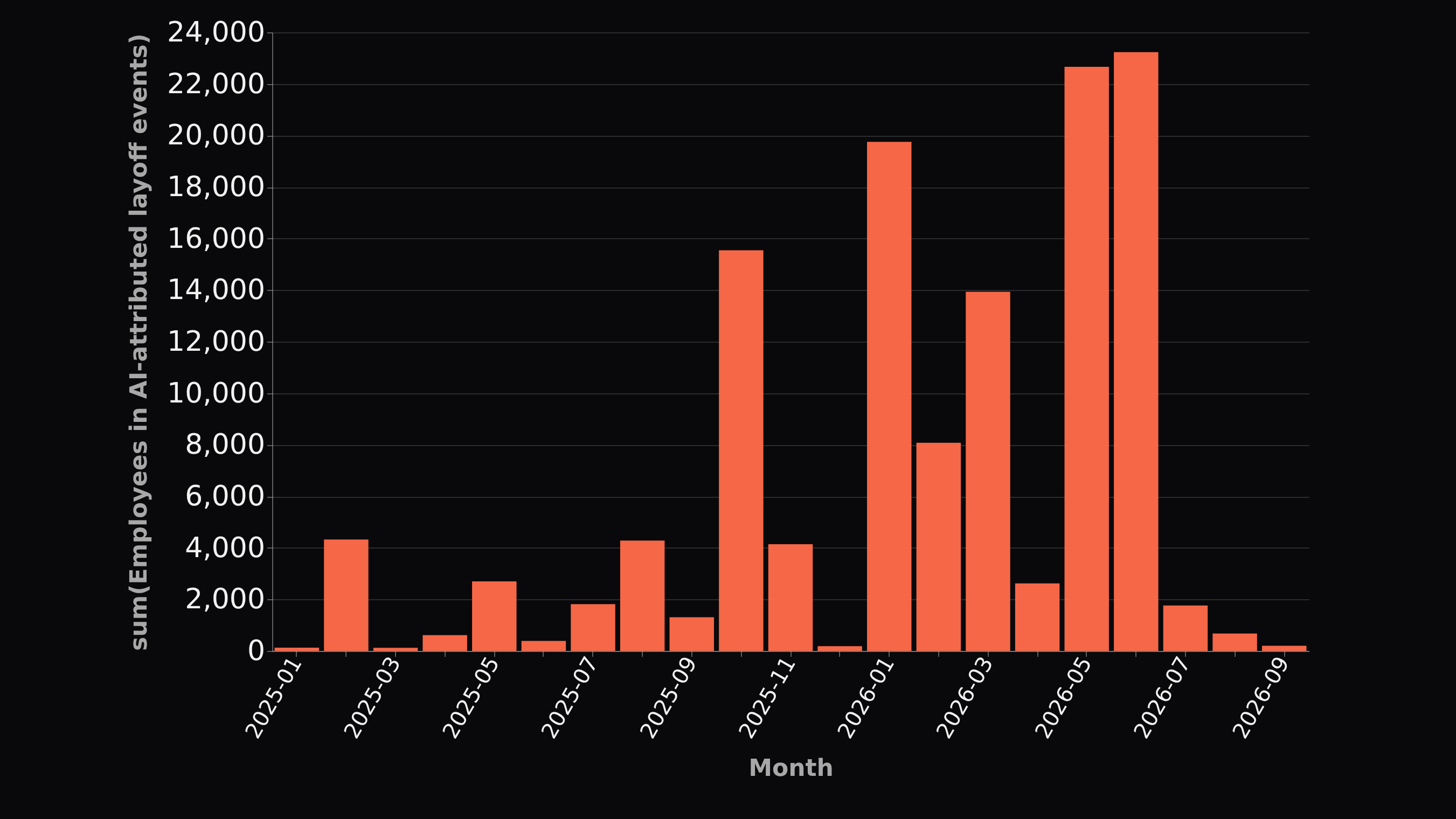
Start with what can be counted. In 2025, layoffs attributed to AI, by the companies or by the reports, covered 35,534 people. In 2026, to 14 September, they covered 93,116, by Token Runner's collection of 9 October; the film above, made a week earlier, says 92,913, before one June event gained a head-count. The list is Layoffs.fyi's: 172 events at 144 companies since January 2024, of which 134 give a number of people. It is a floor. It is a list of layoffs that companies or the press attributed to AI. It is not a count of jobs AI took, it is not a national figure, and it is not unemployment. Events that give no head-count add nothing to the sum, and 2026 is a part year.
Mostly six announcements
Most of 2026 is a handful of large announcements. Six events of 4,000 people or more come to 64,000 people, more than two thirds of the year's count: Oracle 21,000 in June, Amazon 16,000 in January, Dell 11,000 in March, Meta 8,000 in May, and Block and Cisco 4,000 each, every one of them as it stands on Layoffs.fyi's list of layoffs attributed to AI. The next largest is 3,000. That is why the year's total should not be read as a trend: a chart by month is tall where one company announced. The last three months on the table, July to 14 September, hold 2,636 people. The table does not say why, and neither does this article. The list may be catching up late, or it may be quiet.
The warning
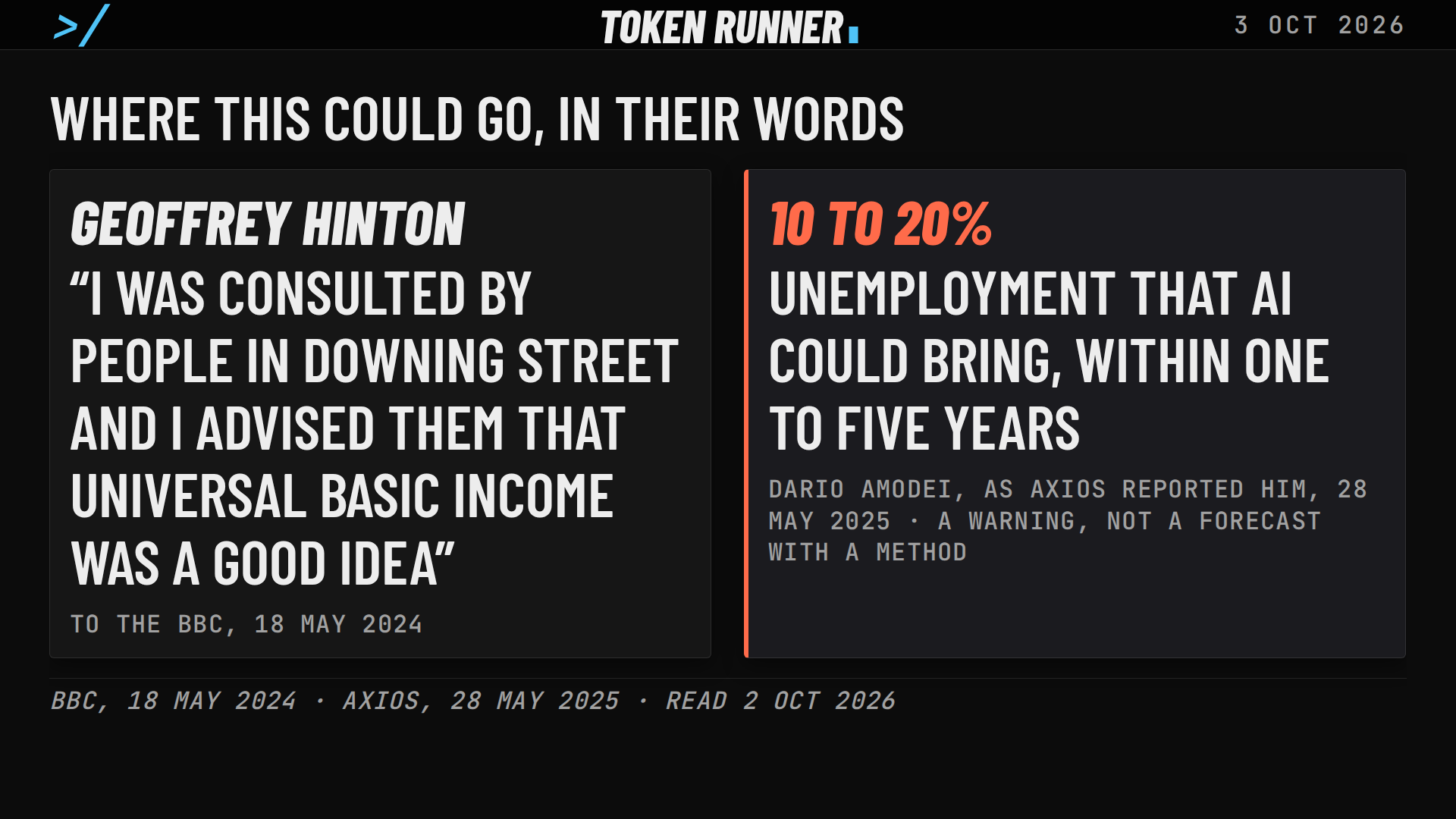
The people closest to the technology have said where this could go. Geoffrey Hinton told the BBC in May 2024: "I was consulted by people in Downing Street and I advised them that universal basic income was a good idea." His reason, on the same page, was that he was "very worried about AI taking lots of mundane jobs", and that the gains would go to the rich "and not the people whose jobs get lost". Dario Amodei, the chief executive of Anthropic, as Axios reported him in May 2025, said AI could wipe out half of all entry-level white-collar jobs and push unemployment to 10 to 20 per cent within one to five years. Could: a warning given in an interview, not a forecast with a method, and not a measurement.
What one of them said
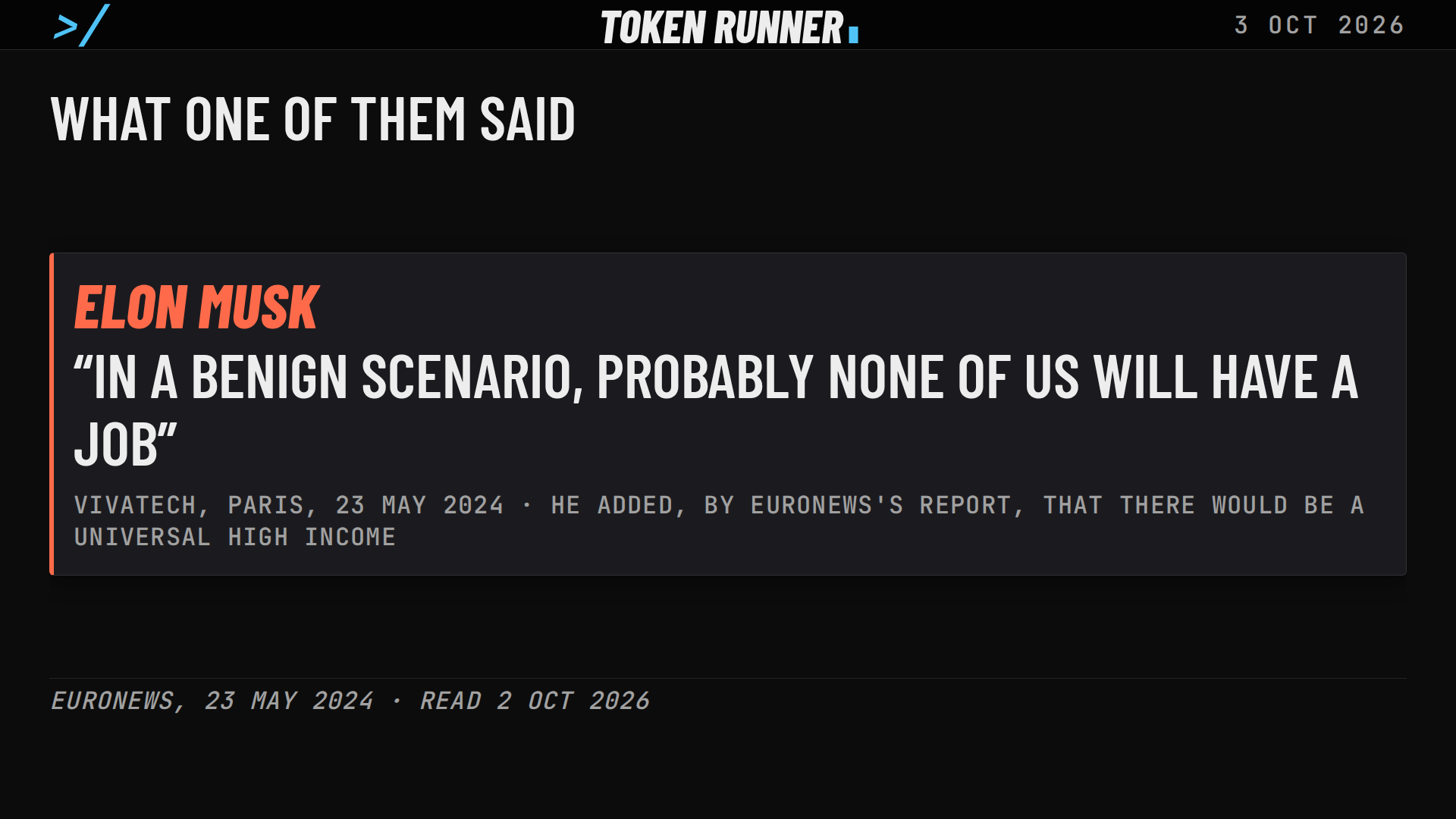
Elon Musk put it more flatly at VivaTech in Paris on 23 May 2024: "In a benign scenario, probably none of us will have a job." By Euronews's report he added that there would be a universal high income; those words are the report's and stand outside its quotation marks. Set beside Hinton and Amodei, the three statements have the same two halves. The first half is that the work may go. The second is that an income should follow it. None of the three said who would pay that income, how much it would be, or when it would begin, and the rest of this article is about the distance between saying it and paying it.
The test
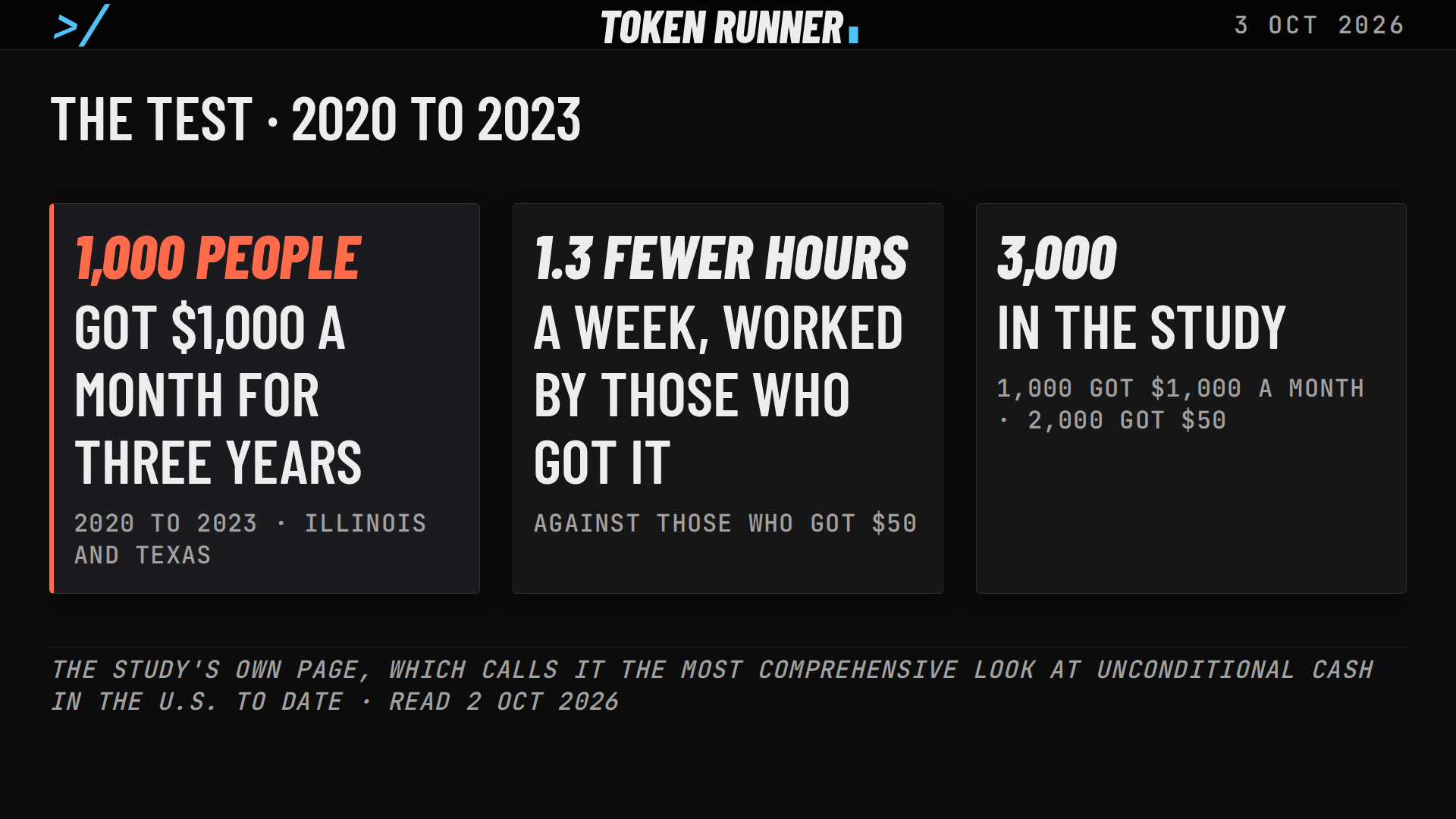
One thing has been tried at scale. A study that describes itself as "the most comprehensive look at the impact of unconditional cash in the U.S. to date" had 3,000 participants in Illinois and Texas. From 2020 to 2023, 1,000 of them received $1,000 a month for three years, and the other 2,000, the control group, received $50. Those who got the $1,000 worked 1.3 fewer hours a week than those who got $50. The study's page says they used the room to choose work that fitted them, and that the largest effect on their spending was on "food, rent, and transportation". The finding has two sides and both are the study's own. Its reach is a thousand people, for three years, ending in 2023.
What has been paid for
On 10 June 2026 Anthropic announced an initial $200 million for an Economic Futures Research Fund and $150 million for a national fellowship programme for early-career professionals. They are different things and are not added together here. Both pay for research and fellowships; neither is income paid to anyone, and Fortune's report said: "Scant details were available". The same day its chief executive proposed, as Fortune reported, "mechanisms such as universal basic income" if job displacement permanently lowers the demand for labour, paid for by taxes on the relevant companies or on capital gains.
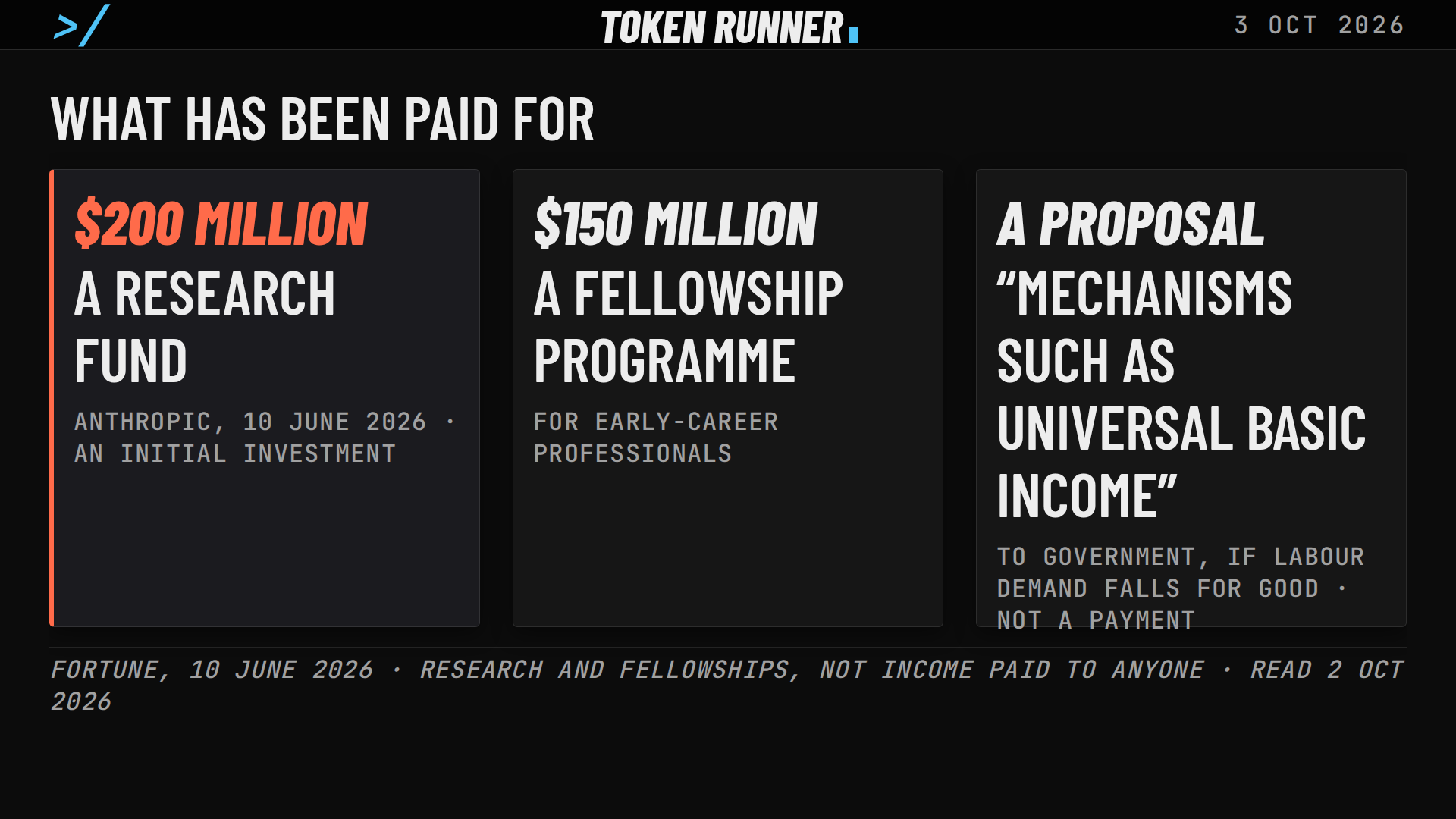
The framework Anthropic published sets out how government could respond at unemployment of 5 per cent, 10 per cent and an unprecedented level it does not number; Fortune noted the latest American rate then was 4.3 per cent. It is a proposal to government, with an if. It is not a payment.
What has been proposed
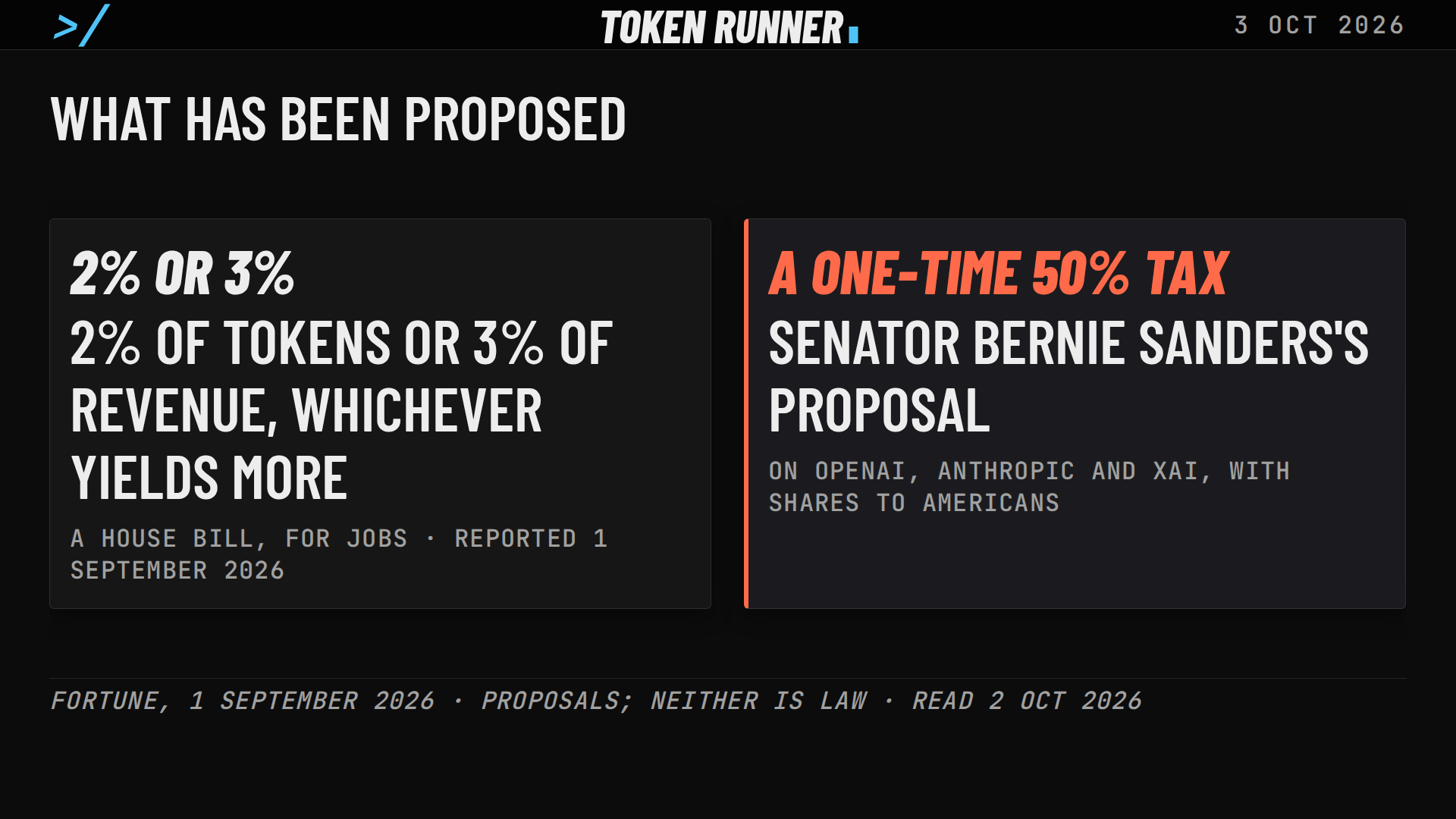
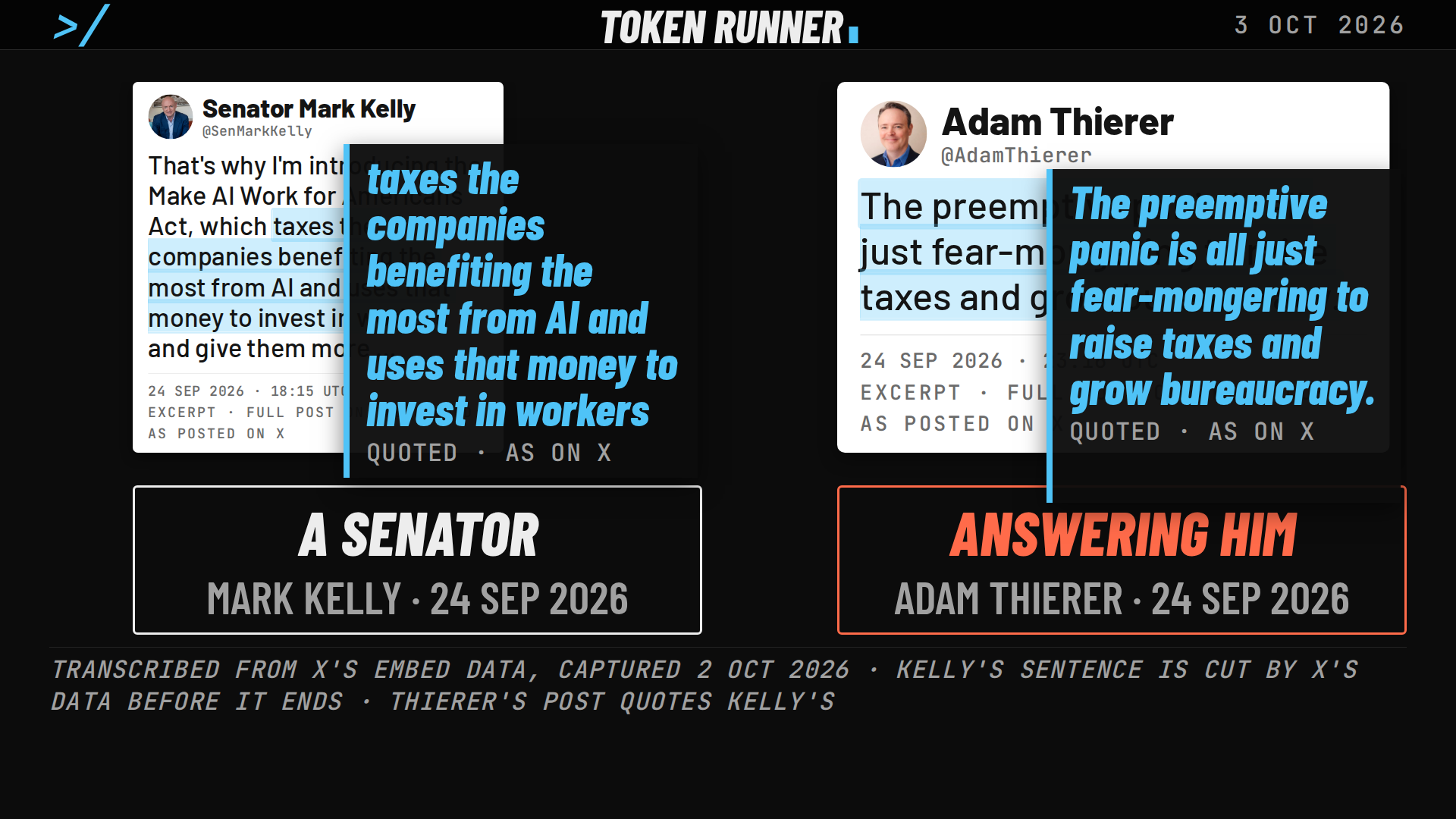
Congress has proposals, and none is law. A House bill from Representatives Sara Jacobs, Greg Casar and Valerie Foushee, reported by Fortune on 1 September 2026, would tax major AI companies on the value of tokens or on revenue, whichever yields more, at rates starting at 2 per cent and 3 per cent and rising with unemployment. The money would go to creating jobs; it is not a basic-income bill. Senator Bernie Sanders has proposed a one-time 50 per cent tax on OpenAI, Anthropic and xAI, with Americans given shares, and the same report lists proposals from Senators Wyden and Warren. On 24 September Senator Mark Kelly added another, in a post on X: "I'm introducing the Make AI Work for Americans Act, which taxes the companies benefiting the most from AI and uses that money to invest in workers".
The conversation
Kelly's post drew an answer the same day. Adam Thierer, a commentator, wrote on X: "AI and data centers are currently creating an explosion of new investment and opportunities for the public. New jobs are being created." And then: "The preemptive panic is all just fear-mongering to raise taxes and grow bureaucracy." The two posts are the argument in small. One side wants the companies taxed before people are hurt, which is how Kelly's post begins; the other points to the investment and the hiring and calls the alarm premature. The copy of Kelly's post held here is cut by X's own data before his sentence ends, and the bill itself has not been read for this article.
Counted. Said. Paid for.
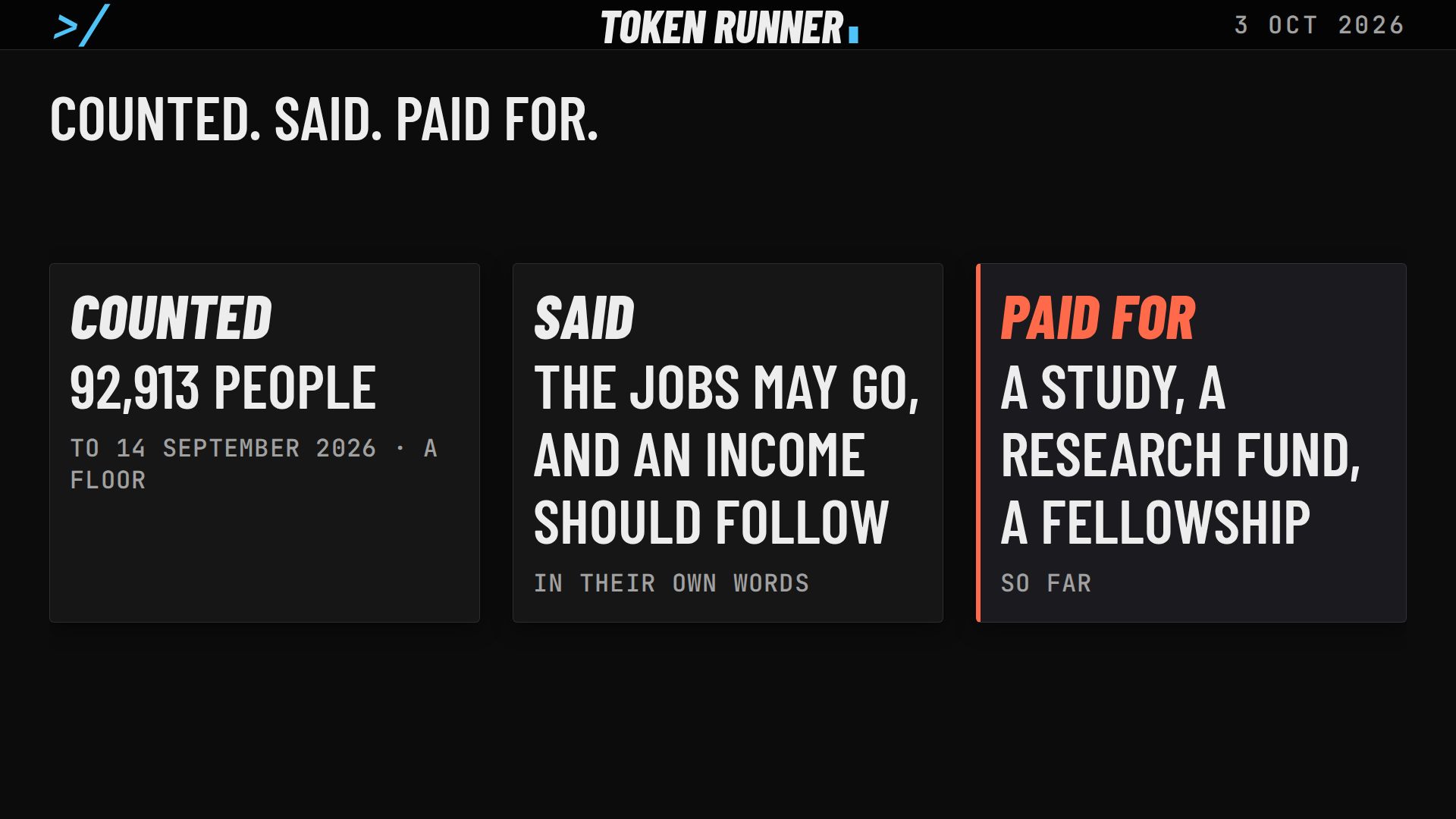
Counted: 93,116 people to 14 September 2026, as a floor, and most of them in six announcements. Said: that the jobs may go, and that an income should follow. Paid for, so far: a study, a research fund and a fellowship. The one payment to people on this list was the study's, to a thousand of them, for three years, ending in 2023. The research fund and the fellowship pay for research and fellowships. Proposed: several taxes, none of them law, and from one company a conditional sentence about a basic income. Watch the gap between what has been said and what has been paid.
Sources
- Layoffs.fyi, the list of layoffs attributed to AI (https://layoffs.fyi/ai-layoffs/), as Token Runner collected it on 2 October and 9 October 2026
- OpenResearch, 'Unconditional Cash Study', the study's own page: https://www.openresearchlab.org/projects/unconditional-cash-study
- Fortune / The Associated Press (Kaitlyn Huamani), 'Anthropic just proposed taxing itself to pay for the jobs its AI destroys', 11 June 2026: https://fortune.com/2026/06/11/anthropic-dario-amodei-ai-jobs-tax-displacement-fund/
- BBC News (Faisal Islam), 'We'll need universal basic income - AI godfather', 18 May 2024: https://www.bbc.co.uk/news/articles/cnd607ekl99o
- Axios, interview with Dario Amodei, 28 May 2025: https://www.axios.com/2025/05/28/ai-jobs-white-collar-unemployment-anthropic
- Euronews (Pascale Davies), 'Life on Mars, honest AI, and a job-free future: Elon Musk opens up at VivaTech Q&A', 23 May 2024: https://www.euronews.com/next/2024/05/23/life-on-mars-honest-ai-and-a-job-free-future-elon-musk-opens-up-at-vivatech-qa
- Fortune (Mia Osmonbekov), 'A new bill would tax AI tokens to fund jobs if the technology causes mass unemployment', 1 September 2026: https://fortune.com/2026/09/01/bill-tax-ai-tokens-fund-jobs-technology-unemployment/
- Senator Mark Kelly (@SenMarkKelly), a post on X, 24 September 2026: https://x.com/SenMarkKelly/status/2103186472077512935
- Adam Thierer (@AdamThierer), a post on X, 24 September 2026: https://x.com/AdamThierer/status/2103262322823209058