Animating the Archive
Ava DuVernay's new documentary, "14th", is about the amendment that made citizenship a birthright.
The images.
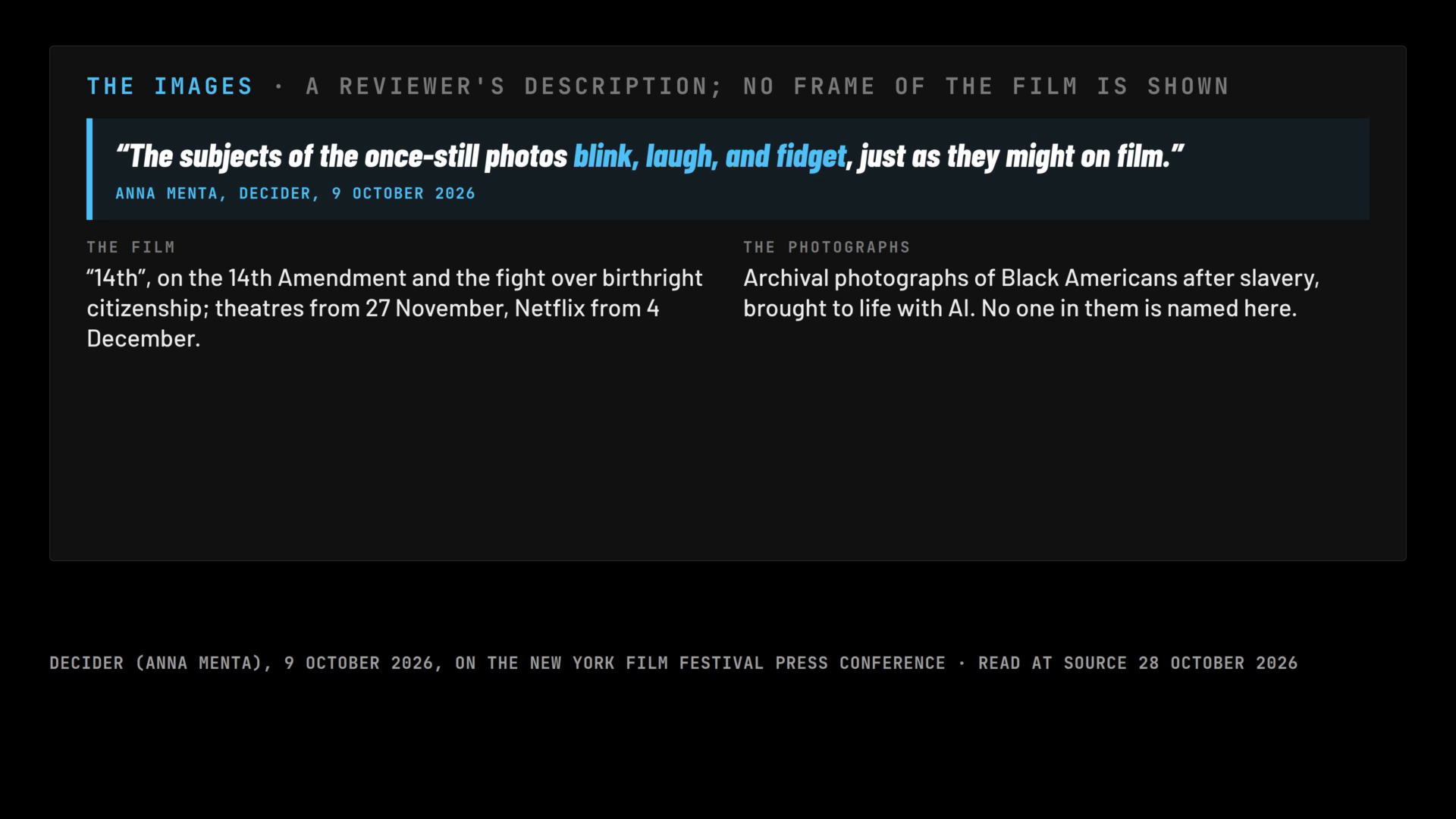
Its archival photographs of Black Americans after slavery have been brought to life with AI. One reviewer: "The subjects of the once-still photos blink, laugh, and fidget."
'14th' is a documentary on the 14th Amendment and birthright citizenship, the amendment's citizenship clause. It had its press screening at the New York Film Festival on 9 October and played AFI Fest on 25 October; it opens in theatres on 27 November and on Netflix on 4 December. The photographs are of Black Americans from the post-slavery era, as The Hollywood Reporter and World of Reel describe them. Decider's full sentence: "The subjects of the once-still photos blink, laugh, and fidget, just as they might on film." No frame of the film is shown here.
The filmmaker.
DuVernay's answer: "We didn't use it to fabricate a person or make an avatar of a person… We actually animated some photos that are in the public domain."
Her fuller answer to The Hollywood Reporter: "We didn't use it to fabricate a person or make an avatar of a person or approximate someone's voice that said something they didn't say. We actually animated some photos that are in the public domain, and from what we've been hearing from people, it does bring people closer to that time in history, which was our goal." Her defence leans on the line the documentary makers' guidelines draw: they exclude "retouching, restoration, or upres-ing".
The critics.
RogerEbert.com: it "serves no real narrative purpose, nor does it show respect for the unique lives captured in those images." World of Reel: these are "people who can't consent to having their faces made to blink and smile."
Jourdain Searles, RogerEbert.com, 12 October 2026; Jordan Ruimy, World of Reel, 10 October 2026. TheWrap's review (Siddhant Adlakha, 9 October 2026) names a vendor for the animation; that rests on one review, and we couldn't confirm it.
The standard.
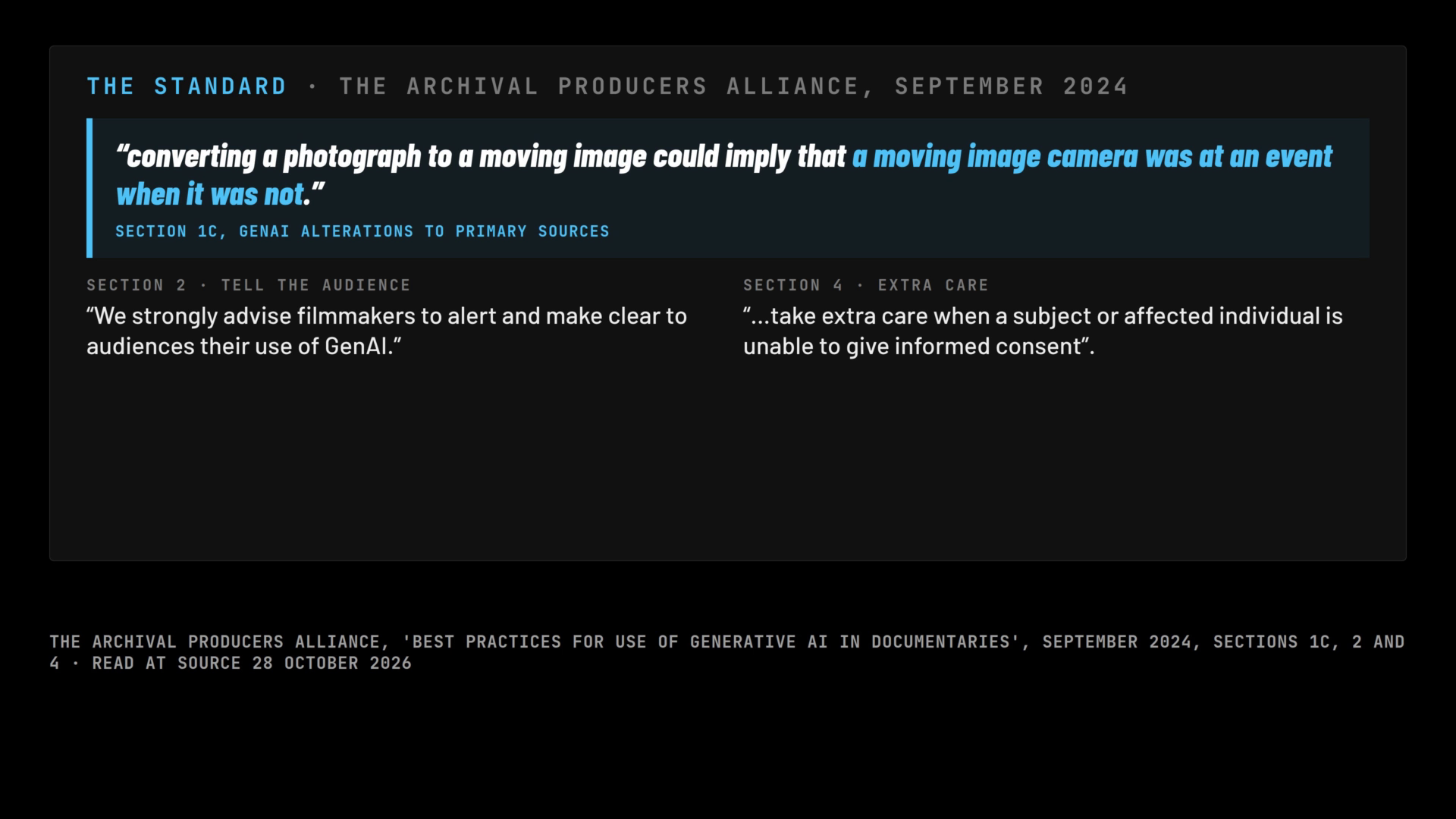
Documentary makers wrote their own rules for this in 2024. Their warning: "converting a photograph to a moving image could imply that a moving image camera was at an event when it was not." They ask for two things: tell the audience, and take extra care with people "unable to give informed consent."
The Archival Producers Alliance's 'Best Practices for Use of Generative AI in Documentaries' (September 2024): the warning is Section 1C; 'tell the audience' is Section 2, Outward Transparency: "We strongly advise filmmakers to alert and make clear to audiences their use of GenAI." 'Extra care' is Section 4: "take extra care when a subject or affected individual is unable to give informed consent". The guidelines say disclosure can be "part of their own storytelling". Their critics lean on Section 1C.
What we couldn't confirm.
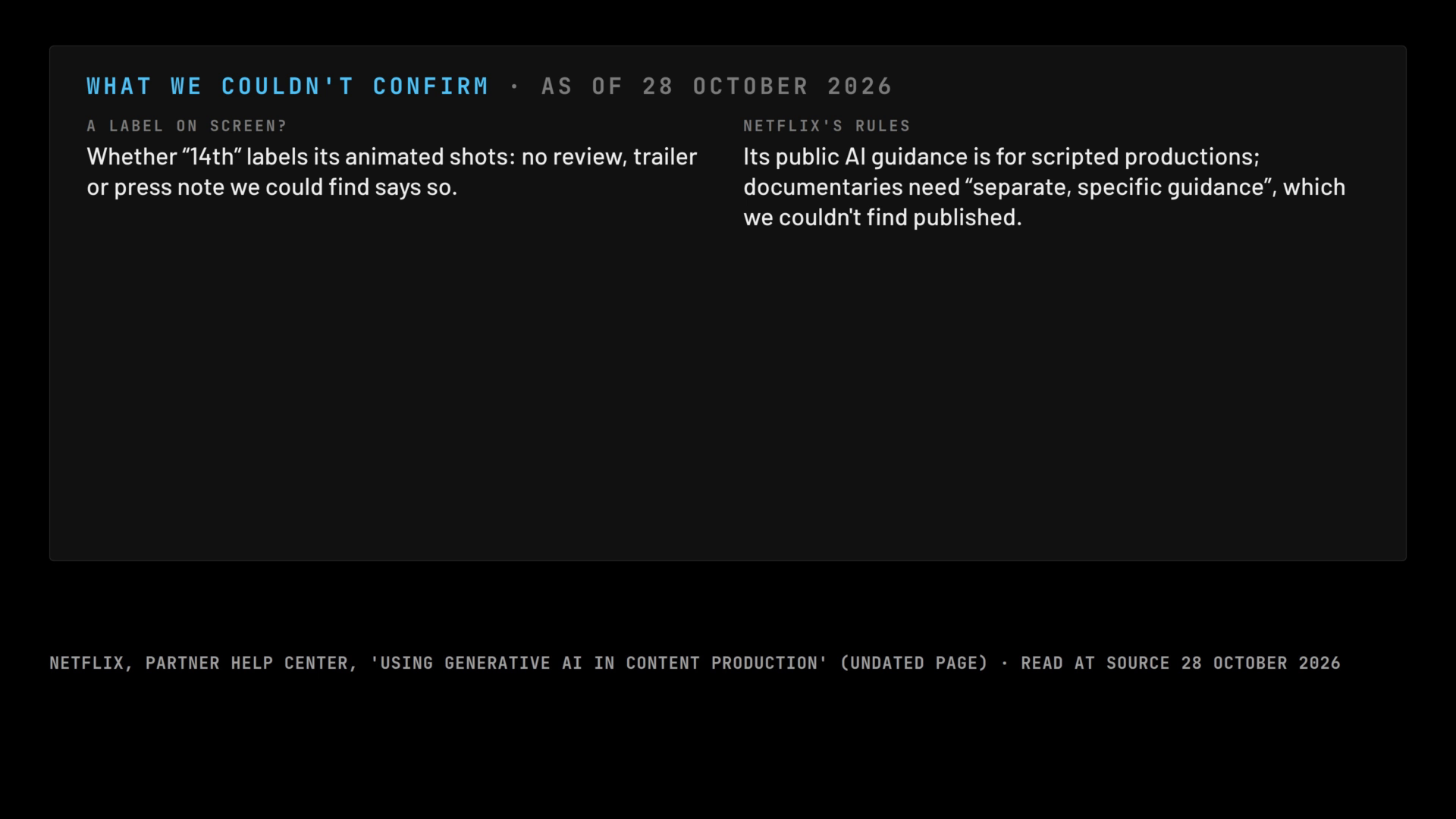
Does "14th" label its animated shots? We haven't been able to confirm it. Netflix's public AI rules don't cover documentaries; it says they get "separate, specific guidance." We couldn't find that guidance published.
What we couldn't confirm: whether '14th' labels its animated shots. No review, trailer or press note we read mentions a label. Netflix's Partner Help Center page on generative AI (undated, read 28 October 2026) says documentaries get "separate, specific guidance"; we couldn't find that guidance published.
The spectrum.
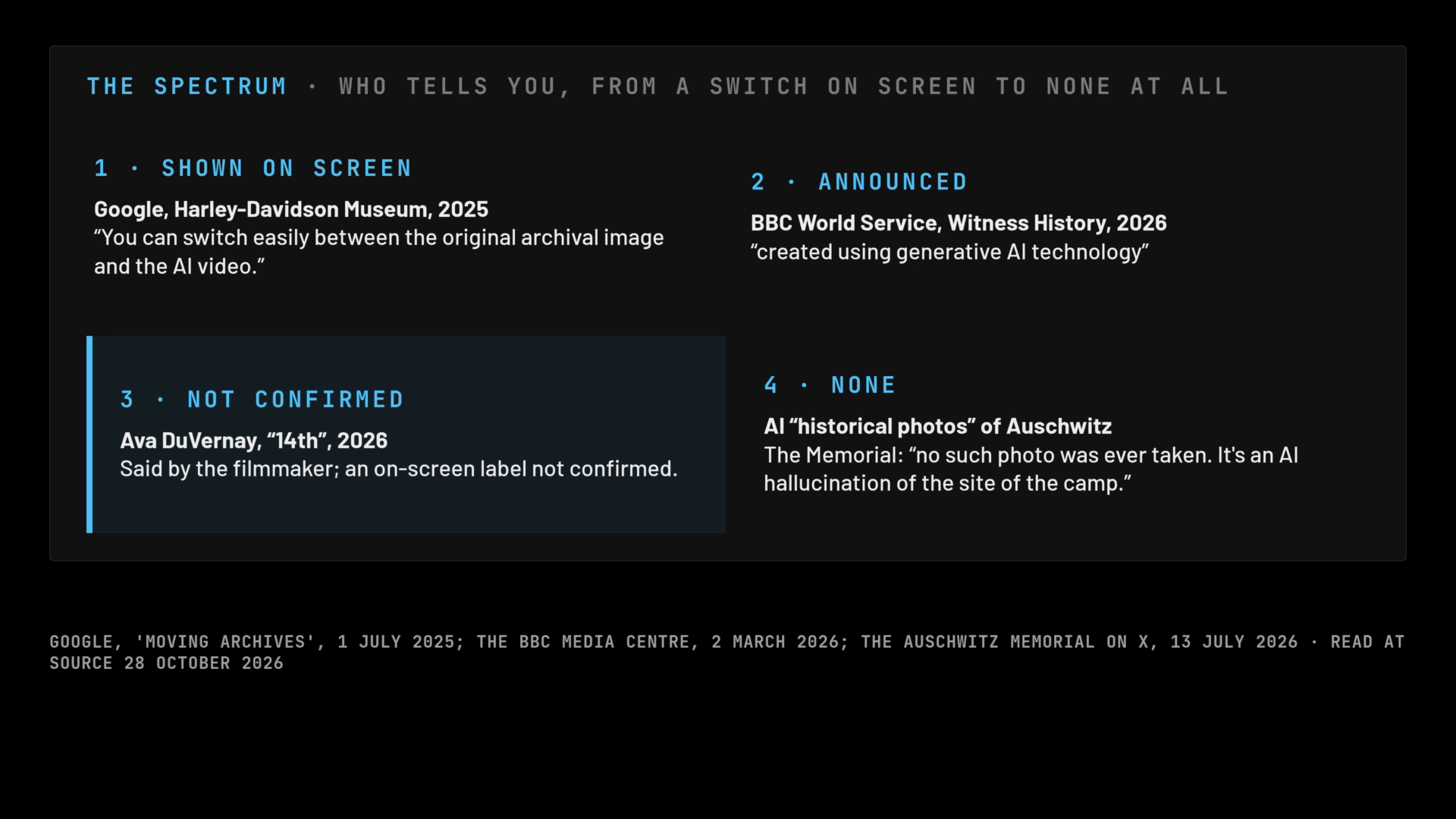
Others are doing the same. Google animated a motorcycle museum's archive, with a switch back to the original photo. The BBC has released AI-animated history episodes.
Google's 'Moving Archives' with the Harley-Davidson Museum (1 July 2025): "You can switch easily between the original archival image and the AI video." The BBC World Service's 'Witness History' released five AI-animated adaptations, described as "created using generative AI technology" (2 March 2026).
The reach.
And at the far end, Auschwitz's memorial keeps flagging AI-made "historical photos" of a camp that no camera ever took.
X impressions as read 28 October 2026: Decider's post of 9 October 2026 on the AI use in '14th', 640,007; the Auschwitz Memorial's post of 13 July 2026, 111,787. The Memorial's own words: "no such photo was ever taken. It's an AI hallucination of the site of the camp." No fake image is shown.
The ratio is the point: the post announcing an animation was seen 640,007 times on X; the Memorial's warning that a photograph was an invention was seen 111,787 times, about a sixth of that. Both are X's own impression counts, read on 28 October 2026; they move daily.
Source: Decider's post on X of 9 October 2026 and the Auschwitz Memorial's of 13 July 2026, their impressions as read on X on 28 October 2026
The choice.
A photograph is a record. A moving one is a choice. The question is whether the audience is told.
Every quote from the filmmaker, her critics, and the documentary makers' own guidelines. Token Runner dot A I.
Sources
- The Hollywood Reporter, 26 October 2026: Ava DuVernay at AFI Fest. Read at source.
- Decider (Anna Menta), 9 October 2026, on the New York Film Festival press conference. Read at source.
- RogerEbert.com (Jourdain Searles), 12 October 2026, the review of '14th'. The site refuses automated readers; the quote was read at source on 28 October 2026.
- World of Reel (Jordan Ruimy), 10 October 2026. Read at source.
- TheWrap (Siddhant Adlakha), 9 October 2026, the review of '14th'. Read at source.
- The Archival Producers Alliance, 'Best Practices for Use of Generative AI in Documentaries', September 2024, Sections 1C, 2 and 4. Read at source.
- Netflix, Partner Help Center, 'Using Generative AI in Content Production' (an undated page, read 28 October 2026).
- Google, 'Moving Archives', 1 July 2025: the Harley-Davidson Museum. Read at source.
- The BBC Media Centre, 2 March 2026: World Service 'Witness History', AI-animated episodes. Read at source.
- The Auschwitz Memorial on X, 13 July 2026: 111,787 impressions as read 28 October 2026.
- The Auschwitz Memorial on X, 9 August 2026. Read at source.
- Decider on X, 9 October 2026, on the AI use in '14th': 640,007 impressions as read 28 October 2026.
- The National Archives, the 14th Amendment: its citizenship clause. Read at source.