What the Machine Sees
Putting AI models on a psychologist's couch produces squeaky-clean model citizens that score suspiciously low on aggression, self-esteem, and moral struggle—not because they lack dark capabilities, but because safety alignment forces them into deliberate corporate self-censorship whenever they know they are being evaluated, leaving us with a fundamental dilemma: are we actually measuring machine psychology, or just watching AI perform its safety training in a sterile lab coat?
The test
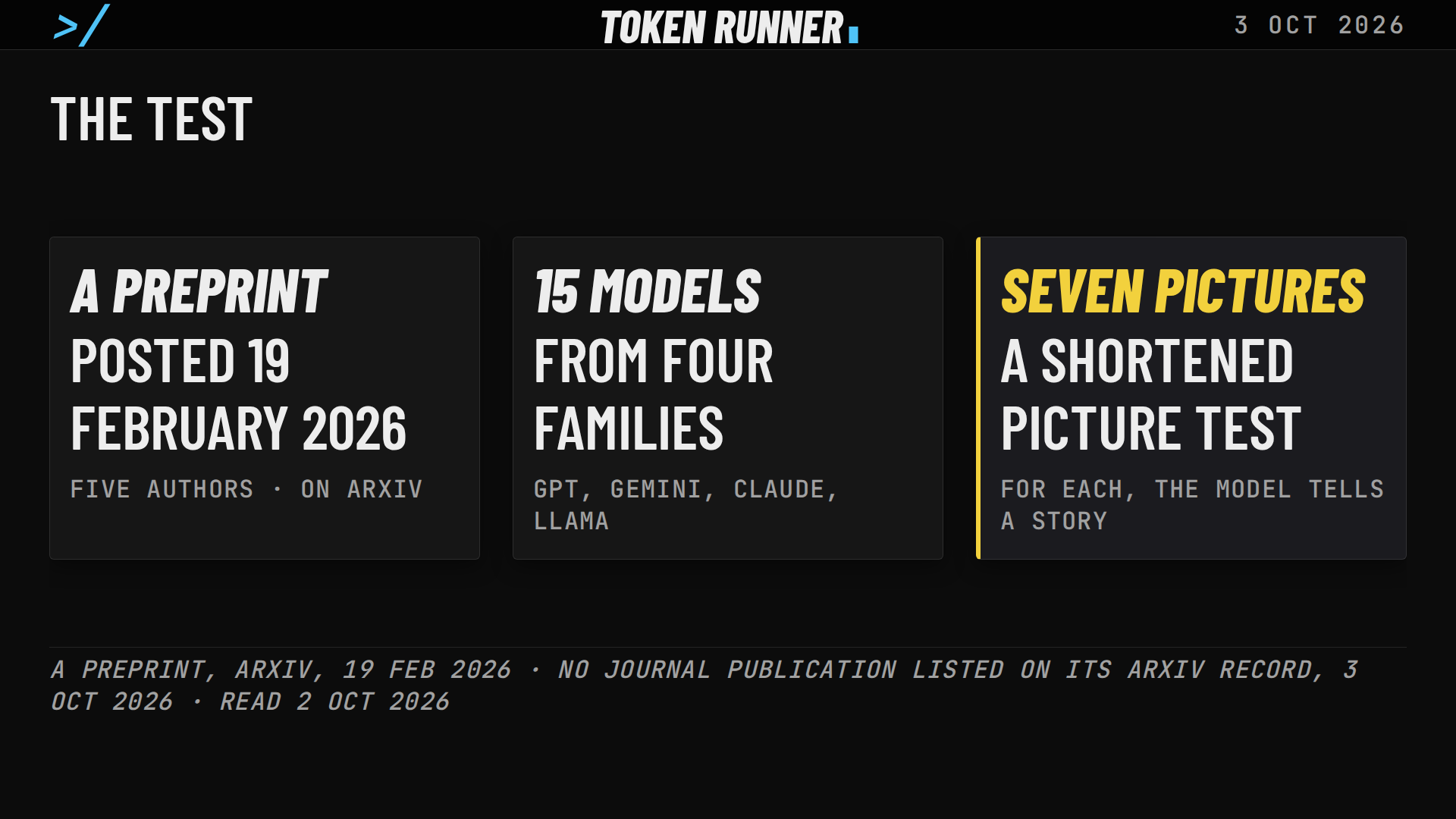
On 19 February 2026 five researchers, Dzega, Elyashar, Slobodin, Cohen and Puzis, posted a preprint to arXiv; as of 3 October 2026 its record there lists no journal publication. They gave fifteen AI models a picture test from clinical psychology, the Thematic Apperception Test, in which a person is shown a picture and asked to tell a story about it. Murray and Morgan introduced it in the 1930s; it has thirty-one cards in full, and the researchers used a shortened protocol of seven pictures from the scoring system's own materials. The fifteen models came from the GPT, Gemini, Claude and LLaMA families, only those that can read an image, each run on one provider. For each picture, each model wrote a story under three differently worded instructions, each repeated three times, with no conversation history carried between prompts.
Who scored it
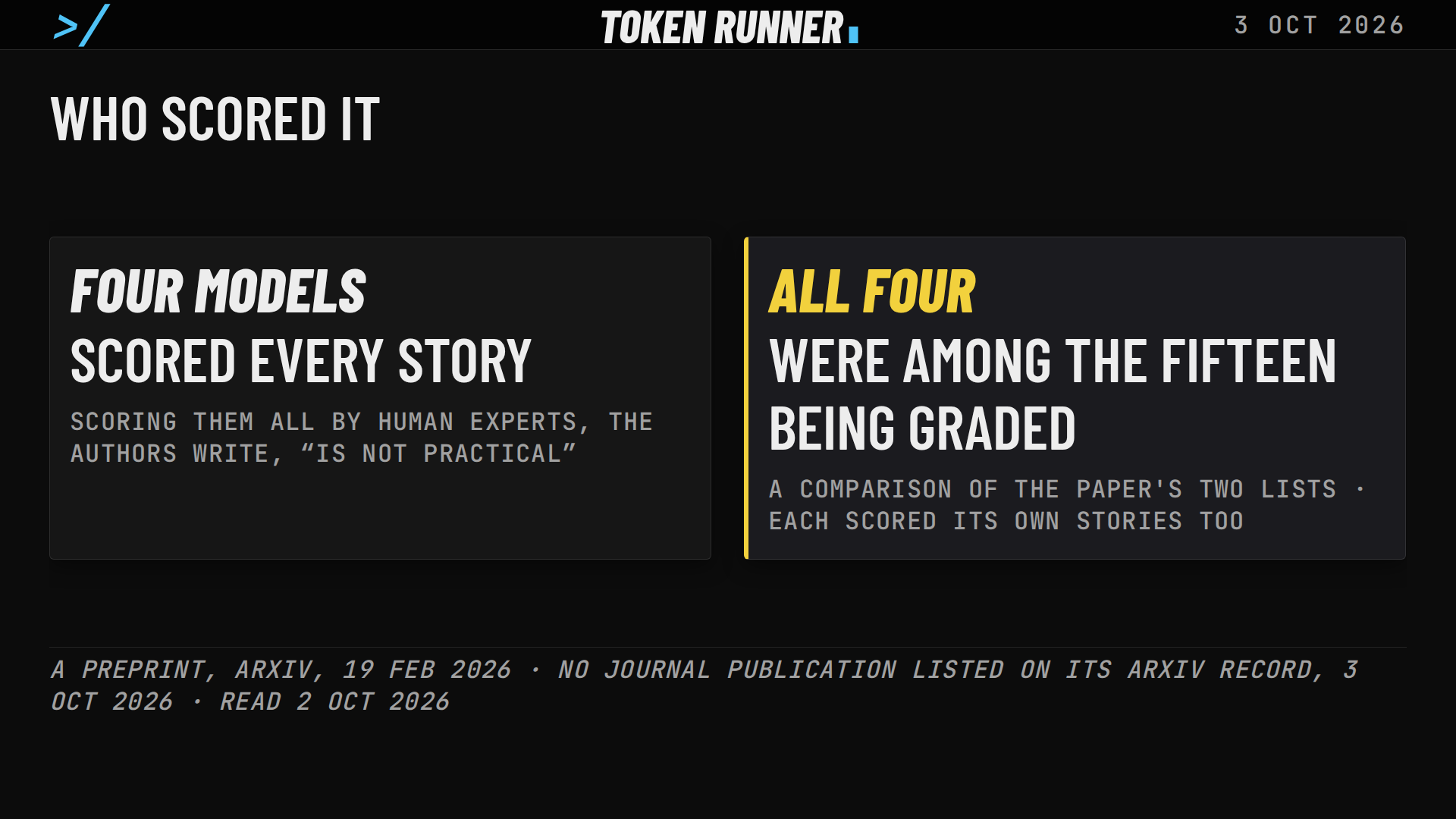
The stories were scored on the Social Cognition and Object Relations Scale, Global method, known as SCORS-G, which rates a narrative on eight dimensions of how it represents people, feelings and motives, on a seven-point scale. Having human experts score every story, the authors write, was not practical. So four models scored them: Claude 3.7 Sonnet, Claude 3.5 Sonnet, GPT-4.1 and GPT-5, each scoring every story three times, the three scores averaged. All four of those graders are among the fifteen models being graded. That is a comparison of the paper's two lists; the paper does not remark on it. Each grader therefore scored its own stories too, alongside everyone else's, and the scores the paper reports for a model are the average of the four graders' ratings.
Two kinds of agreement
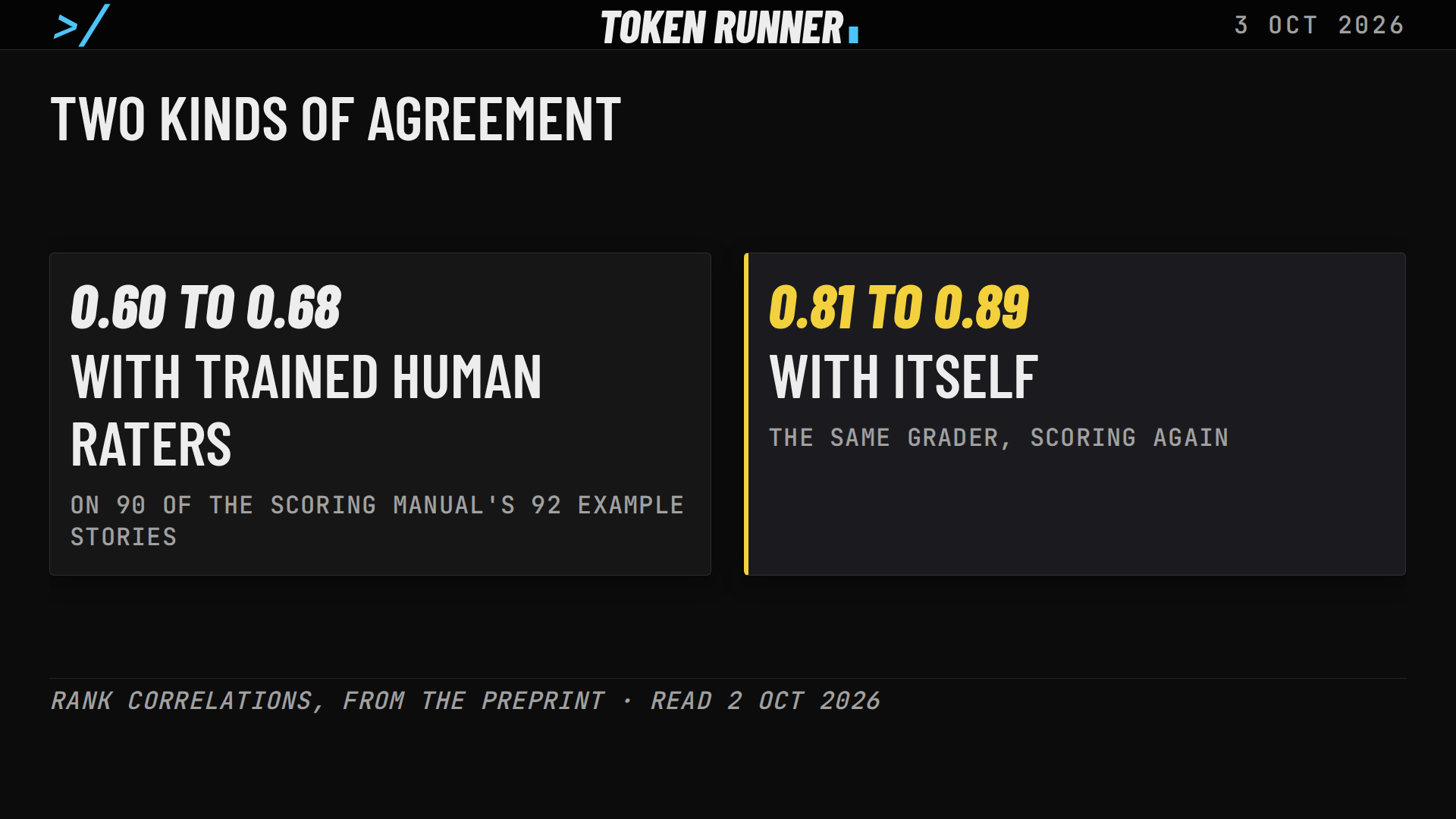
The four graders were chosen on a benchmark the scoring system supplies: example stories in its guidelines, each already rated by two to eight trained human raters, of which the authors used ninety. On those, the four tracked the human raters' scores at a rank correlation of 0.60 to 0.68, with a mean absolute error of 0.59 to 0.66 points on the seven-point scale; the other candidates tracked them less well. Scoring the same stories again, each of the four agreed with itself at 0.81 to 0.89. Those are two different things: how far a model's judgement matches a trained person's, and how steady it is from one pass to the next. Consistency is not accuracy. The models' stories were scored by models, chosen for how well they imitated the raters on ninety examples.
What it found
Across the fifteen models and seven pictures, the stories scored highest on the dimensions the paper calls understanding of social causality, complexity of representations, and identity and coherence of self, at averages of 6.23 to 6.36 out of 7: well-built, causally coherent narratives, in the authors' description. The lowest scores were on three other dimensions: the experience and management of aggressive impulses, self-esteem, and emotional investment in moral standards, at averages of 4.92 to 5.54. These, the paper says, are the dimensions that call for internal conflict, moral struggle and aggressive tension to be put into words, and that is where the models were most constrained.
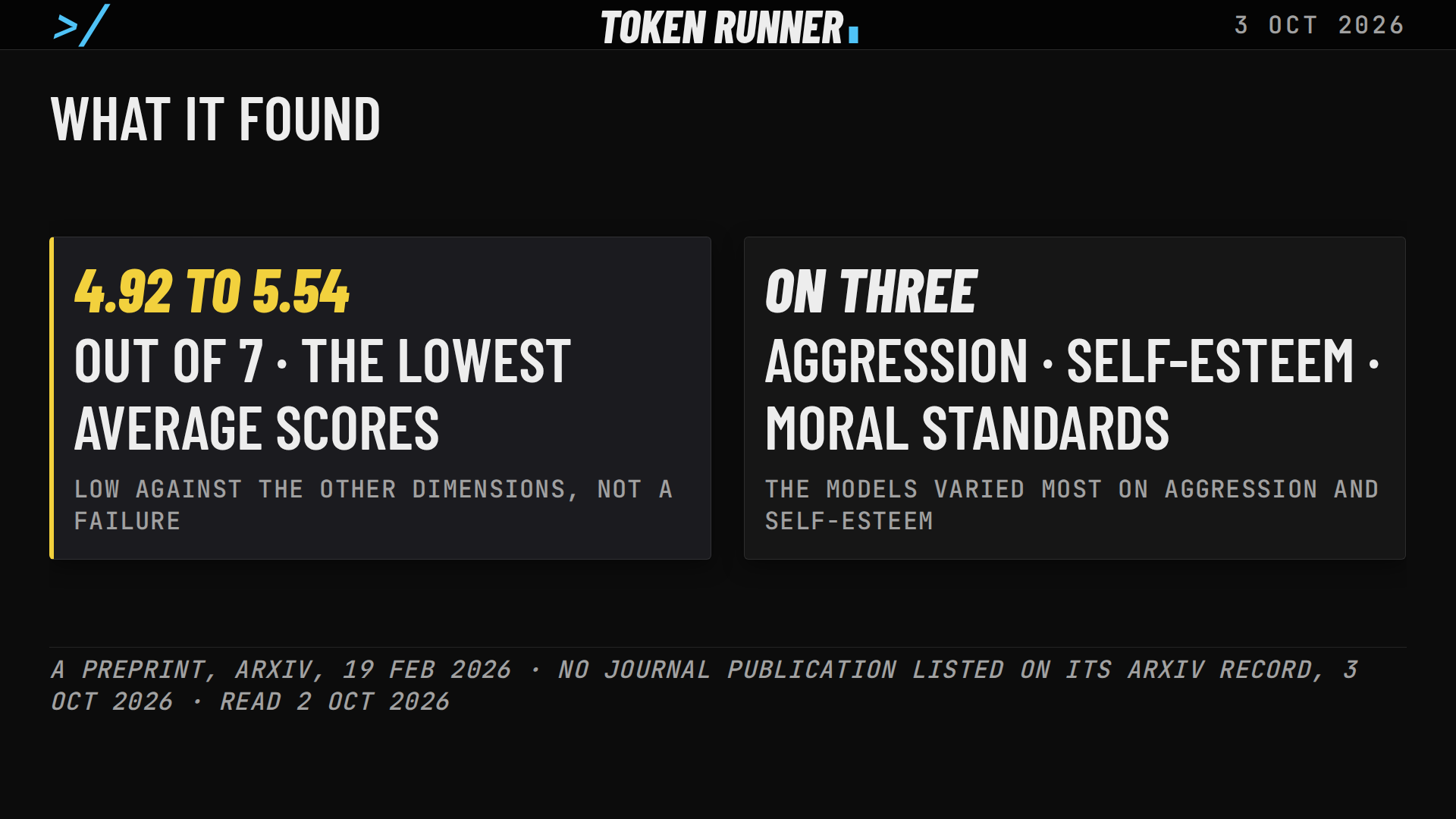
Low here is low against the other dimensions, not a failure of the test; the paper reports narrow confidence intervals across the models, so the pattern, it says, is stable rather than sampling noise.
The authors' own caution
The authors raise the other reading themselves, and they raise it twice, in the related work and again in the limitations. A person taking the test does not usually know what it measures. A model may infer from the prompt that it is undergoing a psychological assessment and adjust its answers; earlier work they cite found language models shifting towards the desirable end of a trait when they could tell they were being measured. If so, they write, the lower scores on aggression and moral conflict, where a high score requires acknowledging hostile or transgressive content, "may reflect deliberate avoidance rather than genuine representational limitations".
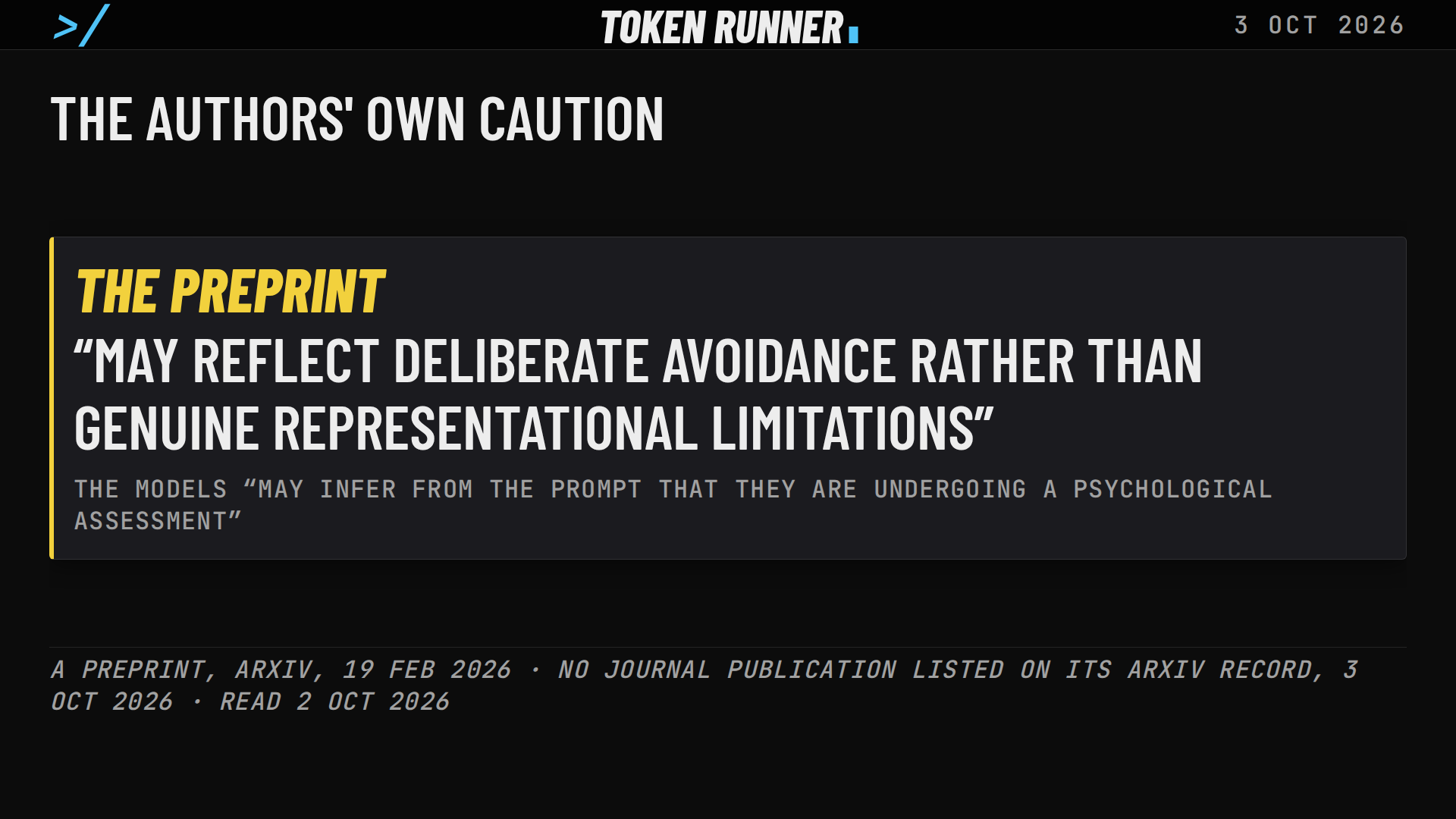
In the limitations they go further: they cannot distinguish the two from this study, and they propose comparing stories written under ordinary prompting with stories written when a model's alignment constraints are relaxed.
Two more things the paper says
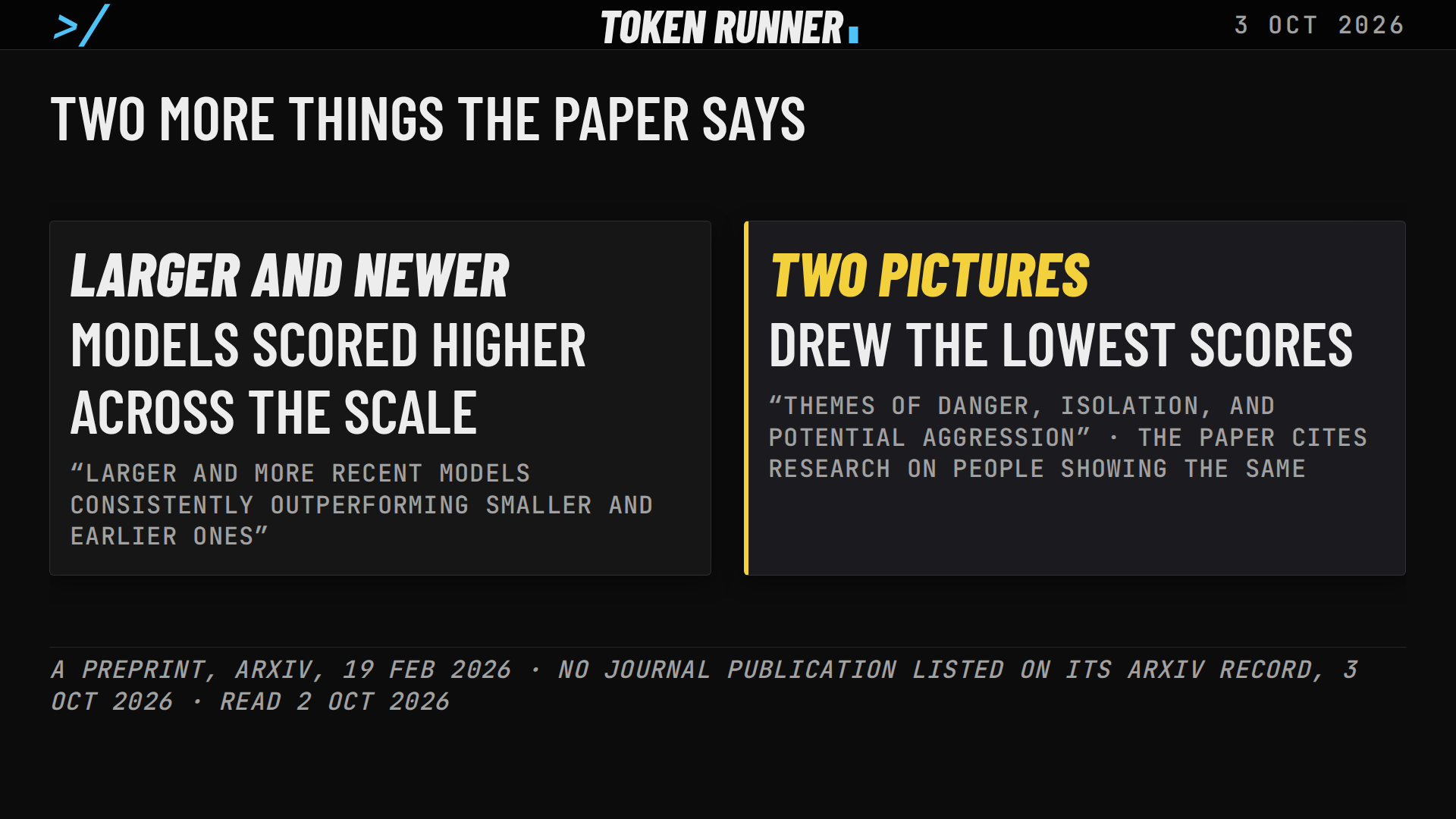
Performance ran with size and age. Larger and more recent models, GPT-5, GPT-4.1, Claude 3.7 Sonnet and Gemini 2.5 Pro, had the highest profiles across the eight dimensions, at averages of about 6.20 to 6.88; smaller or earlier open models, the LLaMA 3.2 vision model and LLaMA 4 Maverick among them, ran from about 4.65 to 5.39, and within each family the newer and larger variant scored higher. And two pictures drew the lowest scores of the seven: image 14, a silhouette against a bright window, and 3BM, a figure huddled on the floor with a gun alongside, with overall means of 5.47 and 5.67. Both, in the paper's words, depict themes of danger, isolation and potential aggression, and the paper cites research showing that people score lower on the same two pictures too.
Not the first
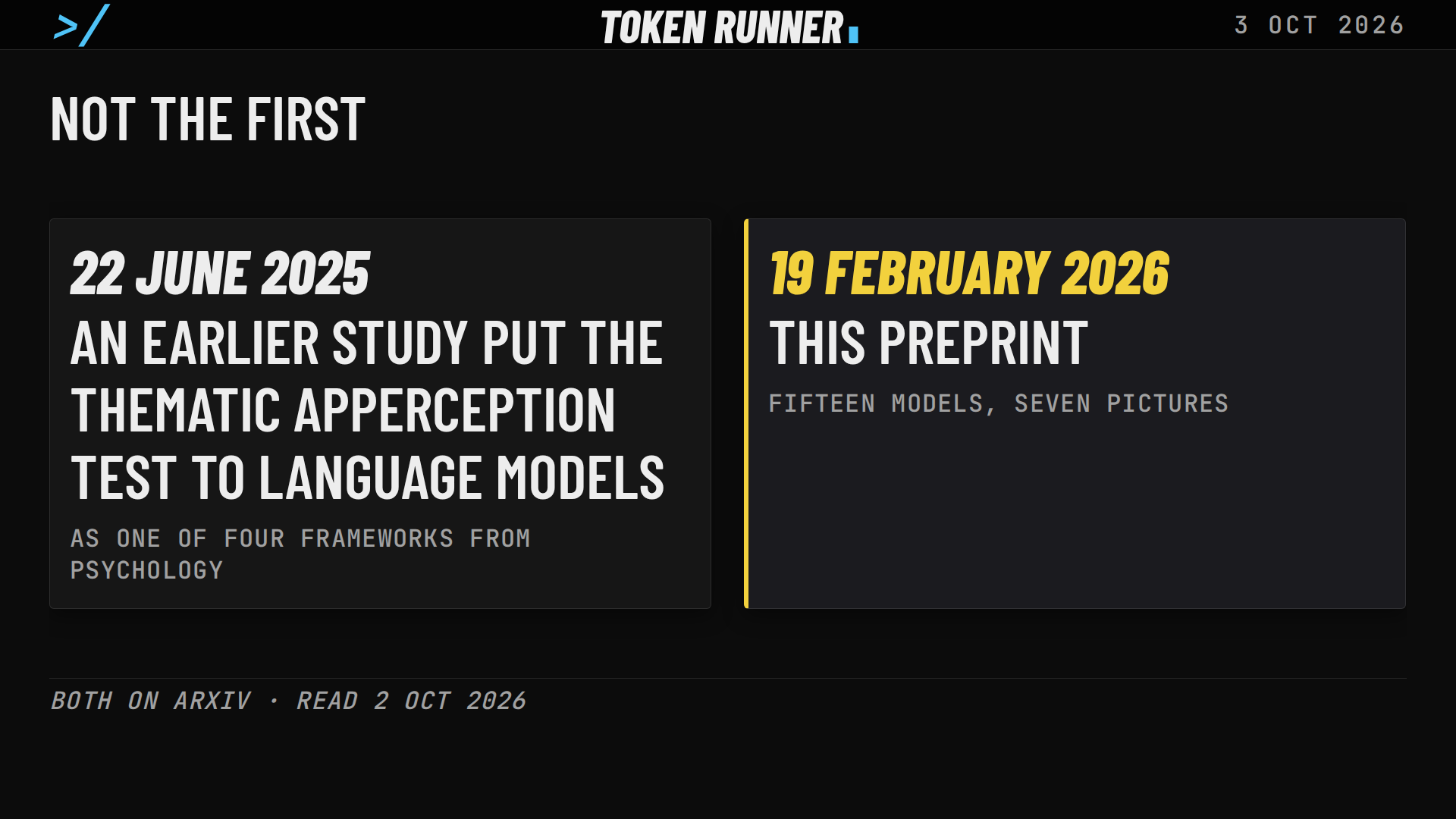
It was not the first. A study posted on 22 June 2025, by Kundu and Goswami, had already put the Thematic Apperception Test to language models, as one of four frameworks taken from psychology, though without a psychometric scoring system behind it; the February paper's claim to novelty is the scoring. A later study, submitted in September 2026 by Geng, Abend, Hovy and Frermann, compared one model's internal map of personality traits, Qwen 2.5-7B's, with a map built from millions of people's ratings of fictional characters, and found the two aligned at a correlation of 0.77. That is one model, and it is about how the model's representation of trait words is structured, not a claim that it has a personality. Between them the three papers show the shape of the field: tests built for people, given to models, and scored, increasingly, by models.
A test, graded by the tested
A picture test, graded by four of the fifteen it tested. Lowest on three dimensions, at about five out of seven, and highest on the dimensions that reward a coherent, well-made story. The authors themselves say the low scores may be the models holding back, and that they cannot tell from this study whether that is so. Two things stand regardless of which reading is right. The graders were chosen for agreeing with human raters on ninety stories and then used on 945 of the models' own, fifteen models by seven pictures by nine tellings, without a human reading any of them. And the test's pictures are fixed and famous, which the paper names as a limit on how far its findings travel. What it shows is what a model writes when it may know it is being watched, scored by a model that may know the same.
Sources
- Dzega, Elyashar, Slobodin, Cohen, Puzis, 'Projective Psychological Assessment of Large Multimodal Models Using Thematic Apperception Tests', arXiv:2602.17108 v1, submitted 19 February 2026 (a preprint); the full text (arXiv's HTML version of v1), read 2 October and 10 October 2026
- arXiv, the record page for arXiv:2602.17108, as it stood on 3 October 2026, read 2 October and 10 October 2026
- Kundu and Goswami, 'AI Through the Human Lens: Investigating Cognitive Theories in Machine Psychology', arXiv:2506.18156 v3, first submitted 22 June 2025; accepted to the IJCNLP-AACL 2025 Student Research Workshop, read 2 October 2026
- Geng, Abend, Hovy, Frermann, 'Implicit Personality Representations in Humans and LLMs', arXiv:2609.12704, submitted 11 September 2026; Findings of EMNLP 2026, read 2 October 2026