The Paper Flood
AI is now in the writing of science and in the reviewing of it. Three measures say so, and none of them measures the same thing. One of them we can count ourselves, and it moved a long way between January and August of 2026.
The gauge
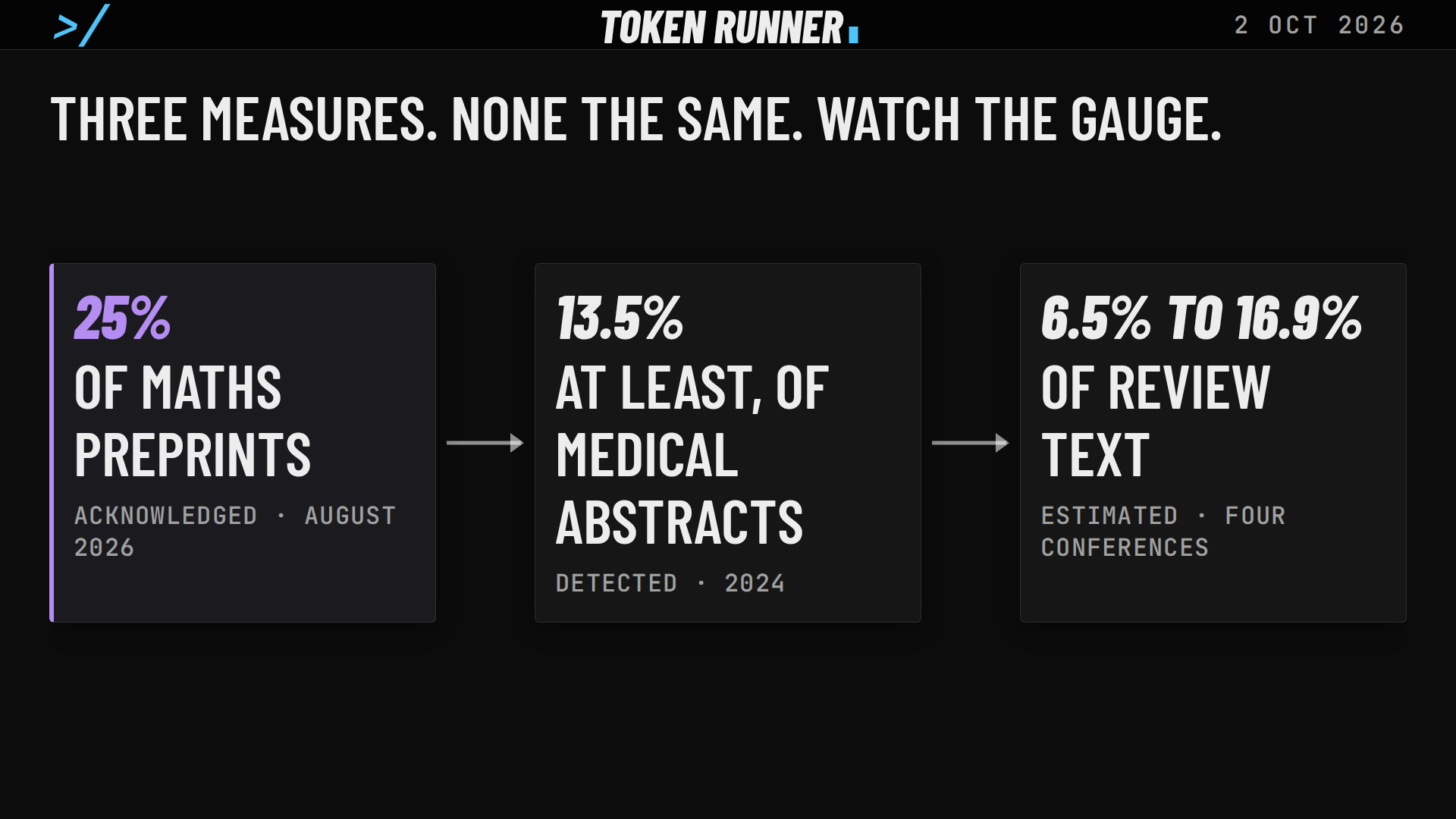
Start with the one thing that can be counted here month by month. In January 2026, 1.9 per cent of new mathematics preprints on arXiv acknowledged using AI: 70 of 3,618. In August it was 26.0 per cent, 1,583 of 6,077, and in September, the newest month in the file, 38.1 per cent: 3,012 of 7,899. The film above was made a week earlier, when August was the newest month and stood at 25 per cent; the file has since added to August and added September. That is Epoch AI's count of what authors themselves say in their papers. It is not a measure of how much of a paper AI wrote, and an author who used it and said nothing is not in it. The newest month may be added to again, as August was.
Field by field
The whole hides a spread. In September 2026 the share ran from 54.0 per cent in Combinatorics, which arXiv files as math.CO, to 18.5 per cent in Numerical Analysis, math.NA. Between them: Differential Geometry (math.DG) 50.2, Algebraic Geometry (math.AG) 45.8, Number Theory (math.NT) 39.7, Probability (math.PR) 37.3, Functional Analysis (math.FA) 35.5, Dynamical Systems (math.DS) 31.6, Analysis of PDEs (math.AP) 30.6 and Optimization and Control (math.OC) 26.3. Every one of the ten was below 5 per cent in January; Combinatorics was 2.2. These are arXiv's own subject names, and only subfields with 200 or more preprints in the month are shown, because a small field swings on a handful of papers. The same ten clear that bar in August and in September.
The conversation
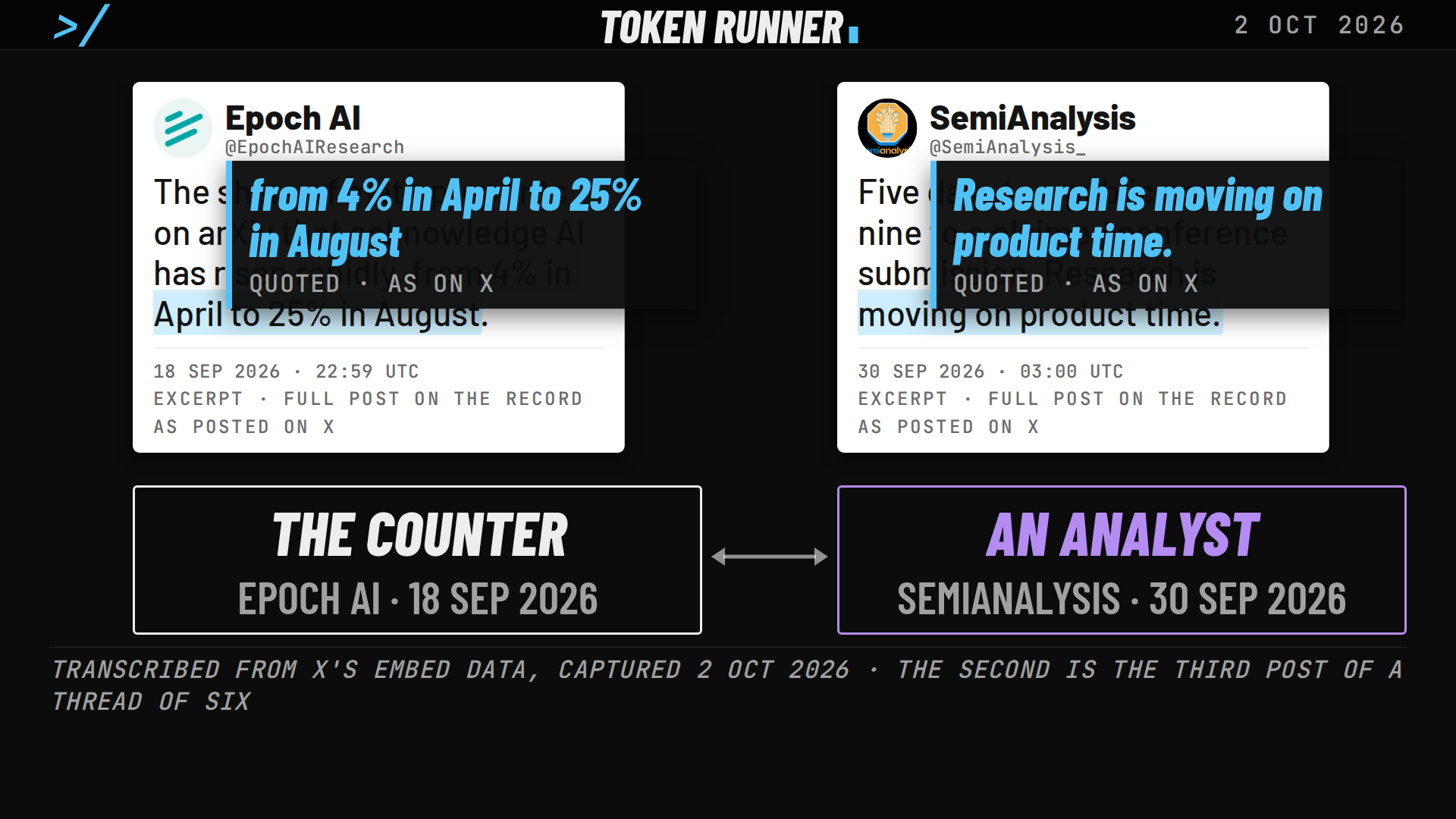
Epoch AI said it in public on 18 September 2026: "The share of math preprints on arXiv that acknowledge AI has risen rapidly, from 4% in April to 25% in August. This increase holds even when filtering to papers with at least one author who published regularly before 2023." That is the counter describing its own count, so it is one source and not a second one; its second sentence says the rise is not only newcomers. A second voice is about speed. On 30 September the analyst firm SemiAnalysis wrote that it had seen a product launch become a paper in five days and a claimed conference submission in nine. "Research is moving on product time," it wrote. It is one firm's account of one product.
The abstract
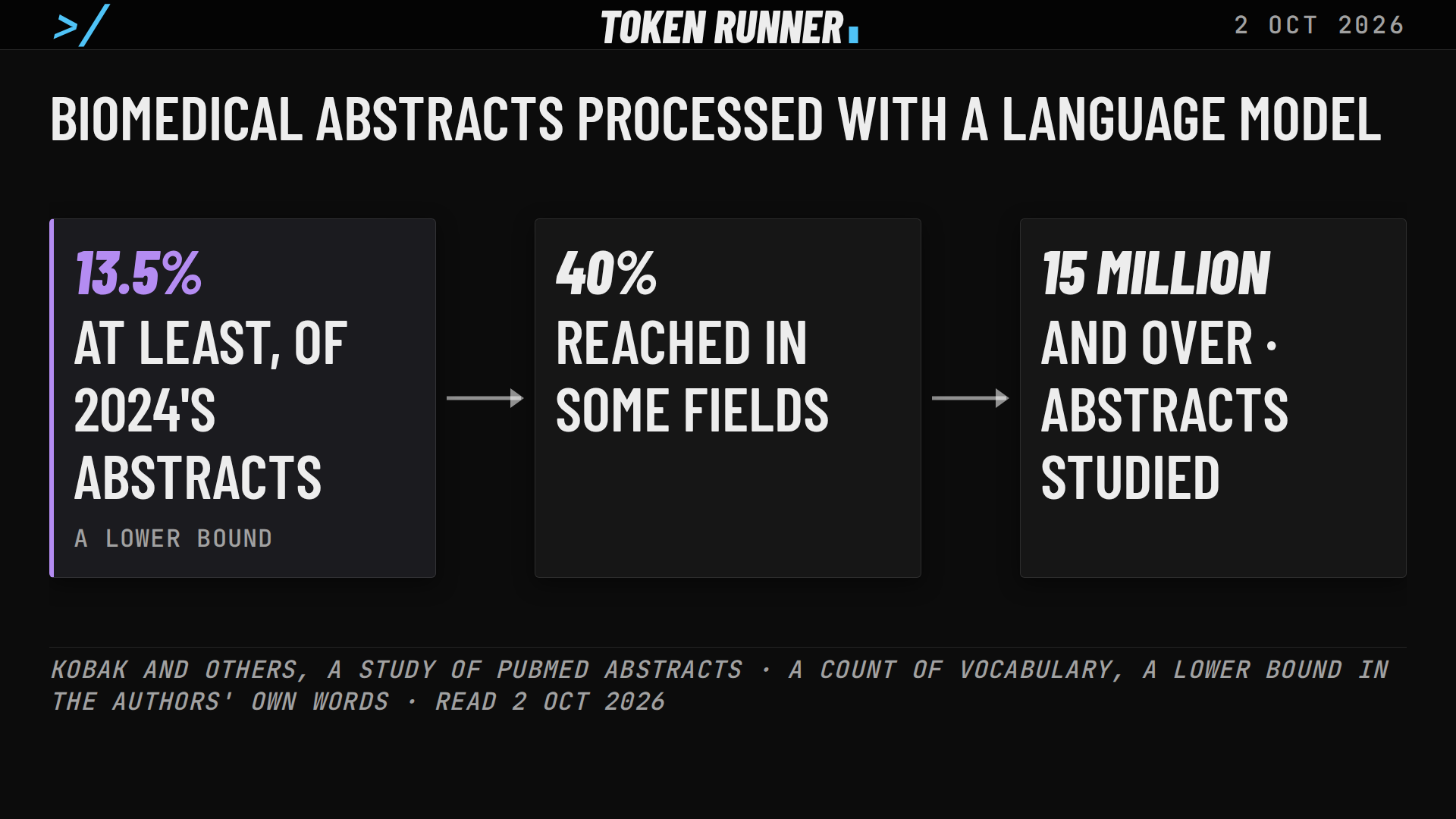
In medicine the trace is older, and it was found a different way. A study of over 15 million abstracts indexed by PubMed from 2010 to 2024 looked for the vocabulary that language models favour, and found that at least 13.5 per cent of the abstracts from 2024 were processed with one. In some fields, countries and journals the same count reached 40 per cent. The authors call their figure a lower bound: it catches the writing that shows, not the writing that does not. Set beside the mathematics it is a different field, a different year and a different method. One is what authors admit; the other is what their words give away.
The review
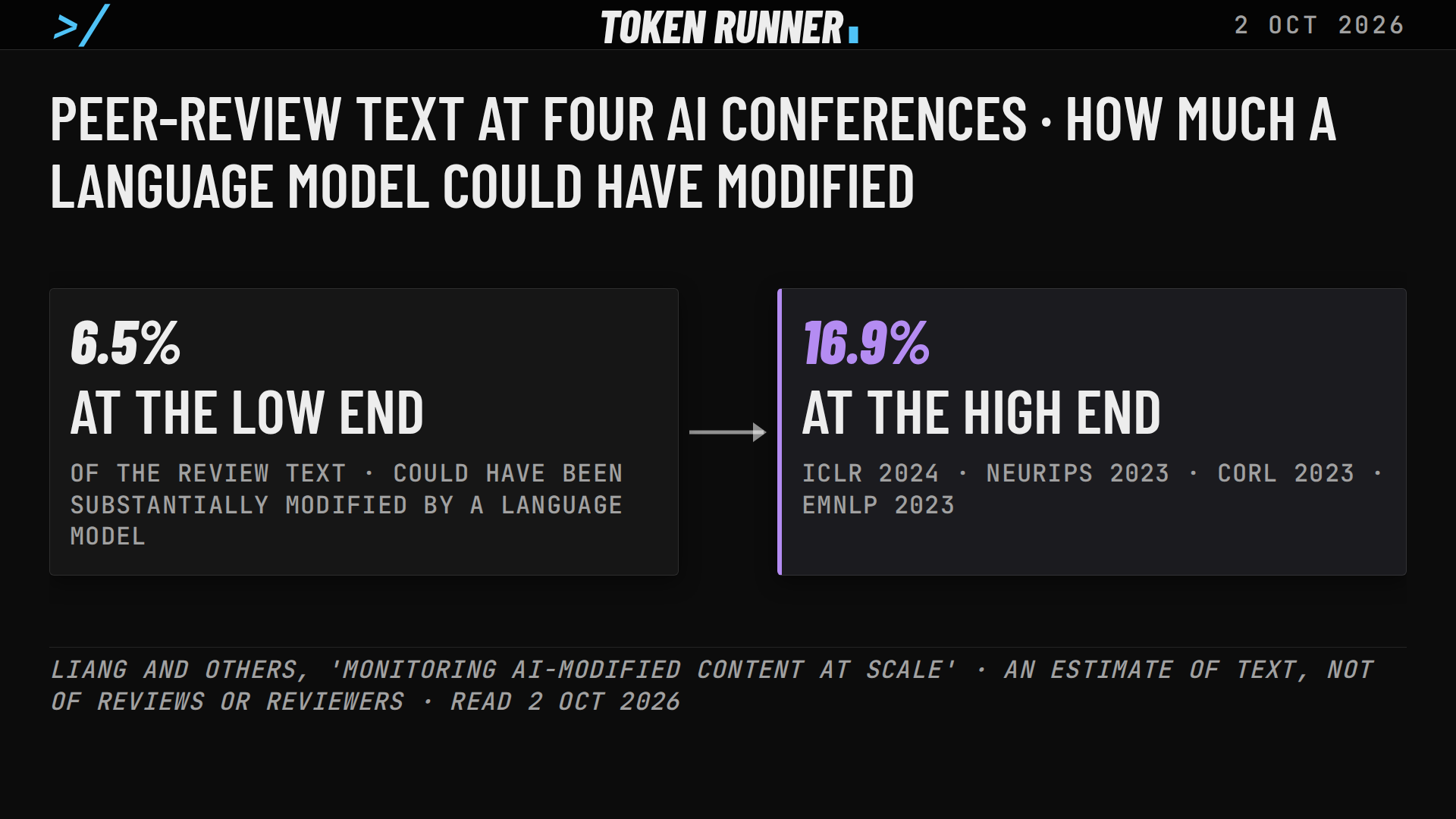
And it is in the reviewing. At four AI conferences, ICLR 2024, NeurIPS 2023, CoRL 2023 and EMNLP 2023, between 6.5 and 16.9 per cent of the peer-review text could have been substantially modified by a language model, by one study's estimate. The two figures are one range and belong together. It is a share of the words in the reviews. It does not say how many reviews were touched, or how many reviewers, and "could have been substantially modified" is the study's own careful phrase for what its method can and cannot see. This is the third measure, and again it is not the same kind of thing as the first two.
The retractions
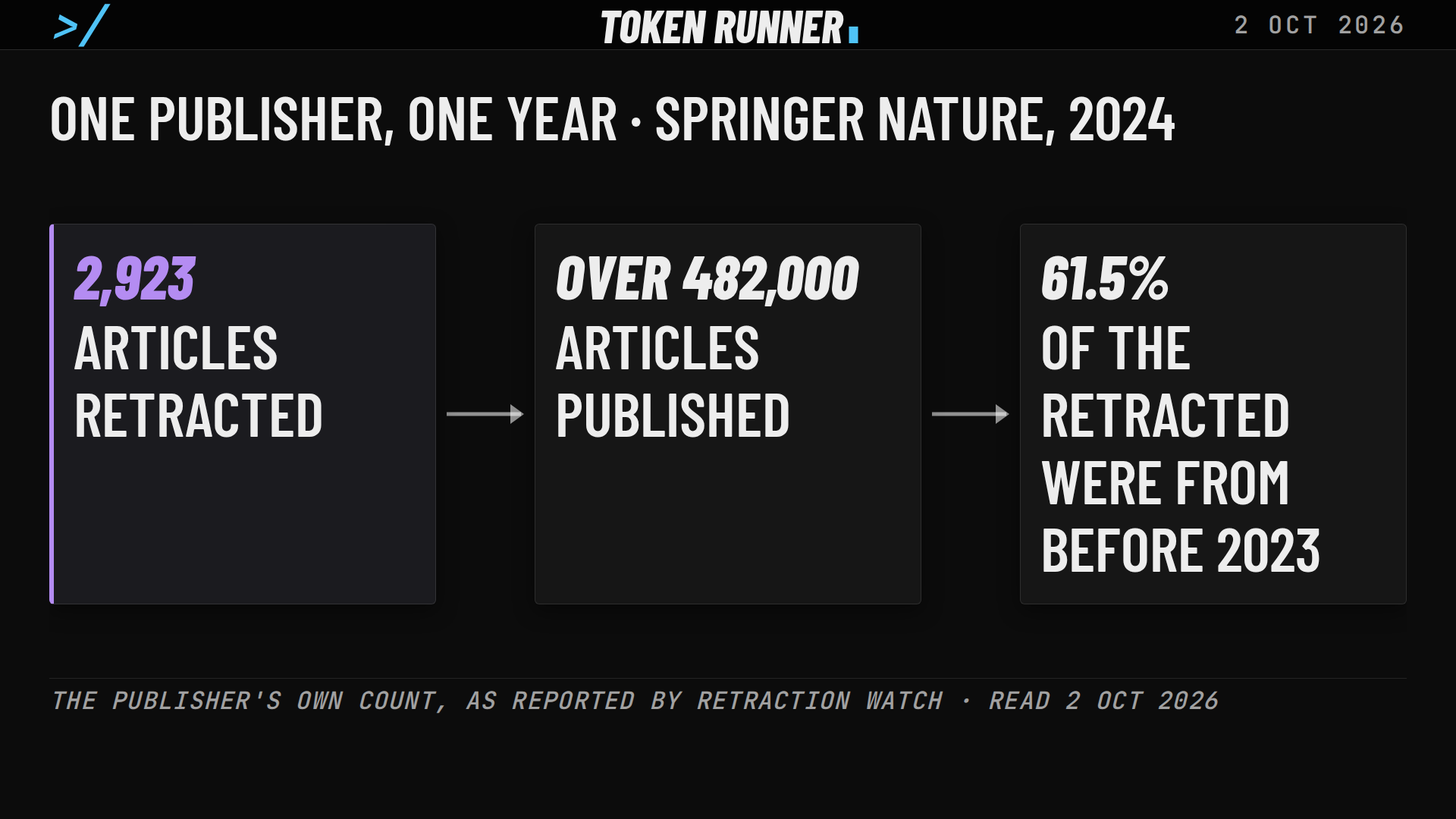
Does it show as bad science? One publisher, Springer Nature, retracted 2,923 articles in 2024, a year in which it published over 482,000, by its own count as Retraction Watch reported it. That is about 0.6 per cent; the division is Token Runner's. Most of those retractions, 61.5 per cent or 1,797 articles, were of papers published before 2023. Retraction lags publication, so a year's retractions say more about the papers of earlier years than about the tools of this one. Nothing in the count ties a retraction to AI, and this article does not.
The same kind of tool, the other way
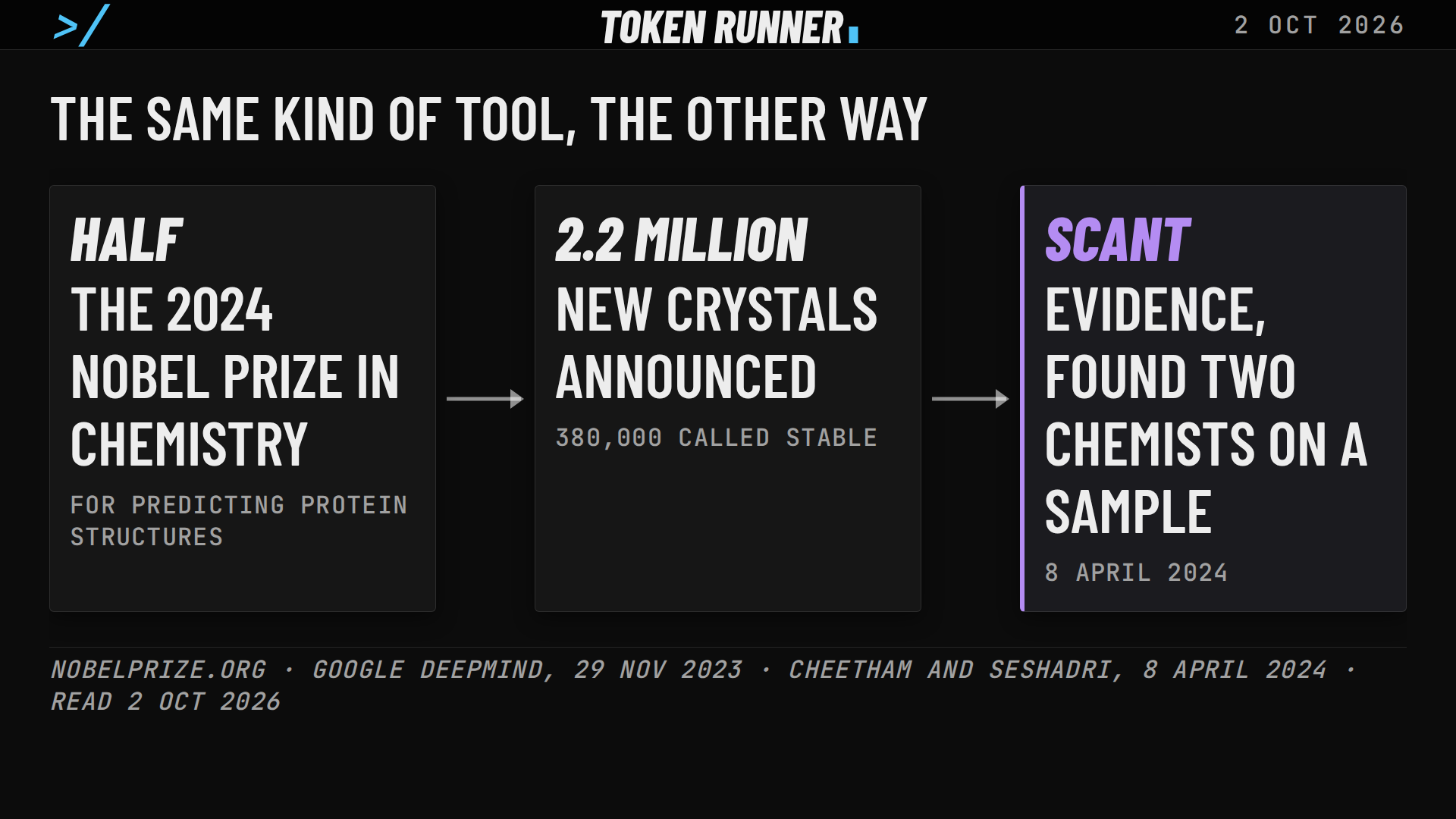
The same kind of tool has also done science that stands. Half of the 2024 Nobel Prize in Chemistry went to Hassabis and Jumper, of Google DeepMind, for predicting the structures of proteins; the other half went to Baker for computational protein design. And the same lab announced 2.2 million new crystal structures on 29 November 2023, 380,000 of which it called stable. A little over four months later two materials chemists, who had examined a small random sample of them, reported "scant evidence" of compounds that are at once novel, credible and useful. The same two write that the method appears to hold promise.
One warning
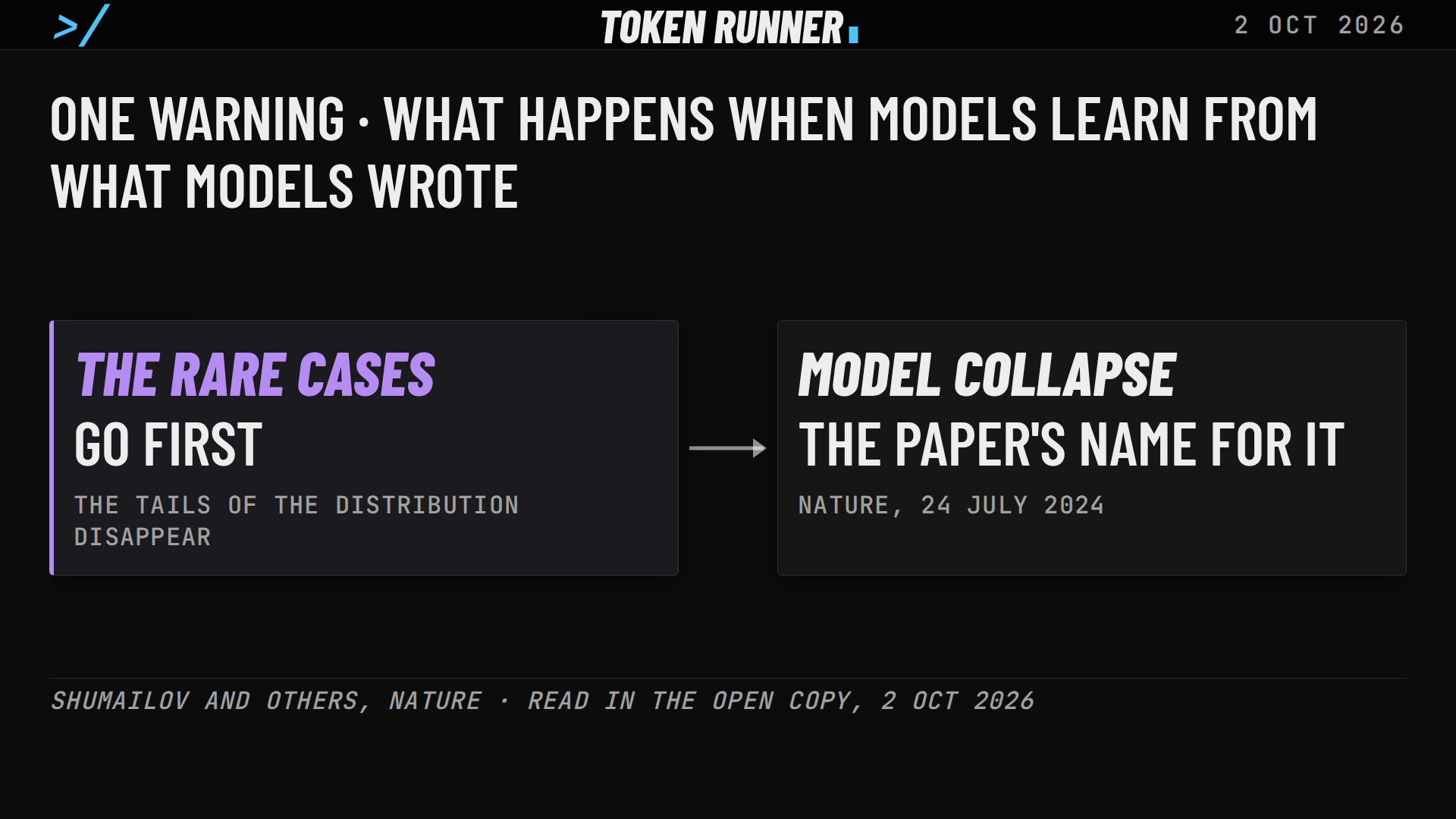
One result bears on where this goes. A paper in Nature on 24 July 2024 showed that models trained on other models' output lose the rare cases first: the tails of the distribution disappear. The authors' name for it is model collapse. If a growing share of what is written is written with these tools, and the tools are then trained on what is written, that is the loop the paper describes. Nothing here measures whether it is happening in science.
Three measures, none the same
Acknowledged: 38.1 per cent of new mathematics preprints in September 2026, by their authors' own word; the film, made on the earlier file, says 25 per cent for August. Detected: at least 13.5 per cent of 2024's biomedical abstracts, by their vocabulary. Estimated: 6.5 to 16.9 per cent of the review text at four AI conferences. They are different fields, different years and different methods, so they do not add up to one number. The first is the one that can be read again each month. Watch the gauge.
Sources
- Epoch AI, 'AI acknowledgment trends in mathematics preprints', the monthly file, as Token Runner collected it on 2 October and 9 October 2026: https://epoch.ai/data
- Kobak, González-Márquez, Horvát, Lause, 'Delving into LLM-assisted writing in biomedical publications through excess vocabulary', arXiv 2406.07016 (v5, 3 July 2025); journal reference Science Advances, 2 July 2025, vol. 11 no. 27: https://arxiv.org/abs/2406.07016
- Liang and 11 others, 'Monitoring AI-Modified Content at Scale: A Case Study on the Impact of ChatGPT on AI Conference Peer Reviews', arXiv 2403.07183: https://arxiv.org/abs/2403.07183
- Retraction Watch, 'Springer Nature retracted 2,923 papers last year', 17 February 2025: https://retractionwatch.com/2025/02/17/springer-nature-journal-retractions-2024/
- The Nobel Prize in Chemistry 2024, summary, NobelPrize.org: https://www.nobelprize.org/prizes/chemistry/2024/summary/
- Google DeepMind (Merchant and Cubuk), 'Millions of new materials discovered with deep learning', 29 November 2023: https://deepmind.google/blog/millions-of-new-materials-discovered-with-deep-learning/
- Cheetham and Seshadri, 'Artificial Intelligence Driving Materials Discovery? Perspective on the Article: Scaling Deep Learning for Materials Discovery', Chemistry of Materials, 8 April 2024, 36(8):3490-3495, read in the open copy at PubMed Central (PMC11044265): https://pmc.ncbi.nlm.nih.gov/articles/PMC11044265/
- Shumailov and others, 'AI models collapse when trained on recursively generated data', Nature, 24 July 2024, 631(8022):755-759, read in the open copy at PubMed Central (PMC11269175): https://pmc.ncbi.nlm.nih.gov/articles/PMC11269175/
- Epoch AI (@EpochAIResearch), a post on X, 18 September 2026: https://x.com/EpochAIResearch/status/2101083734401601837
- SemiAnalysis (@SemiAnalysis_), a post on X, 30 September 2026: https://x.com/SemiAnalysis_/status/2105130564214731206