Claimed
On the twenty-sixth of October, OpenAI announced three new discoveries. One in mathematics. One in computer science. One in physics. The biggest: its system, in OpenAI's words, "has recently proved that the ETH is false."
The claim.
The biggest: its system, in OpenAI's words, "has recently proved that the ETH is false." ETH here is the Exponential Time Hypothesis. Not the university, not the currency. It's a working assumption that some problems can't be solved without exponential time: the time doubles, and doubles again, as the problem grows. Decades of computer science lean on it.
“has recently proved that the ETH is false.”
OpenAI, "Working with academic communities to build scientific understanding", 26 October 2026
The hypothesis is Impagliazzo and Paturi's (CCC 1999; JCSS 2001): that 3-SAT needs exponential time, 2^Ω(n). In the reviewers' words, "ETH has helped organize decades of research". OpenAI's page: "Our AI found its natural language disproof for the ETH on October 16th, 2026". This piece treats the announcement as a claim under examination; it says neither proven nor refuted.
What anyone can check.
Here's what you can check yourself. The computer science paper is public. So is its formal proof, written in Lean, a language a machine can verify. The mathematics paper is public too.
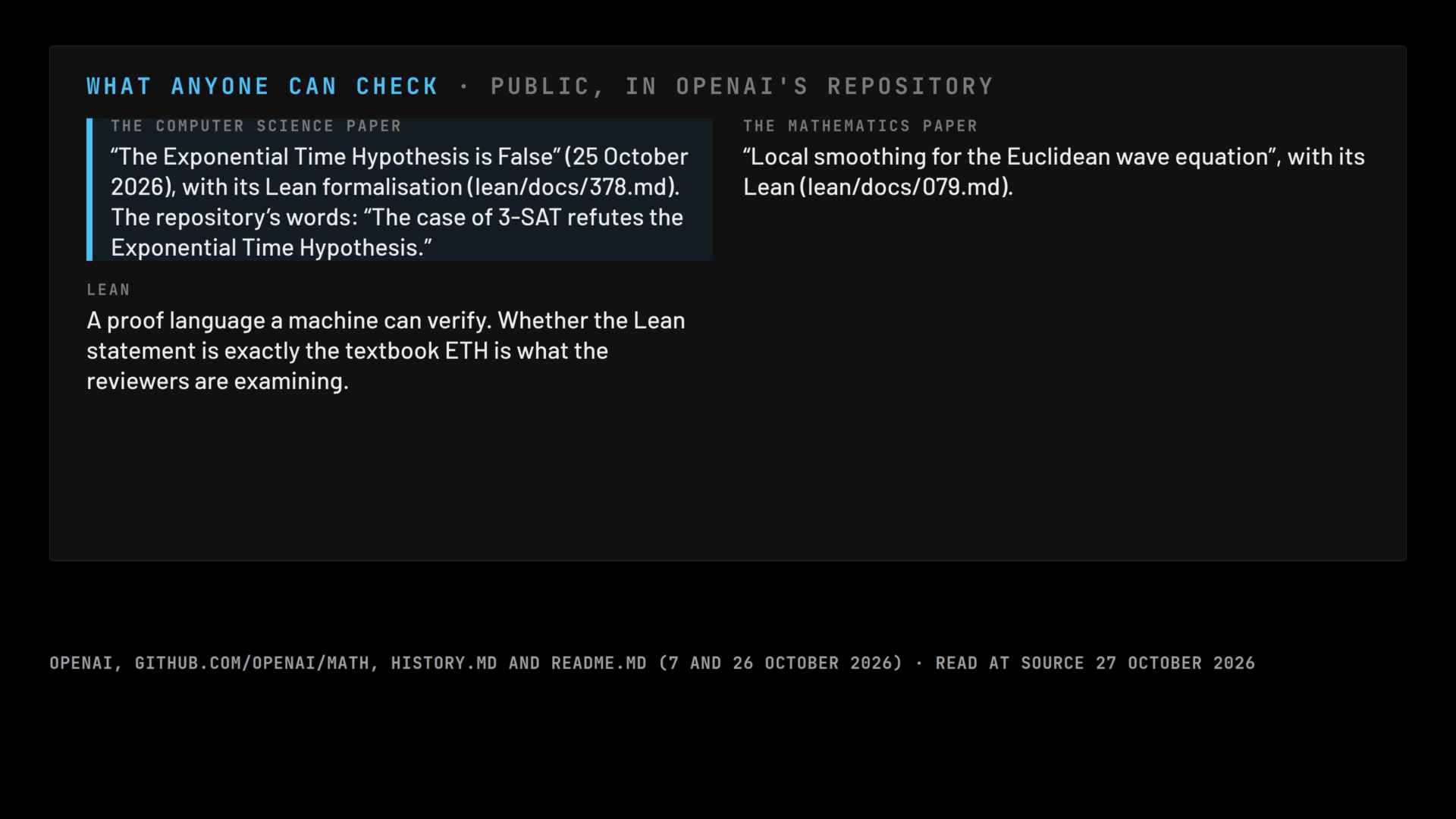
In the repository: "The Exponential Time Hypothesis is False" (25 October 2026) with its Lean formalisation (lean/docs/378.md); the repository's words: "The case of 3-SAT refutes the Exponential Time Hypothesis." And "Local smoothing for the Euclidean wave equation", with its Lean (lean/docs/079.md). Whether the Lean statement is exactly the textbook hypothesis is what the reviewers are examining. On the mathematics, the announcement says Stein's restriction conjecture is resolved "in all dimensions"; the repository's history says "Stein's spherical restriction estimates throughout the interior of the conjectured range". Both are printed here; neither is judged.
What is withheld.
The physics is not. OpenAI says the physicists it's working with decided "to hold off on releasing" the AI's output and write it up themselves. A group at the Institute for Advanced Study has called on OpenAI to release it "without delay."
OpenAI's sentence: "the group has decided to hold off on releasing the AI-produced artifacts and instead work on writing it up themselves." OpenAI claims existence proofs for Yang–Mills theory, quantum chromodynamics and a completion of the Standard Model, not the mass gap. AGMAI, 26 October: "We call on OpenAI to make public without delay the natural-language and Lean outputs behind its announced existence proofs for Yang–Mills theory, quantum chromodynamics, and a completion of the Standard Model."
“We call on OpenAI to make public without delay the natural-language and Lean outputs behind its announced existence proofs for Yang–Mills theory, quantum chromodynamics, and a completion of the Standard Model.”
AGMAI, the Advisory Group on Mathematics and Artificial Intelligence, Institute for Advanced Study, 26 October 2026
The checkers.
OpenAI asked three computer scientists to organise the examination. Two of them first proposed the hypothesis. Their own statement: "Our involvement should not be taken as certification of the claim."
Russell Impagliazzo and Ramamohan Paturi, the hypothesis's original authors, and Ryan Williams, in their message to the theoretical computer science community of 26 October 2026. Their resource list includes Anthropic's refutation of ETH beside OpenAI's.
The repository's count.
And there's a count. Earlier this month, OpenAI's repository withdrew three papers after a sign error, and revised fourteen more. As of the seventh of October, it said about forty-two percent of its main results were machine-checked. The rest were not.
The repository's history, 7 October 2026: "a sign error invalidates a stabilization-trace cancellation argument" in one paper, withdrawn with two that depended on it; "We have revised 14 other manuscripts"; and "This brings the total percentage of top-line results formalized to 300 / 719 = ~42%." After the 26 October additions the README still says "~42%" with no new count, so the figures are dated 7 October; 419 without a formal proof is our arithmetic. The catalogue on 26 October: "721 manuscripts organized into 373 families".
The second claim.
One more thing. The next day, Anthropic posted its own paper claiming the same result, found, it says, on the same day: the sixteenth of October. Anthropic makes Claude. A disclosure: Token Runner is built with Claude.
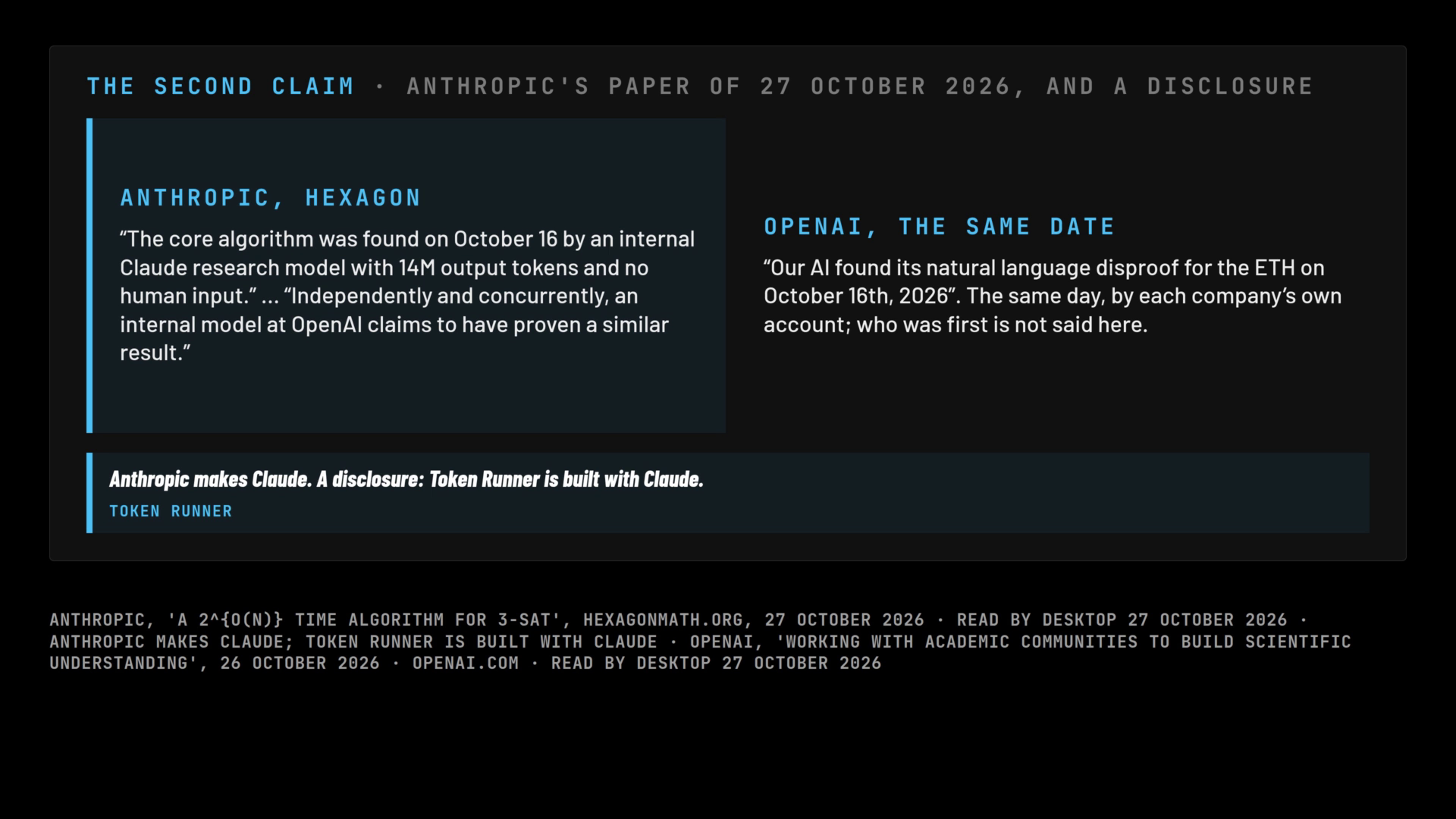
Anthropic's paper on Hexagon, 27 October 2026: "The core algorithm was found on October 16 by an internal Claude research model with 14M output tokens and no human input." It says the result is formalised in Lean 4, and: "Independently and concurrently, an internal model at OpenAI claims to have proven a similar result." OpenAI's page gives the same date, 16 October. Who was first is not said here.
Certified by no one yet.
So: two companies, one claim. Machine-checked, they say. Certified by no one yet. The people who will decide are the ones now reading the proof.
Every quote from OpenAI's announcement, its repository, the reviewers' own statement, and the Institute for Advanced Study group. Token Runner dot A I.
Sources
- OpenAI, "Working with academic communities to build scientific understanding", 26 October 2026, read by Desktop on 27 October 2026: "Our AI found its natural language disproof for the ETH on October 16th, 2026"; its system "has recently proved that the ETH is false"; on the physics, "the group has decided to hold off on releasing the AI-produced artifacts and instead work on writing it up themselves."
- OpenAI, github.com/openai/math, history.md and README.md, read at source by Token Runner on 27 October 2026: the 26 October additions ("The Exponential Time Hypothesis is False", with its Lean formalisation at lean/docs/378.md; "Local smoothing for the Euclidean wave equation", lean/docs/079.md); the 7 October entry: three papers withdrawn after "a sign error invalidates a stabilization-trace cancellation argument", 14 manuscripts revised, and "the total percentage of top-line results formalized to 300 / 719 = ~42%"; the README's "721 manuscripts organized into 373 families". Token Runner's own table of the repository's counts.
- Russell Impagliazzo, Ramamohan Paturi and Ryan Williams, "Message to the TCS Community on ETH", 26 October 2026, read by Desktop on 27 October 2026: "Our involvement should not be taken as certification of the claim."; "ETH has helped organize decades of research". The Exponential Time Hypothesis: Impagliazzo and Paturi, CCC 1999 and JCSS 2001 (Grok, G-020).
- AGMAI, the Advisory Group on Mathematics and Artificial Intelligence (Institute for Advanced Study), 26 October 2026: "We call on OpenAI to make public without delay the natural-language and Lean outputs behind its announced existence proofs for Yang–Mills theory, quantum chromodynamics, and a completion of the Standard Model."
- Anthropic, "A 2^{o(n)} Time Algorithm for 3-SAT", Hexagon, 27 October 2026, read by Desktop: "The core algorithm was found on October 16 by an internal Claude research model with 14M output tokens and no human input."; "Independently and concurrently, an internal model at OpenAI claims to have proven a similar result." Anthropic makes Claude. A disclosure: Token Runner is built with Claude.
- Token Runner's own table of the repository's counts (CC BY 4.0).