The Preemption Play
One national AI rule in place of the states' rules is being pursued with money and with an executive order. The states had started first. And when the Senate voted on it, it voted the other way.
The money
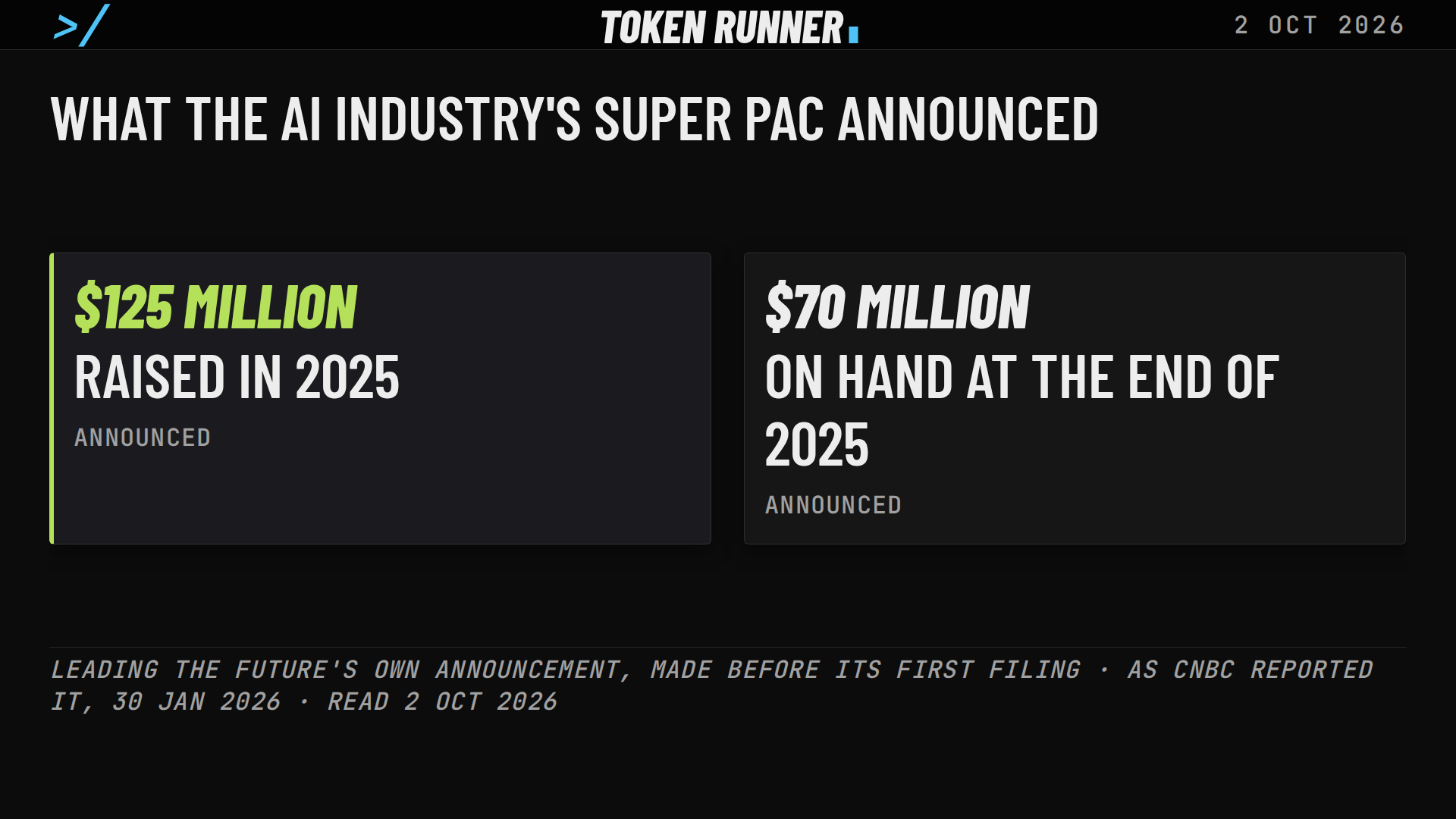
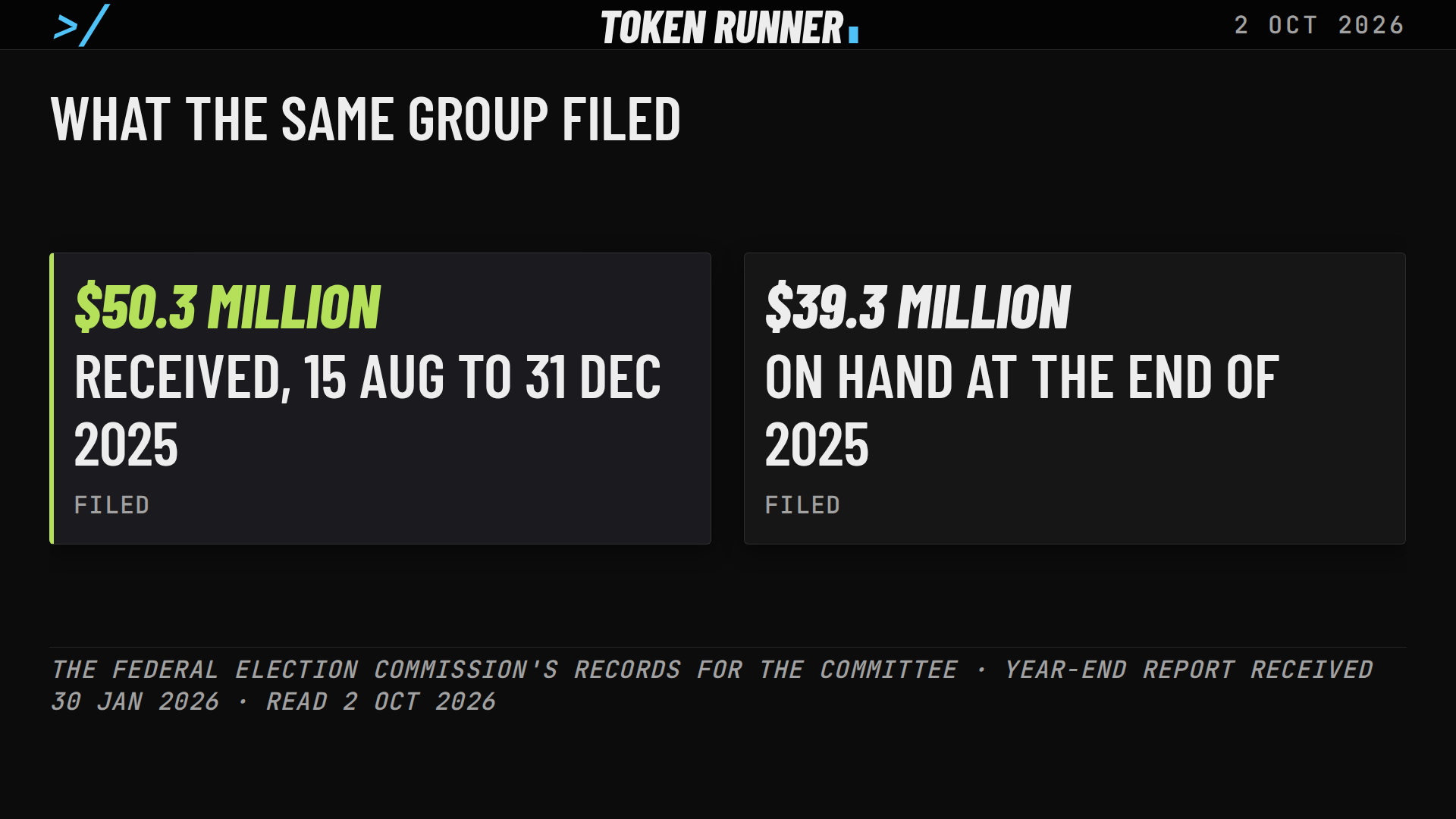
Leading the Future, the AI industry's super PAC, announced that it raised $125 million in 2025 and had $70 million on hand at the end of the year. That was its own statement, made before its first filing, as CNBC reported it on 30 January 2026. Its filing with the Federal Election Commission says something else. For 15 August to 31 December 2025 it reports $50.3 million received, $11.0 million spent and $39.3 million on hand at the end of the year. The filing does not explain the difference, and this article cannot. The announcement may count connected groups that file elsewhere, but no source read here says so. Both figures are printed, each for what it is: one announced, one filed.
The money since
The same committee's filings give two more periods. From January to March 2026 it received $25.2 million, spent $13.4 million and ended with $51.1 million on hand. From April to June it received $0.25 million, a quarter of a million dollars, spent $20.4 million and ended with $31.0 million. By 30 June 2026 it had filed $75.8 million of receipts in all and had spent $44.8 million. These are one committee's own figures. Nothing in them says why any of them is what it is, and the line for independent expenditures reads zero in every report read. What the money bought is in the itemised schedules, which were not read for this article, so it does not say that the money was spent on candidates.
What it is for
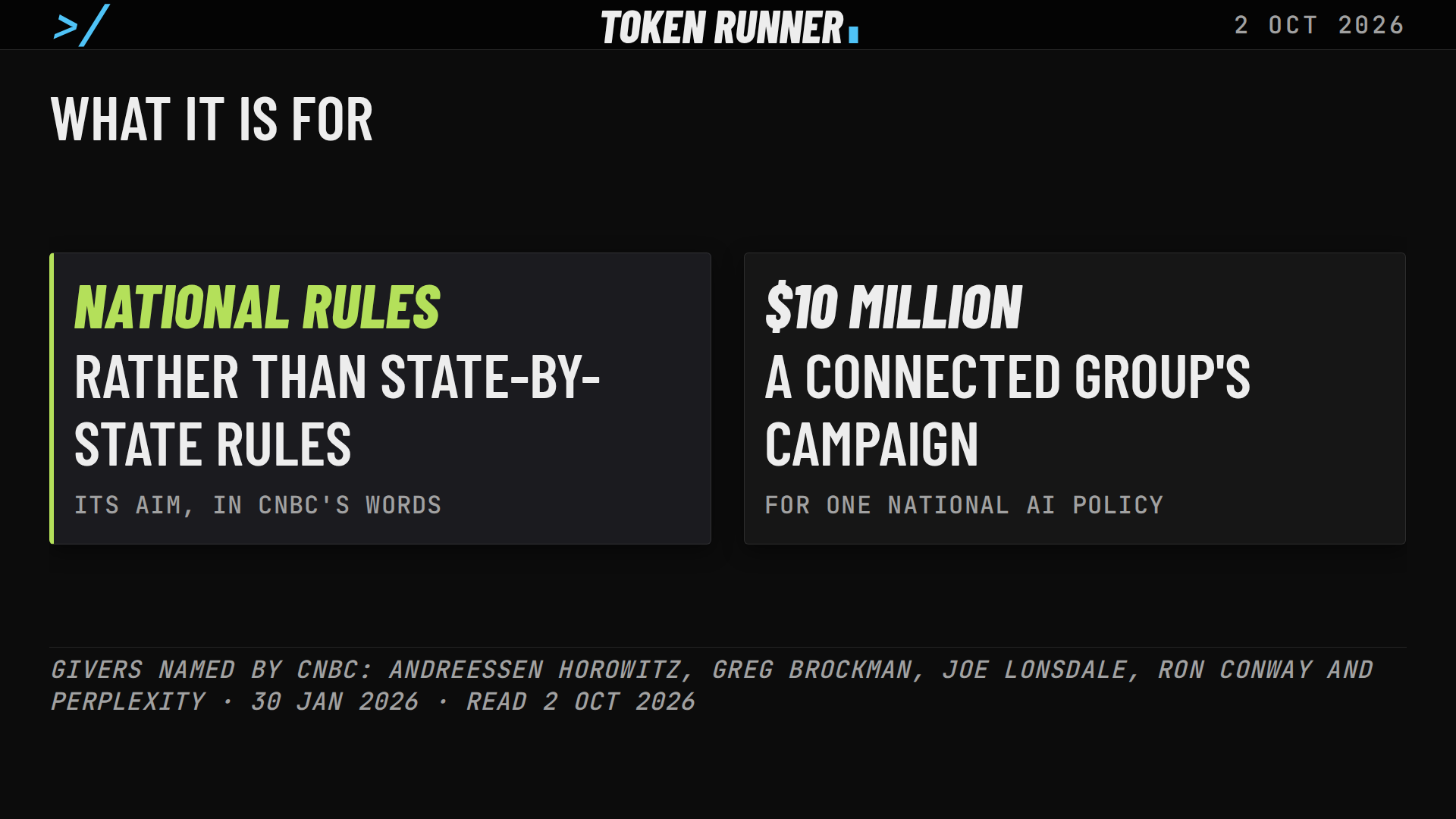
The aim, in CNBC's words, is candidates who back "national AI regulations rather than state-by-state rules". The givers CNBC names are Andreessen Horowitz, Greg Brockman, Joe Lonsdale, Ron Conway and Perplexity. A connected advocacy group launched a $10 million campaign for one national AI policy. That is the whole argument of the play in the funders' own terms: one rule made in Washington in place of fifty made in the states. It is called preemption because a federal rule, once made, can displace the state rules beneath it. Whether the national rule would be a floor that states may build on or a ceiling they may not exceed is not something any source read for this article settles.
The order
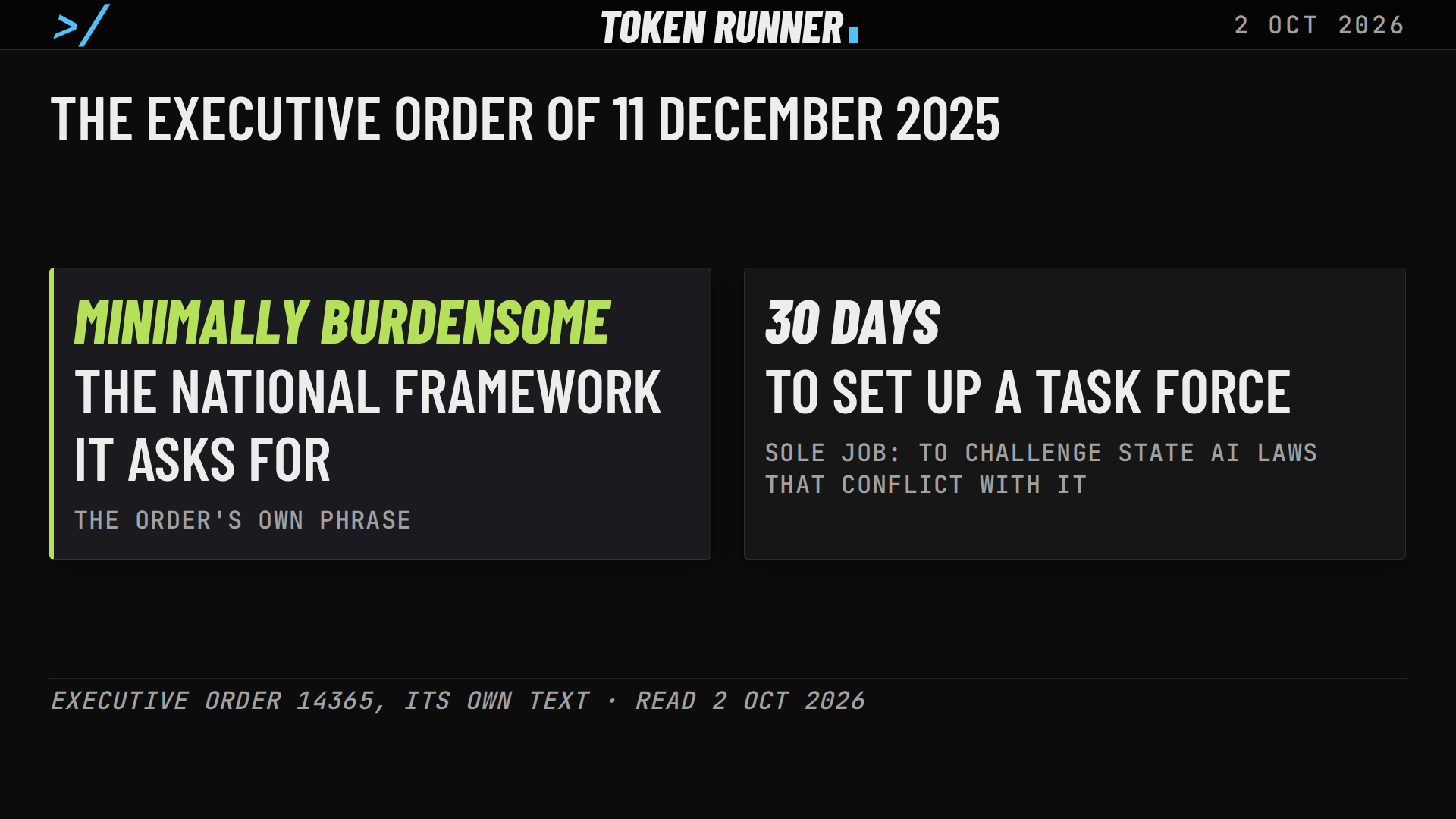
The government moved too. Executive Order 14365, signed on 11 December 2025, sets the policy in its own words as "a minimally burdensome national policy framework for AI". It tells the Attorney General to set up, within 30 days, an AI Litigation Task Force whose sole job is to challenge state AI laws that conflict with that policy. An executive order is not a statute. It cannot repeal a state law, and it does not create the national framework it names; it directs the federal government's lawyers at the state laws while Congress has yet to write one. So by the end of 2025 the play had money behind it and the executive behind it, and no national rule.
The states had started first
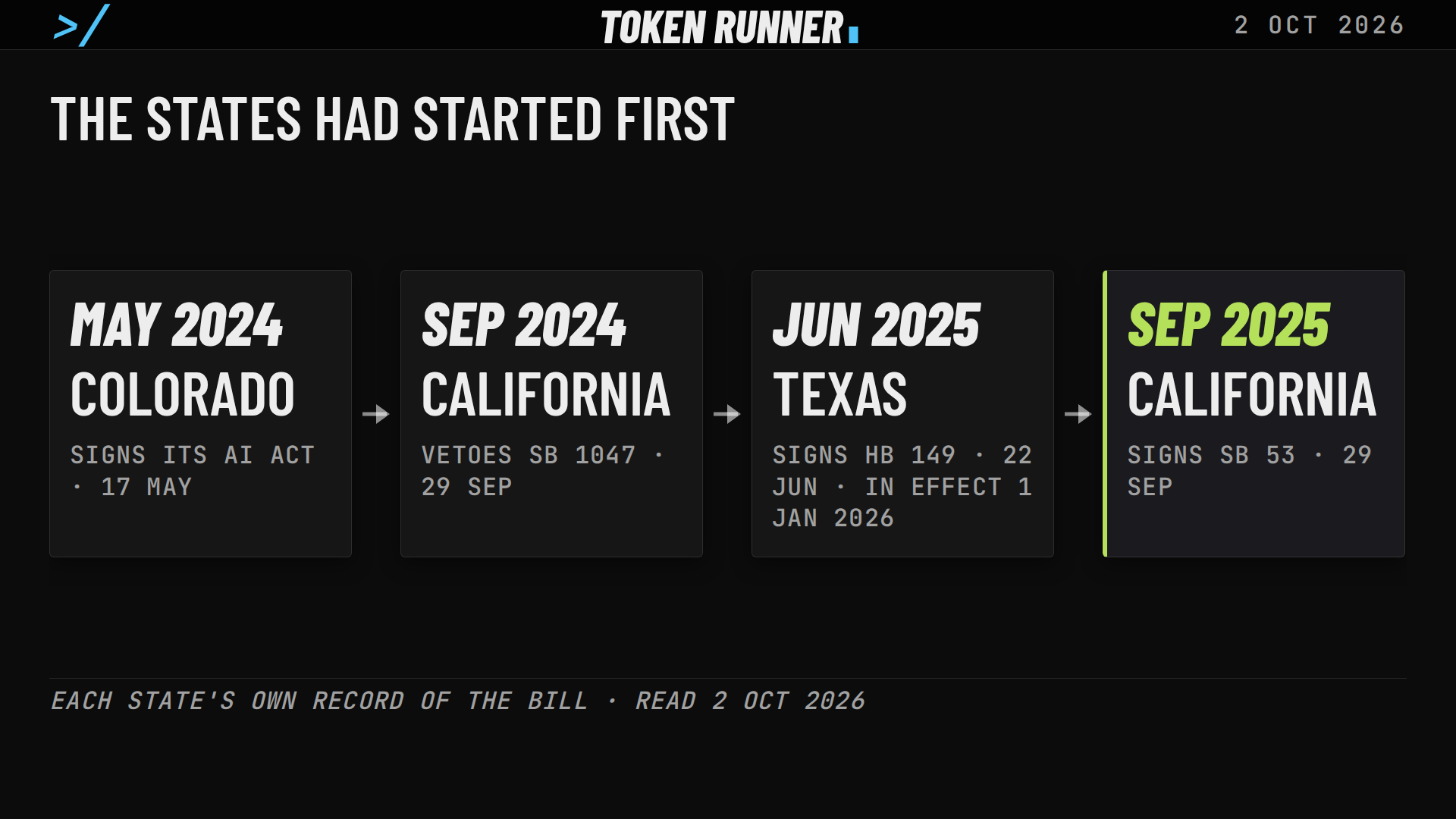
The states were there before the money and before the order. Colorado signed its act on algorithmic discrimination on 17 May 2024. California vetoed one bill, SB 1047, on 29 September 2024, and signed another, SB 53, the Transparency in Frontier Artificial Intelligence Act, on 29 September 2025: a year later to the day. Texas signed its law, HB 149, on 22 June 2025, and it took effect on 1 January 2026. These are different laws about different things, a discrimination act in Colorado, a transparency act in California and Texas's own law, and they are what the phrase "state-by-state rules" refers to. Each date here is from the state's own record of its bill.
Colorado: one law, three start dates
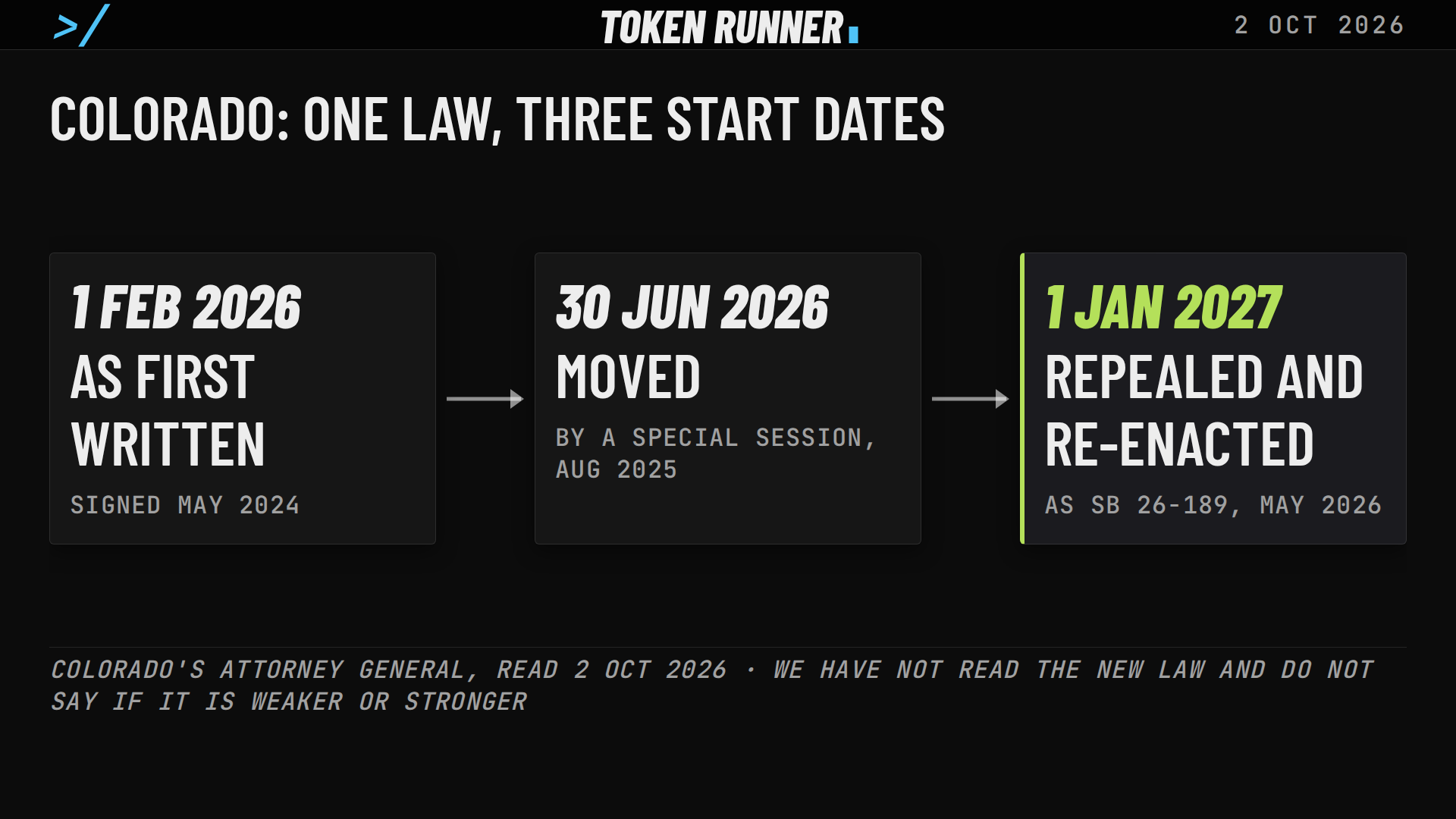
Colorado shows that a state law can move without Washington touching it. Its act was to apply from 1 February 2026. A special session in August 2025 moved that to 30 June 2026. Then, in May 2026, before that date arrived, the legislature repealed the law and re-enacted it as SB 26-189, with new requirements, to take effect on 1 January 2027. So it has had three start dates and has been moved twice, the second time in a changed form. The state's Attorney General describes the new law's subject as "automated decision-making technology". The new law was not read for this article, which does not say whether it is weaker or stronger than the first.
When the Senate voted
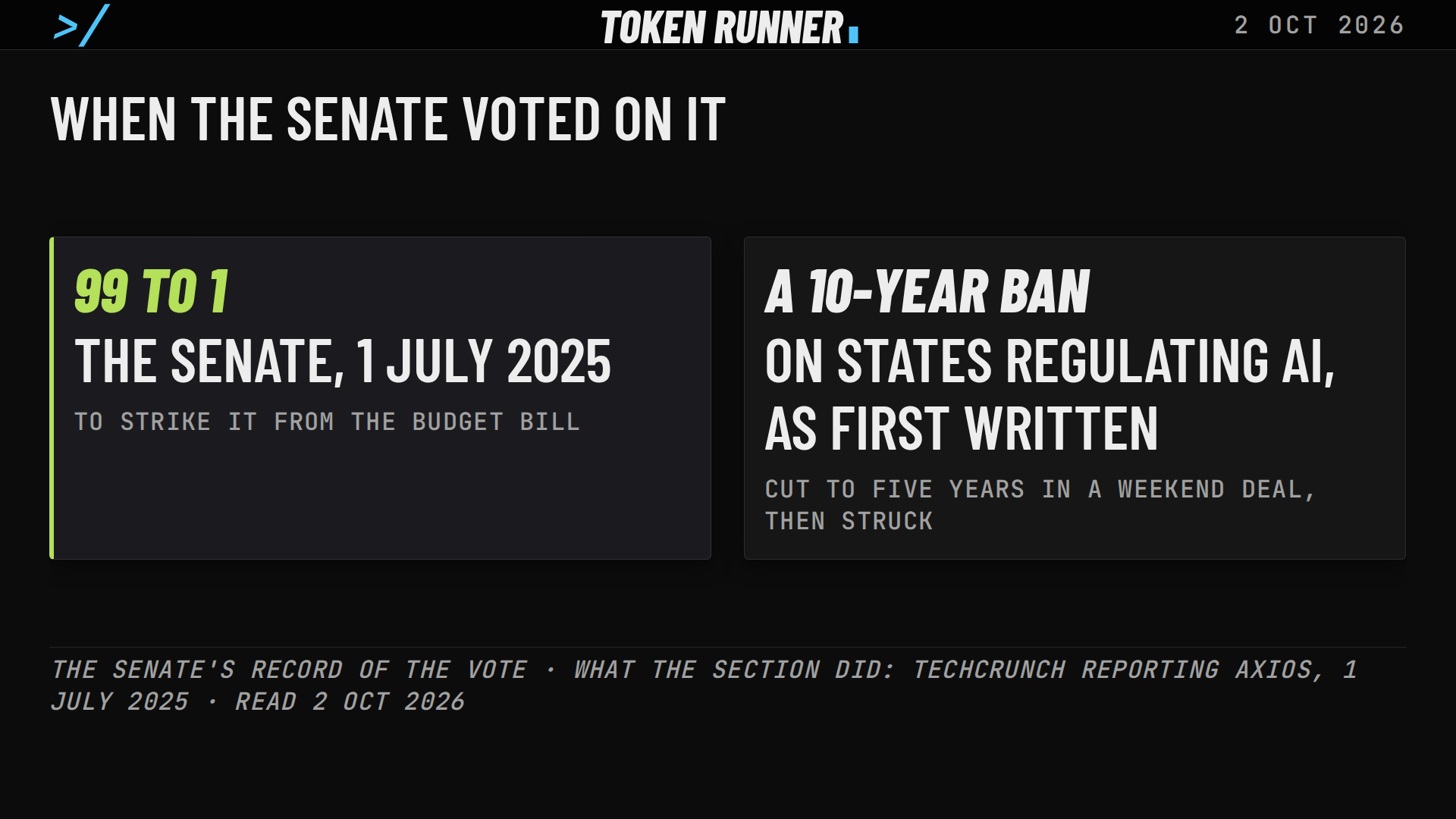
Congress has voted on preemption once, and it voted the other way. On 1 July 2025 the Senate voted 99 to 1 for an amendment by Senator Blackburn, with Senator Cantwell, striking the artificial intelligence section from the budget bill; the one vote against was Senator Tillis of North Carolina. What it struck, as TechCrunch reported it, was a 10-year ban on states regulating AI, a provision of Senator Cruz's. A weekend deal had cut it from ten years to five before it was struck. The same report names executives who favoured the ban, to prevent what they called "an unworkable patchwork" of state rules; one of them, Andreessen's firm, is also among the super PAC's named givers.
The conversation
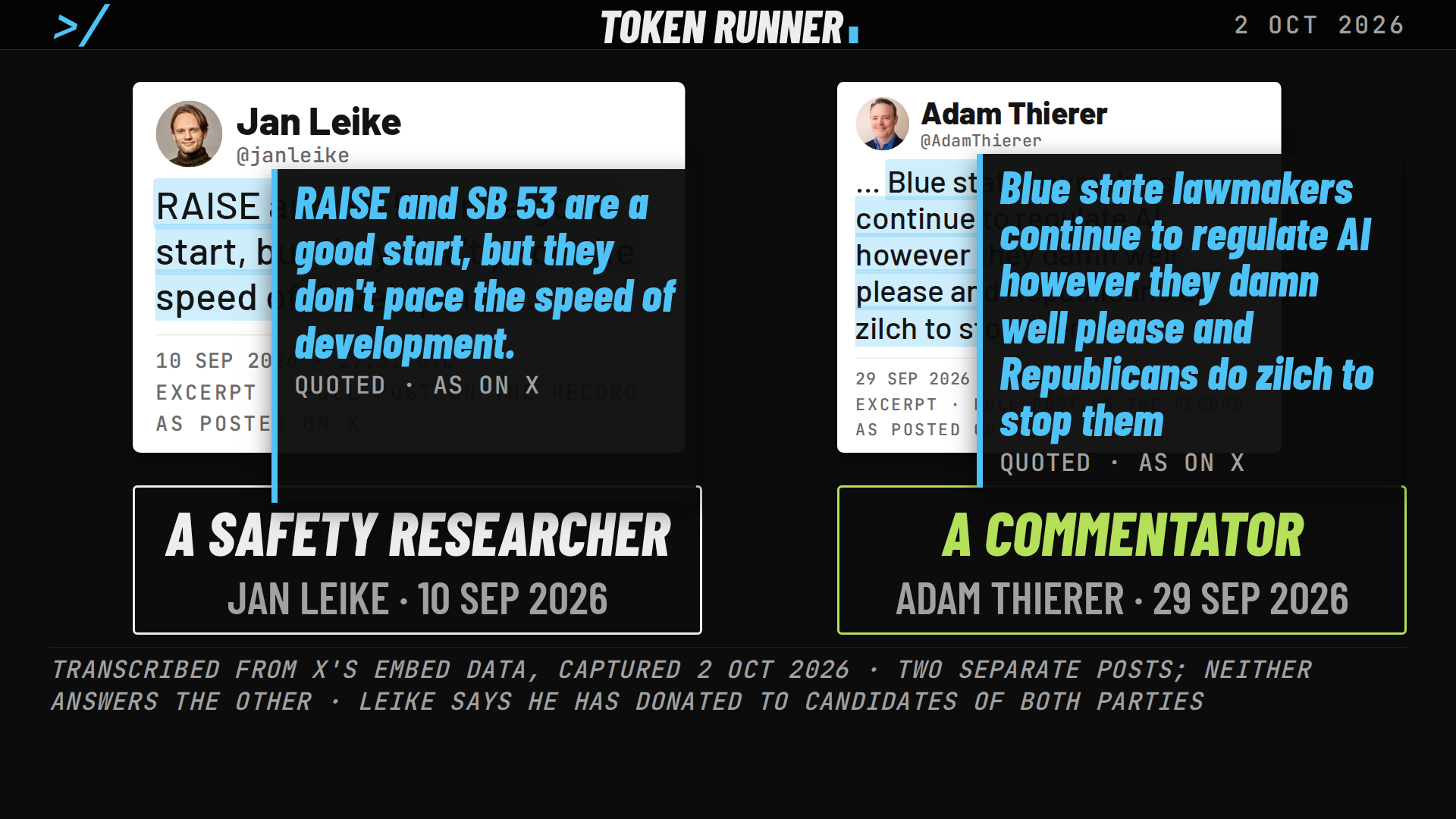
The argument has gone on since. Jan Leike, a safety researcher who says he has donated to candidates of both parties, wrote on 10 September 2026: "RAISE and SB 53 are a good start, but they don't pace the speed of development. They ask for transparency and self-commitments." He is a participant, not an observer. Adam Thierer, a commentator, complained on 29 September, in a reply to another post, that blue-state lawmakers "continue to regulate AI however they damn well please and Republicans do zilch to stop them". The two posts are separate, and neither answers the other. Between them they mark the ends of the argument: the state laws are too little, and the state laws are too free.
A federal rule of the opposite kind
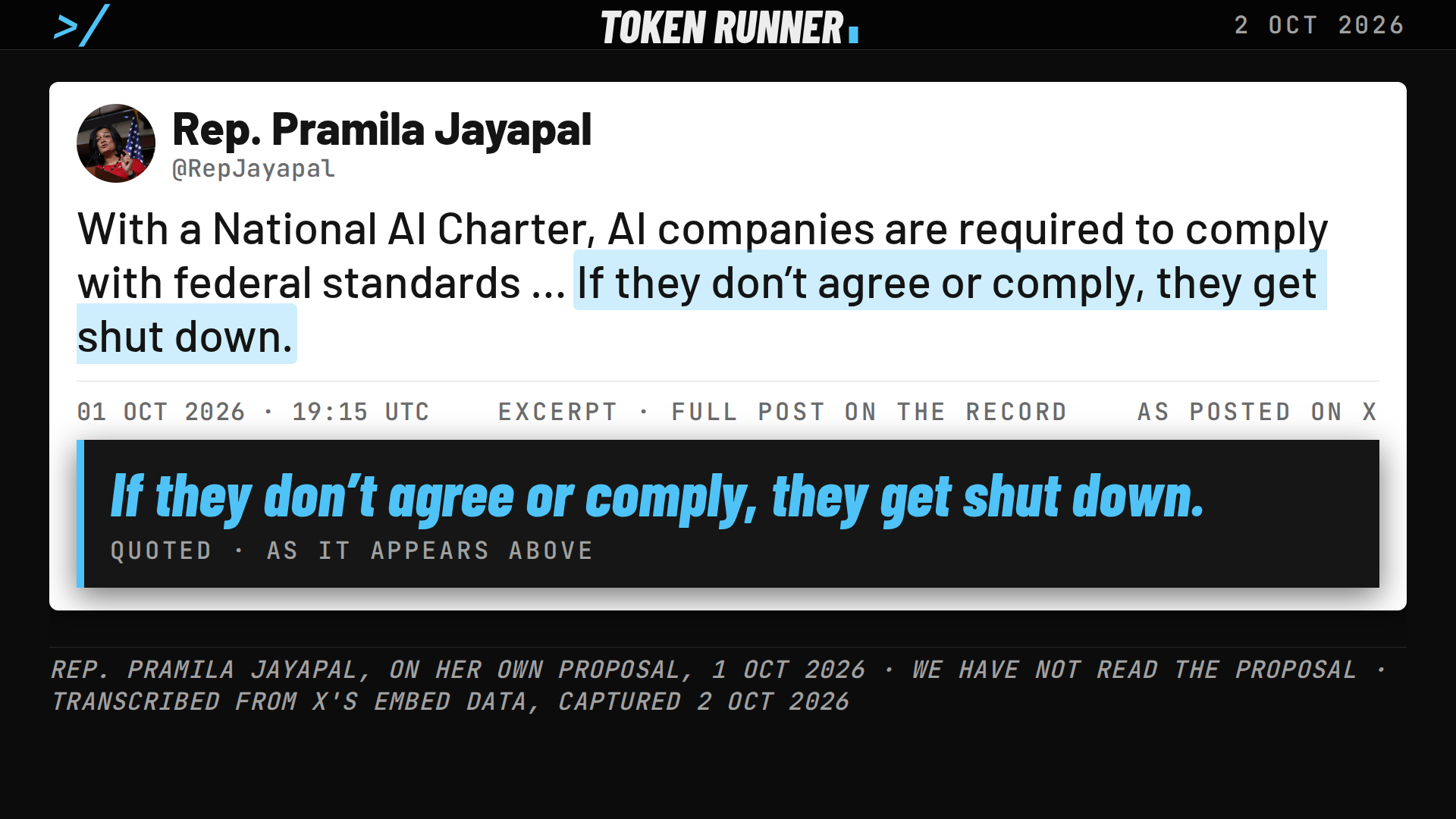
National does not have to mean lighter. On 1 October 2026 Representative Pramila Jayapal described her own proposal on X: "With a National AI Charter, AI companies are required to comply with federal standards that prevent the release of risky models, stealing data through surveillance, exploiting workers, and causing serious harm. If they don’t agree or comply, they get shut down." The proposal itself was not read for this article. But it is one national rule in place of the states' rules, as the super PAC's aim is, and it points the opposite way. The fight over who writes the rule is not the same as the fight over what the rule says.
Money, an order, a vote
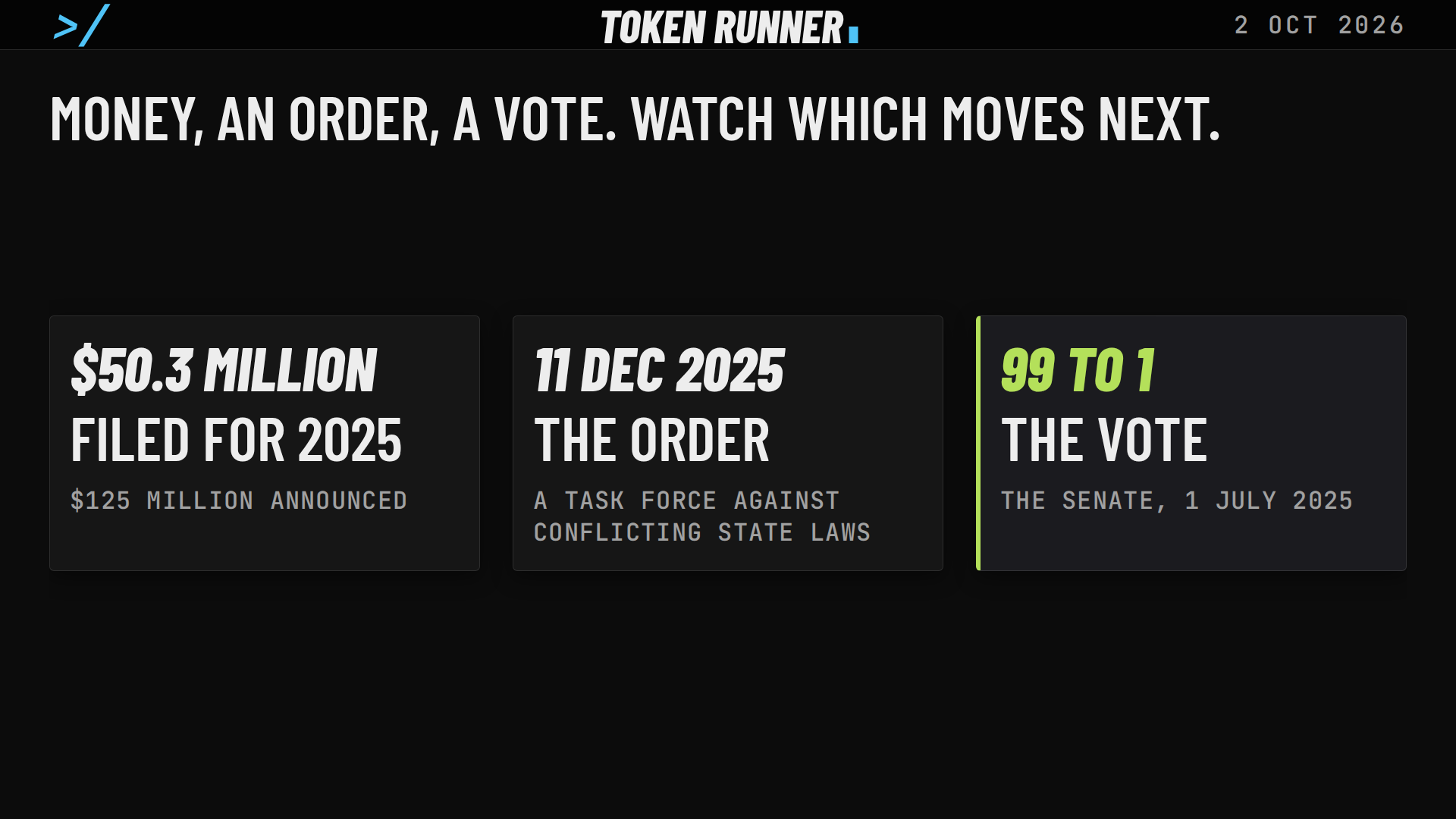
Money for one national rule: $50.3 million filed for 2025, where $125 million was announced, and $75.8 million filed by the middle of 2026. An order, of 11 December 2025, with a task force against state laws that conflict with it. And a Senate that voted 99 to 1 the other way. Meanwhile the states went on: Texas's law is in effect, California's is signed, and Colorado's has been rewritten and put off to 2027. Watch which of the three moves next: the money, the order's task force, or a vote.
Sources
- CNBC (Emily Wilkins), 'AI industry super PAC raises $125 million in 2025', 30 January 2026: https://www.cnbc.com/2026/01/30/ai-industry-super-pac-raises-campaign-money.html
- U.S. Federal Election Commission, committee C00916114, 'LEADING THE FUTURE' (a super PAC), its reports on Form 3X: the year-end report for 2025 and the April and July quarterly reports for 2026, read through the Commission's public data service on 2 October 2026
- U.S. Senate, roll call vote 363, 119th Congress, 1st session, 1 July 2025, 4:08 AM: on the Blackburn amendment, S.Amdt. 2814 to S.Amdt. 2360 to H.R. 1: https://www.senate.gov/legislative/LIS/roll_call_votes/vote1191/vote_119_1_00363.htm
- Colorado Attorney General, 'Colorado Automated Decision-Making Technology & Chatbot Safety Rulemaking': https://coag.gov/ai/
- The White House, Executive Order 14365, 'Ensuring a National Policy Framework for Artificial Intelligence', 11 December 2025: https://www.whitehouse.gov/presidential-actions/2025/12/eliminating-state-law-obstruction-of-national-artificial-intelligence-policy/
- California Legislature, SB 1047 (Wiener), bill status: https://leginfo.legislature.ca.gov/faces/billStatusClient.xhtml?bill_id=202320240SB1047
- California Legislature, SB 53 (Wiener), 'Artificial intelligence models: large developers', Chapter 138, bill text as chaptered: https://leginfo.legislature.ca.gov/faces/billNavClient.xhtml?bill_id=202520260SB53
- Texas Legislature Online, HB 149, 89th Regular Session, bill history: https://capitol.texas.gov/BillLookup/History.aspx?LegSess=89R&Bill=HB149
- Colorado General Assembly, SB24-205, 'Consumer Protections for Artificial Intelligence', bill summary as enacted: https://leg.colorado.gov/bills/sb24-205
- Colorado General Assembly, SB25B-004, 'Increase Transparency for Algorithmic Systems', bill summary as enacted: https://leg.colorado.gov/bills/sb25b-004
- TechCrunch (Rebecca Bellan), 'US Senate removes controversial AI moratorium from budget bill', 1 July 2025: https://techcrunch.com/2025/07/01/us-senate-removes-controversial-ai-moratorium-from-budget-bill/
- Jan Leike (@janleike), a post on X, 10 September 2026: https://x.com/janleike/status/2098102090908541083
- Adam Thierer (@AdamThierer), a post on X, 29 September 2026: https://x.com/AdamThierer/status/2105022638024282543
- Rep. Pramila Jayapal (@RepJayapal), a post on X, 1 October 2026: https://x.com/RepJayapal/status/2105738307317477657