
Token Runner
Politics · An Interlinked production · 9 October 2026

The Export-Control Clock

Washington isn't backing down on AI tech—they've taken the war off the public register. While the export bureau's rules and proposals fell from 63 to 12, regulators didn't relax enforcement; they bypassed public rulemaking for direct mandates to companies. By tearing up a 30-day grace period and wiping out billions for Nvidia with an unprinted command, Washington proved the real tech war is happening off the register.

Fewer rules

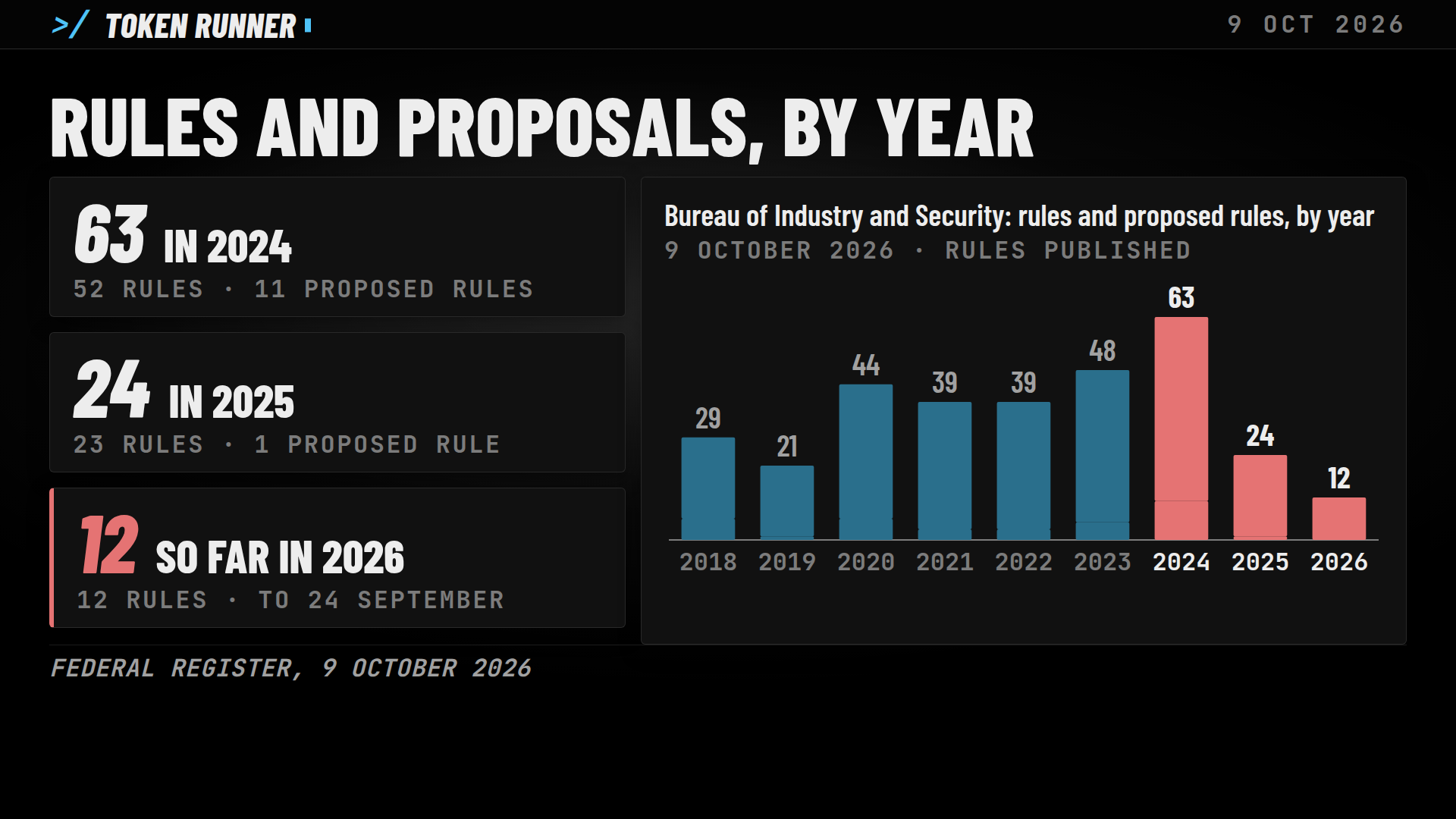
Count the rules and Washington looks to be easing off. The Bureau of Industry and Security, the office in the Commerce Department that writes America's export controls, published 63 rules and proposed rules in 2024, the most in any year since 2018. In 2025 it published 24. In 2026, through 24 September, it has published 12. That is every subject the Bureau regulates, each document counted once, and 2026 is not over. The fines went the other way: an analysis published by the Center for Strategic and International Studies on 24 September 2026 counts them at "over $297 million, more than triple the average total for the past five years", though one settlement the Bureau announced in February, of about $252 million, may be most of that. The count is not the control. Look at the two dates on each rule.

OPEN THE INSTRUMENT →
A frame of the film: rules and proposals by year, 63 in 2024, 24 in 2025, 12 so far in 2026

A clock that reads zero

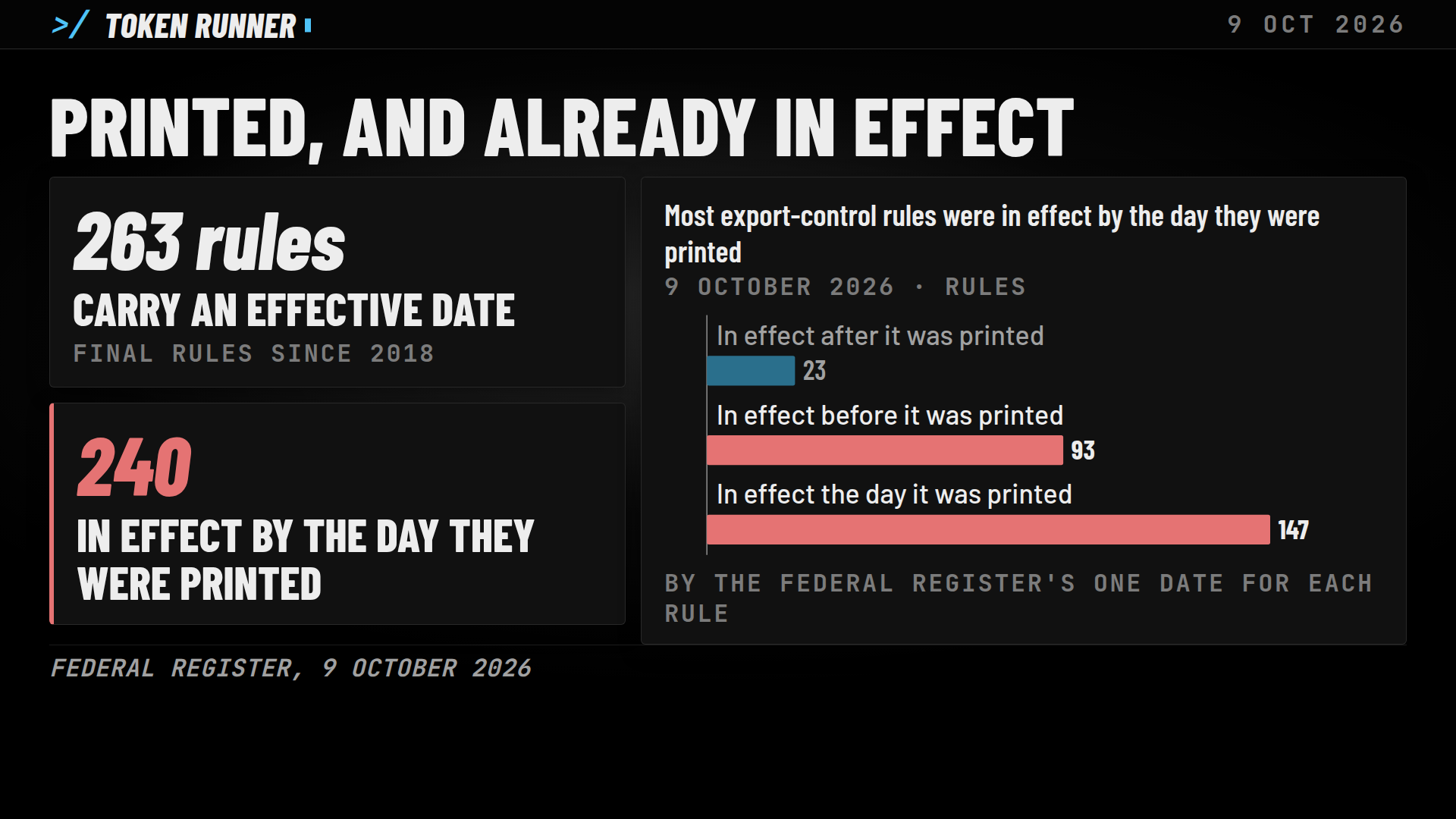
A rule in the Federal Register has two dates: the day it is printed and the day it takes effect. The gap is the notice an exporter gets. For the Bureau that gap is usually nothing. The Register records one effective date for each document. By that date, of the 263 rules since 2018 that carry one, 240 were in effect on or before the day they were printed, 93 of them before. The typical gap is zero days. The chip rules follow the pattern. Of the thirteen on advanced chips and AI, the Register's date shows a delay for one pair. It undercounts at least once: the first chip rule, in October 2022, carried three dates, and its chip controls took effect eight days after printing.

OPEN THE INSTRUMENT →
A frame of the film: 263 rules carry an effective date, 240 in effect by the day they were printed, and the three timing bars

Thirty days, cut to five

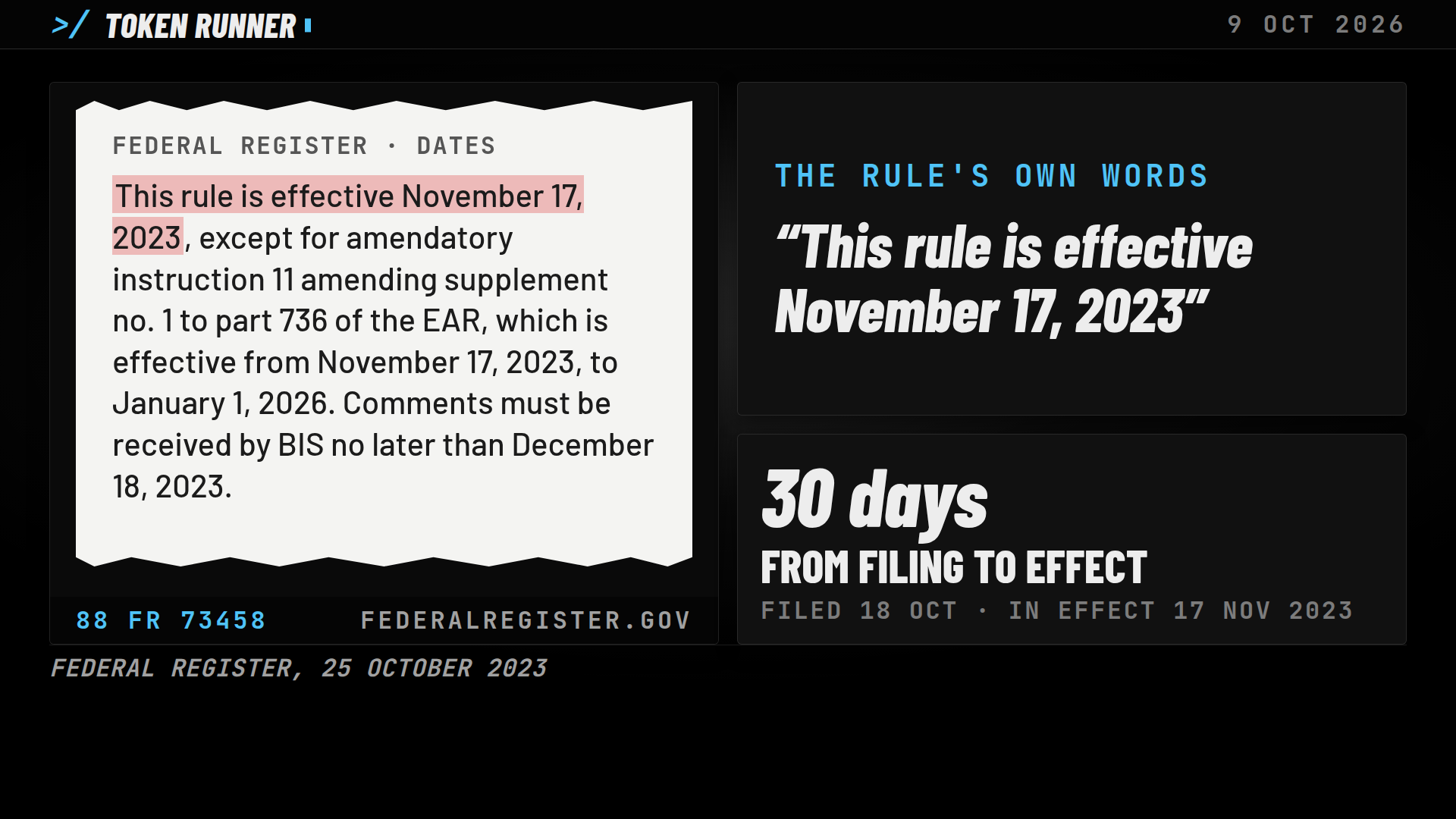
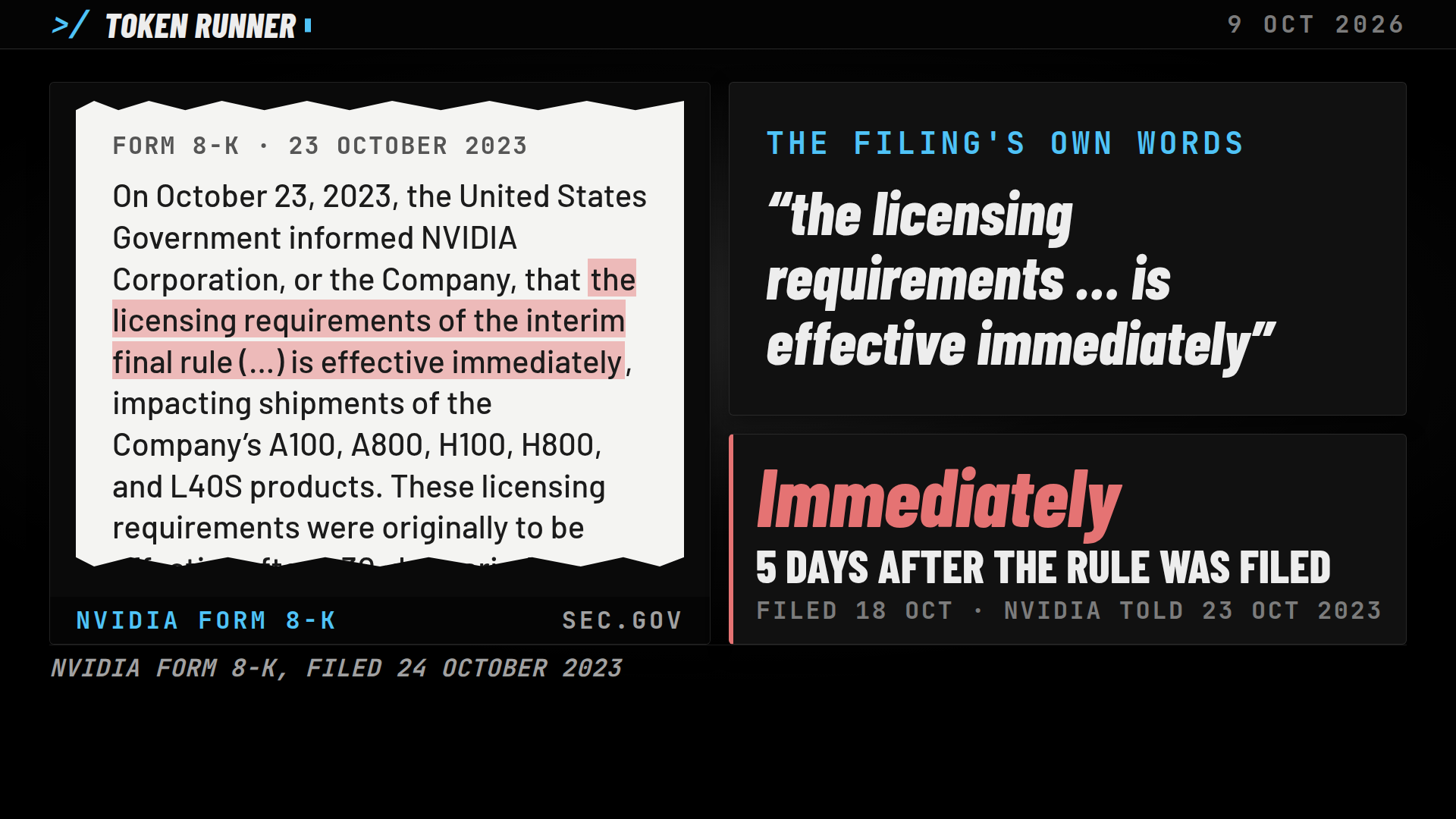
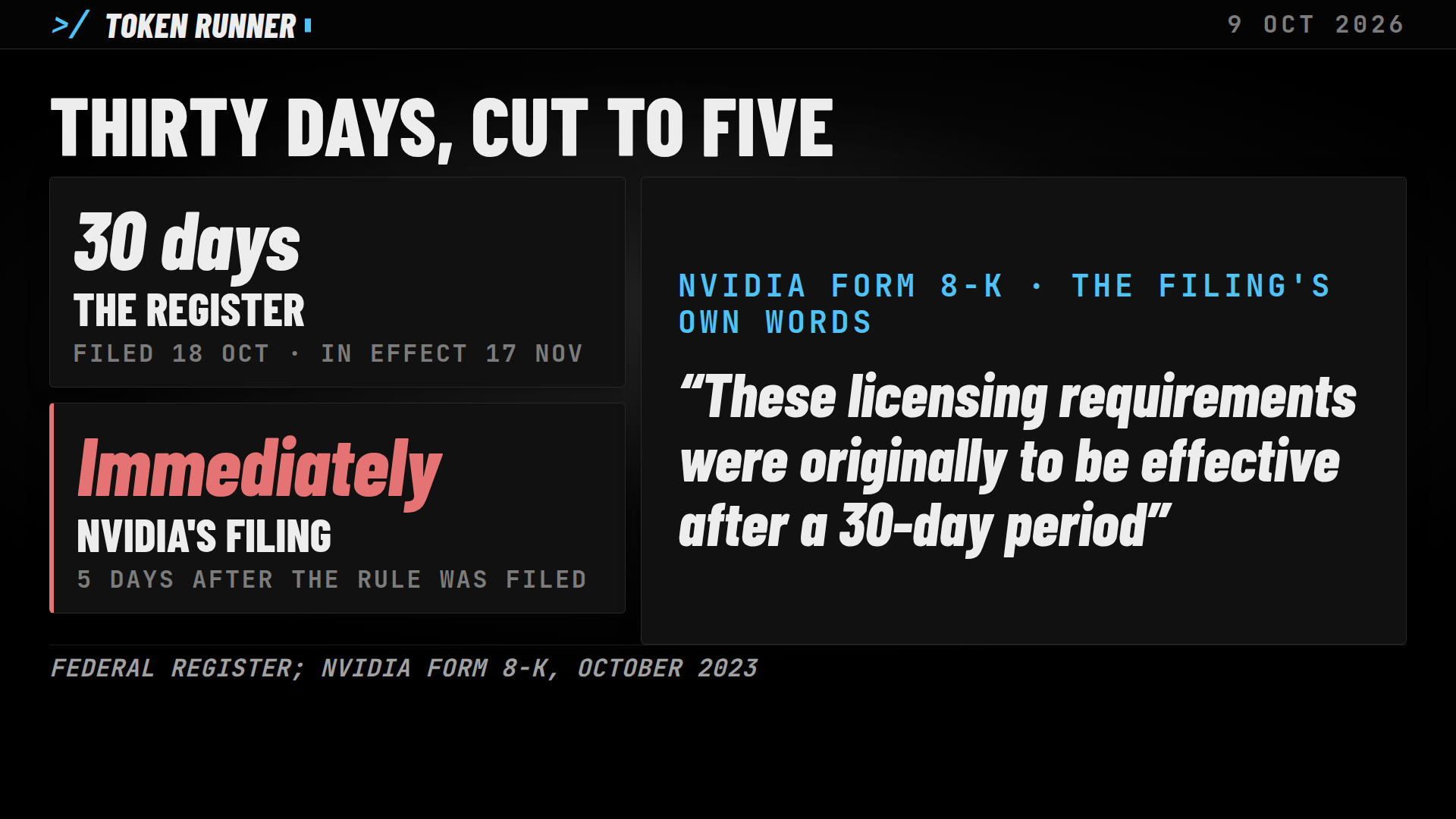
The pair was the rule of October 2023, which tightened the thresholds set a year earlier, in the Bureau's words "to prevent technical workarounds". It was filed on 18 October, printed on the 25th and set to take effect on 17 November, thirty days from its filing and twenty-three from its printing, a delay that the Bureau defended in the rule itself: longer delays "can ease confusion by companies and help improve compliance", but a long one "can undermine those national security and foreign policy concerns". Five days after the filing, and two days before the rule was printed, the government informed Nvidia that the requirement was "effective immediately" for its A100, A800, H100, H800 and L40S chips. The Register says thirty days. Nvidia's filing says immediately, five days after the rule was filed. Both are true: the printed rule kept its date, and for five named chips the notice was the rule.

A frame of the film: the rule's date line, effective November 17, 2023, thirty days from filing to effect
A frame of the film: Nvidia's Form 8-K, the licensing requirements effective immediately, five days after the rule was filed
A frame of the film: thirty days in the Register, immediately in Nvidia's filing

Told first

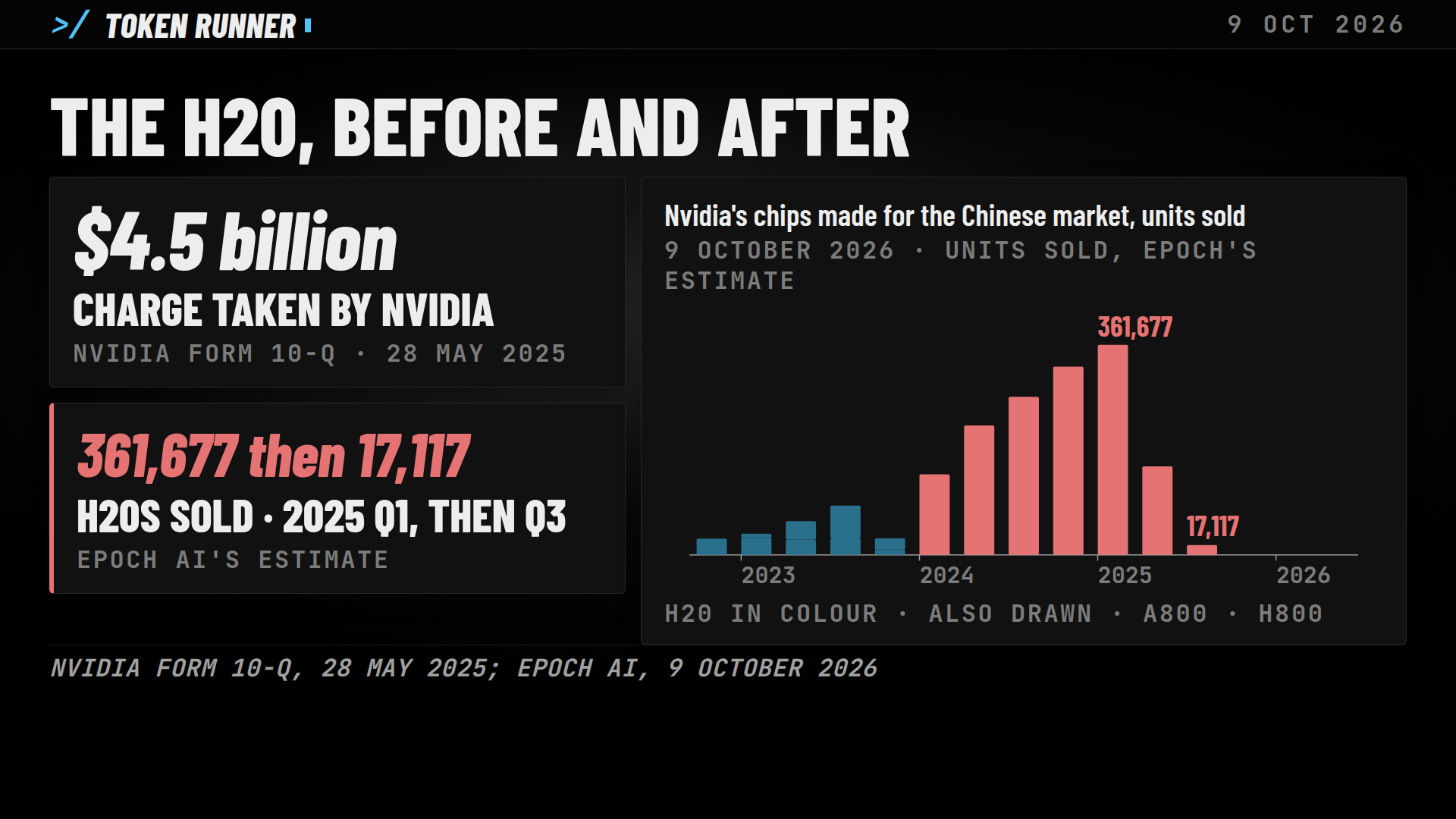
The move that cost Nvidia most was made the same way. In August 2022 Nvidia was informed that a licence was required, "effective immediately", for the A100 and H100, six weeks before the first chip rule was filed. In April 2025 it was told a licence was required for the H20, a chip Epoch AI marks as made mainly for the Chinese market, and no rule for it was printed. CNBC reported on 15 April 2025 that the government had told Nvidia the requirement would hold "for the indefinite future". Nvidia took a $4.5 billion charge that quarter, after $4.6 billion of H20 sales made before it was told. Epoch AI's estimates show the shape: about 360,000 H20s sold in the first quarter of 2025, about 150,000 in the second, about 17,000 in the third. Nvidia's own filing says it made no H20 sales to customers based in China in its quarter to July 2025; the two counts use different quarters and are not reconciled here.

OPEN THE INSTRUMENT →
A frame of the film: the H20 before and after, the 4.5 billion dollar charge and the units sold by quarter

The clock that is still running

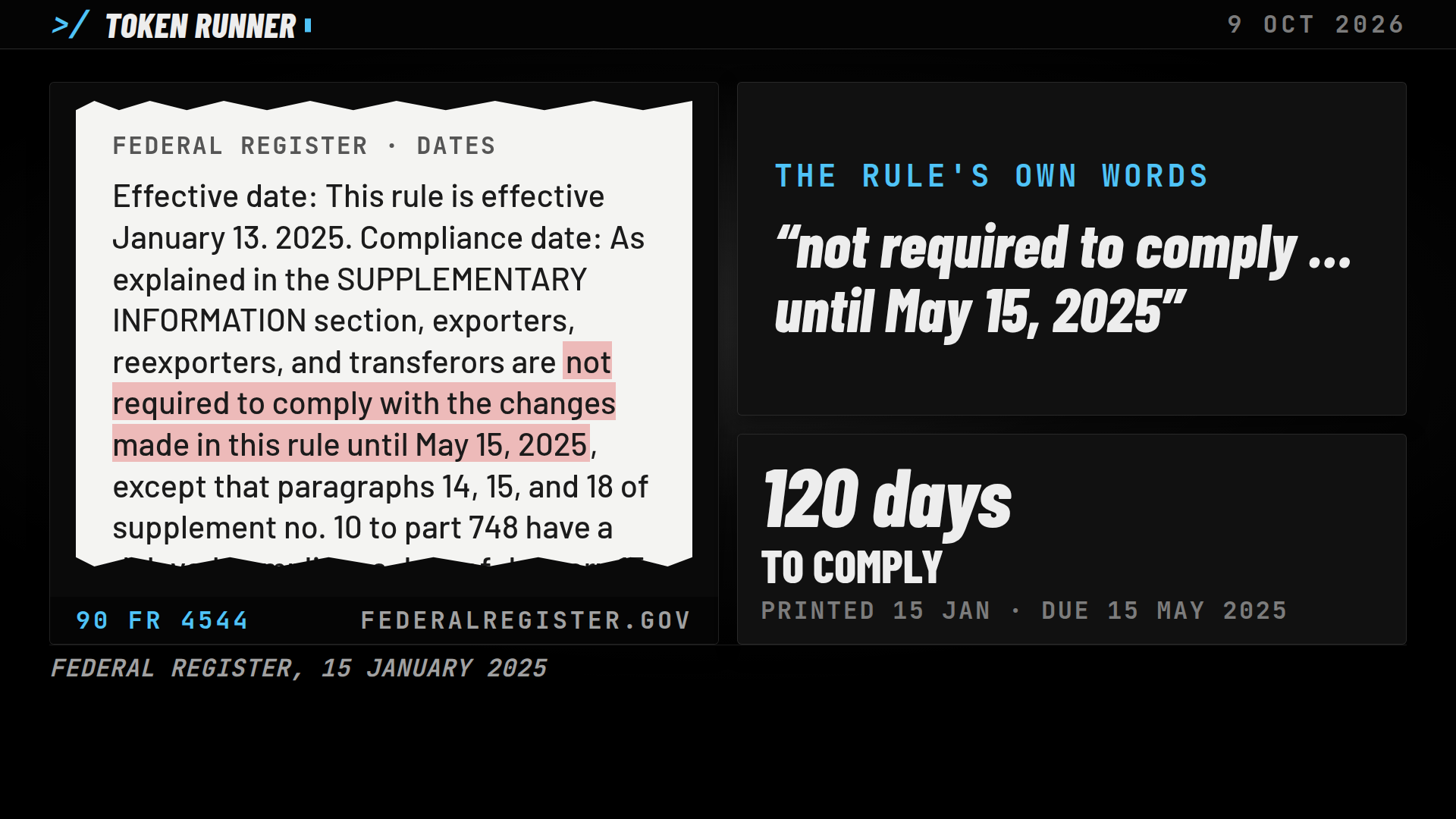
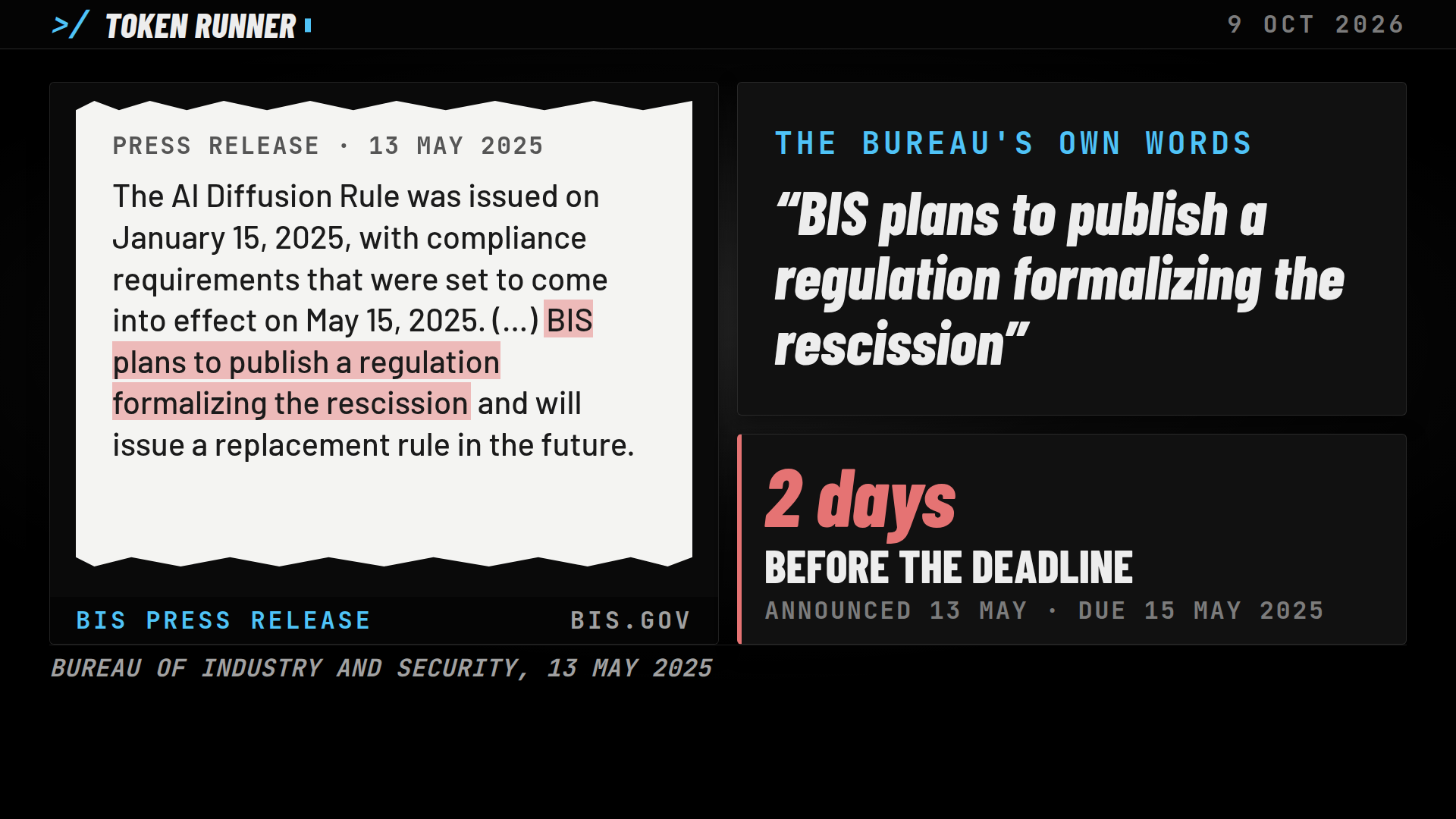
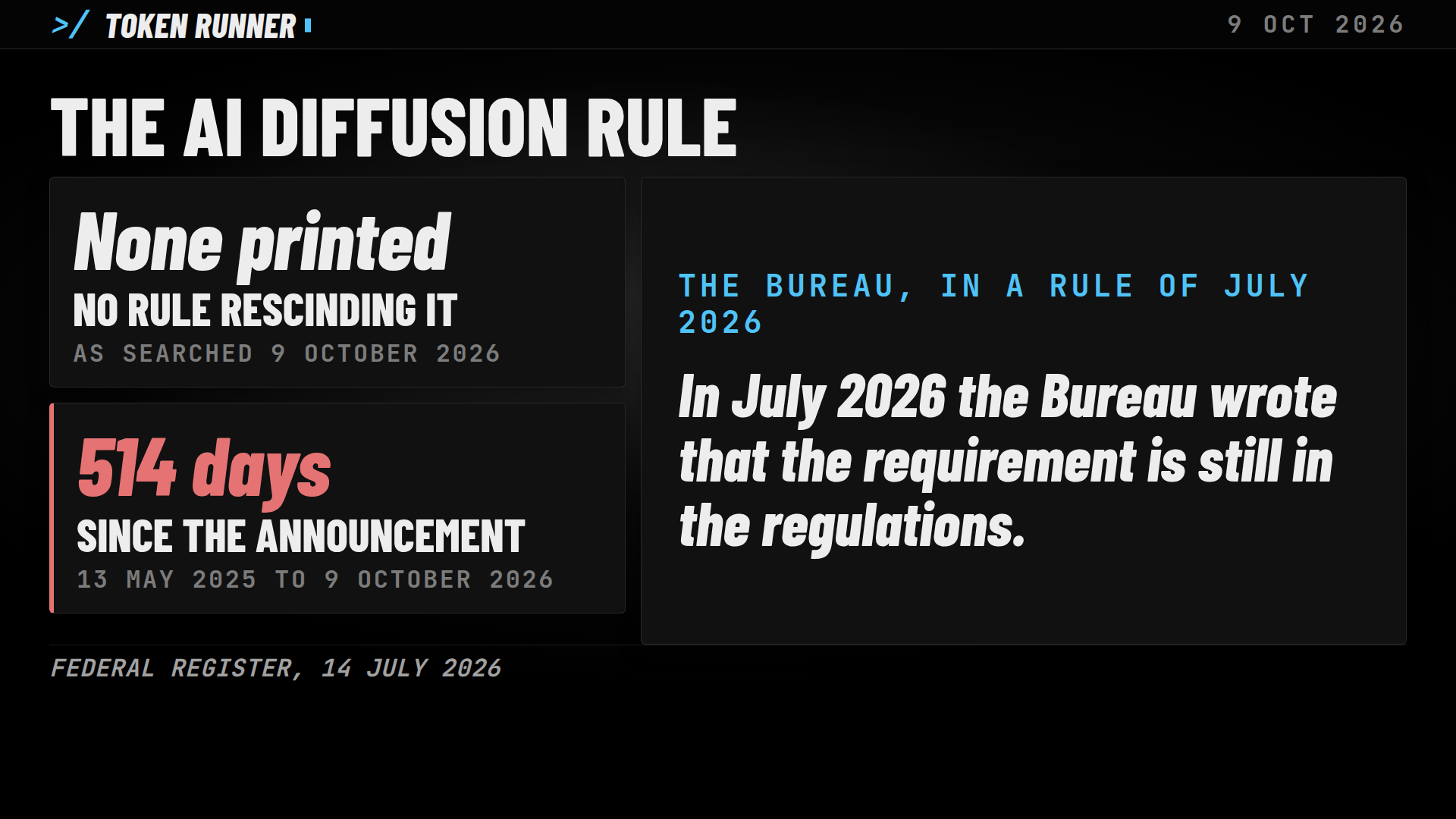
One rule did come with a long clock. The AI diffusion framework took effect on 13 January 2025 and was printed two days later, with what Nvidia's filing called "a 120-day delayed compliance period": nobody had to comply until 15 May. On 13 May the Commerce Department announced it was rescinding the rule and said the Bureau "plans to publish a regulation formalizing the rescission". TechCrunch reported that day that the department had "formally rescinded" the rule; the Bureau's own release says only that its Under Secretary "has instructed BIS enforcement officials not to enforce" it. In the record searched on 9 October 2026, none has been printed. That is 514 days. In a rule of July 2026 the Bureau wrote that the regulations still specify "a worldwide license requirement", and that it "is only enforcing this license requirement" for some destinations. No rule in the Register rescinds it.

A frame of the film: the AI diffusion rule's dates, not required to comply until May 15, 2025, 120 days
A frame of the film: the Bureau's press release, BIS plans to publish a regulation formalizing the rescission
A frame of the film: none printed, 514 days since the announcement

Waiting on a licence

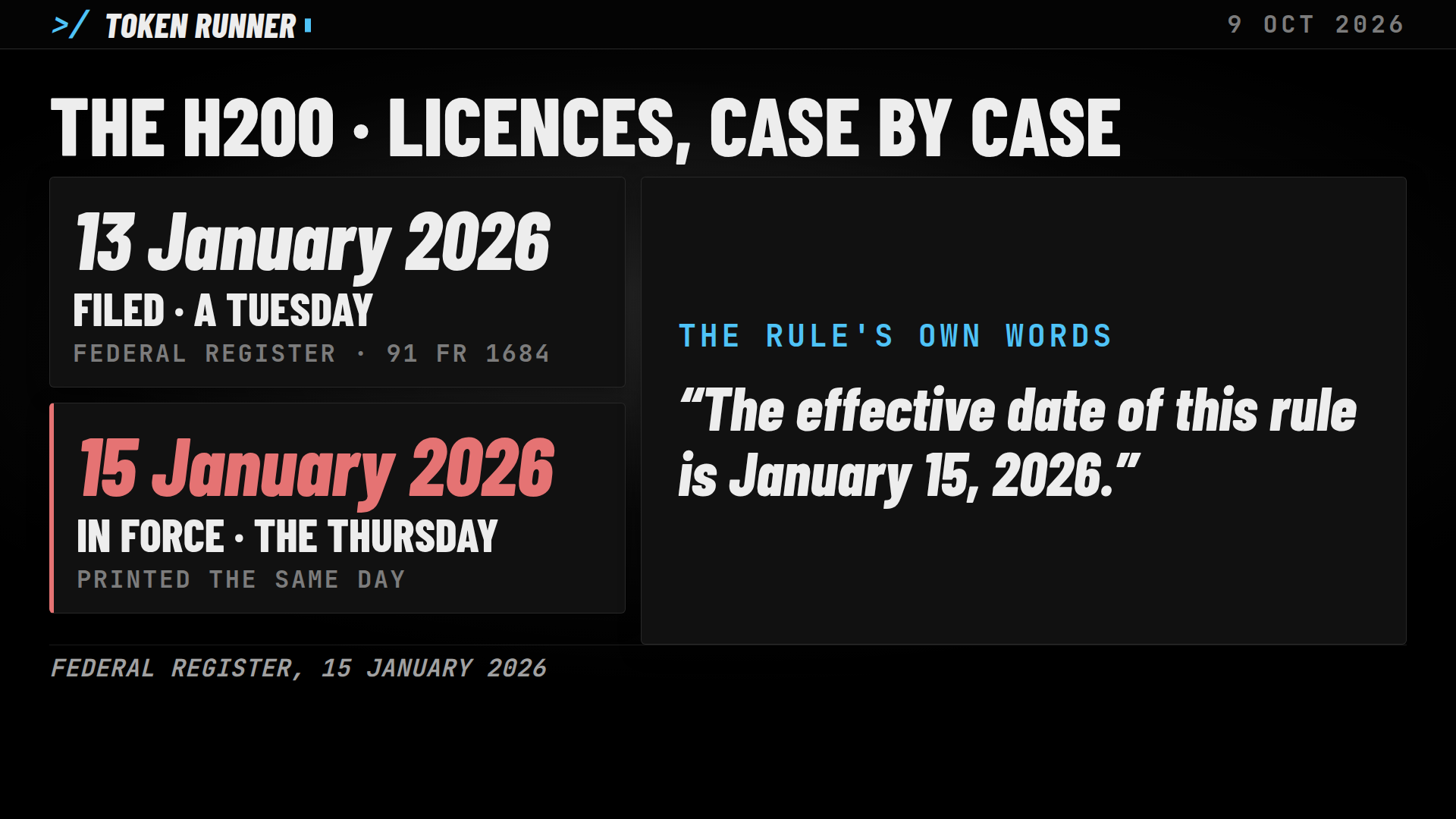
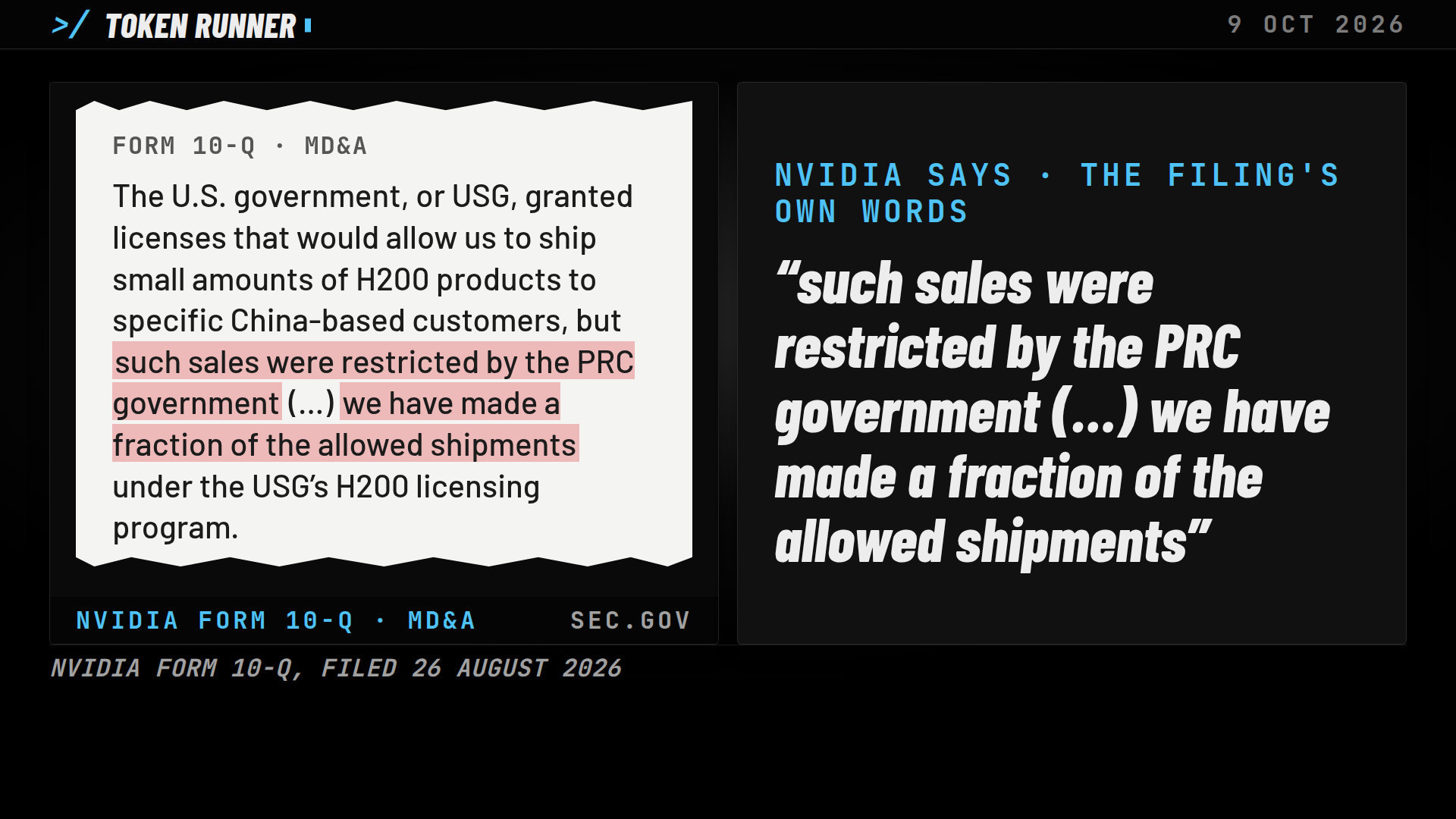
For an exporter the wait is now for a licence, not a rule. Nvidia says H20 licences were granted in August 2025, about four months after it was told, and that by November they had produced about $50 million of revenue. The rule that let H200 sales to China be considered case by case was filed on 13 January 2026 and was printed and in effect two days later, with no comment period: it declares itself exempt from "delay in effective date". Nvidia's annual report says a licence was granted in February. It has since made "a fraction of the allowed shipments", and says the sales "were restricted by the PRC government". It also reported, in November 2025 and again in February 2026, that officials had expressed an expectation that the government would receive 15 per cent or more of licensed revenue, and that no regulation said so.

A frame of the film: the H200 rule, filed 13 January 2026 and in force 15 January 2026
A frame of the film: Nvidia's Form 10-Q, a fraction of the allowed shipments

What the conversation says

Two posts touch the point. Miles Brundage wrote on X on 1 October 2026 of "policy turning on a dime after a meeting btwn Trump and Jensen". The record supports the first half: notices to a company, same-day rules, a rescission by announcement. No filing or rule read for this piece records a meeting. Epoch AI wrote on 17 September that the US "banned exports of Nvidia’s A800/H800 GPUs to China (October 2023)". The rule imposed a licence requirement with a presumption of denial, and its legal date was 17 November; October is when Nvidia was told.

The Bureau's own account runs the other way. On 30 September 2025 it posted the words of its Under Secretary, Jeffrey Kessler: "BIS is closing the loopholes and ensuring that export controls work as intended." A rule extending its controls to the affiliates of listed companies was printed that day; the two share a date, and no more is claimed here. Six weeks later that rule was suspended for a year. It was in effect before it was printed, and so was its suspension.

Miles Brundage@Miles_BrundageOPEN THE POST ON X →

To clarify, if Oracle were actually rigorously monitoring how it was used + prepared to intervene I’d feel differently (likewise for selling chips in some cases, though the bar is higher in the latter case for effectiveness of monitoring).

I just have no reason to think that’s the situation given the general state of export control policy (rampant smuggling tolerated for years, huge loopholes lasting years, policy turning on a dime after a meeting btwn Trump and Jensen, etc) though hopefully I’m missing something here!

AS POSTED ON X

Epoch AI@EpochAIResearchOPEN THE POST ON X →

This flow began a few months after the US banned exports of Nvidia’s A800/H800 GPUs to China (October 2023) and then collapsed within weeks of Malaysia requiring a permit to export or transship high-performance AI chips (July 2025).

AS POSTED ON X

“For too long, loopholes have enabled exports that undermine American national security and foreign policy interests. Under this Administration, BIS is closing the loopholes and ensuring that export controls work as intended." - Under Secretary Jeffrey I. Kessler https://t.co/XsoEj4KUBu

AS POSTED ON X

Two things to watch. Whether the rescission is ever printed. And whether the next chip rule comes with a date in the future, or with a notice.

Sources