
Token Runner
INDUSTRY · AN INTERLINKED PRODUCTION · 9 October 2026

Who holds the Nvidia chips

Trillion-dollar valuations and the future of artificial intelligence hinge on a single question: who actually holds Nvidia's AI chips? No public ledger exists, but Epoch AI's data points to Microsoft, while buyer spending places Amazon first and the top labs own very little. As Nvidia invests in its own buyers, who holds the hardware, who pays for it, and who uses it are now three separate questions.

The estimate

Nobody publishes a ledger of who owns Nvidia's AI chips. The closest thing to one is Epoch AI's chip-owners data, a model that works backwards from the vendors' recognised revenue and the chips' known compute to estimate how many H100-equivalents each large buyer holds. In Epoch's own words, on its data page as read on 9 October 2026, the explorer "tracks ownership, not usage", and its numbers are made with "Monte Carlo models incorporating uncertainty in both the total volume and computing power of AI chips". An H100-equivalent is Epoch's unit: the compute of one H100 at dense 8-bit operations, so a newer chip counts as more than one and the figures here count compute, not chips. Epoch adds that it attributes ownership "informally without strict legal/financial criteria" and that its hub "is not intended to serve as a tool for financial analysis of the companies mentioned".

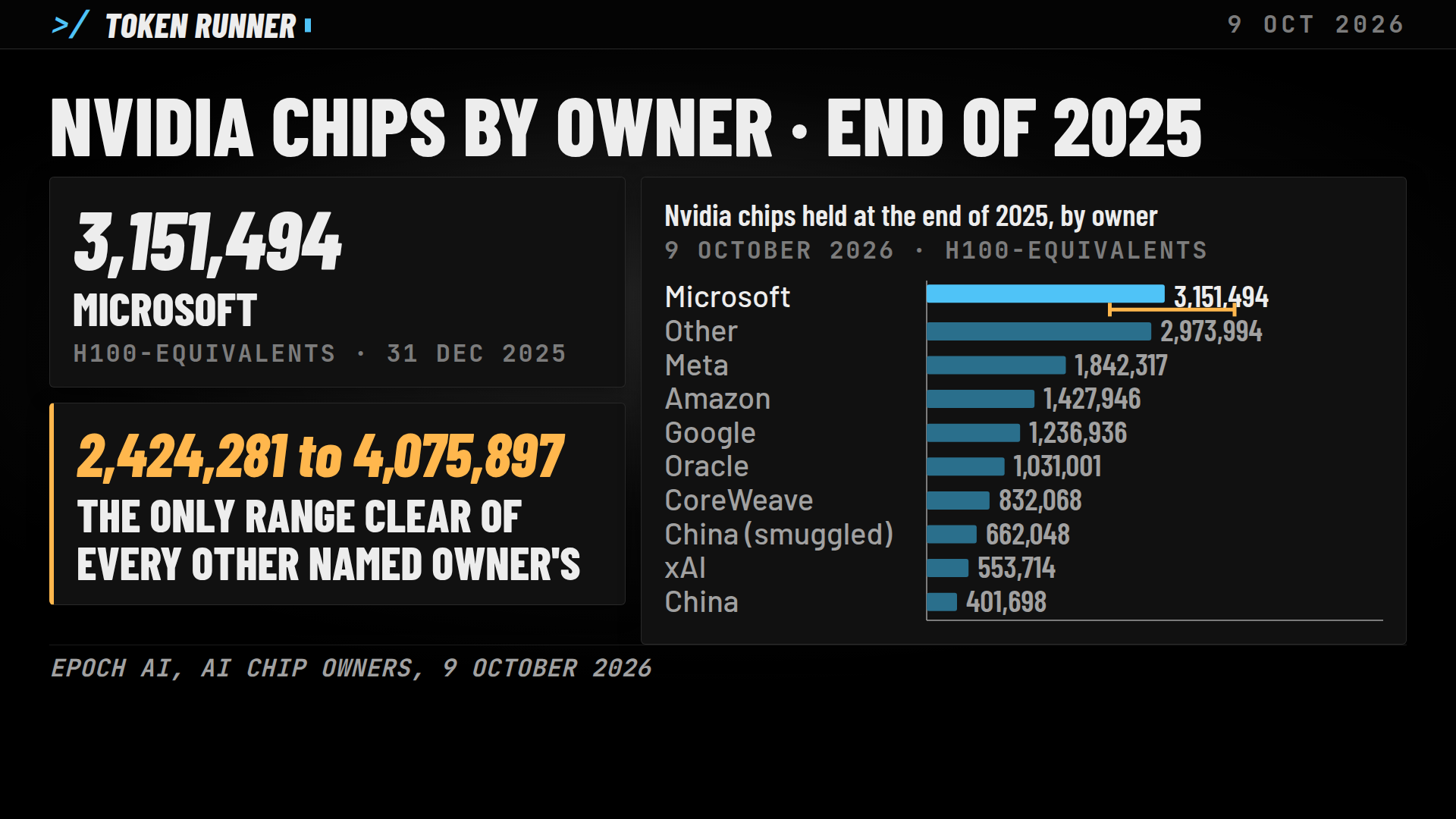
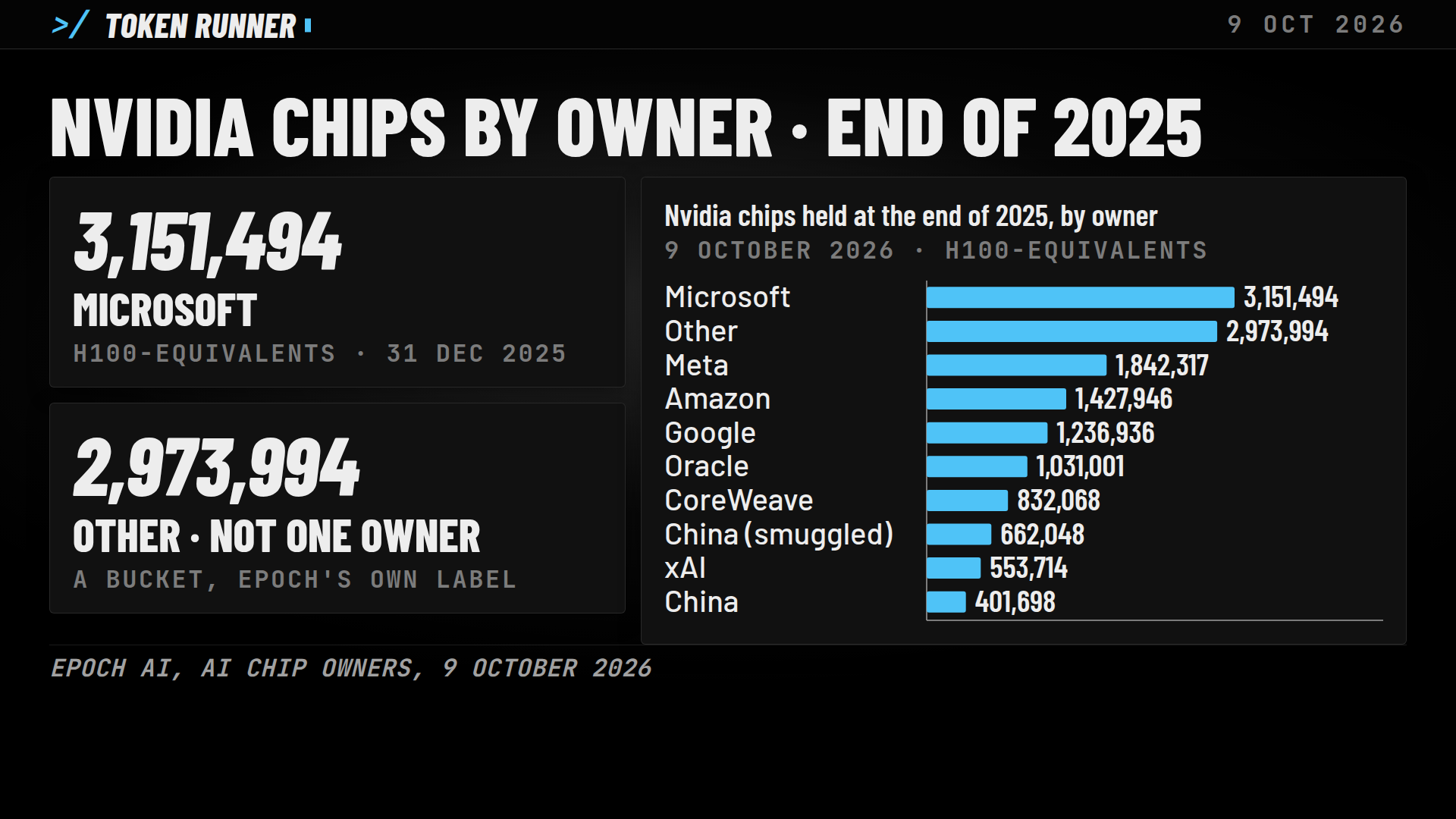
On that measure, as of 31 December 2025 and in Token Runner's 9 October 2026 collection of Epoch's file, Microsoft held about 3.2 million H100-equivalents of Nvidia chips, in a range from 2.4 million to 4.1 million. A row Epoch calls "Other", which its documentation says includes neoclouds, "Sovereign AI" projects, enterprises and research organisations, held about 3.0 million. Then Meta at about 1.8 million, Amazon 1.4 million, Google 1.2 million, Oracle 1.0 million and CoreWeave about 830,000. xAI held about 550,000, an estimate Epoch marks as lumpy and lagging because it is read from deployed data centres rather than from sales, and it carries no range. The chart has the exact figures.

OPEN THE INSTRUMENT →
A frame of the film: Microsoft's range, the only one clear of every other named owner's

The ranges matter more than the order. Microsoft's low end sits above every other named owner's high end, so Microsoft stands clear; the one exception is the "Other" row, whose range, from 2.0 million to 4.2 million, contains Microsoft's. Below it, every range overlaps at least one other: Meta's runs from 1.4 million to 2.4 million and Amazon's from 1.1 million to 1.8 million; Google's from 1.0 million to 1.6 million and Oracle's from about 770,000 to 1.4 million; CoreWeave's, the narrowest, from about 790,000 to 880,000, inside Oracle's. Epoch's data does not put those five in a complete order, and this article does not either.

A frame of the film: Nvidia chips by owner at the end of 2025, Microsoft and the Other row

Why it is an estimate, even at the source

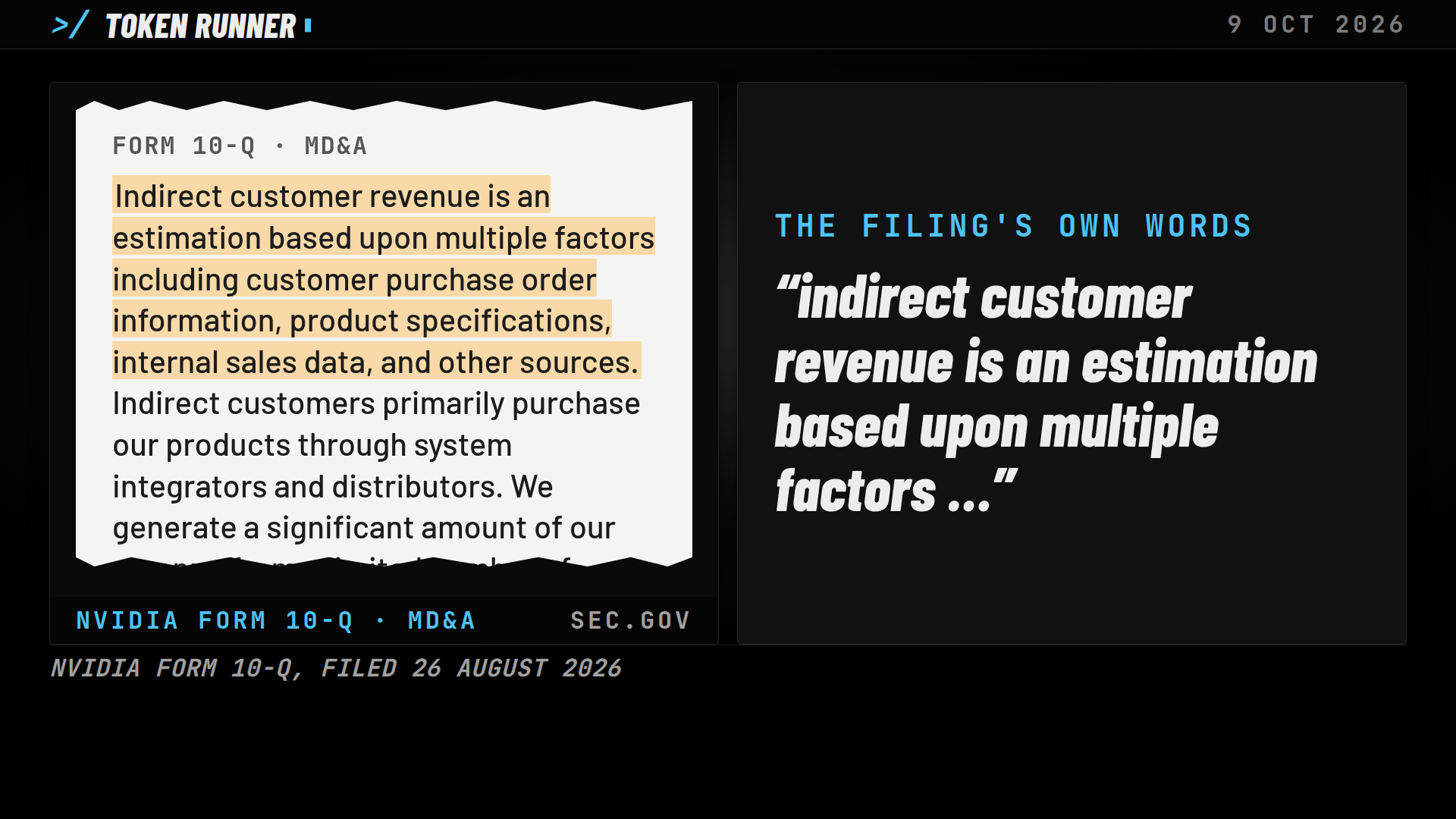
Nvidia does not publish a ledger either, and its own filings call part of its customer revenue an estimation. In its annual report for the fiscal year ended 25 January 2026, filed with the SEC on 25 February 2026, Nvidia says that "sales to one direct customer represented 22% of total revenue and sales to another direct customer represented 14%". But Nvidia's direct customers are, in its words from the quarterly report filed on 26 August 2026, "add-in board manufacturers, or AIBs, distributors, original design manufacturers, or ODMs, original equipment manufacturers, or OEMs, cloud service providers, or CSPs, AI model makers, and system integrators". The companies that end up with the chips are often indirect customers, and Nvidia writes: "Indirect customer revenue is an estimation based upon multiple factors including customer purchase order information, product specifications, internal sales data, and other sources".

“Indirect customer revenue is an estimation based upon multiple factors including customer purchase order information, product specifications, internal sales data, and other sources”

Nvidia, Form 10-Q, filed 26 August 2026

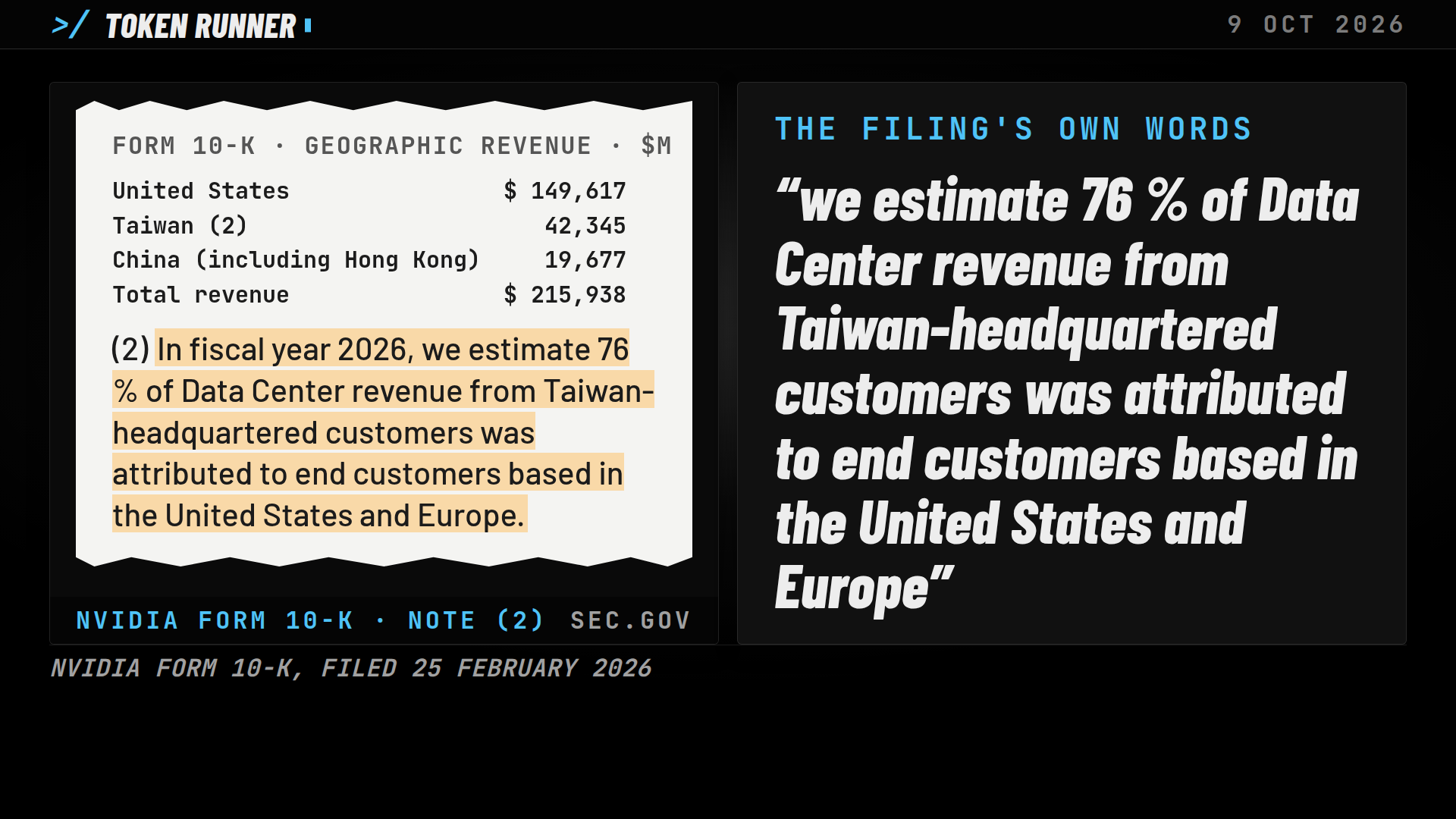
The geography says the same thing. Nvidia reports revenue by the headquarters of its direct customer, and it estimates that 76 per cent of the Data Center revenue it booked to customers headquartered in Taiwan in fiscal 2026 was attributed to end customers in the United States and Europe. In its report for the quarter to 26 July 2026 Nvidia also names, without naming, "one AI research and deployment company" that contributed "a meaningful amount of our revenue" through cloud purchases. So Epoch's count and Nvidia's own figure for its indirect customers are both estimates.

A frame of the film: Nvidia's Form 10-K: revenue by geography and the 76 per cent estimate
A frame of the film: Nvidia's Form 10-Q: indirect customer revenue is an estimation

The money trail, in a different order

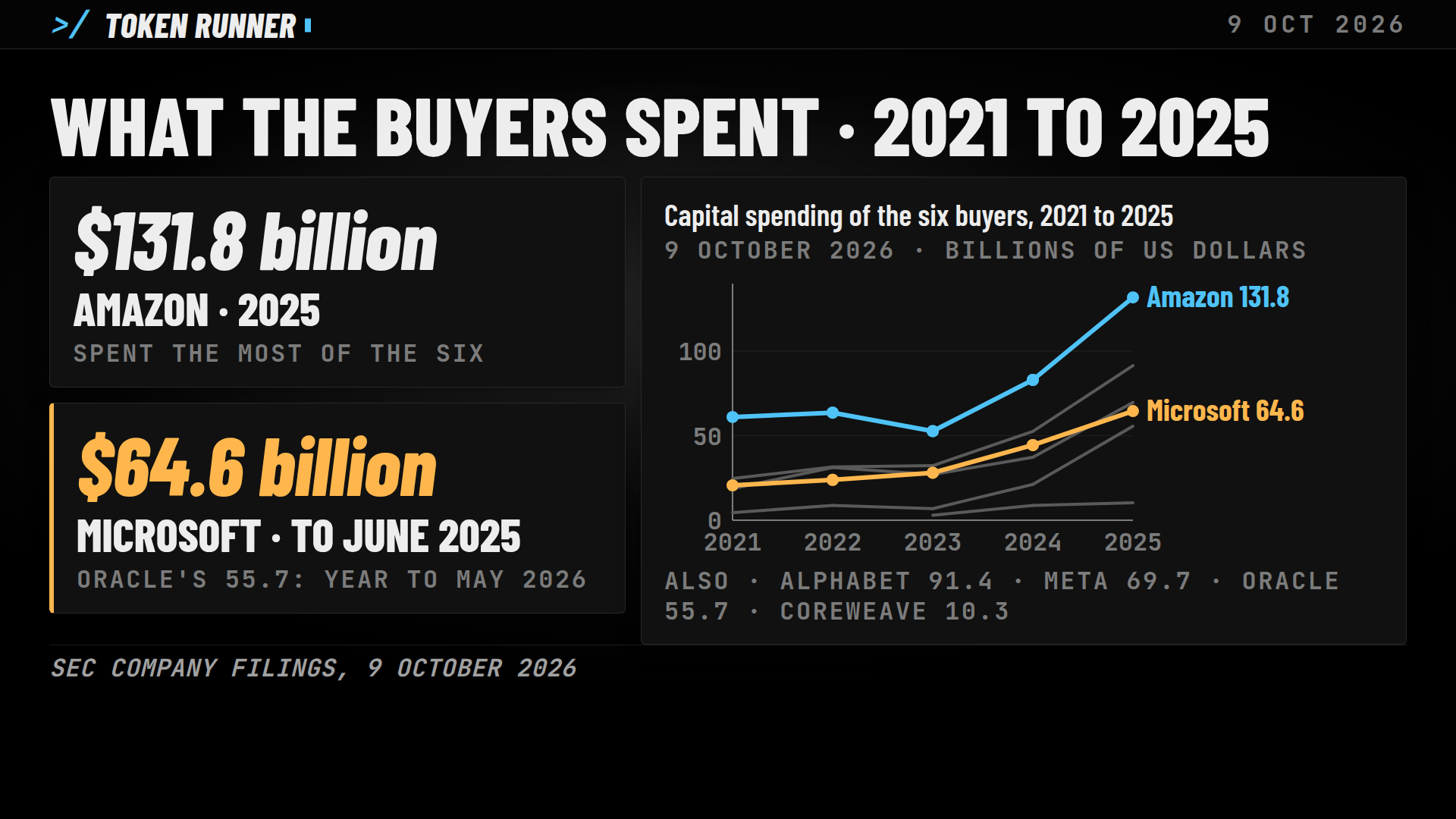
Four of the six buyers' latest filings do not use the word Nvidia: Microsoft's annual report for the year to 30 June 2026, Alphabet's and Meta's quarterly reports for June 2026, and Oracle's quarterly report filed on 11 September 2026. Amazon's quarterly report for June 2026 uses it once. CoreWeave's quarterly report for June 2026 uses it seven times, among them: "all of the GPUs used in our infrastructure today are NVIDIA GPUs". What the buyers file is what they spent, and it puts the buyers in a different order from Epoch's. By the spending on property and equipment each company files for 2025, Amazon is first at $131.8 billion; Alphabet is next at $91.4 billion; then Meta at $69.7 billion; Oracle at $55.7 billion in its fiscal year to May 2026; and CoreWeave at $10.3 billion. Microsoft, first by Epoch's count of Nvidia chips, spent $64.6 billion in its fiscal year to June 2025 and $115.9 billion in the year to June 2026, which the chart leaves out; its 2025 point for Microsoft is the year to June 2025, and for Oracle the year to May 2026.

OPEN THE INSTRUMENT →
A frame of the film: what the buyers spent, 2021 to 2025

The two orders disagree, and the records explain most of the gap. Capital spending buys buildings, land, power and networks as well as chips, and the filings do not split it. And Amazon and Google buy their own chips too: Epoch puts Google's holdings of its own TPUs at about 3.8 million H100-equivalents at the end of 2025 and Amazon's Trainium at about 1.0 million. Add Google's own chips to its Nvidia ones, which is the one sum our table allows, a sum of two of Epoch's medians with no range, and Google holds about 5.0 million H100-equivalents against Microsoft's 3.4 million including Microsoft's AMD chips. Who holds the most Nvidia chips, who spends the most and who holds the most compute are three questions with three different answers.

Owning and using

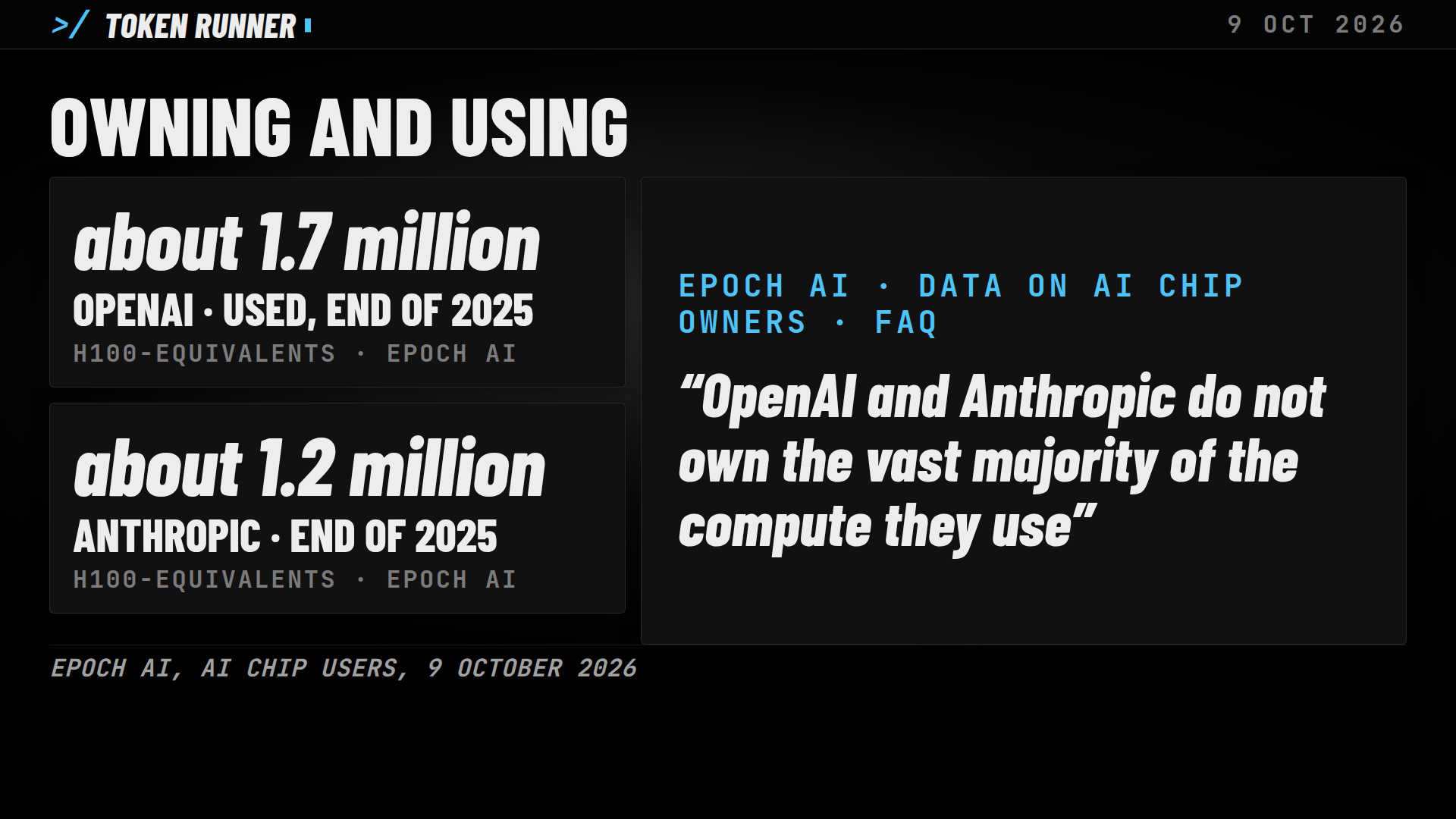
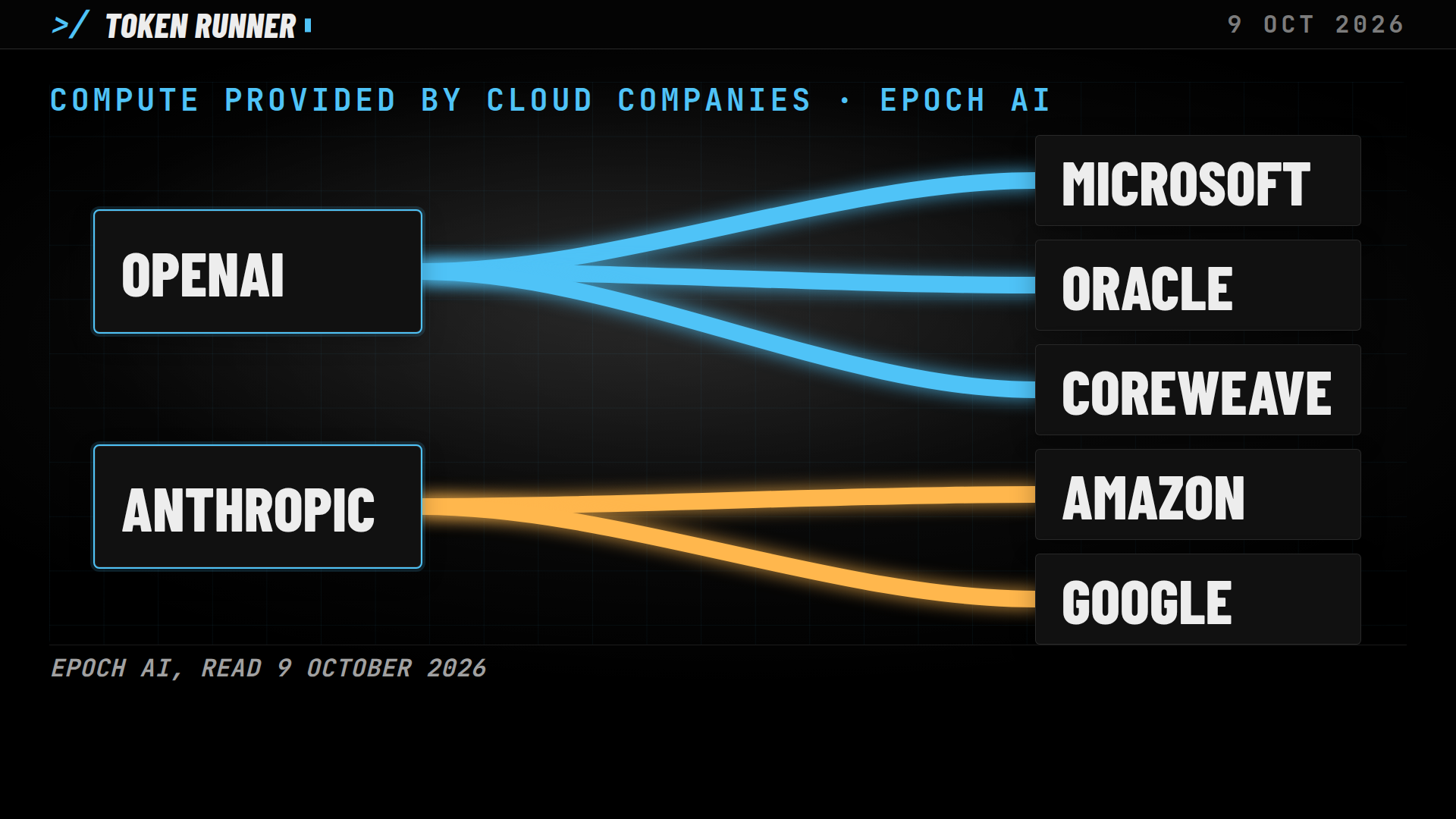
OpenAI and Anthropic own little of the compute they use. Epoch's separate file on chip users, generated on 9 September 2026 and collected on 9 October, estimates that OpenAI used about 1.7 million H100-equivalents at the end of 2025 and Anthropic about 1.2 million. Of the two Epoch's documentation says that "OpenAI and Anthropic do not own the vast majority of the compute they use", which is provided by cloud companies, "primarily Microsoft, Oracle (including 'Stargate'), and CoreWeave for OpenAI, and primarily Amazon and Google for Anthropic".

A frame of the film: what OpenAI and Anthropic used at the end of 2025A frame of the film: where OpenAI and Anthropic rent their compute

CoreWeave's quarterly report for June 2026 shows what that looks like from the landlord's side: three customers were 36, 26 and 10 per cent of its revenue in the quarter, where a year earlier one customer had been 71 per cent; OpenAI "committed to pay us up to approximately $6.5 billion through May 31, 2031"; Meta signed for up to about $21.0 billion; Jane Street for about $6.0 billion. And Nvidia bought $2.0 billion of CoreWeave's shares in January 2026.

Nvidia's financial ties to its customers are described one way in an investor's posts and another in Nvidia's own filing. Through the summer of 2026 the investor Michael Burry wrote on X that Nvidia was financing its own customers: on 22 July that Nvidia's "formal rebuttal was that its 'strategic' investments in its customers 'represent a minimal portion of revenue' already booked", while in the "forward book" of announced multi-year commitments "circular financing is nearly 100% to date"; on 12 August, of a "$500 billion" arrangement, that it "involves Nvidia taking 25% stakes & providing residual value guarantees on purchase of its chips".

Cassandra Unchained@michaeljburryOPEN THE POST ON X →

When the circularity questions got loud November of 2025, Nvidia’s formal rebuttal was that its “strategic” investments in its customers ‘represent a minimal portion of revenue’ already booked. Granted. However, BIS’s chart is about the announced multi-year commitments. This is the forward book, part of Jensen’s “visibility” to $1 trillion. There, circular financing is nearly 100% to date.
Short Thoughts - NVDA, Neos, Hyperscalers, Jevons Paradox, and Compression open.substack.com/pub/michaeljbu…

AS POSTED ON X
Cassandra Unchained@michaeljburryOPEN THE POST ON X →

That $500 billion $NVDA Wall Street stunt involves Nvidia taking 25% stakes & providing residual value guarantees on purchase of its chips. All filtered through Private Equity’s Private Credit schemes. I have an idea how that will look. Meet the new Boss. Same as the old Boss https://t.co/vzAnWLkhxI

AS POSTED ON X

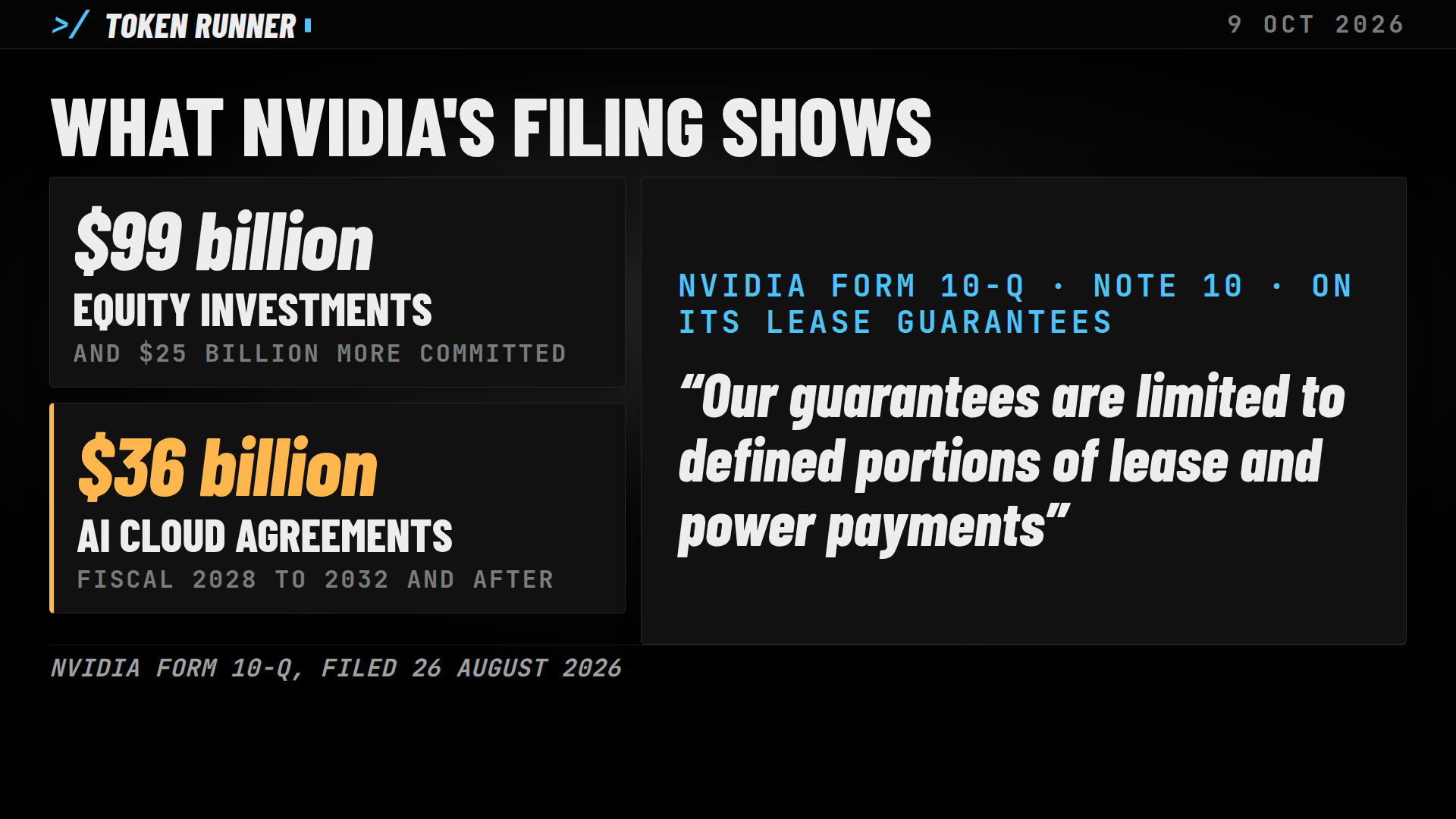
Nvidia's quarterly report, filed on 26 August 2026, says that in August Nvidia "entered into guarantees, capped at a total of $105 billion", for leases "on behalf of a customer, an affiliate of OpenAI Group PBC (OpenAI)"; that they "are limited to defined portions of lease and power payments"; and that payment is "triggered upon certain tenant defaults". It reports up to $3.5 billion of guarantees of AI cloud partners' leases "in the event of their default"; "equity investments of $99 billion and equity investment commitments of $25 billion" in what it calls "our ecosystem", naming no investee; and $36 billion of "AI cloud agreements" under which Nvidia has "agreed to purchase" committed capacity the clouds do not sell to others.

A frame of the film: what Nvidia's filing shows: 99 billion dollars of equity investments, 36 billion of AI cloud agreements

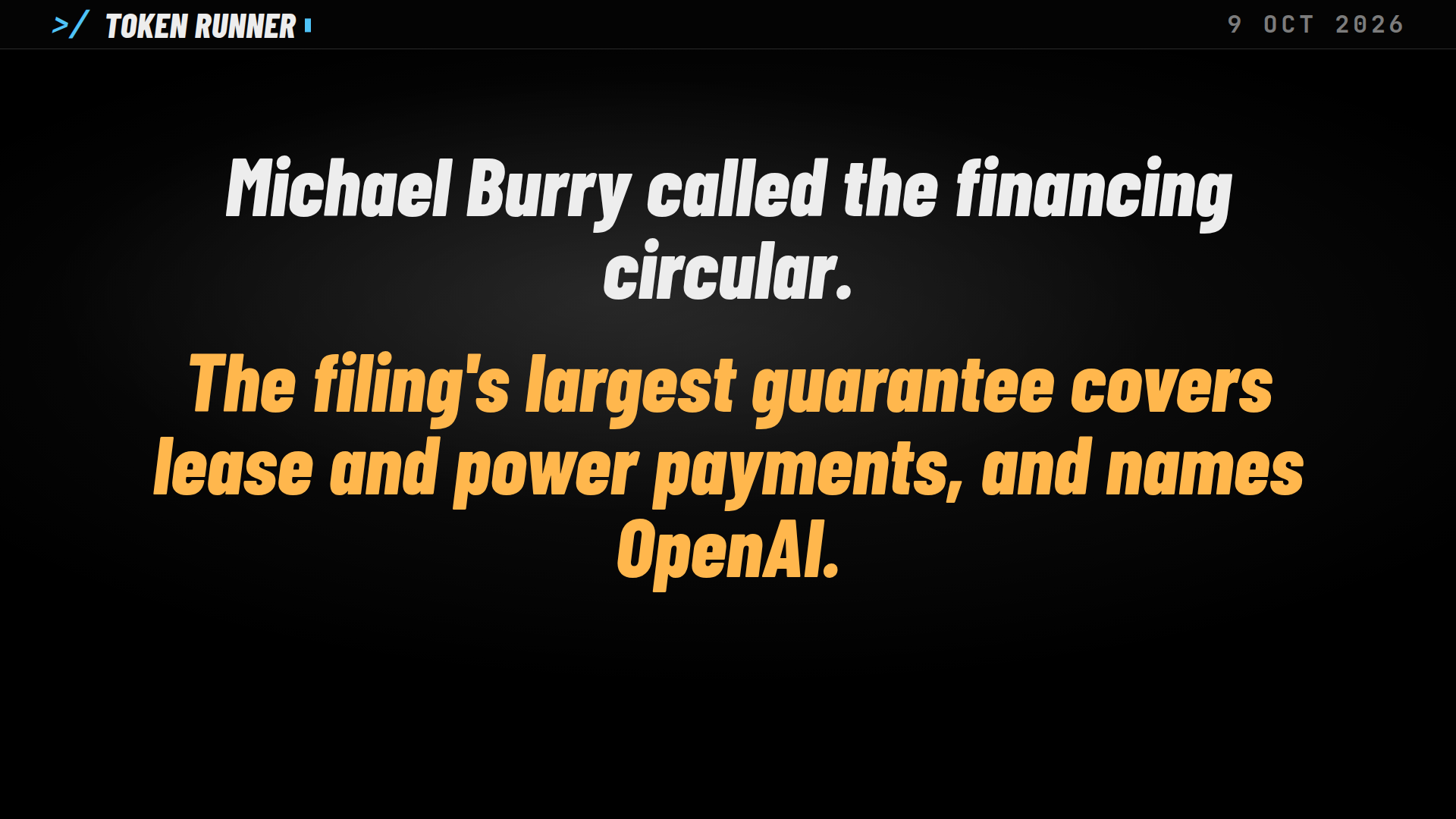
Of third-party financing platforms it says it "entered into memorandums of understanding" in August, that these "may not lead to definitive agreements", and that "At our option, we may provide limited residual-value support for a portion of specific projects"; and it lists as exhibit 10.1 a "Form of Residual Value Guaranty", which Token Runner has not read. Mr Burry's word for such ties, in his post of 22 July 2026, is circular. The filing does not use it, and names OpenAI for the lease guarantee alone. That is as far as the record read for this article goes.

The two rows for China

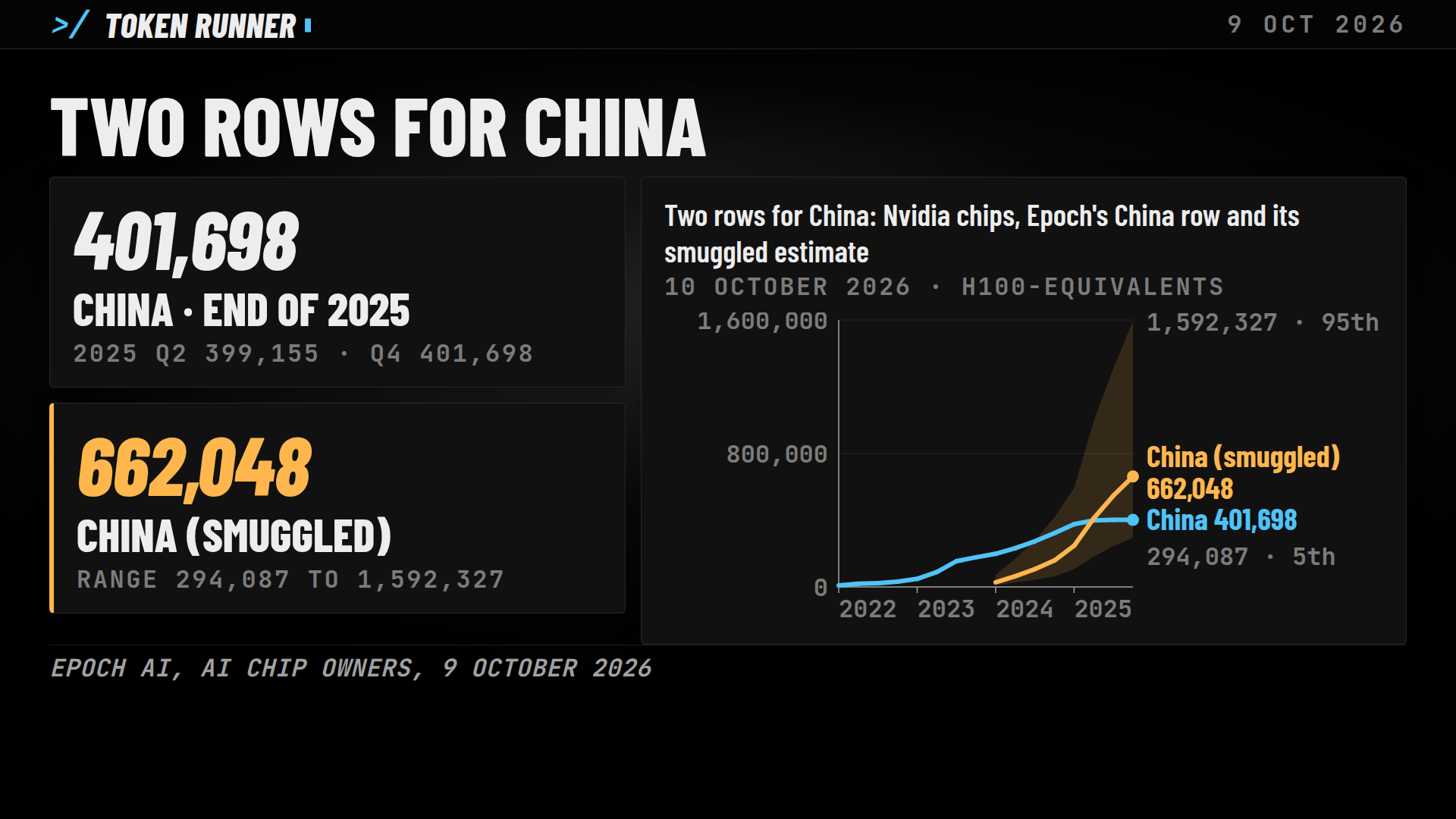
Epoch keeps two rows for China and says the first does not include smuggled chips. The row it calls "China", the chips it infers were sold to companies in the People's Republic, stood at about 400,000 H100-equivalents at the end of 2025 and has barely moved since the middle of 2025. That flat line is consistent with Nvidia's filings: a $4.5 billion charge in early 2025 for H20 chips it could no longer sell, about $60 million of H20 revenue under the licences granted in August 2025, and, in the quarter to July 2026, Hopper shipments to China at less than one per cent of Data Center revenue, with H200 licences granted by Washington but sales "restricted by the PRC government".

OPEN THE INSTRUMENT →
A frame of the film: two rows for China, Epoch's China row and its smuggled estimate

The second row, "China (smuggled)", is what Epoch calls a speculative estimate from a separate model of diverted and resold chips: about 660,000 H100-equivalents at the end of 2025, in a range from about 290,000 to 1.6 million. Its low end is below the China row, and its high end, 1.6 million, is about four times the China row's 400,000. Here the conversation adds what the filings cannot. In an X thread on 17 September 2026 Epoch wrote that China recorded "$3.8 billion in server imports from Malaysia, averaging $106,000 each", a flow that "could represent 150,000 H100e of compute, about a quarter of our earlier modeled estimate of all chips smuggled into China through 2025", while adding: "This doesn't prove diversion". CSET put the measurement problem in one line on 6 October 2026: "AI chip smuggling is like an iceberg: we only see what's above the surface."

Epoch AI@EpochAIResearchOPEN THE POST ON X →

For a sense of scale, this trade could represent 150,000 H100e of compute, about a quarter of our earlier modeled estimate of all chips smuggled into China through 2025.

Read our previous full report on our modeled estimates: epoch.ai/publications/c…

AS POSTED ON X
CSET@CSETGeorgetownOPEN THE POST ON X →

#AI chip smuggling is like an iceberg: we only see what’s above the surface. To estimate its true scale, we need to know how much is hidden below the waterline. Whether that’s 50% or 90% makes a big difference. In this Q&A, @jacob_feldgoise describes how location verification methods can—and cannot—improve enforcement of export controls on these powerful chips. Link below ⬇️

AS POSTED ON X

Where the next chips go

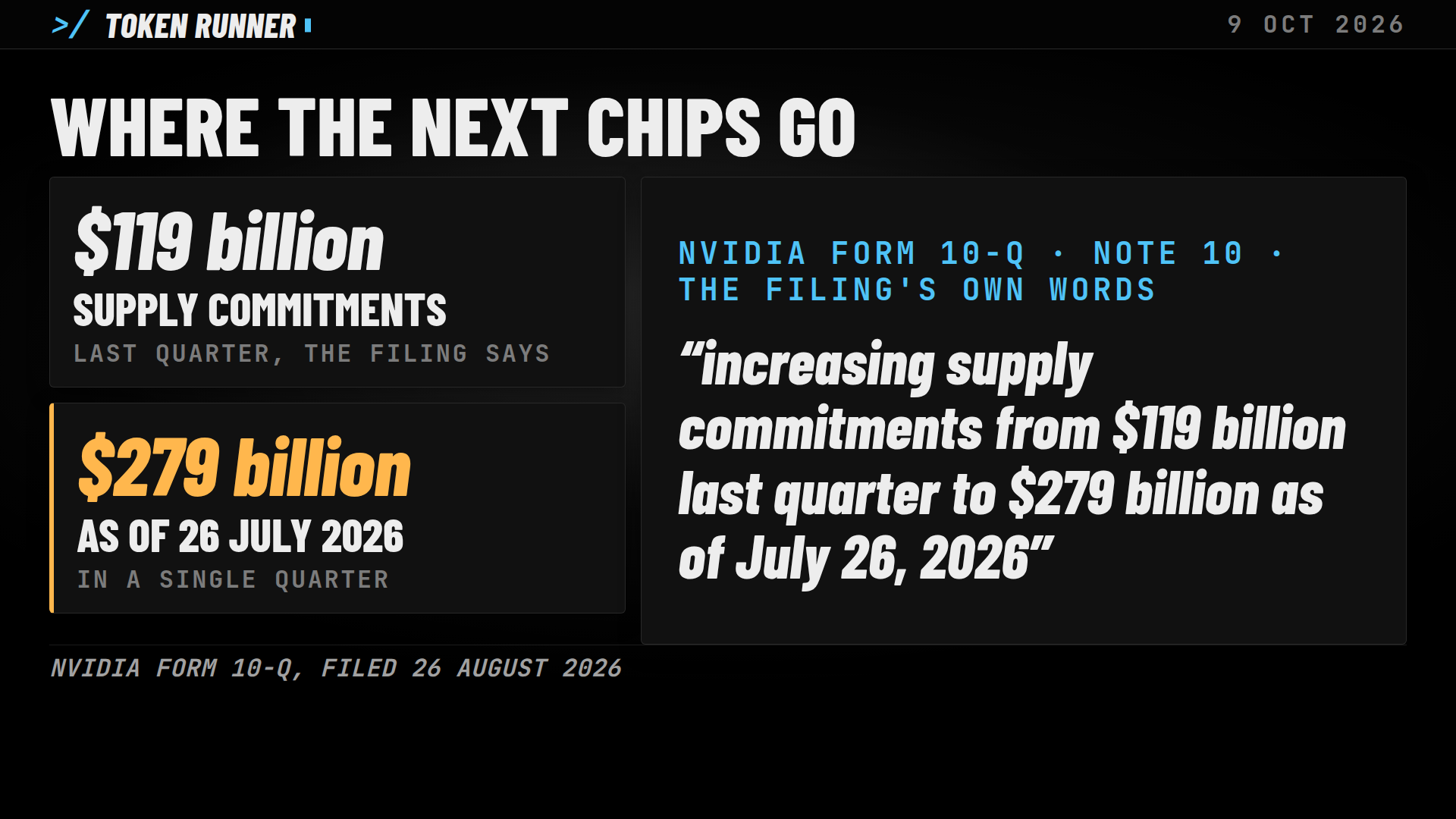
The holders are estimates. The commitments are filed. Nvidia's quarterly report for the period to 26 July 2026 shows its own supply and capacity commitments rising "from $119 billion last quarter to $279 billion", for "primarily memory and manufacturing facilities, to produce our products for long-term demand", and notes that Blackwell "continued to account for the majority of our system shipments", that the next architecture, Vera Rubin, "began production shipments", and that Nvidia is "currently experiencing certain supply constraints".

A frame of the film: supply commitments, 119 to 279 billion dollars

The buyers have filed commitments too, of two kinds: what Alphabet is committed to pay, and the contracted revenue Microsoft and Oracle have yet to recognise. Alphabet reports $707.0 billion of fixed or guaranteed commitments, "the significant majority of which related to long-term supply agreements". Microsoft reports commercial remaining performance obligations of $678 billion; Oracle, $664 billion, up from $455 billion a year earlier, an increase it calls "primarily attributable to certain significant cloud contracts". None of those numbers is a count of chips, and none says which chips. But they are what is filed.

A frame of the film: Michael Burry called the financing circular; the filing's largest guarantee covers lease and power payments, and names OpenAI
A frame of the film: the film's closing frame

Two things to watch. Whether Epoch's ranges narrow as the vendors' filings catch up with deliveries. And whether the users become owners: OpenAI and Anthropic, who today rent from Microsoft, Oracle, CoreWeave, Amazon and Google.

Sources
  • Epoch AI, AI chip owners, cumulative by designer, 9 October 2026 data collection
  • Epoch AI, AI chip users, year end by lab, 9 October 2026 data collection
  • Epoch AI, Data on AI chip owners, documentation and FAQ, epoch.ai, read 9 October 2026
  • SEC EDGAR company facts, 9 October 2026 data collection
  • SEC EDGAR 10-Q and 10-K commitment facts, 9 October 2026 data collection
  • Nvidia, Form 10-K for the fiscal year ended 25 January 2026, filed 25 February 2026
  • Nvidia, Form 10-Q for the quarter ended 26 July 2026, filed 26 August 2026
  • Microsoft, Form 10-K for the fiscal year ended 30 June 2026, filed 29 July 2026
  • Amazon, Form 10-Q for the quarter ended 30 June 2026, filed 31 July 2026
  • Alphabet, Form 10-Q for the quarter ended 30 June 2026, filed 23 July 2026
  • Meta, Form 10-Q for the quarter ended 30 June 2026, filed 30 July 2026
  • Oracle, Form 10-Q for the quarter ended 31 August 2026, filed 11 September 2026
  • CoreWeave, Form 10-Q for the quarter ended 30 June 2026, filed 12 August 2026
  • X posts: Michael Burry, 22 July and 12 August 2026; Epoch AI, 17 September 2026; CSET, 6 October 2026