The Needle's Eye
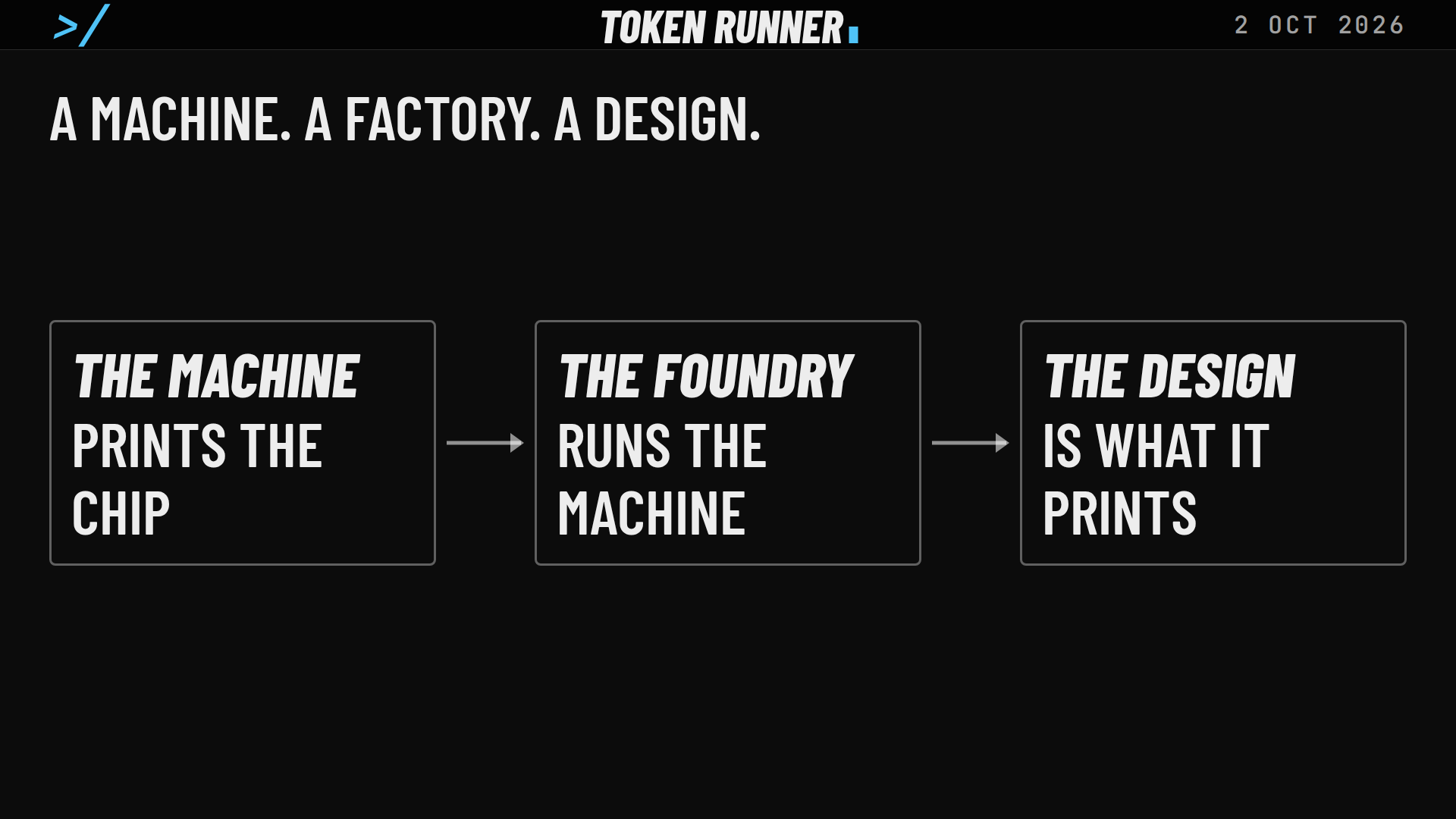
A chip needs a machine, a factory and a design. At each of those three steps one company stands far ahead, each by its own measure. This piece sets the three side by side, each with its source and its date, and says what to watch.
The claim
Every argument about the AI build-out assumes the chips keep coming. They come through three steps: a machine prints them, a factory runs the machine, and a designer decides what is printed. Each step has a leader with a long lead. That is not the same thing at each step, and the three leads are measured three different ways: one by who sells a machine at all, one by a share of revenue, one by an estimate of computing power. So each layer here gets its own number, its own source and its own date, and no sum is drawn across them. What the three have in common is only the shape: one company far ahead, and a second number that is small or missing.
The machine
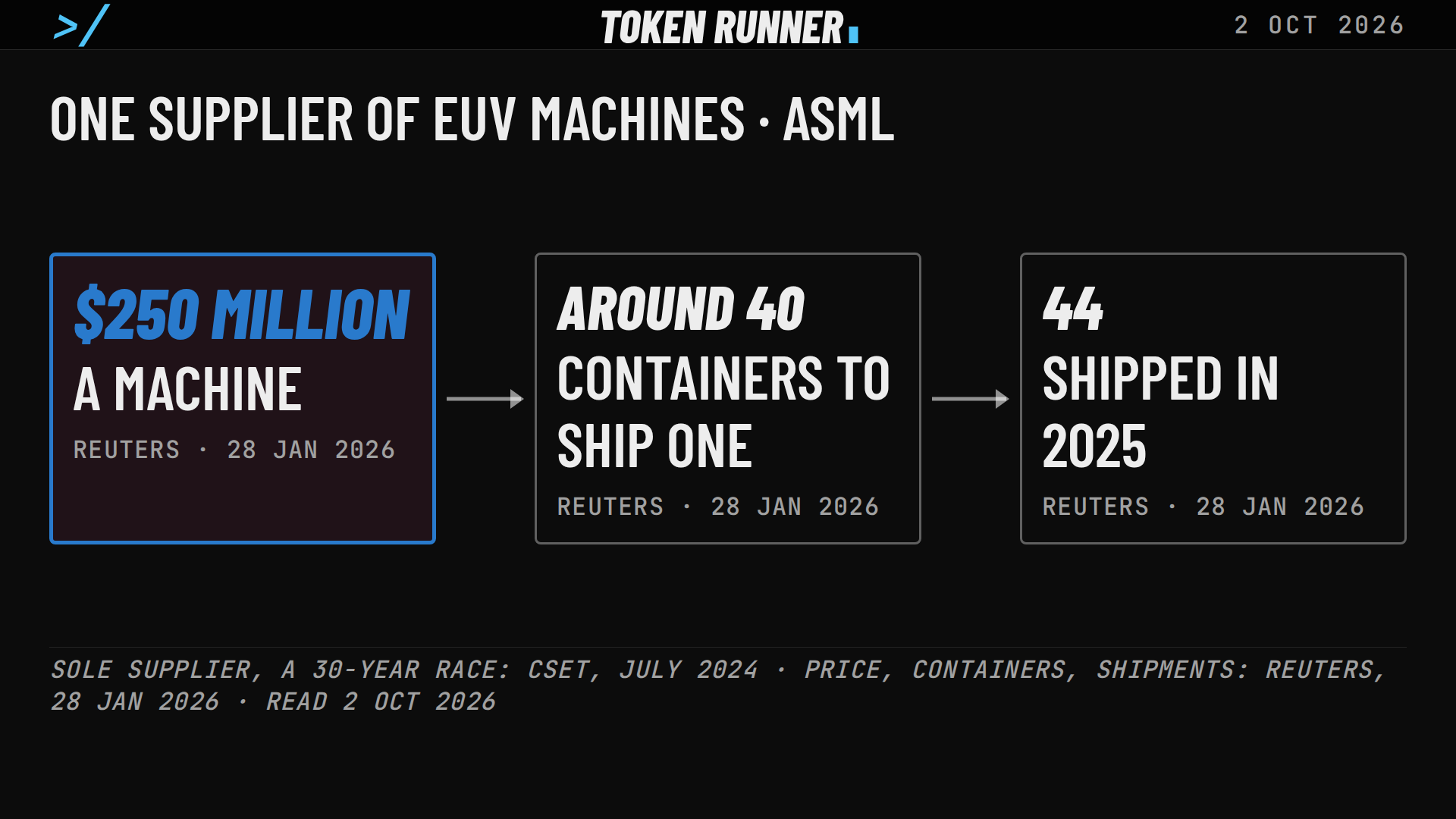
The first step is a machine. A study of July 2024 from Georgetown's Center for Security and Emerging Technology calls ASML, of the Netherlands, "the sole supplier of EUV machines", the winner of "a 30-year race", and calls its tool essential for fabricating leading-edge semiconductors. Reuters, in January 2026, put the price of one at $250 million. It ships in around 40 containers, on 747 cargo planes. In 2025 ASML shipped 44 of them. A newer and different machine, called High NA, costs around $400 million, by CNBC's report of September 2026. For the EUV machine itself there is no second supplier to set beside ASML. This is the one layer where the second number is nothing.
The order book
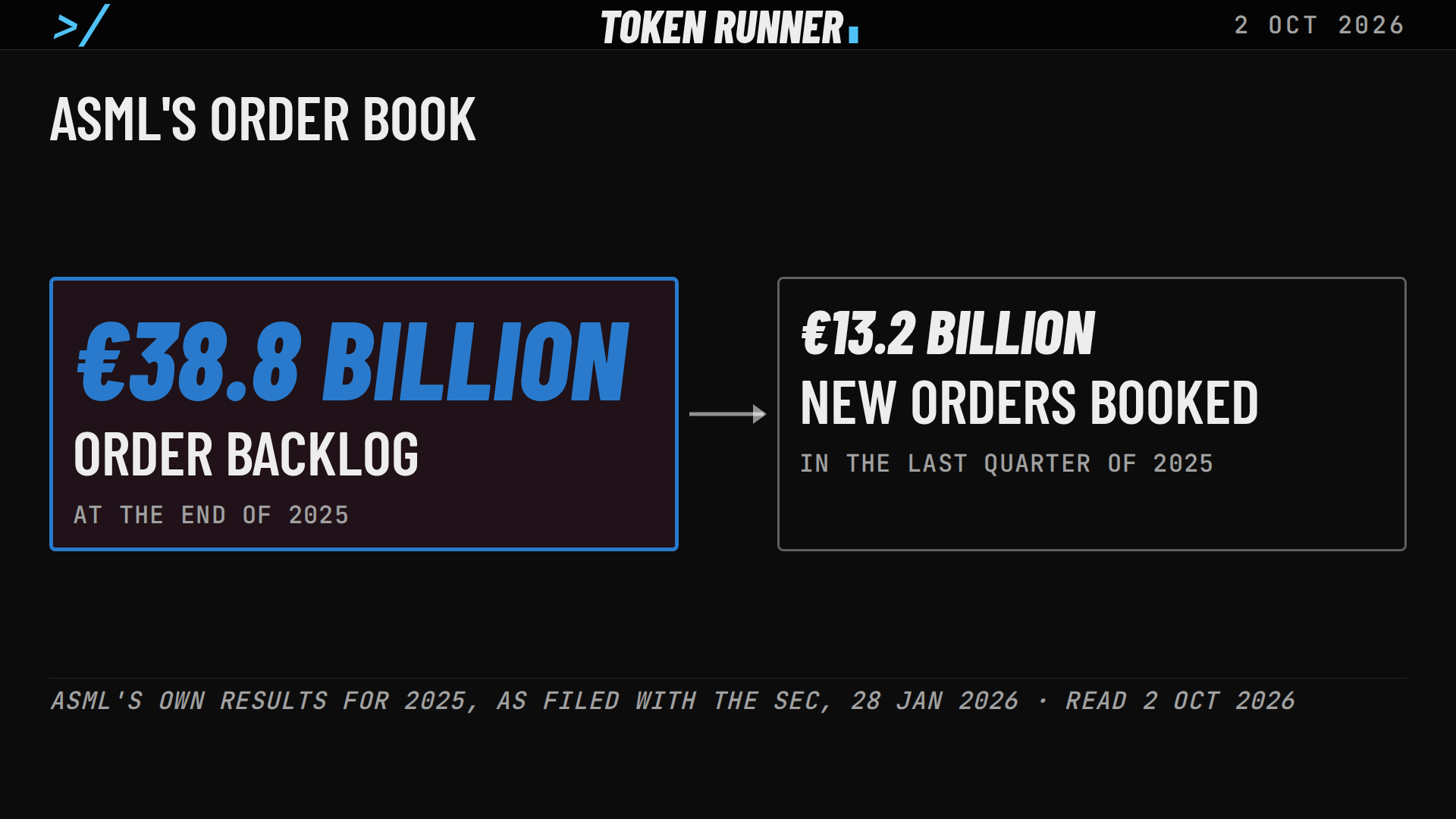
At the end of 2025 ASML's order backlog stood at €38.8 billion. That is the whole company's order book, older kinds of machine included, where it does have rivals. In the last quarter of that year it booked €13.2 billion of new orders, and €7.4 billion of that was for EUV machines, the kind only it sells; the release gives no such split for the backlog. These figures are the company's own, from its results for 2025 as filed with the regulator in January 2026. They are a year-end reading, nine months old as this is written, and no newer one was looked for. Forty-four machines in a year, at about a quarter of a billion dollars each: that is the size of the first step.
The foundry
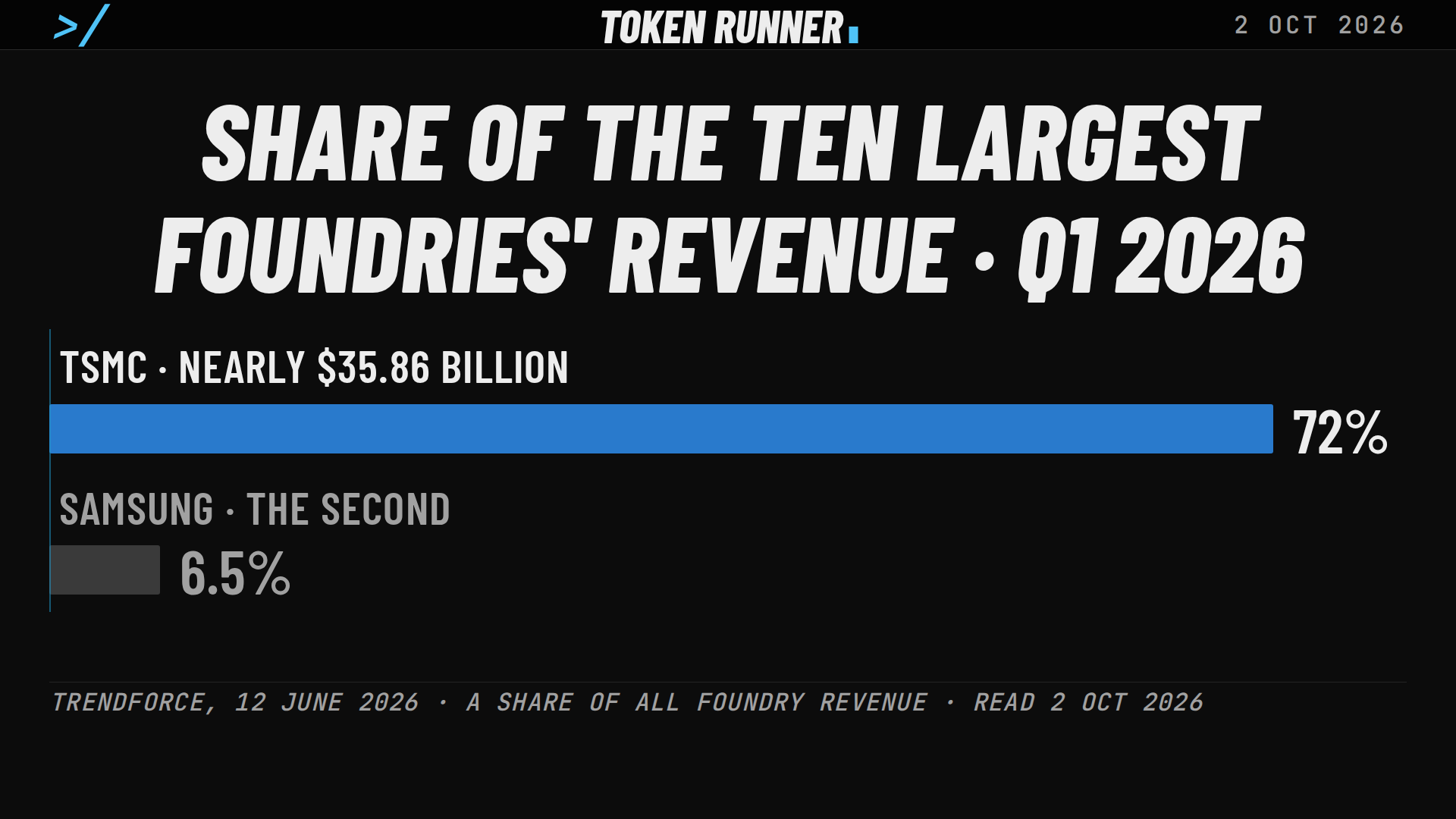
The second step is a factory. In the first quarter of 2026 TSMC took 72 per cent of the revenue of the world's ten largest foundries, by TrendForce's count: nearly $35.86 billion in the quarter. Samsung, the second, took 6.5 per cent. That is a share of all foundry revenue, old chips and new. It is not a share of the most advanced chips, and no figure for that is held here. So the 72 understates nothing and overstates nothing about the leading edge; it simply measures something wider. The second number in this layer exists, and it is about a tenth of the first.
The design
The third step is a design. Of the AI compute that Epoch AI tracked as sold in 2025, 65 per cent was Nvidia's, by Epoch's estimate, measured in H100-equivalents. The next largest share, 20 per cent, was Google's own chips, which it designs for its own use. Counted another way, by the number of chips and not by their computing power, Nvidia's share of 2025 was 46 per cent: a different measure of the same year, and a smaller one, because Nvidia's chips are the more powerful ones. In the last quarter of 2025 Nvidia's designs took 59 per cent of the advanced-packaging wafers, again by Epoch's estimate. The chart shows the years stacked by designer. These are estimates, and the table covers the designers Epoch names, not every chip maker.
Two more measures of the lead
There is a measure of revenue, and it is neither Token Runner's nor Epoch's. The analyst firm Silicon Analysts estimates Nvidia's share of AI-accelerator revenue at 81 per cent for 2025 and 75 per cent for 2026. It is one small firm's estimate, made in February 2026, and it stands alone. And the lead is not only in silicon. Nvidia first released its software platform, CUDA, in November 2006, just under twenty years ago. A share of compute, a share of chips, a share of wafers, a share of revenue and a software platform are five different things. They agree on who leads the design layer and on nothing more exact than that.
The conversation
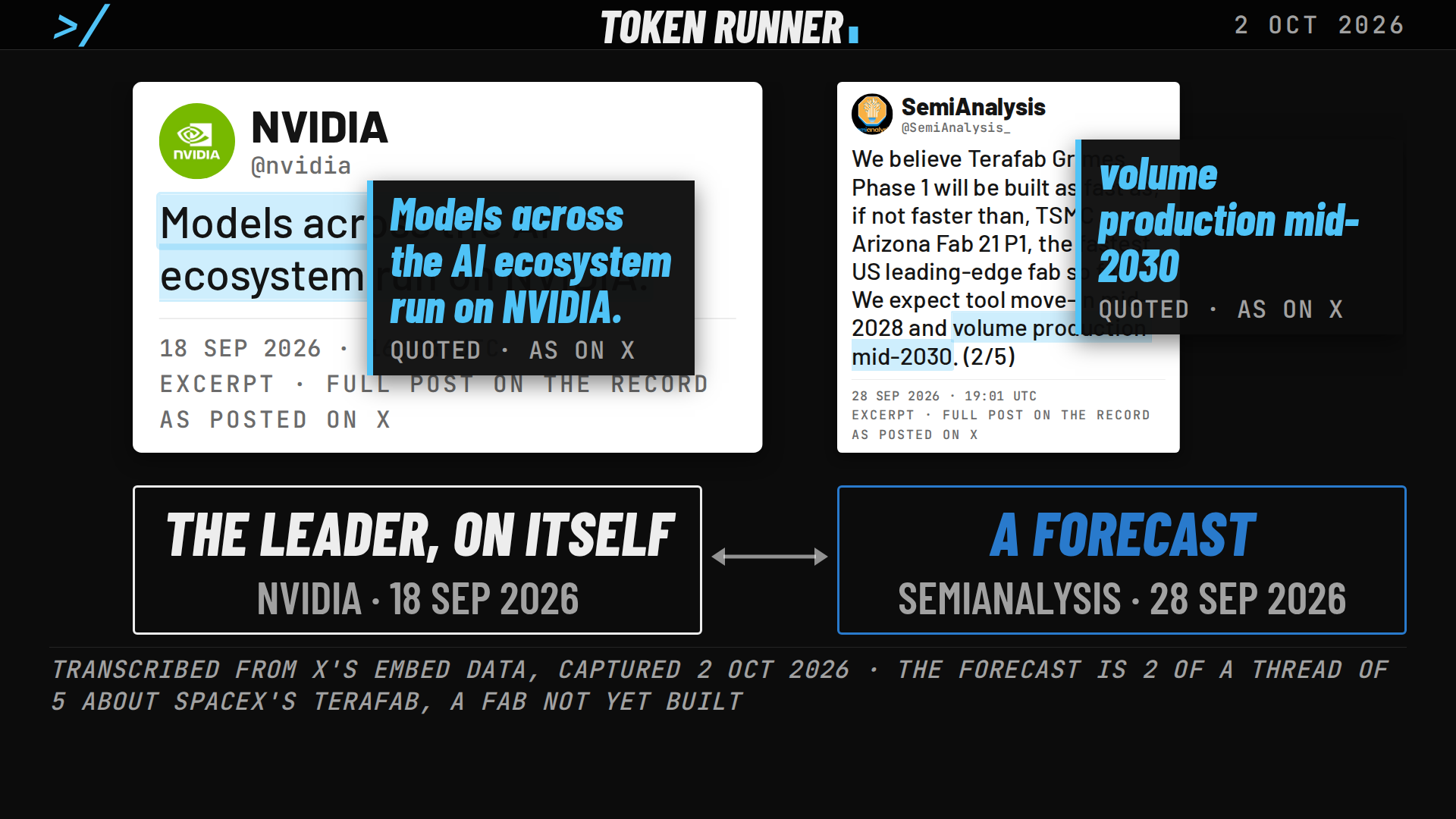
Nvidia says it of itself. On 18 September 2026 the company posted: "Models across the AI ecosystem run on NVIDIA." It was promoting a talk by its chief executive, and it is the leader of the design layer describing its own position. The second voice is a forecast. On 28 September the analyst firm SemiAnalysis wrote that a fab SpaceX is building, called Terafab, would be built as fast as, if not faster than, TSMC's Arizona fab, with volume production in mid-2030. It is not built: by the same forecast its tools move in in mid-2028. It is the kind of thing to watch for, a new leading-edge fab, if the forecast holds. The conversation held here on this subject is thin, and nothing captured speaks to the machine layer.
What passes through
And the money. Seven cloud companies filed $424.6 billion of capital spending for 2025, each for its own filed year: Amazon $131.8 billion, Alphabet $91.4 billion, Meta $69.7 billion, Microsoft $64.6 billion, Oracle $55.7 billion, CoreWeave $10.3 billion and IBM $1.1 billion. Whatever share of it buys leading-edge chips, those chips were printed on one company's machines. What share that is, is not known here, and no number is put on it: the filings give the total, not what it bought. For scale, and added to nothing: the sixty companies on Token Runner's debt table, a wider list than the seven, filed $349.4 billion of debt raised between them in fiscal 2025, and forty-three of the sixty filed a figure above zero. That is borrowing, not spending.
Watch the second number
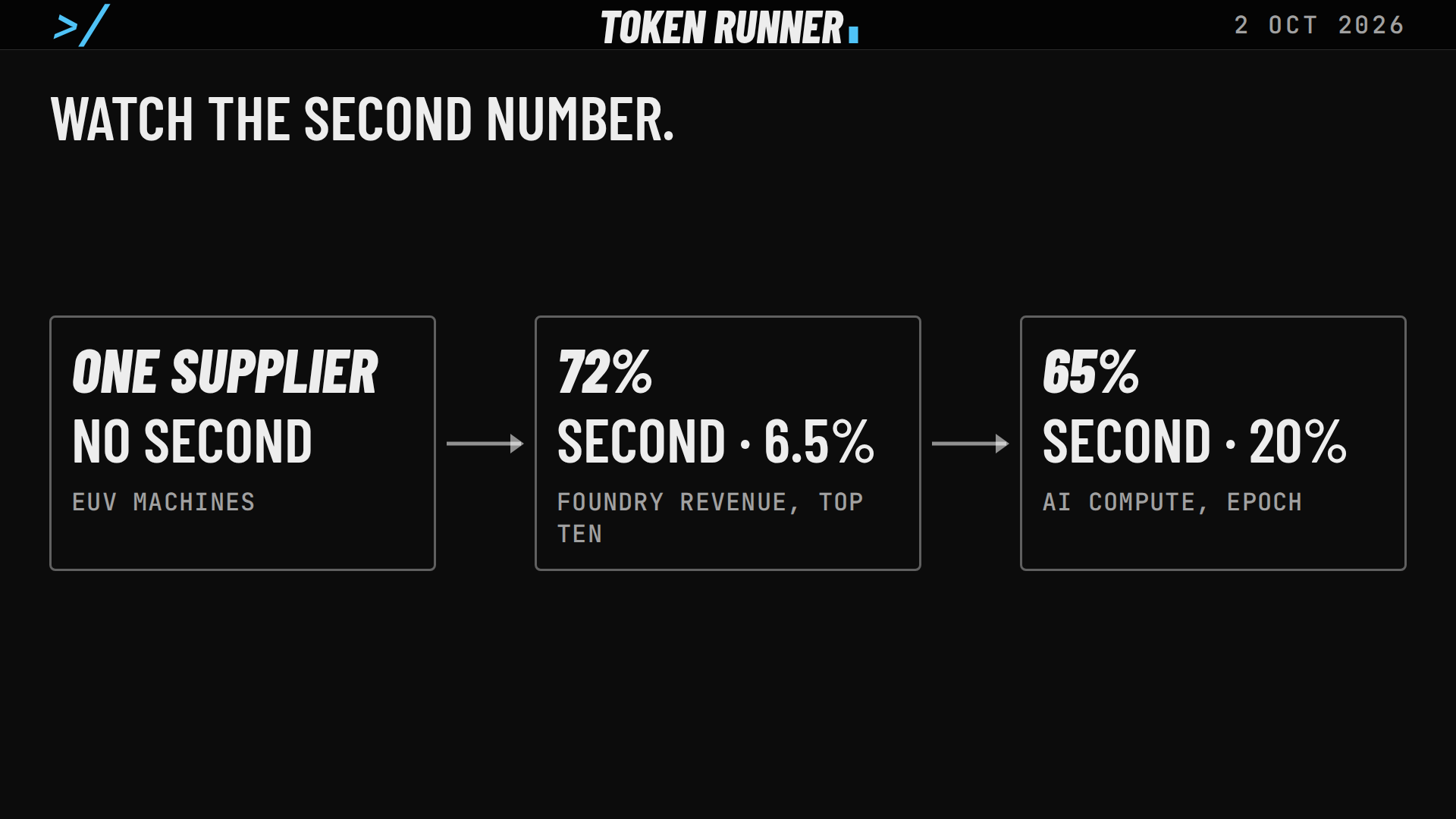
One supplier, and no second. 72 per cent against 6.5. 65 per cent against 20. Three different measures, so there is no total to give. The number to watch in each layer is the second one: whether a second supplier of the machine appears, what the second foundry's share does, what the second designer's share does. When one of those moves, the eye of the needle has widened.
Sources
- TrendForce, press release 'Strong AI Demand and Early Consumer Electronics Inventory Build Drive Top 10 Foundries to 3.7% QoQ Revenue Growth in 1Q26', 12 June 2026: https://www.trendforce.com/presscenter/news/20260612-13095.html
- Epoch AI, 'AI Chip Sales' and 'AI Chip Components', its estimates by chip and by designer, as Token Runner collected them on 2 October and 9 October 2026
- CSET (John VerWey), 'Tracing the Emergence of Extreme Ultraviolet Lithography', July 2024, executive summary: https://cset.georgetown.edu/publication/tracing-the-emergence-of-extreme-ultraviolet-lithography/
- Reuters (Toby Sterling), 'Explainer: The $250 million ASML printer behind Nvidia's chips', 28 January 2026, as carried by KELO: https://kelo.com/2026/01/27/explainer-the-250-million-asml-printer-behind-nvidias-chips/
- CNBC (Arjun Kharpal), 'TSMC, Samsung commit to ASML's newest chipmaking tools as AI drives demand', 8 September 2026: https://www.cnbc.com/2026/09/08/tsmc-samsung-asml-high-na-euv-machine-ai-chips.html
- ASML Holding NV, press release 'ASML reports €32.7 billion total net sales and €9.6 billion net income in 2025', 28 January 2026, as filed with the SEC on Form 6-K (Exhibit 99.1): https://www.sec.gov/Archives/edgar/data/937966/000162828026003701/pressreleasefinancialresul.htm
- Silicon Analysts, 'NVIDIA GPU Market Share 2024-2026: 87% Peak, What Comes Next', 21 February 2026: https://siliconanalysts.com/analysis/nvidia-ai-accelerator-market-share-2024-2026
- NVIDIA Technical Blog (Pradeep Gupta), 'CUDA Refresher: Getting started with CUDA', 6 May 2020: https://developer.nvidia.com/blog/cuda-refresher-getting-started-with-cuda/
- Token Runner's tables of capital spending and of debt raised, by company and year, from the Securities and Exchange Commission's company facts; collections of 2 October and 9 October 2026
- NVIDIA (@nvidia), a post on X, 18 September 2026: https://x.com/nvidia/status/2100979179655200951
- SemiAnalysis (@SemiAnalysis_), a post on X, 28 September 2026: https://x.com/SemiAnalysis_/status/2104647661366211024