
Falling costs are driving rapid growth in battery markets – with average prices dropping 8% in 2025.
But regional price disparities are widening: battery packs in China were 30% cheaper than in the US & 35% cheaper than in Europe last year.
Read more 👉 https://t.co/fRDiu5lrpx https://t.co/sWuURw6hHB
The Cell
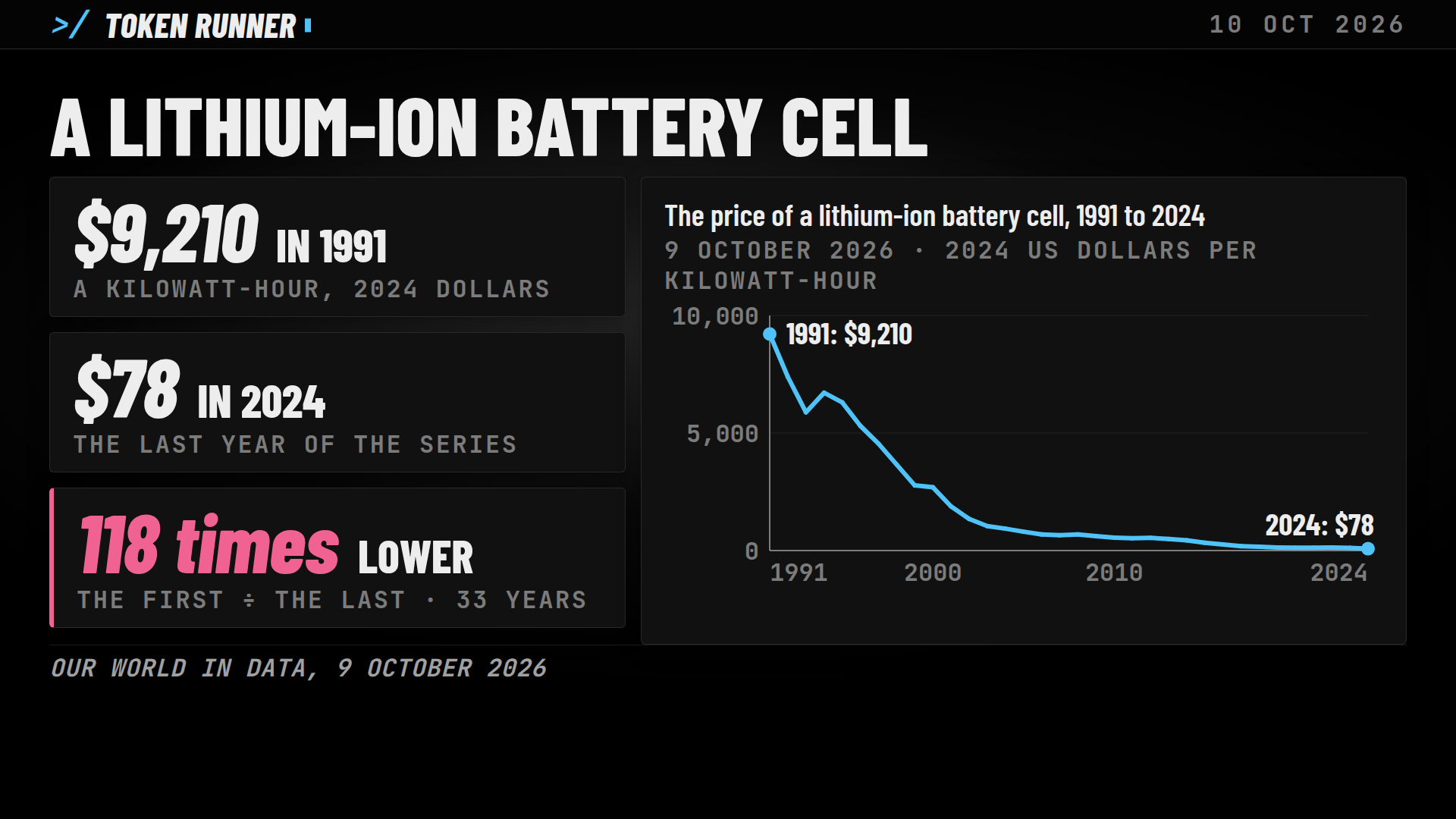
The most famous chart in clean energy prices a component, not a finished product, and we've all been misreading the fine print. Between 1991 and 2024, cell prices plummeted 99% down to $78 per kWh—a triumph of engineering, sure, but not the price of the battery you actually buy. So what does a battery truly cost? Only as much as the fine print allows you to believe.
One line, 1991 to 2024
Our World in Data publishes a price for the lithium-ion battery cell: one world figure for each year from 1991 to 2024, in its metadata's words a "Representative estimate of the price of battery cells for lithium-ion batteries, across all major cell chemistries." In Token Runner's 9 October 2026 collection of it, a cell cost $9,210 a kilowatt-hour in 1991 and $78 in 2024, both in 2024 dollars. Divide the 1991 figure by the 2024 figure and the price is 118 times lower; take the 2024 figure as a share of the 1991 figure and the fall is 99.2 per cent, across 33 years. On the way it stood at $2,691 in 2000, $931 in 2004 and $551 in 2010. The chart beside this is that series and nothing else: one line, 34 points.
Which year's dollars
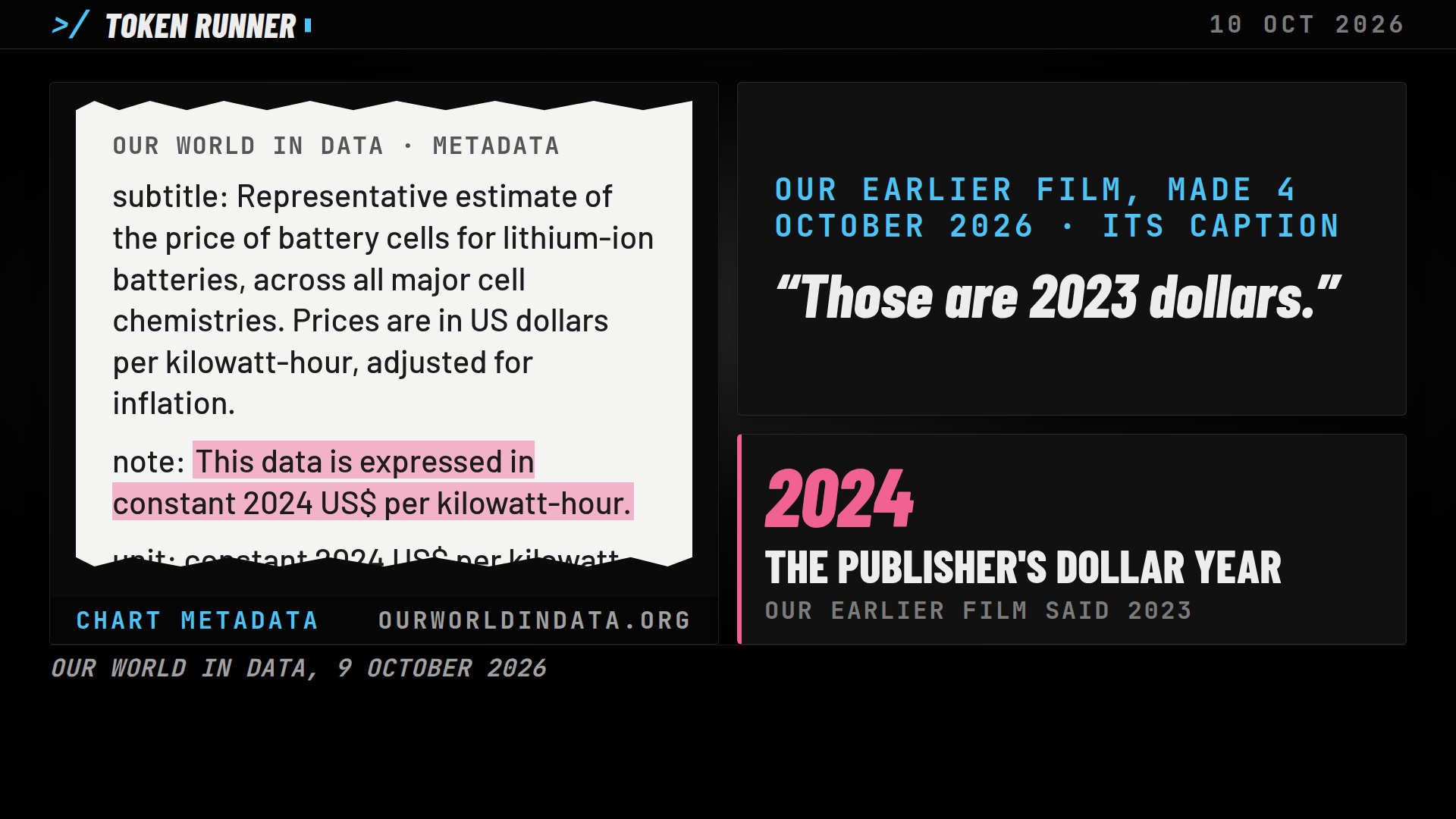
Those are not the prices paid in each year. Every figure is adjusted for inflation and stated in the money of one year, and the publisher says which: "This data is expressed in constant 2024 US$ per kilowatt-hour", reads the note in the chart's metadata, as read on 9 October 2026. Token Runner's earlier film on this series, made on 4 October 2026, labelled the figures 2023 dollars, in its title and its narration: "Those are 2023 dollars." That was wrong. The label had been typed by hand on the old copy of the data; the publisher's note, its unit and its own processing code all say 2024, and nothing read for this piece says the series was ever in 2023 dollars. No number moved: all 34 yearly values are identical in the old copy and the new. The correction is to the label.
The years it rose
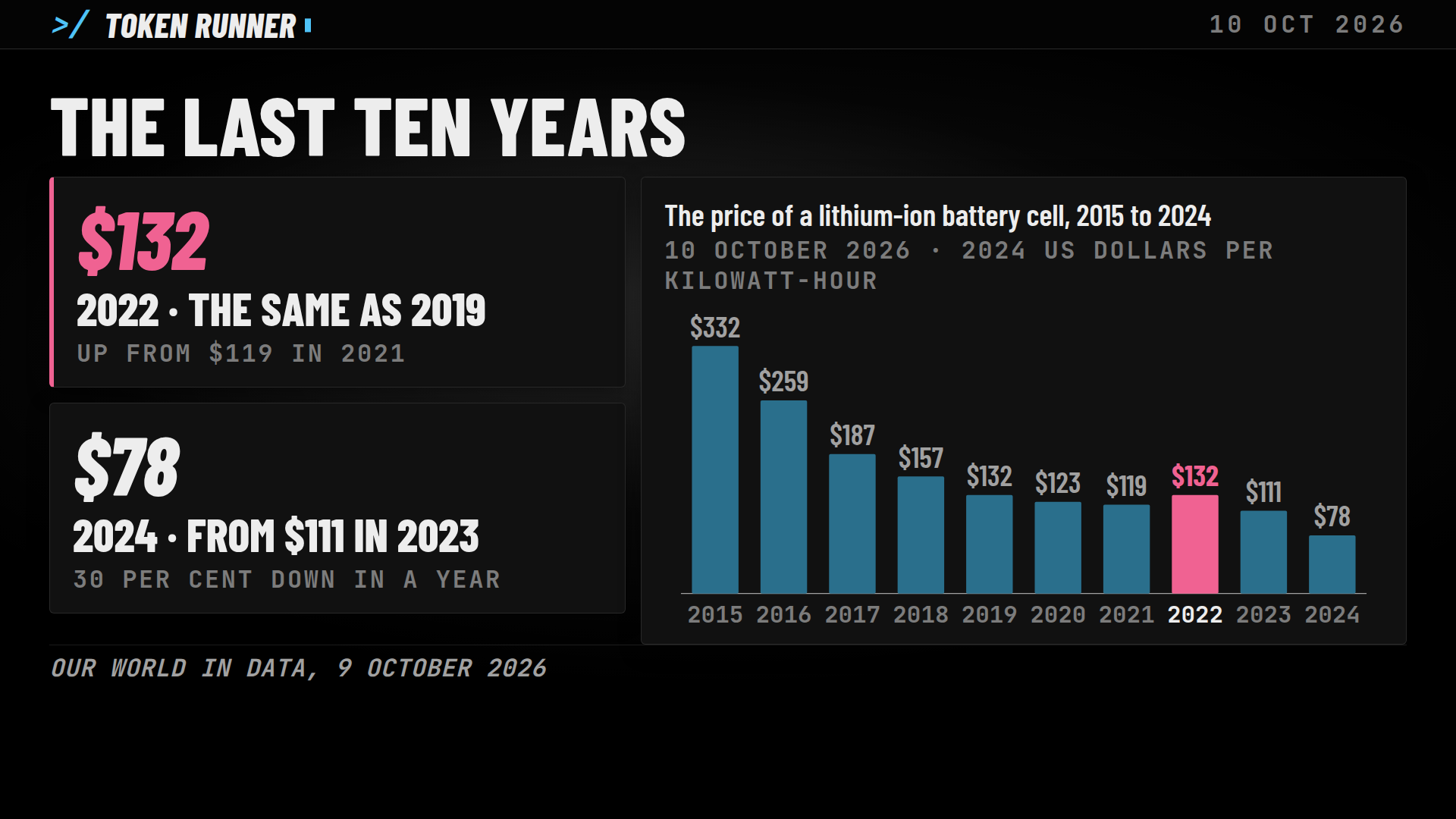
It did not fall every year. Year on year, four of the 33 steps go up: 1994, 2008, 2012 and 2022. The series reads $5,882 in 1993 and $6,714 in 1994, the largest of the four at about 14 per cent; $656 in 2007 and $688 in 2008; $525 in 2011 and $540 in 2012. The last rise is the one the bars show: $119 in 2021 and $132 in 2022, about 11 per cent, to the same figure as in 2019. After it the series reads $111 in 2023 and $78 in 2024: that step, $111 to $78, is a fall of about 30 per cent in one year, the largest by percentage since 2001. The bars beside this show the last ten years; the film marks all four rises on the whole line.
The reasons others give
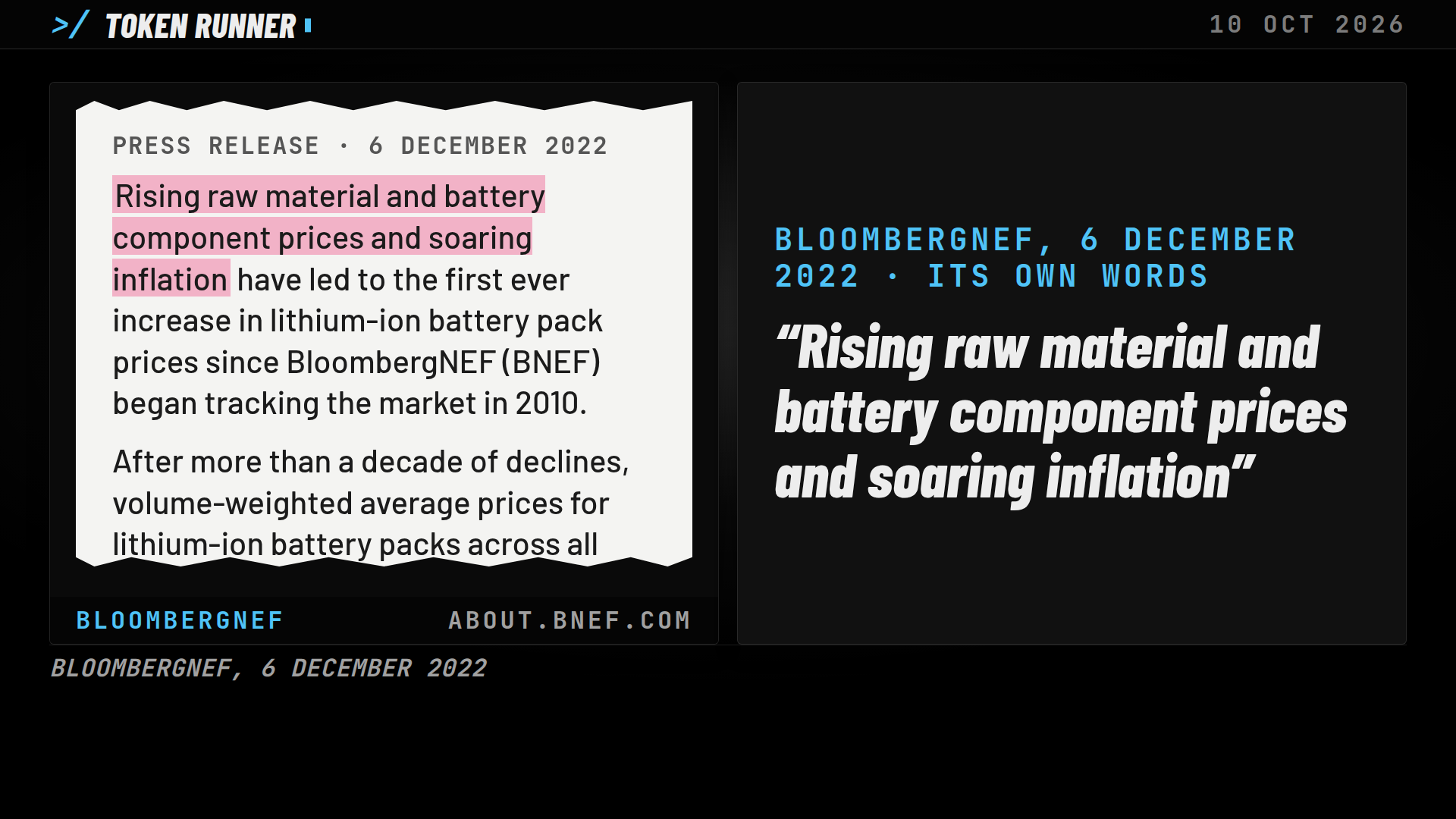
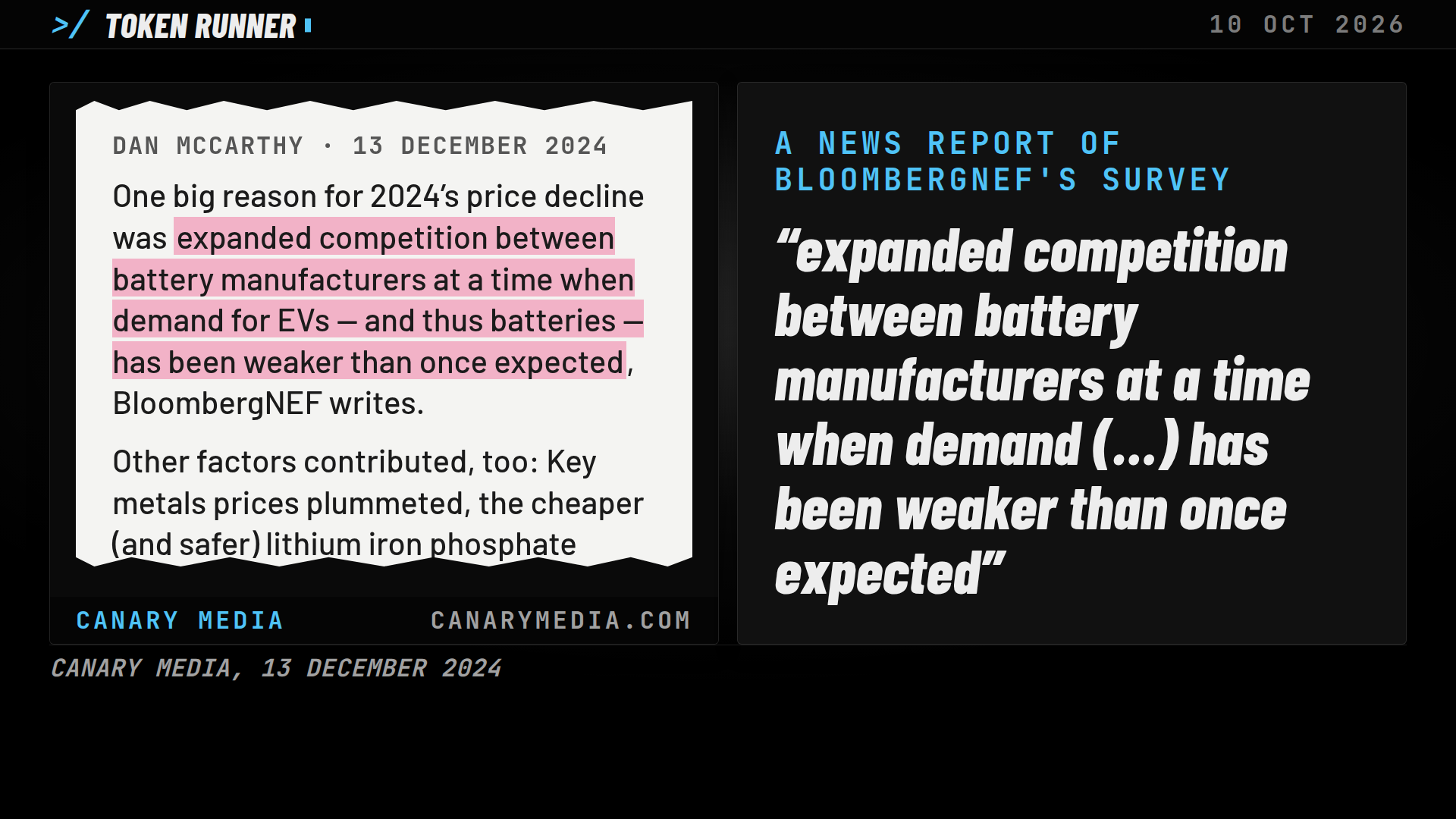
The series carries no cause; others have supplied one. BloombergNEF, one of the series' sources, said on 6 December 2022 that "Rising raw material and battery component prices and soaring inflation" lay behind the first rise in pack prices it had recorded. The International Energy Agency's Global EV Outlook 2023 said lithium supply had not kept up with demand and that "cell production costs increased in 2022 relative to 2021, returning to 2019 levels", as the held series shows, $132 in both years. Of the fall in pack prices in 2024, Canary Media, a clean-energy newsroom reporting BloombergNEF's survey, relayed its finding that "One big reason" was "expanded competition between battery manufacturers at a time when demand for EVs — and thus batteries — has been weaker than once expected". Their judgements.


A cell is not a pack
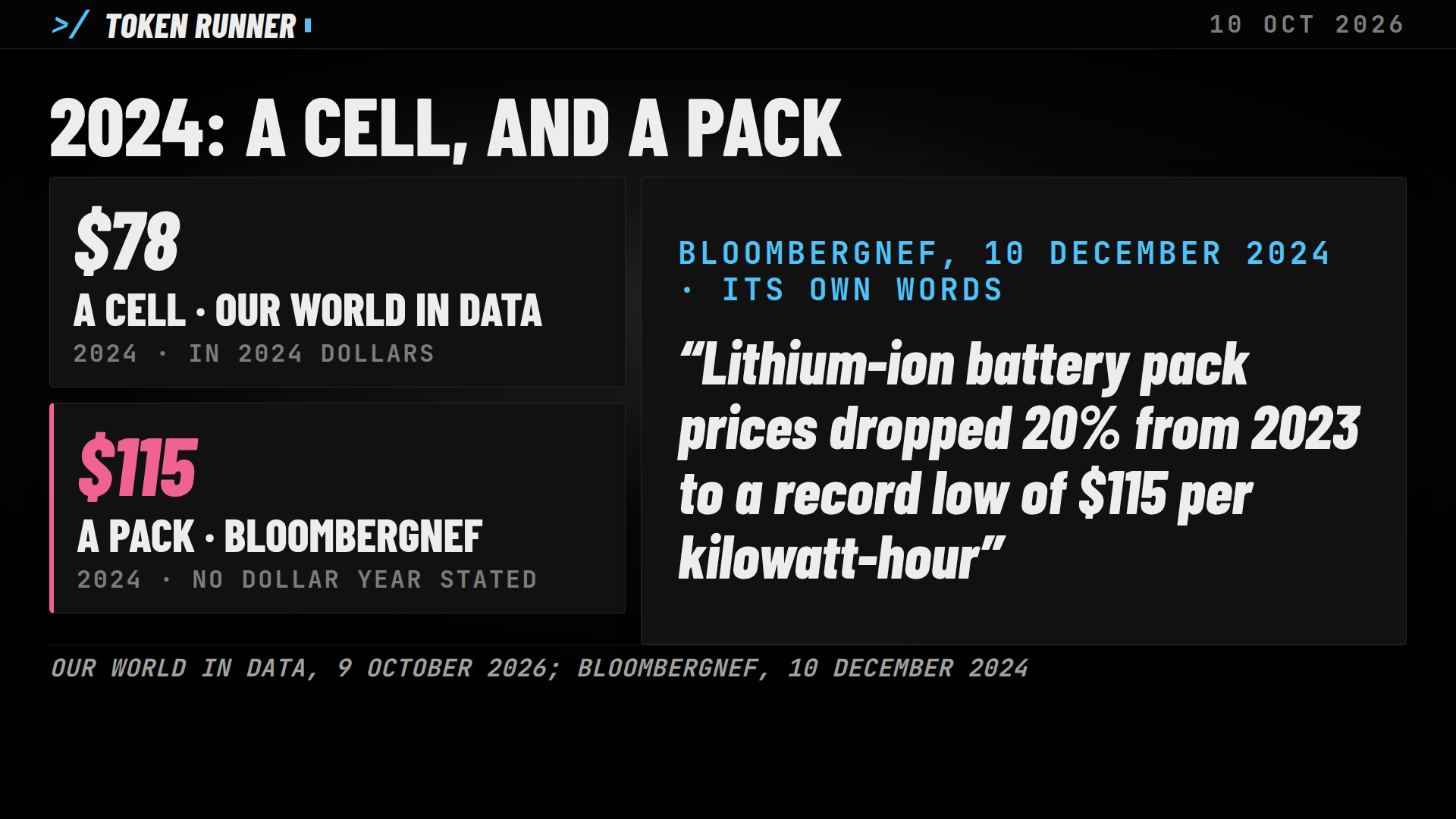
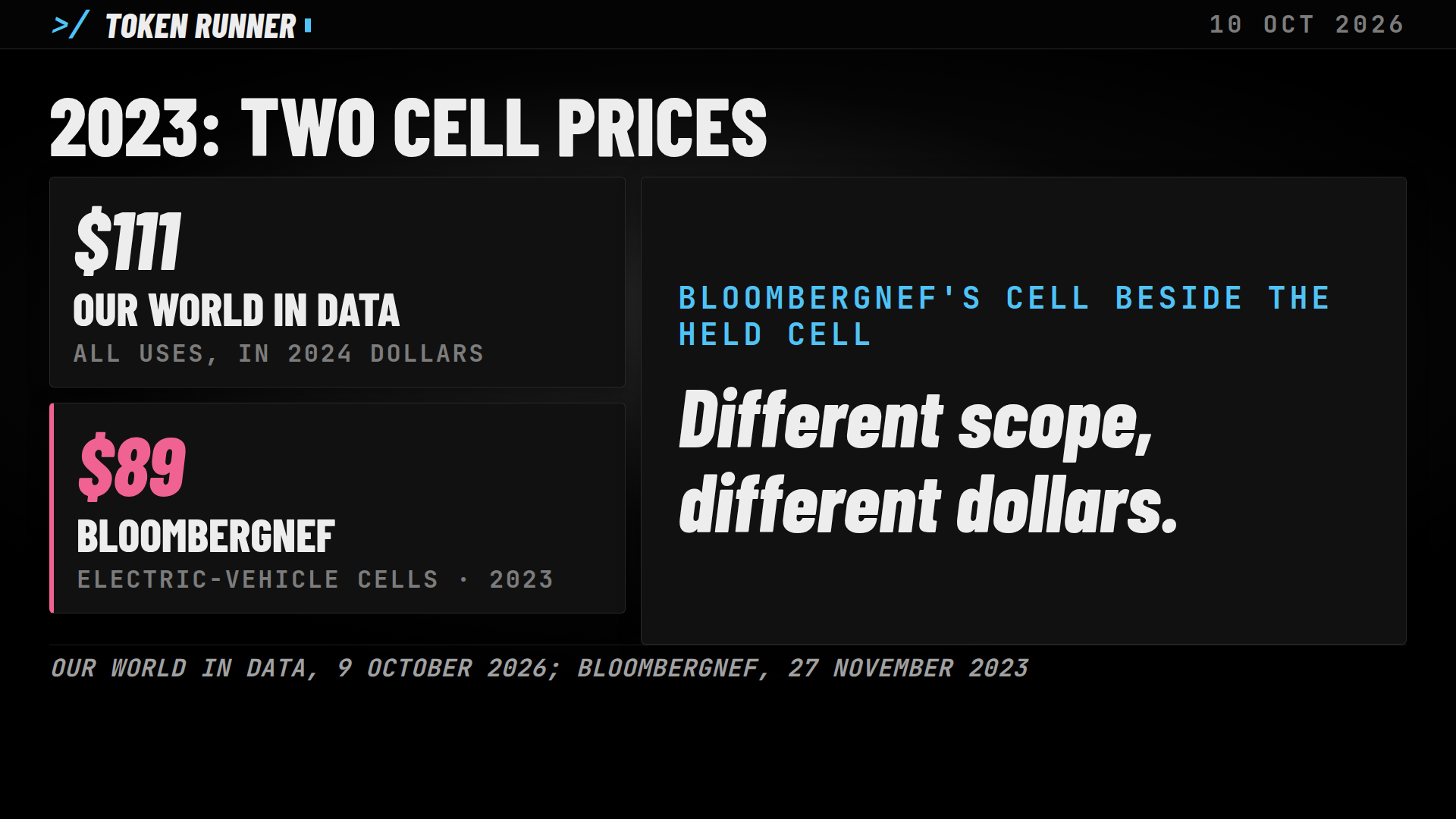
The $78 is a cell's price, not a pack's, and Token Runner's data holds no pack price. The pack figures here are BloombergNEF's. Its release of 10 December 2024 said: "Lithium-ion battery pack prices dropped 20% from 2023 to a record low of $115 per kilowatt-hour". So 2024 has two prices, $78 for the cell and $115 for the pack, from different publishers, and the release does not say which year's dollars. BloombergNEF prices electric-vehicle cells too, and its figures sit below the held series: $115 in 2022 and $89 in 2023, as its releases print them, against $132 and $111 here in 2024 dollars. Different scope, electric vehicles against all uses, and different dollars; the same direction, up in 2022, down in 2023. In 2023, BloombergNEF said, electric-vehicle cells "account for 78% of the total pack price".


What the publisher holds and does not print
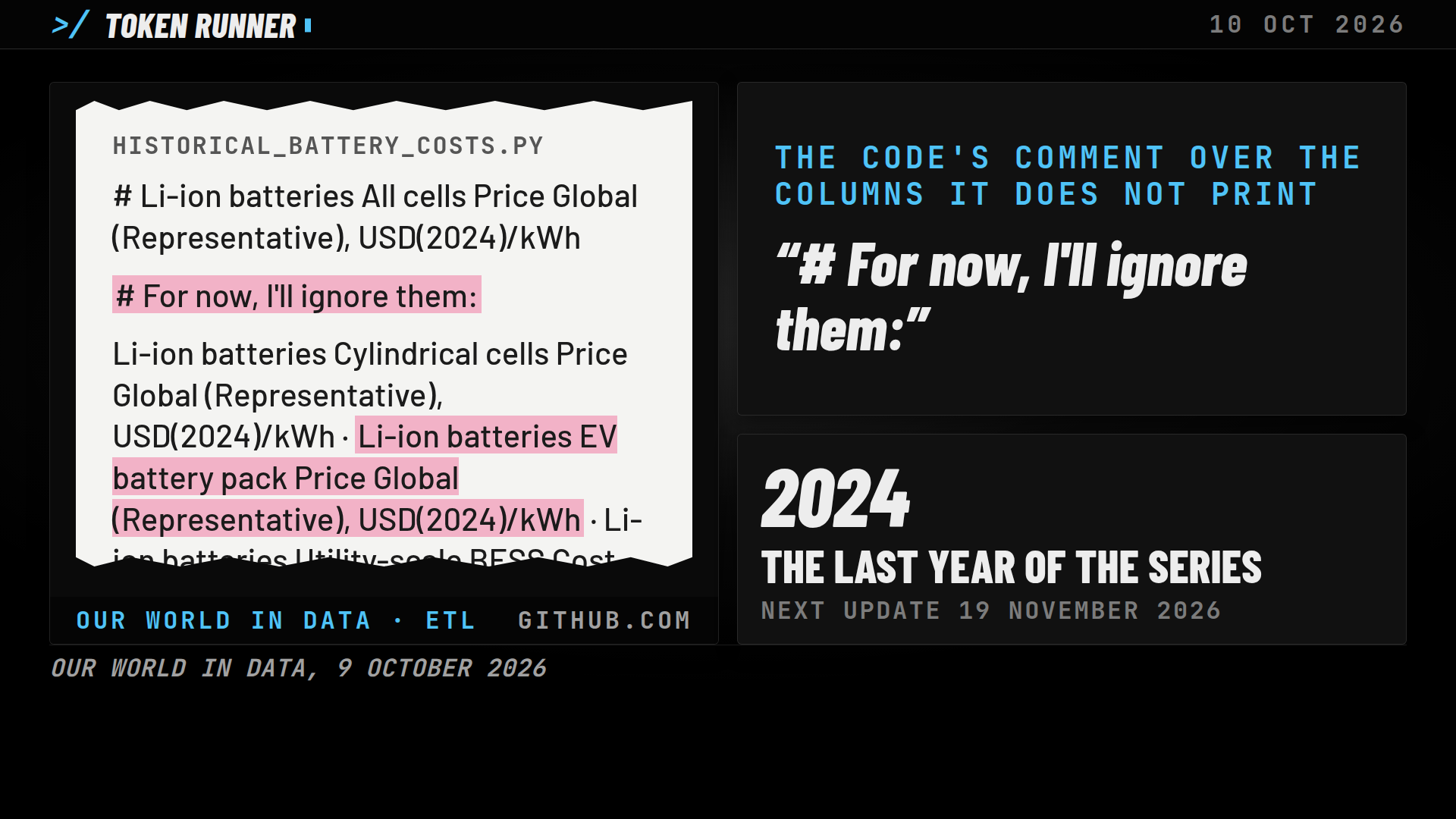
The series is a compilation. Our World in Data credits it to Rupert Way, "based on Ziegler and Trancik (2021), BloombergNEF, and Avicenne Energy", and its fuller citation calls the work "in preparation, 2026" and "shared with Our World in Data via private communication". No public copy of the compiled data was found, so the figures here are Our World in Data's and were checked no further back. The publisher's code shows the compilation holds more than is printed. Under a comment that reads "# For now, I'll ignore them:" it lists columns it does not publish, among them "Li-ion batteries EV battery pack Price Global (Representative), USD(2024)/kWh" and a utility-scale storage-system cost. The code names an electric-vehicle pack price in the same dollars as the cell; Our World in Data does not publish it.
Past the last year
The series stops at 2024; the publisher dates its next update 19 November 2026. The newest prices found are BloombergNEF's. Its release of 9 December 2025 said pack prices "dropped 8% since 2024 to a record low of $108 per kilowatt-hour"; the earlier release had printed $115, and whether that was restated is not said. And: "Battery pack prices for stationary storage dropped to $70/kWh in 2025, 45% lower than in 2024." BloombergNEF's $70 for a storage pack in 2025 beside the series' $78 for a cell in 2024 does not show a pack costing less than its cells: the publisher, the thing priced, the year and, unstated, the dollar year all differ.
AI is getting cheaper more quickly than any other transformative tech in history. At a given level of performance, cost has fallen ~47%/quarter since 2023.
That’s 4× faster than DNA sequencing, 6× faster than compute, 18× faster than lithium batteries, and (up to 1973) 54× faster than electricity.
No post in Token Runner's record of X prints a price in dollars a kilowatt-hour. The International Energy Agency wrote on 30 September 2026 of "average prices dropping 8% in 2025" and of packs in China being "30% cheaper than in the US" and 35 per cent cheaper than in Europe. The post links to an Agency commentary of 13 February 2026 whose price charts are credited "IEA analysis based on data from Bloomberg New Energy Finance": the Agency's figures rest on BloombergNEF's data; BloombergNEF's own release put North America and Europe "44% and 56% higher" than China's $84. Epoch AI wrote on 22 September 2026 that the cost of AI has fallen "18× faster than lithium batteries"; the post names no battery series, years or measure, so it is not set against this series.
Two things to watch. The publisher's next update, and whether it adds a year. And whether the pack and storage columns behind the series are ever published beside the cell.
Sources
- Our World in Data, Price of lithium-ion battery cells, 9 October 2026 data collection
- Our World in Data, the chart's metadata and the processing code for "Historical battery costs and production", read 9 October 2026
- BloombergNEF, press release, "Lithium-ion Battery Pack Prices Rise for First Time to an Average of $151/kWh", 6 December 2022
- BloombergNEF, press release, "Lithium-Ion Battery Pack Prices Hit Record Low of $139/kWh", 27 November 2023
- BloombergNEF, press release, "Lithium-Ion Battery Pack Prices See Largest Drop Since 2017, Falling to $115 per Kilowatt-Hour", 10 December 2024
- BloombergNEF, press release, "Lithium-Ion Battery Pack Prices Fall to $108 Per Kilowatt-Hour, Despite Rising Metal Prices", 9 December 2025
- International Energy Agency, Global EV Outlook 2023, "Trends in batteries"
- International Energy Agency, commentary, "Global battery markets are growing strongly – and so are the supply risks", Teo Lombardo, Leonardo Paoli, Araceli Fernandez Pales and Timur Gül, 13 February 2026
- Canary Media, "Chart: Lithium-ion battery prices fall yet again", Dan McCarthy, 13 December 2024
- X posts: International Energy Agency, 30 September 2026; Epoch AI, 22 September 2026
- Token Runner, the earlier film of this piece, The Cell, 4 October 2026, and its captions