Who Gets Paid
Everyone agrees the AI boom is enormous. The question is who it is paying.
Two point seven trillion.
Gartner, the research firm, says the world will spend two point seven trillion dollars on AI this year. Up almost fifty percent.
More than half of it on infrastructure. Servers, chips, data centres.
Gartner's release of 16 September 2026 forecasts worldwide AI spending of $2,670,460 million in 2026, up 49.5% from $1,786,671 million in 2025, and $3,637,292 million in 2027. Its Table 1 puts AI infrastructure at $1,484,397 million of the 2026 total, about 56% by our division, and names it the largest market in every year. All three figures are forecasts.
The largest project. In a trough.
Gartner's own analyst calls it the largest infrastructure project humanity has ever undertaken.
And in the very same release, Gartner says generative AI is, in its words, firmly in the Trough of Disillusionment.
The biggest build in history. For a technology in a trough.
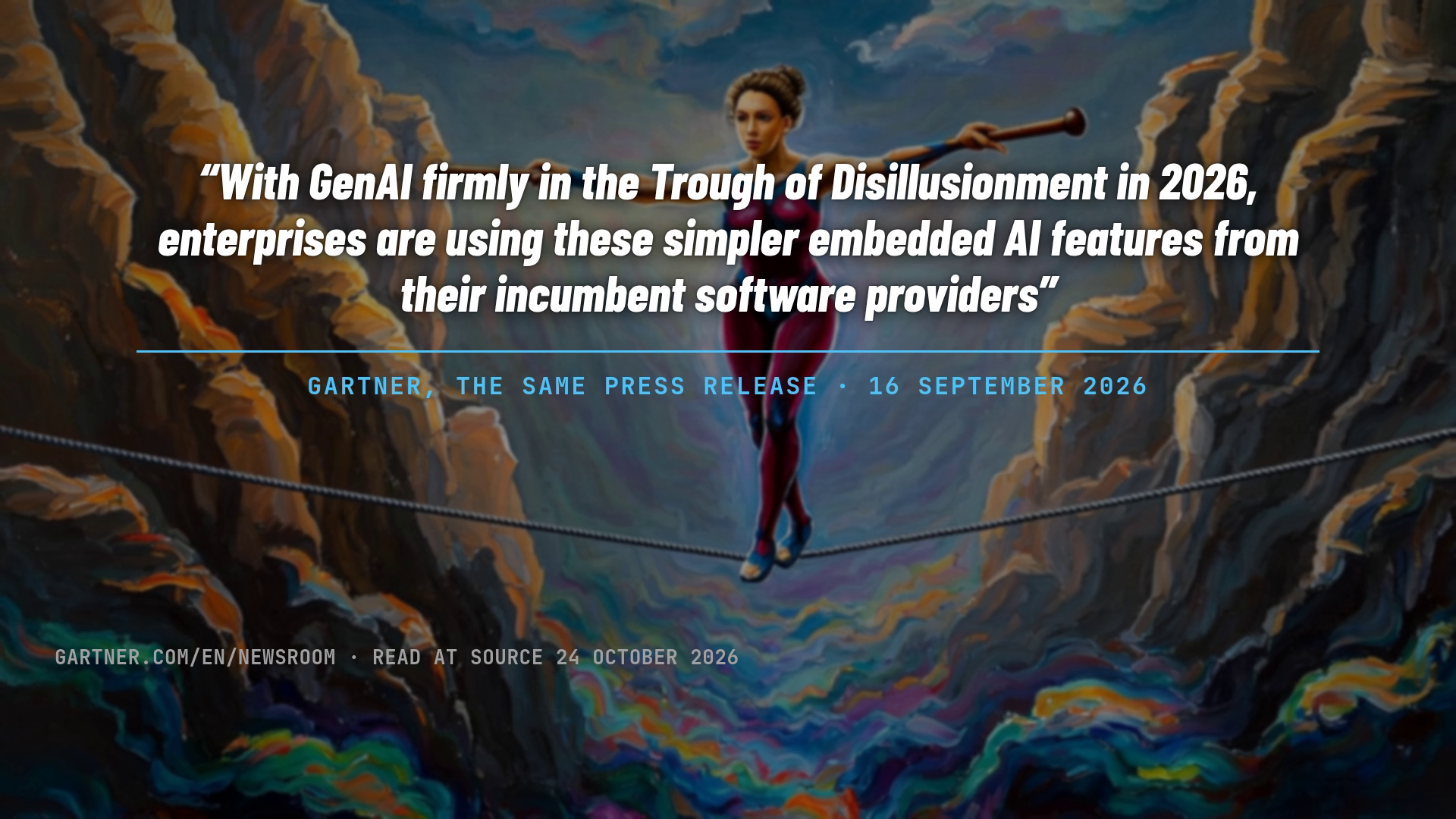
John-David Lovelock, Gartner's Distinguished VP Analyst, in the release: "The buildout of AI data center capacity is the largest infrastructure project humanity has even undertaken." The release prints "even"; the film says "ever". The same release: "With GenAI firmly in the Trough of Disillusionment in 2026, enterprises are using these simpler embedded AI features from their incumbent software providers".

The one being paid.
So follow the money to the factory.
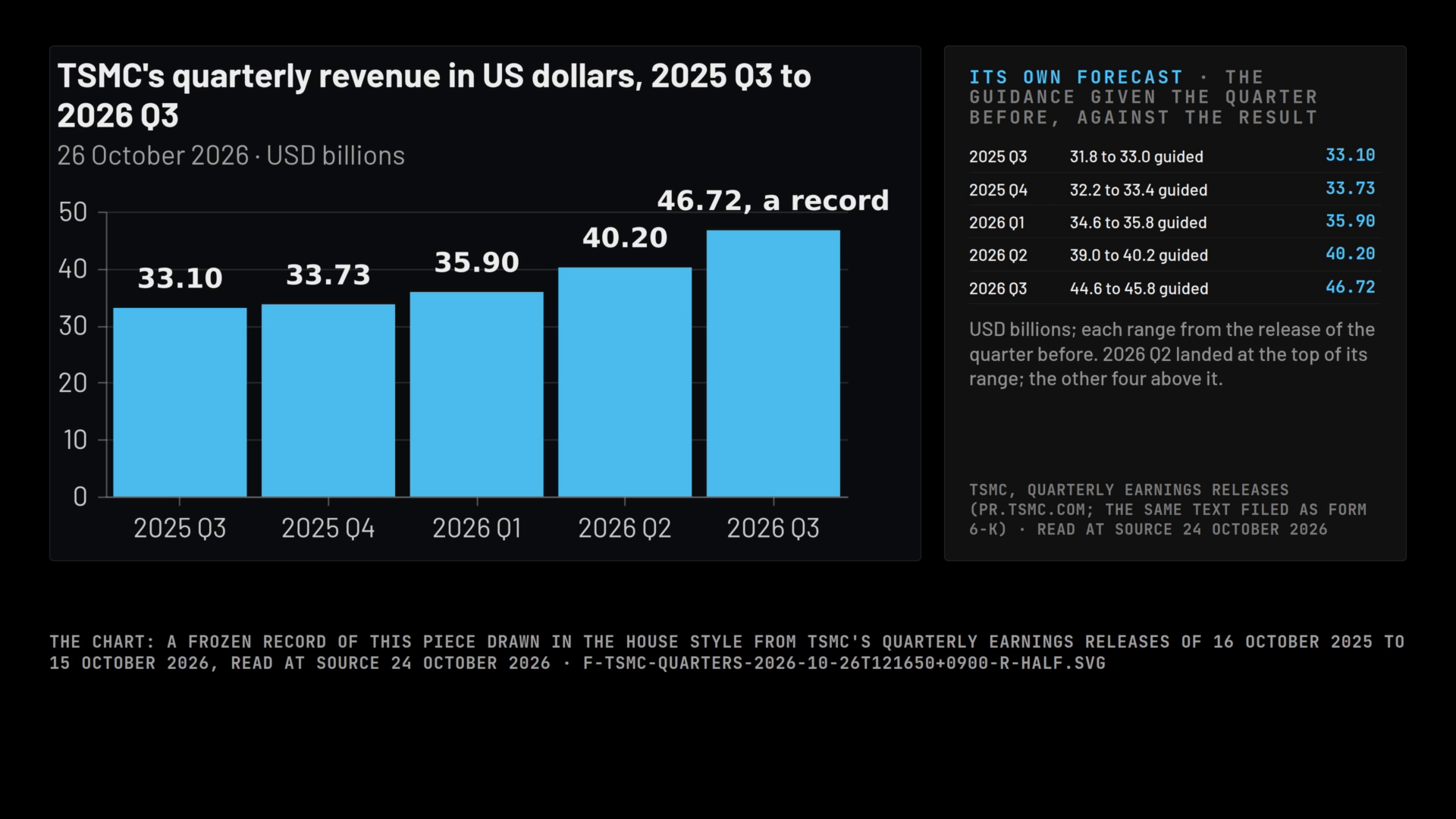
TSMC makes the chips. Last quarter, it took in forty-six point seven billion dollars. A record. Up forty-one percent in a year.
Five quarters in a row, it hit or beat the top of its own forecast.
And more than half of every dollar it took in came out the other side as profit.
TSMC's release of 15 October 2026: "In US dollars, third quarter revenue was $46.72 billion, which increased 41.2% year-over-year and increased 16.2% from the previous quarter." The five quarters from the third of 2025: 33.10, 33.73, 35.90, 40.20 and 46.72 billion dollars, against the guidance TSMC gave the quarter before of 31.8 to 33.0, 32.2 to 33.4, 34.6 to 35.8, 39.0 to 40.2 and 44.6 to 45.8: four above the top of the range and one, the second quarter of 2026, at it. The net profit margin: 45.7%, 48.3%, 50.5%, 55.6% and 51.1%. For the fourth quarter TSMC expects 52.3 to 54.3 billion dollars; its 2026 capital budget is 52 to 56 billion, of which 40.64 billion was spent by the end of September.
The reason.
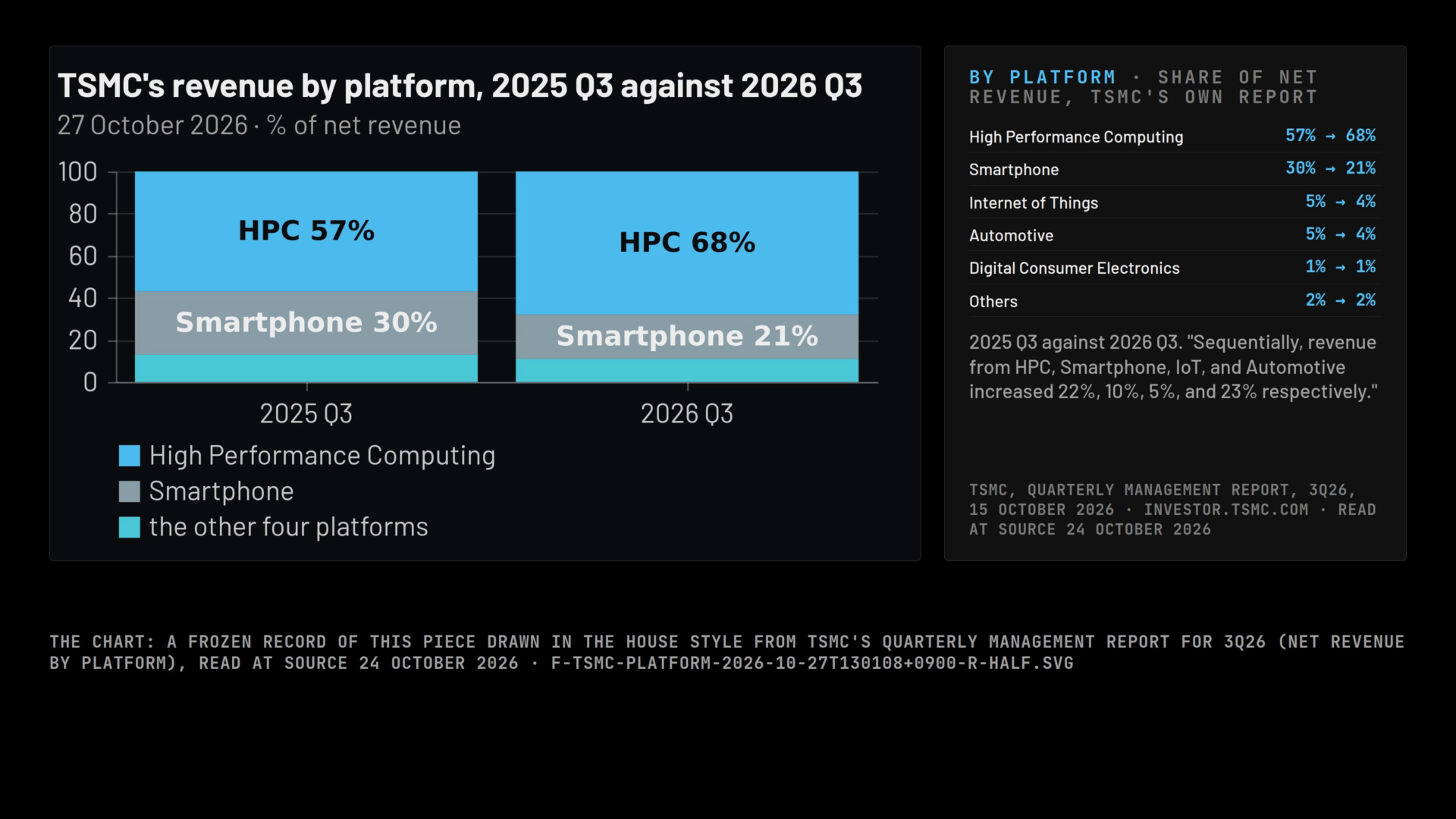
The reason? High-performance computing. The AI chips. Sixty-eight percent of its revenue now, up from fifty-seven a year ago.
TSMC's own quarterly report for the third quarter of 2026 gives net revenue by platform: High Performance Computing 68%, Smartphone 21%, Internet of Things 4%, Automotive 4%, Digital Consumer Electronics 1%, Others 2%; a year earlier 57%, 30%, 5%, 5%, 1% and 2%. "Sequentially, revenue from HPC, Smartphone, IoT, and Automotive increased 22%, 10%, 5%, and 23% respectively." Seventy-nine per cent of wafer revenue came from 7-nanometre and smaller nodes; North America was 79% of revenue.
The ones paying.
Now look at who is writing the checks.
Microsoft, Alphabet, Amazon, Meta and Oracle. In their latest years, four hundred and sixty-four billion dollars of capital spending.
Microsoft put thirty-five cents of every revenue dollar back into the build. Meta, thirty-five. Oracle, eighty-three.
From each company's own filings, as the SEC's company facts hold them: payments for property and equipment of 131.8 billion dollars at Amazon in 2025 (its tag covers productive assets), 115.9 at Microsoft in the year to June 2026, 91.4 at Alphabet in 2025, 69.7 at Meta in 2025 and 55.7 at Oracle in the year to May 2026: 464.5 billion in all, our addition of five fiscal years that end on different days. Divided by each company's revenue: Microsoft 35 cents (115.9 of 331.8), Meta 35 (69.7 of 201.0), Oracle 83 (55.7 of 67.4), Alphabet 23 (91.4 of 402.8), Amazon 18 (131.8 of 716.9). The same ratios two years earlier: Microsoft 13, Meta 20, Oracle 13, Alphabet 10, Amazon 9.
To be fair.
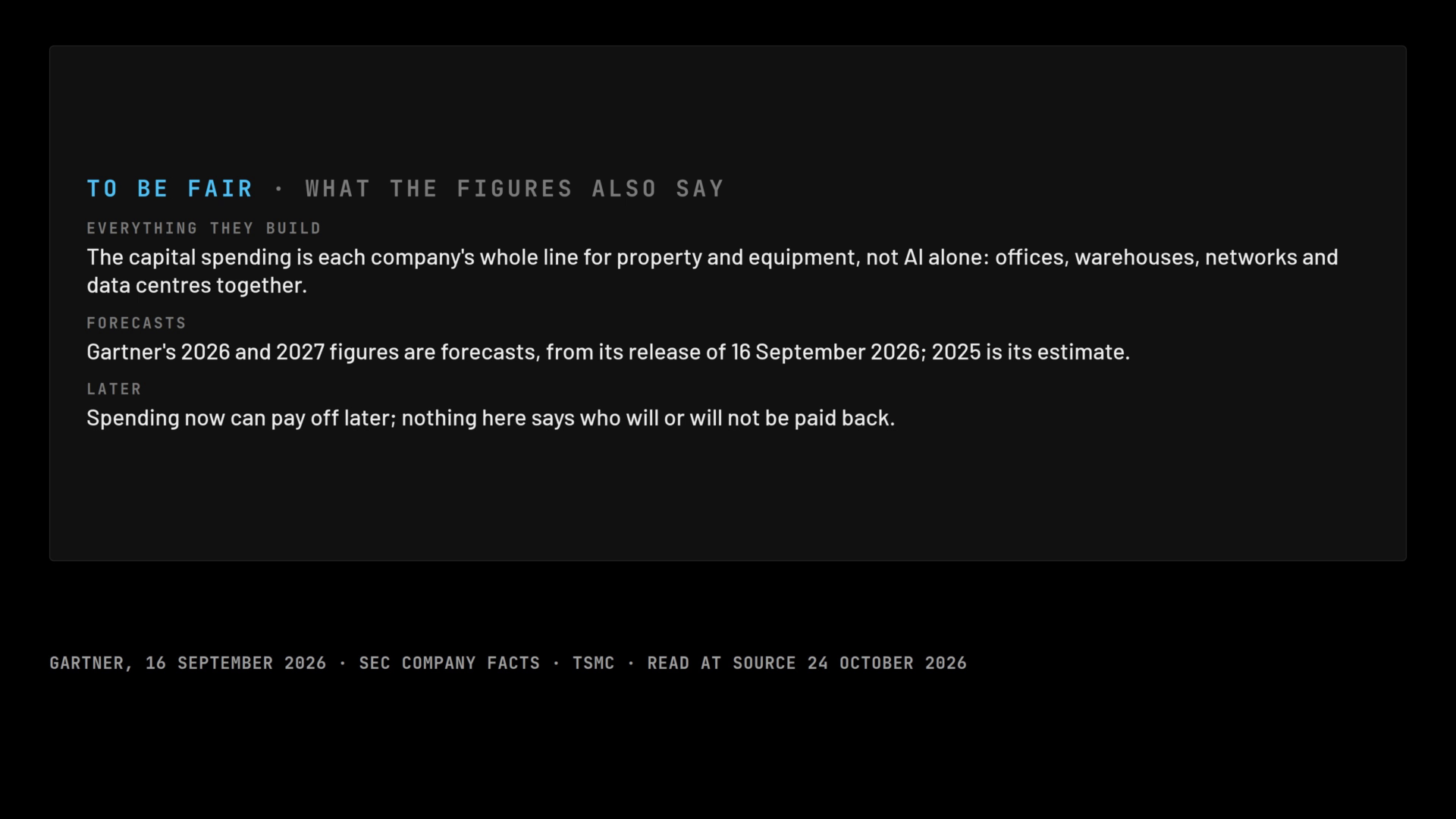
To be fair, that spending is everything they build, not just AI. Gartner's numbers are forecasts. And spending now can pay off later.
The capital spending is each company's whole line for property and equipment: offices, warehouses, networks and data centres together, not AI alone. Gartner's 2026 and 2027 figures are forecasts from one release. Nothing here says who will or will not be paid back.
But today, the bill and the profit sit in different places.
The chip maker is paid. Now. The builders are paying. Now. And the people who count it say the payoff is in a trough.
Every figure from Gartner, TSMC, and the companies' own filings.
Sources
- Gartner, press release, "Gartner Forecasts Worldwide AI Spending to Grow 49.5% in 2026", Stamford, 16 September 2026: "Worldwide spending on AI is forecast to total $2.7 trillion in 2026, a 49.5% increase year-over-year"; John-David Lovelock, Distinguished VP Analyst: "The buildout of AI data center capacity is the largest infrastructure project humanity has even undertaken." (as printed); "With GenAI firmly in the Trough of Disillusionment in 2026, enterprises are using these simpler embedded AI features from their incumbent software providers"; Table 1, Worldwide AI Spending by Market, 2025-2027: AI Infrastructure 981,920 / 1,484,397 / 1,977,685 million dollars of totals 1,786,671 / 2,670,460 / 3,637,292. Read at source by Desktop in a browser, 24 October 2026.
- TSMC, "TSMC Reports Third Quarter EPS of NT$29.43", 15 October 2026 (also filed as Form 6-K): "In US dollars, third quarter revenue was $46.72 billion, which increased 41.2% year-over-year and increased 16.2% from the previous quarter."; "Gross margin for the quarter was 66.4%, operating margin was 58.7%, and net profit margin was 51.1%."; fourth-quarter guidance US$52.3 to 54.3 billion.
- TSMC, the quarterly earnings releases of 17 July 2025, 16 October 2025, 15 January 2026, 16 April 2026 and 16 July 2026: revenue in US dollars of 33.10, 33.73, 35.90 and 40.20 billion for the quarters from the third of 2025 to the second of 2026, and each quarter's guidance given the quarter before: 31.8 to 33.0; 32.2 to 33.4; 34.6 to 35.8; 39.0 to 40.2; 44.6 to 45.8 billion dollars; net profit margins 45.7%, 48.3%, 50.5%, 55.6%; the 2026 capital budget "between US$52 billion and US$56 billion".
- TSMC, Quarterly Management Report, 3Q26, 15 October 2026, Net Revenue by Platform: High Performance Computing 68% of net revenue (66% in 2Q26, 57% in 3Q25); Smartphone 21% (22%, 30%); IoT 4%, Automotive 4%, DCE 1%, Others 2%; "Sequentially, revenue from HPC, Smartphone, IoT, and Automotive increased 22%, 10%, 5%, and 23% respectively."; capital expenditures US$13.84 billion in the quarter, US$40.64 billion in the year to date.
- Token Runner's own table of the companies' filings, built from the SEC's company facts (the companies' own filings): payments for property and equipment and revenue by fiscal year. Microsoft, the year to 30 June 2026: 115.9 of 331.8 billion dollars; Alphabet 2025: 91.4 of 402.8; Amazon 2025: 131.8 of 716.9 (the tag PaymentsToAcquireProductiveAssets); Meta 2025: 69.7 of 201.0; Oracle, the year to 31 May 2026: 55.7 of 67.4. The five latest fiscal years add to 464.5 billion dollars of capital spending: our addition. Read 19 October 2026.