Six Percent
Cisco says the AI era demands hard decisions. Here are the decisions. And here is the AI.
The claim.
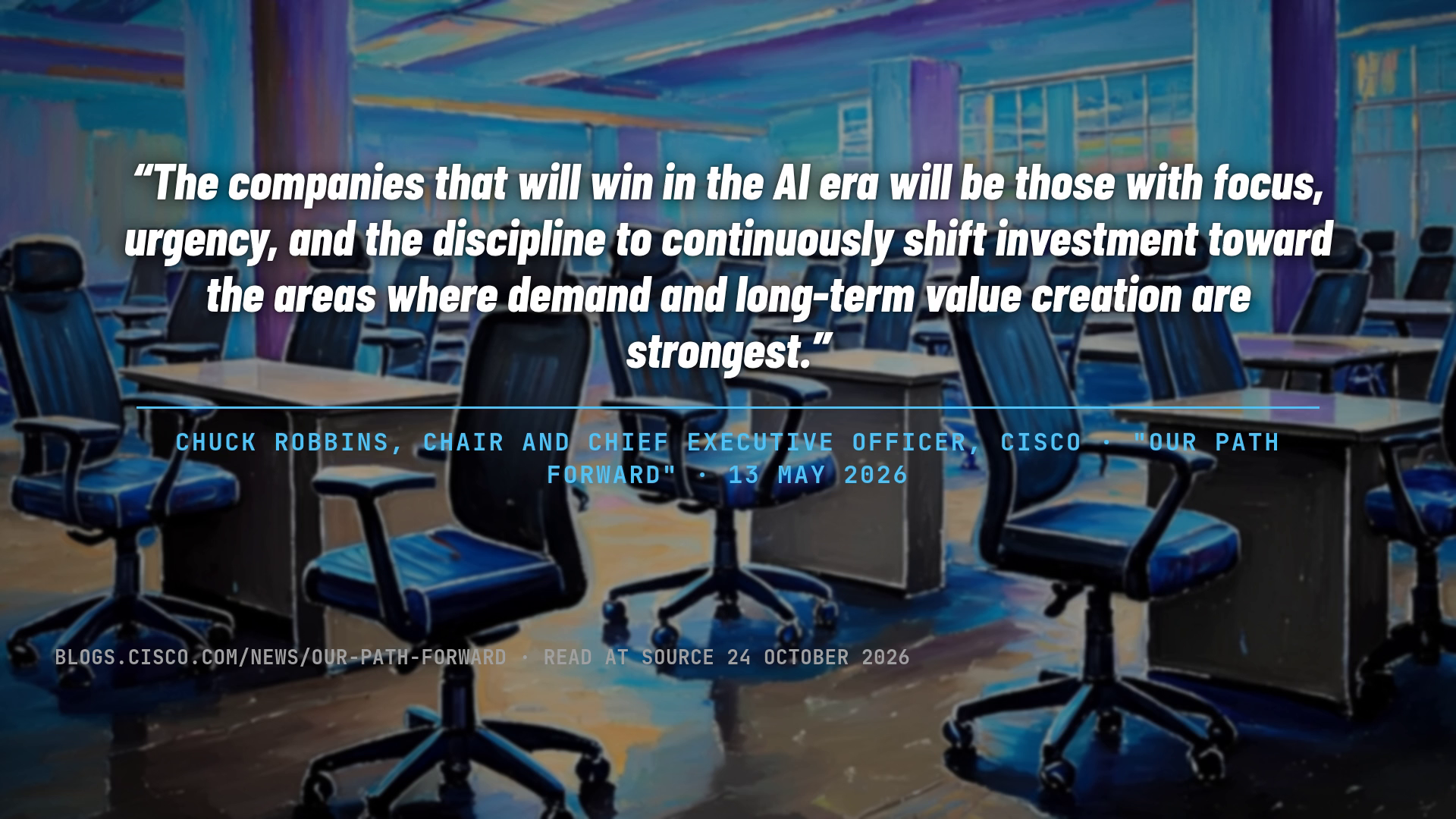
In May, Cisco's chief executive, Chuck Robbins, wrote to his staff. The companies that will win in the AI era, he said, will be the ones with the discipline to keep shifting investment to where demand is strongest.
Then he told them Cisco would cut fewer than four thousand jobs.
His post of 13 May 2026, "Our Path Forward", put it in his own words: "The companies that will win in the AI era will be those with focus, urgency, and the discipline to continuously shift investment toward the areas where demand and long-term value creation are strongest." And then: "With this, we are making changes today that will result in the reduction of our overall workforce in Q4 by fewer than 4,000 jobs, representing less than 5 percent of our total employee base." Cisco's Form 8-K of the same day names no number of jobs; it estimates pre-tax charges of up to $1 billion.
Two plans in two years.
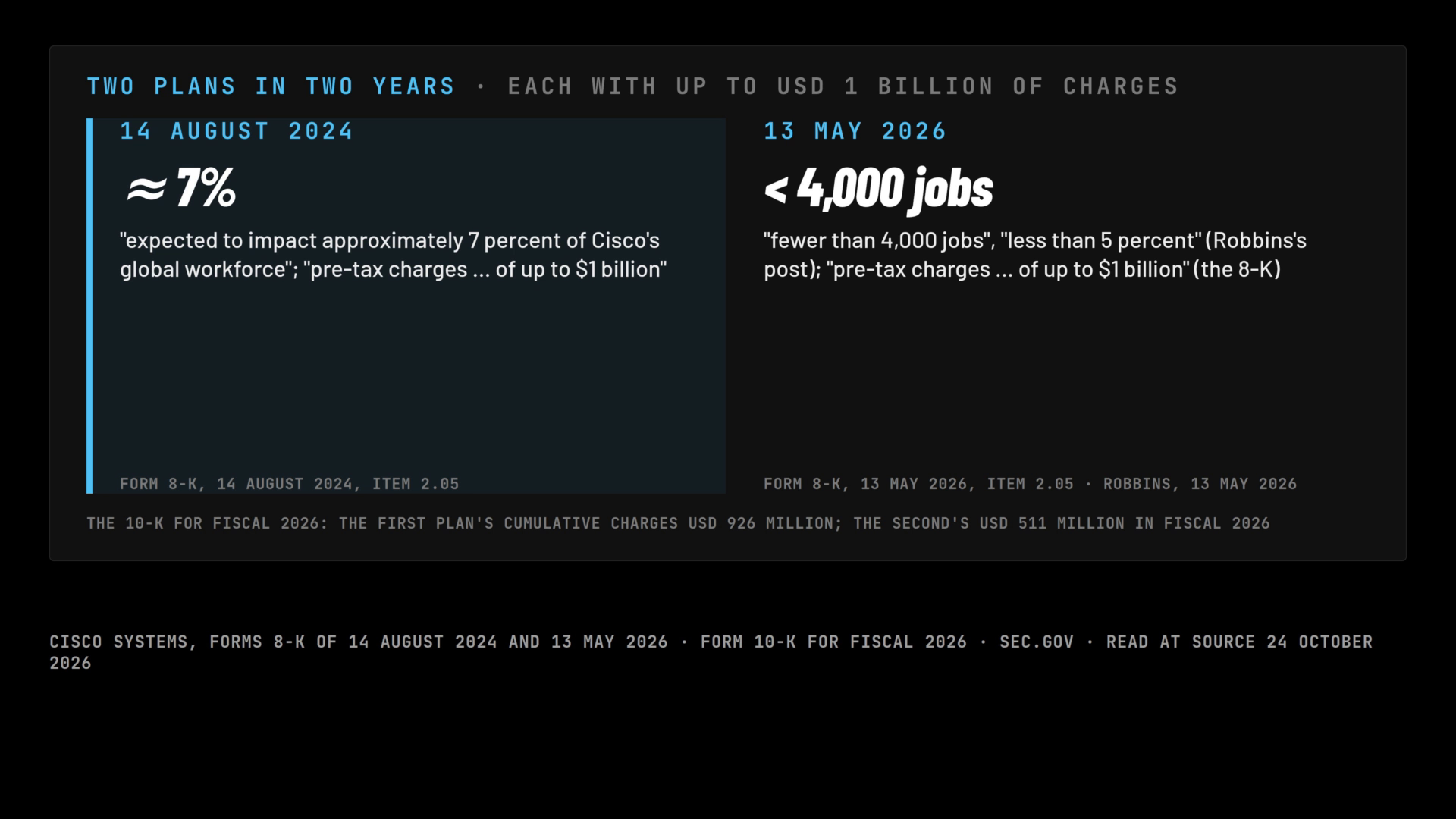
It was the second plan in two years. The first, in August 2024, was about seven percent of the workforce. Each plan came with up to a billion dollars in charges.
Cisco's Form 8-K of 14 August 2024 announced a plan "expected to impact approximately 7 percent of Cisco's global workforce", with pre-tax charges of up to $1 billion; by the 10-K for fiscal 2026 its cumulative charges were $926 million. The plan of 13 May 2026 carries the same ceiling, up to $1 billion, of which $511 million was recorded in fiscal 2026.
Eight thousand fewer.
In July 2024, Cisco had about ninety thousand four hundred people. By July this year, about eighty-two thousand four hundred.
Eight thousand fewer.
The three figures are Cisco's own, one from each annual filing: "approximately 90,400 employees" at 27 July 2024, "approximately 86,200" at 26 July 2025, "approximately 82,400" at 25 July 2026. It is a net figure: the people hired and the people of acquired companies are counted in it.
The money going the other way.
Now look at the money going the other way.
In those same three years, Cisco returned about thirty-seven billion dollars to its shareholders. Dividends and buybacks. More than twelve billion every single year.
Cisco's 10-K for fiscal 2026 tabulates it: dividends paid and repurchases of common stock came to $12,148 million in fiscal 2024, $12,432 million in fiscal 2025 and $12,659 million in fiscal 2026. The three years together, $37,239 million, are Token Runner's addition of the table's totals.
The chief executive's pay.
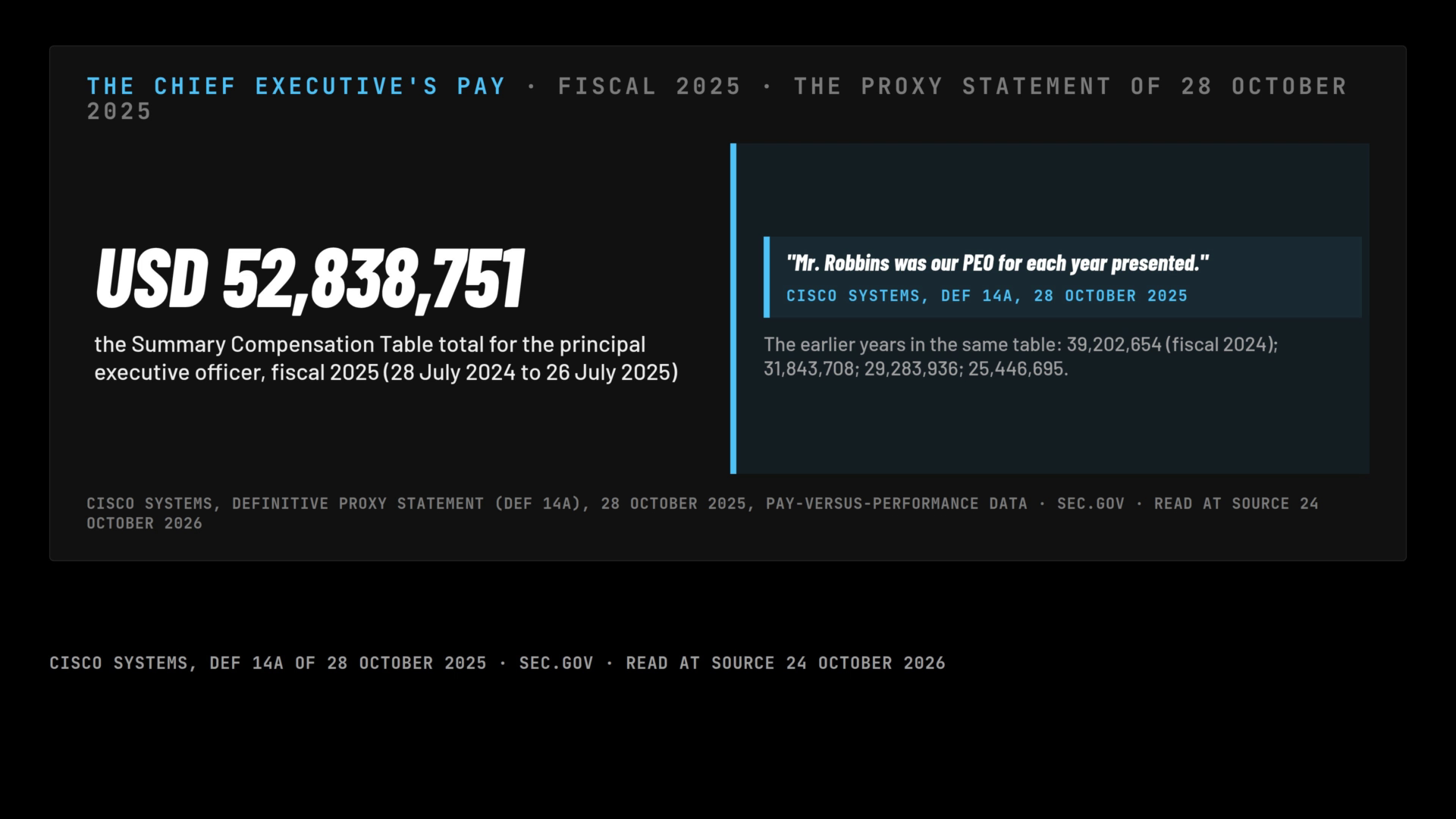
And for fiscal 2025, it paid its chief executive fifty-two point eight million dollars.
The figure is the Summary Compensation Table total for the principal executive officer in Cisco's proxy statement of 28 October 2025: $52,838,751 for the fiscal year to 26 July 2025. "Mr. Robbins was our PEO for each year presented," the proxy says.
The same table lists the total for the earlier years: $39,202,654 for fiscal 2024, and $31,843,708, $29,283,936 and $25,446,695 for the three years before that.
So how big is the AI business?
So how big is the AI business all of this was for?
Cisco answered that itself. In its annual filing to the regulator.
AI infrastructure for the big cloud companies was about six percent of total revenue.
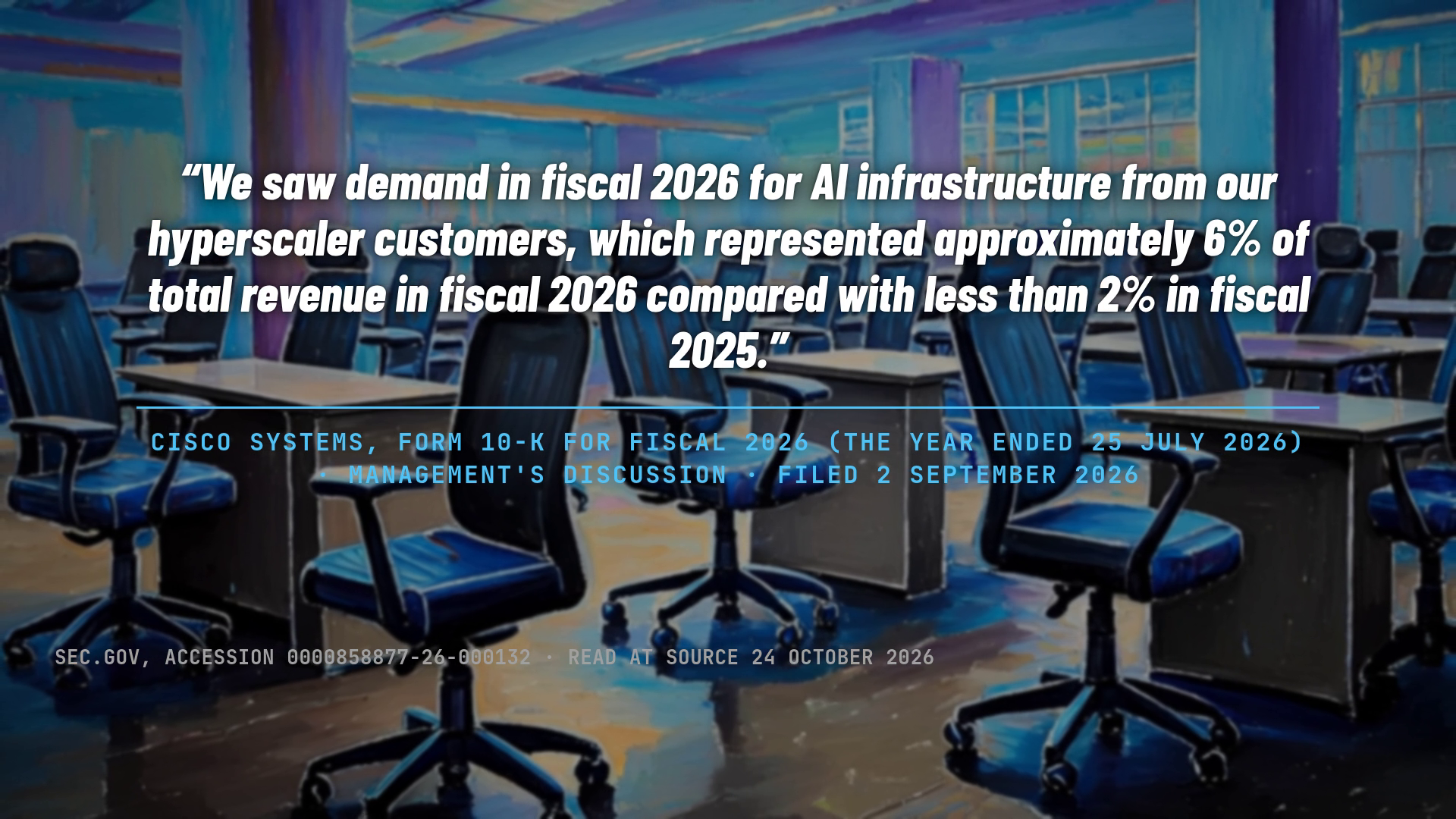
The sentence in the 10-K for fiscal 2026 reads: demand for AI infrastructure from hyperscaler customers, "which represented approximately 6% of total revenue in fiscal 2026 compared with less than 2% in fiscal 2025". The filing gives no closer figure than "less than 2%" for the year before, so the chart draws that year as a ceiling, in outline.
Six percent of sixty-three billion.
Six percent. Of sixty-three billion dollars.
"Total revenue was $63.3 billion, an increase of 12% compared with fiscal 2025," the 10-K says. Six percent of it is about $3.8 billion: Token Runner's arithmetic from Cisco's two figures, one of two sums in this piece that are ours. The other is the three-year total of capital returned.
Cisco's own release of 12 August 2026 puts the same business at approximately $4 billion of revenue delivered in fiscal 2026, which rounds the same way. The chart draws the slice inside the year's revenue, both in millions of dollars, so that the two figures can be held in one look: 63,300, and about 3,800 of it.
To be fair.
To be fair, it is growing fast. Less than two percent the year before. And Cisco expects more next year.
Its orders for AI were bigger than its AI revenue. Orders are promises. Revenue is what was delivered.
Cisco's release of 12 August 2026: "$4 billion of orders taken in Q4, bringing the total for FY 2026 to $9.3 billion"; "Delivered approximately $4 billion of revenue in FY 2026; $7.5 billion expected in FY 2027".
Orders are Cisco's count of what customers have committed to buy; revenue is what the filing records as delivered in the year. The gap between $9.3 billion and about $4 billion is business Cisco expects to deliver later, and its figure for fiscal 2027, $7.5 billion, would by its own numbers be nearly double the year just closed.
But the cuts were not a forecast. Neither were the buybacks.
Eight thousand fewer people. Thirty-seven billion to shareholders. In the name of a business that was six percent of the company.
Every figure from Cisco's own filings.
Sources
- Chuck Robbins, "Our Path Forward", blogs.cisco.com, 13 May 2026: "The companies that will win in the AI era will be those with focus, urgency, and the discipline to continuously shift investment toward the areas where demand and long-term value creation are strongest." and "With this, we are making changes today that will result in the reduction of our overall workforce in Q4 by fewer than 4,000 jobs, representing less than 5 percent of our total employee base."
- Cisco Systems, Form 8-K, 13 May 2026, Item 2.05: a restructuring plan announced on 13 May 2026; pre-tax charges to GAAP results of up to $1 billion, about $450 million in the fourth quarter of fiscal 2026 and the remainder in fiscal 2027. The filing names no number of jobs.
- Cisco Systems, Form 8-K, 14 August 2024, Item 2.05: a restructuring plan "expected to impact approximately 7 percent of Cisco's global workforce"; pre-tax charges of up to $1 billion.
- Cisco Systems, Form 10-K for fiscal 2024 (year ended 27 July 2024), Item 1, Human Capital: "As of July 27, 2024, we had approximately 90,400 employees".
- Cisco Systems, Form 10-K for fiscal 2025 (year ended 26 July 2025), Item 1: "As of July 26, 2025, we had approximately 86,200 employees".
- Cisco Systems, Form 10-K for fiscal 2026 (year ended 25 July 2026), filed 2 September 2026: "As of July 25, 2026, we had approximately 82,400 employees"; "Total revenue was $63.3 billion, an increase of 12% compared with fiscal 2025"; demand for AI infrastructure from hyperscaler customers "which represented approximately 6% of total revenue in fiscal 2026 compared with less than 2% in fiscal 2025"; the dividends and repurchases table: fiscal 2024 dividends $6,384 million and repurchases $5,764 million, fiscal 2025 $6,437 million and $5,995 million, fiscal 2026 $6,553 million and $6,106 million; the fiscal 2025 plan's cumulative charges $926 million, the fiscal 2026 plan's charges $511 million in fiscal 2026.
- Cisco Systems, fourth-quarter and fiscal 2026 earnings release, 12 August 2026 (Exhibit 99.1 to the Form 8-K of 12 August 2026): "$4 billion of orders taken in Q4, bringing the total for FY 2026 to $9.3 billion"; "Delivered approximately $4 billion of revenue in FY 2026; $7.5 billion expected in FY 2027".
- Cisco Systems, definitive proxy statement (DEF 14A), 28 October 2025, pay-versus-performance data: the Summary Compensation Table total for the principal executive officer for fiscal 2025, $52,838,751; "Mr. Robbins was our PEO for each year presented."