Paying Off
On the twenty-first of October, Meta reported its results. Mark Zuckerberg's verdict: "Our investments are paying off."
The spending.
The investment is in AI: data centres, chips and power. Meta expects to spend up to a hundred and forty-five billion dollars on building this year. In the last quarter alone, almost thirty-five billion. And for the first time since 2012, more went out than came in: free cash flow, negative two billion dollars.
Capital spending (property and equipment plus finance-lease principal, Meta's own definition) against operating cash flow, by quarter, from Meta's own filings: in Q3 2026, $34.91bn against $32.79bn. Free cash flow was -$2.12bn in Q3 2026 (+$10.63bn a year earlier), the first negative quarter since Q2 2012 by Meta's own filings. Meta's 2026 capital spending guidance is $135bn to $145bn, narrowed from $130bn to $145bn. Between 31 December 2025 and 30 September 2026, its cash and cash equivalents fell from $35.87bn to $11.22bn, and its long-term debt rose from $58.74bn to $80.92bn.
Source: Meta's own 10-Q and 10-K filings with the SEC (the cash-flow statements: purchases of property and equipment, finance-lease principal payments, operating cash flow), quarters computed from the year-to-date figures, read 28 October 2026
The call.
On the same day, an analyst asked its finance chief about raising money. Her answer: "We don't have any specific financing plans to announce at this time."
Susan Li, Meta's finance chief, was answering a Goldman Sachs analyst's question on capital, by Meta's own transcript. Her answer in full: "We don't have any specific financing plans to announce at this time but we thought it was prudent to establish the appropriate capital structure framework to ensure that we have access to a diverse pool of funding sources." On the same call: "these investments will take longer to generate returns than those in our core business".
The sale.
Five days later, Meta launched about thirty-five billion dollars of new shares, raised to thirty-seven and a half the next day, and said it planned sixty billion more next year. Close to a hundred billion dollars in all: by Reuters' count, a record. The new shares come with a twist: the sixty billion will be a new class of stock with "no voting rights". Mark Zuckerberg keeps control.
Launched on 26 October and raised on 27 October: $25.0bn of Class A common stock at $625 a share, sold forward, so Meta receives the cash only when it settles, on or before 19 November 2027; and $12.5bn of 6.50% mandatory convertible preferred stock. That is $37.5bn underwritten. On top, Meta plans an at-the-market programme of about $60bn in a new Class C stock from 2027; it "has not entered into any agreement" for it yet. $97.5bn in all is Reuters' count, and 'a record' is Reuters' word.
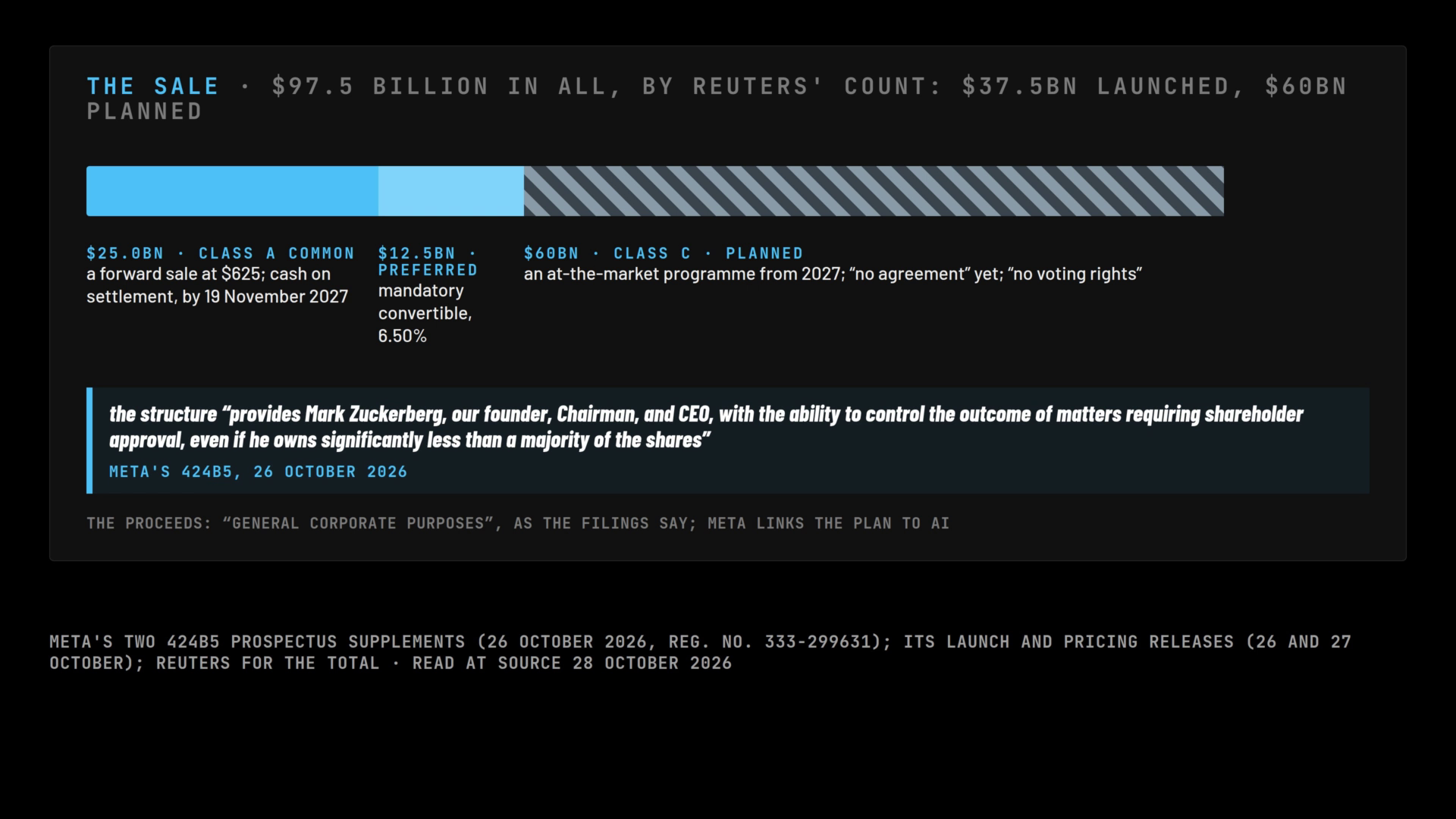
Each share of Class C "will have no voting rights"; the prospectus says the structure "provides Mark Zuckerberg, our founder, Chairman, and CEO, with the ability to control the outcome of matters requiring shareholder approval, even if he owns significantly less than a majority of the shares". The proceeds are for "general corporate purposes", as the filings say; Meta links the plan to AI. NVIDIA, AMD and Broadcom indicated an interest in buying up to $5.0bn of the Class A shares.
The case.
Meta's case, in its own words: its AI investments "are already delivering substantial incremental advertising revenue." The analysts at William Blair: "We expect investors to continue to question the financing and potential for future capital raises."
Meta's launch release says it will fund its investments "through a balanced mix of operating cash flow, investment-grade debt, strategic partnerships, and equity capital." William Blair, as quoted by Reuters, also said "the financing reinforces both Meta's confidence in the long-term returns from AI investment and the increasingly capital-intensive nature of pursuing that opportunity."
Paid for.
Paying off, says Meta. And now, paid for by its shareholders too.
New shares sold to investors dilute the shares already held; Meta's own prospectus for the preferred stock says it "could result in dilution to our earnings per share". What we couldn't confirm: the final terms. The final prospectus supplements were not yet on the SEC's system when we read the filings on 28 October.
Every figure from Meta's own results, its filings with the SEC, and the analysts who said it on the record. Token Runner dot A I.
Sources
- Meta, Q3 2026 results release, 21 October 2026 (Exhibit 99.1): "Our investments are paying off"; 2026 capital expenditures "in the range of $135-145 billion"; cash and cash equivalents $11,222 million against $35,873 million; long-term debt $80,922 million against $58,744 million.
- Meta, Q3 2026 earnings call, 21 October 2026, its own transcript: Susan Li's answer to a Goldman Sachs analyst.
- Meta, 424B5 prospectus supplement, Class A common stock, 26 October 2026 (Reg. No. 333-299631): the forward sale settling "on or prior to November 19, 2027"; Class C "will have no voting rights"; the control sentence; "general corporate purposes".
- Meta, 424B5 prospectus supplement, Series A mandatory convertible preferred stock, 26 October 2026.
- Meta, launch release, 26 October 2026: the planned approximately $60 billion at-the-market programme; "The Company has not entered into any agreement with respect to any such program"; "a balanced mix of operating cash flow, investment-grade debt, strategic partnerships, and equity capital".
- Meta, pricing term sheet, 27 October 2026: the common stock offering increased to $25.0 billion at $625.00 a share; the 6.50% Series A mandatory convertible preferred, net proceeds approximately $12.5 billion.
- Meta's own XBRL filings with the SEC (company facts), the cash-flow lines from which the quarterly chart is computed.
- Reuters, 27 October 2026, as carried by Investing.com: $97.5 billion in all, 'a record'; William Blair's two lines.