Lost on Paper
On the twenty-sixth of October, Anthropic filed to go public. Anthropic makes Claude. A disclosure: Token Runner is built with Claude. So we read the filing ourselves.
The money coming in.
First, the money coming in. Forty-one million dollars in 2023. Four point six billion last year.
And in the first six months of this year, sixteen point three billion.
Eleven point six of it in a single quarter.
The filing's summary statement of operations: revenue of $41 million in 2023, $386 million in 2024 and $4,585 million in 2025; $1,163 million in the six months to 30 June 2025 and $16,286 million in the six months to 30 June 2026. In its own words: "In 2023, 2024, and 2025, our revenue was $41 million, $386 million, and $4.6 billion, respectively, representing year-over-year growth rates of 841% and 1,088%, respectively. In the six months ended June 30, 2026, our revenue was $16.3 billion, representing a year-over-year growth rate of 1,300%." The quarterly table: $376 million, $787 million, $1,382 million, $2,040 million, $4,731 million and $11,555 million for the six quarters from March 2025 to June 2026.
The other number.
Then the other number. A net loss of eighty point seven billion dollars. That sounds like a company on fire. It isn't, quite.
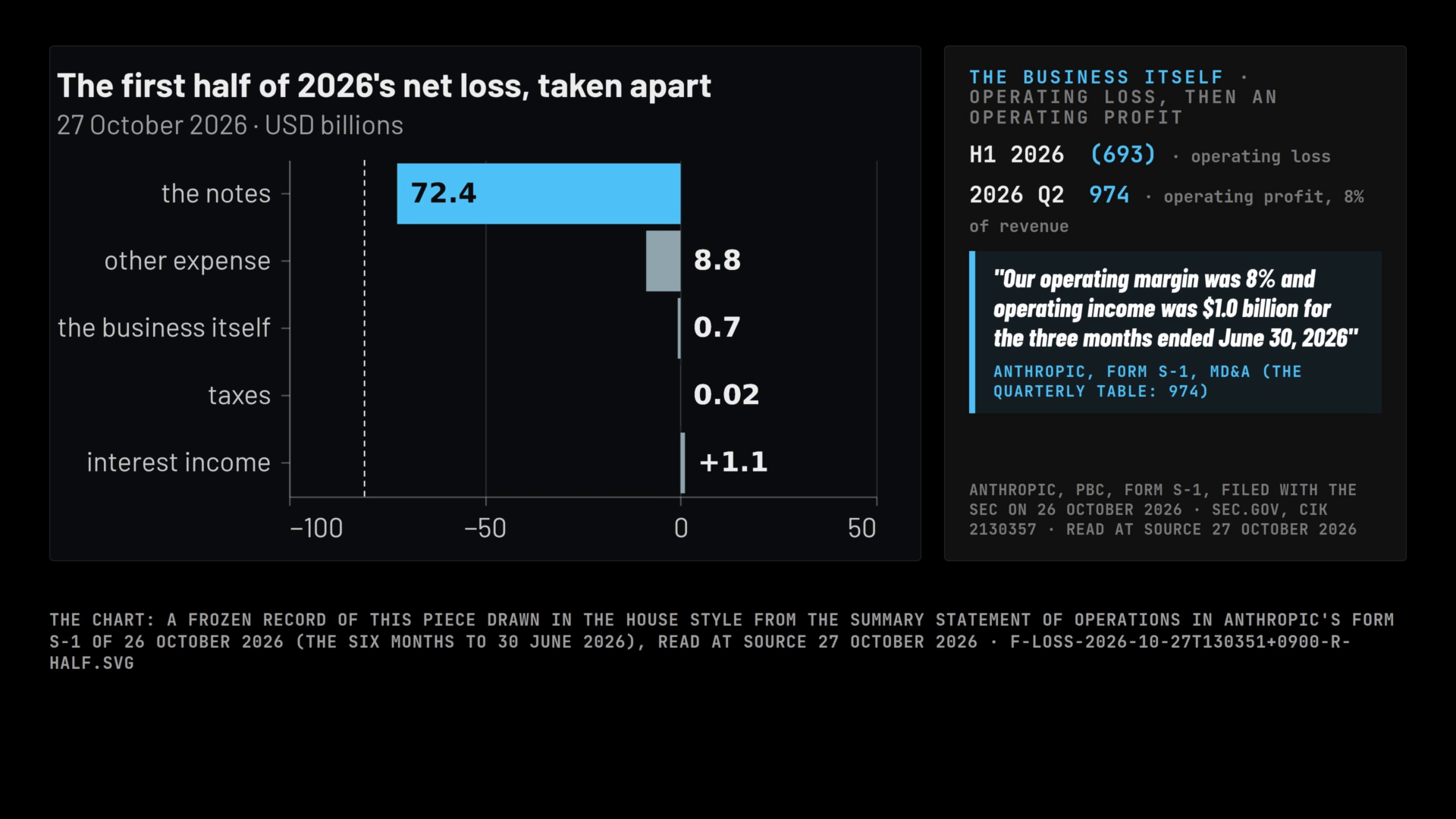
Seventy-two billion of that loss is the company's own debt. Notes that turn into shares. As Anthropic became worth more, those notes became worth more, and the accounts count that as a loss.
The business itself lost six hundred and ninety-three million. And in the second quarter, it made a profit.
The net loss for the six months to 30 June 2026 is $80,748 million: an operating loss of $693 million; a change in the fair value of convertible notes, derivative liabilities and SAFEs of $72,388 million; other expense of $8,757 million; interest income of $1,111 million; and taxes of $21 million. The filing's own footnote: "These changes were primarily driven by an increase in the fair value of our outstanding convertible promissory notes resulting from an increase in our enterprise valuation during each of the respective periods." The other expense, the filing says, "was primarily driven by the initial fair value recognition and change in fair value of the assets and liabilities recognized under the note purchase agreements described in Note 4". The quarterly table gives operating income of $974 million for the three months to 30 June 2026, 8% of revenue, after losses of $935 million, $1,200 million, $3,089 million, $2,836 million and $1,667 million in the five quarters before; the text rounds it to "$1.0 billion". Its non-GAAP measure, adjusted operating income, was $1,618 million for the half.
Where the money goes.
So where does the money go? Fifty-five cents of every dollar goes to compute. The chips and the data centres.
Operating expenses of $16,979 million against revenue of $16,286 million in the half: compute and infrastructure $8,945 million (about 55 cents of each revenue dollar, our division; 48 cents in the second quarter, $5,558 million of $11,555 million); sales, marketing and partnerships $3,168 million; personnel $3,152 million, including $2.2 billion of stock-based compensation; other operating and administrative $1,714 million. A year earlier compute cost 251% of revenue, in the quarter to March 2025. Before 2026, the filing says, the company "obtained substantially all of its compute infrastructure from three cloud service providers"; in March 2026 it signed an equipment lease with Broadcom for AI accelerators, payable, if needed, with up to $42.0 billion of convertible notes at 9.00% a year, paid in kind, or 13.00% if revenue conditions are missed, of which none had been issued at 30 June 2026.
Who holds the keys.
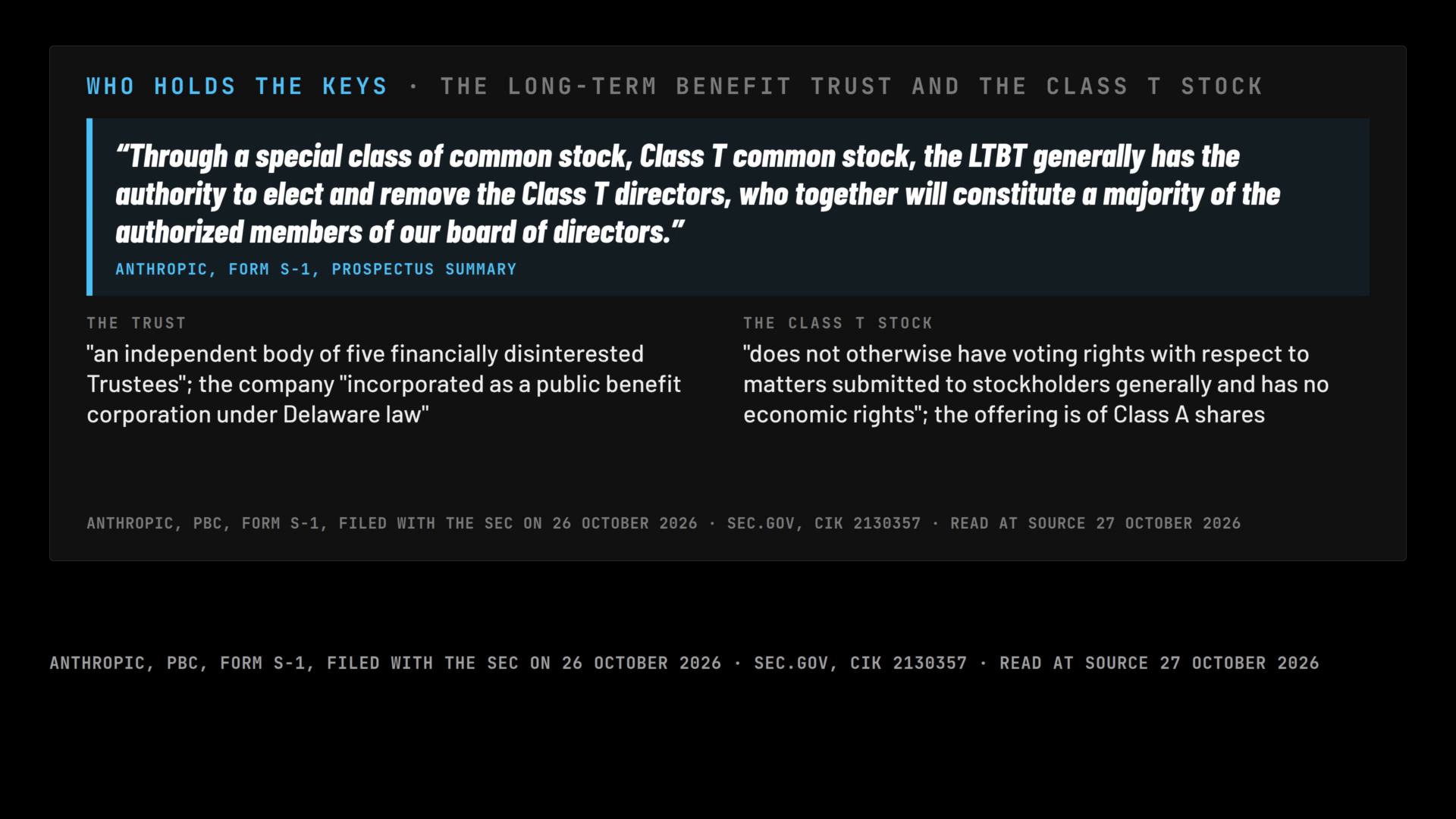
And who holds the keys? Not just the buyers of the shares. A trust of independent trustees picks most of the board, through a special class of stock held by the trust.
The filing: "Through a special class of common stock, Class T common stock, the LTBT generally has the authority to elect and remove the Class T directors, who together will constitute a majority of the authorized members of our board of directors." The Class T stock "does not otherwise have voting rights with respect to matters submitted to stockholders generally and has no economic rights"; the trust is "an independent body of five financially disinterested Trustees"; the company is "incorporated as a public benefit corporation under Delaware law".
The shares offered are Class A, applied for listing on the Nasdaq Global Select Market under the symbol ANT. Amazon holds $6.2 billion of convertible promissory notes, the company's whole indebtedness at 30 June 2026, and no note converts if Amazon "would hold more than 12% of our capitalization".
What else the filing says.
As of 30 September 2026, "More than 11,900 customers with $100,000 or more of revenue on a TTM basis; More than 1,900 customers with $1 million or more of revenue on a TTM basis; and Approximately 250 customers with $10 million or more of revenue on a TTM basis." Approximately 5,300 employees at the same date. Cash, cash equivalents and short-term investments of $131,651 million at 30 June 2026, total assets of $147,358 million, total liabilities of $117,467 million, an accumulated deficit of $132,902 million. A $1,500 million settlement, the Bartz settlement, in 2025's costs. Revenue through the cloud providers' marketplaces: about 47% of 2025's and 48% of the first half of 2026's; one customer was 43% of 2023's revenue.
On power: "In some regions, including certain regions where we have contracted compute commitments, data center development has prompted public controversy and regulatory scrutiny regarding environmental impact, land and water use, and the allocation of limited power resources."
To be fair.
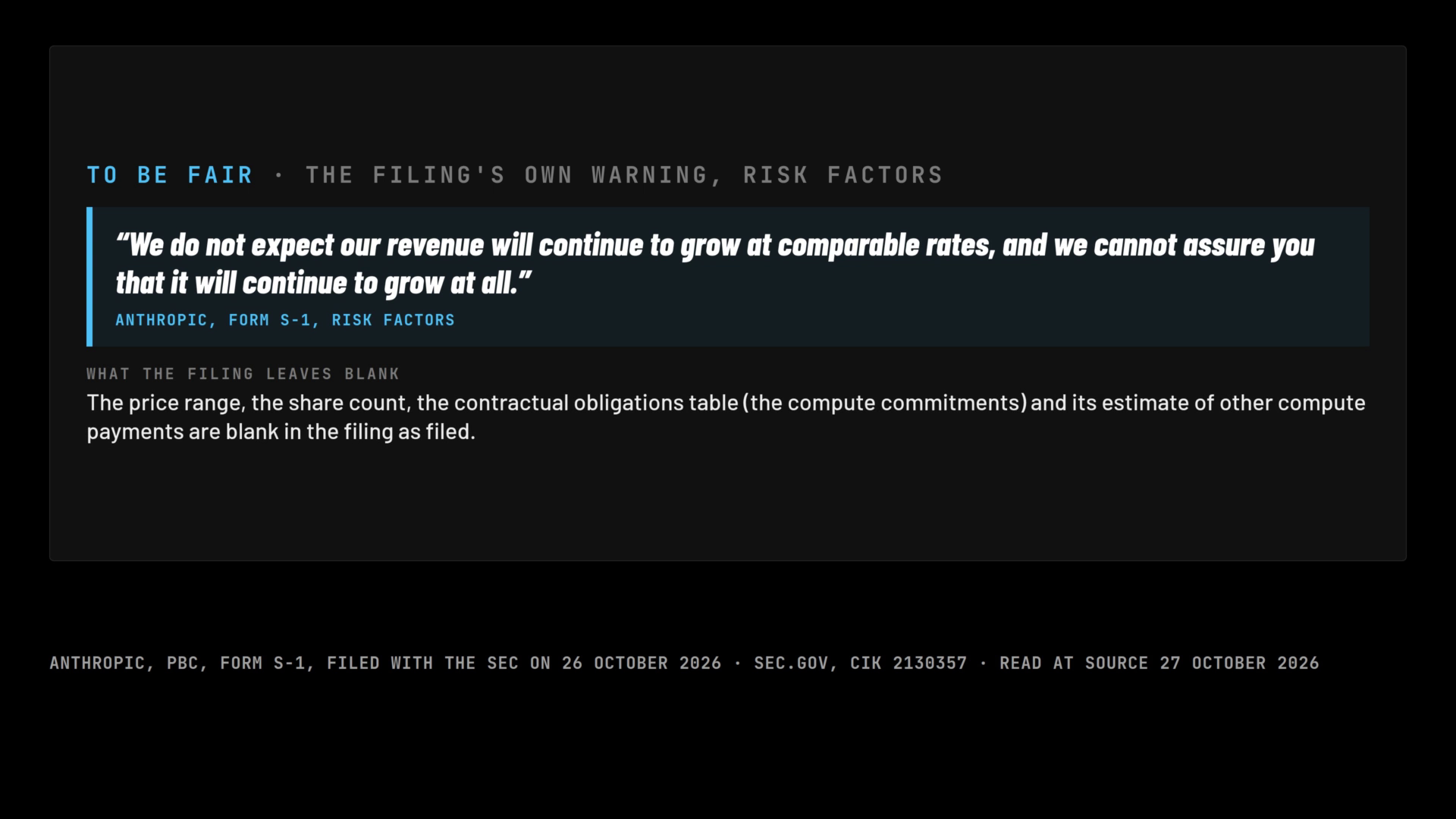
To be fair, the filing warns about itself. In its words: we do not expect our revenue will continue to grow at comparable rates.
The sentence, in full: "We do not expect our revenue will continue to grow at comparable rates, and we cannot assure you that it will continue to grow at all." And what the filing leaves blank, as filed: the price range and the share count; the contractual obligations table, whose total "approximately $" and every cell are empty, "substantially all of which is related to compute and infrastructure"; and its estimate of other compute payments, "approximately $ to $". The reported timing and valuation of the offering are press reports, not the filing's.
Sixteen billion dollars in. A loss that's mostly paper. And a market about to put a price on it.
Every figure from Anthropic's own filing. Anthropic makes Claude, and Token Runner's agents run on Claude.