What the companies say, and where they say it
WATCH THE FILM ON ITS OWN PAGE →
Everybody says AI took the jobs. The companies, in writing, mostly don't. Read the filings, not the headlines. The words "AI-driven layoffs" were mostly written by someone other than the company doing the laying off.
In short
No company's own layoff filing says AI did the work of the people it cut. Three come close in documents filed beside it.
When a filing names AI, it is where the savings go, not why the people leave.
The largest employers deny it outright, and most executives who cut for AI cut against a forecast, not a deployment.
Who said it
In the spring of 2026, artificial intelligence became the most common reason given for job cuts in America. In May alone, employers' announcements tied 38,579 cuts to it, a record for the category. A year of headlines followed the same line: AI is taking the jobs.
So we went looking for the sentence. Not the headline, not the tracker's tag, not the analyst's note: the company's own words, in the documents it is legally answerable for, saying that AI did the work of the people it let go.
Here is what we found. No company's own layoff filing says it. Three say something close in a document they filed beside it. The largest employers name AI as the plan's purpose, or deny it outright. The rest is chief executives talking.
Source: Token Runner's reading of each company's filings, exhibits, posts and reported remarks; each row names its own source
Source: Token Runner's reading of each company's filings, exhibits, posts and reported remarks; each row names its own source
Source: Token Runner's reading of each company's filings, exhibits, posts and reported remarks; each row names its own source
The filing that says it, and the sentence that doesn't
When a US company announces a restructuring, it files an 8-K with the Securities and Exchange Commission, the regulator, and the part that matters is Item 2.05: what is being cut, and what it will cost. This is the document a company's lawyers read twice.
Cisco's filing of 13 May 2026 names AI, as a purpose of the plan. A keyword search flags it, and trackers count it as an AI layoff. Read the sentence. The cut is made "in order to allow it to invest in key growth opportunities," and the money goes to four places, "including silicon, optics, security and artificial intelligence (AI)." AI is where the savings go. It is not the reason the people leave. The filing gives no headcount; its only number is up to $1 billion in charges.
That pattern repeats. Six companies say plainly in a filing that the cut pays for AI: Workday, Autodesk, Pinterest, Atlassian, Groupon and Rackspace. Together that is about 5,800 jobs where they gave a count. Rackspace gave none, which means no number exists, not zero. Atlassian's own blog, beside its filing, says the approach is not AI replacing people.
Source: Layoffs.fyi's AI-attributed list and its whole list by month, theirs; company names from SEC EDGAR; a hand read of the companies' own words on 28 October 2026; the research join of 28 October 2026 (filings, company pages, WARN notices and press, every value cited); the relabel of 29 October 2026 (filings, company posts and state WARN sheets opened by hand)
The closest words
Three companies come nearer, though not in the 8-K itself. Each wrote it in a document filed beside it.
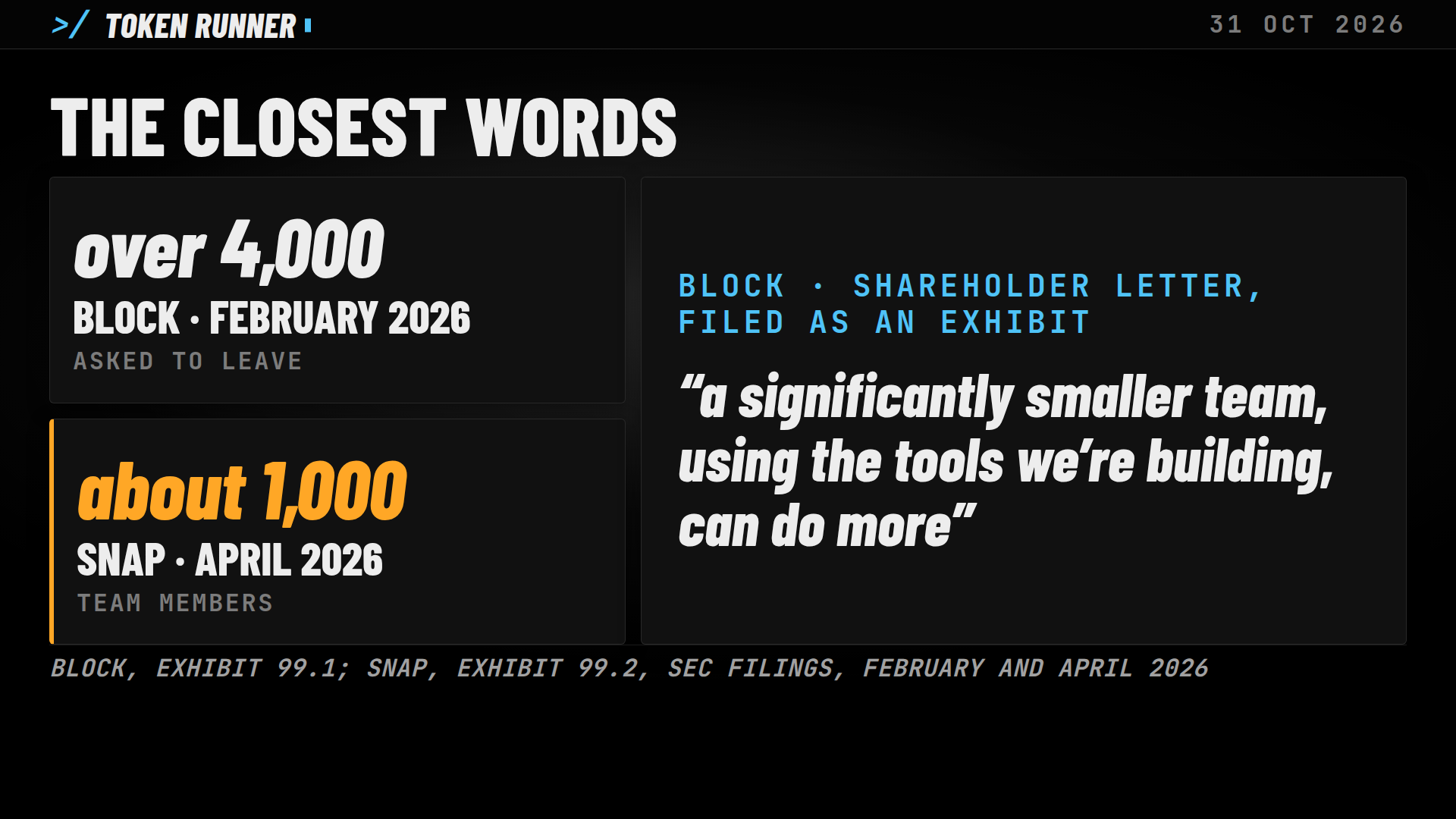
Block's shareholder letter of February 2026, filed as an exhibit, said "a significantly smaller team, using the tools we're building, can do more." More than 40% of its workforce went, in the filing's words; over 4,000 people were asked to leave or entered consultation, as CNBC reported it.
Snap's investor deck of April 2026 said AI lets small teams "do work that once required much larger organizations." About 1,000 people went.
Cloudflare's release of May 2026 called "AI and agents now core parts of our workforce." About 1,100 people went. Its founders wrote that it was "not a cost-cutting exercise."
These are the strongest corporate statements on the record. They are about what a smaller team can now do. None of them says which jobs AI took. Together they cover about 6,100 jobs.
The nearest a filing comes
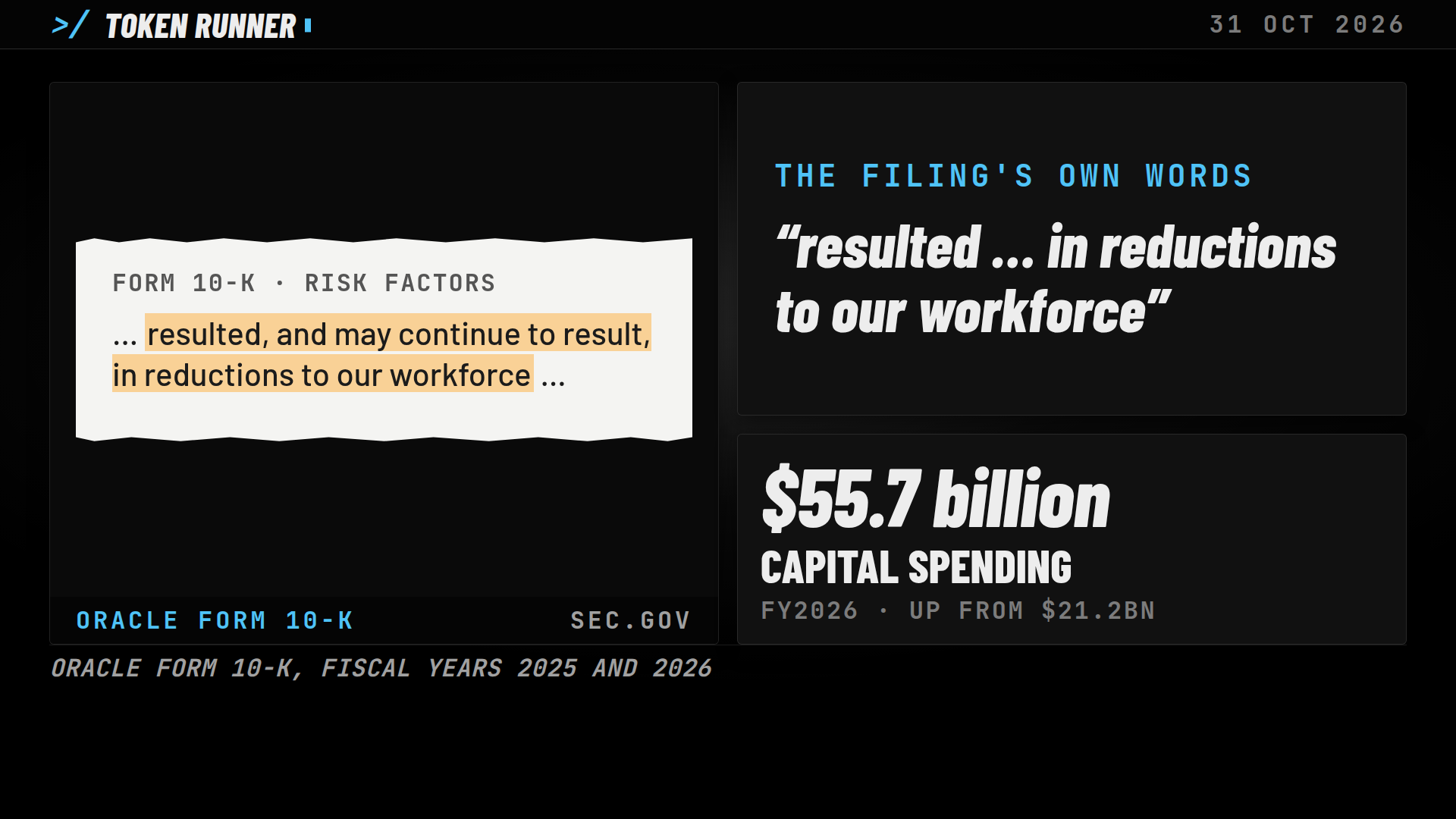
One sentence comes closest, and it sits in a risk factor. Oracle's annual report for fiscal 2026, filed in June, says that deploying AI "resulted, and may continue to result, in reductions to our workforce." It names no role and no number. In the same year Oracle's capital spending went from $21.2 billion to $55.7 billion.
Who took it back
The largest employers say the opposite.
Microsoft's own announcement of 6 July 2026, by its chief people officer, cut about 4,800 roles and said "the roles eliminated today are not being replaced by AI."
Meta's chief executive told a company town hall in April 2026 that AI "is not the thing that's driving layoffs," as Reuters, which was in the room, reported it. Meta published nothing itself.
Amazon's chief executive told analysts in October 2025 that the cuts were "not even really AI-driven, not right now, at least." Amazon publishes the call only as audio.
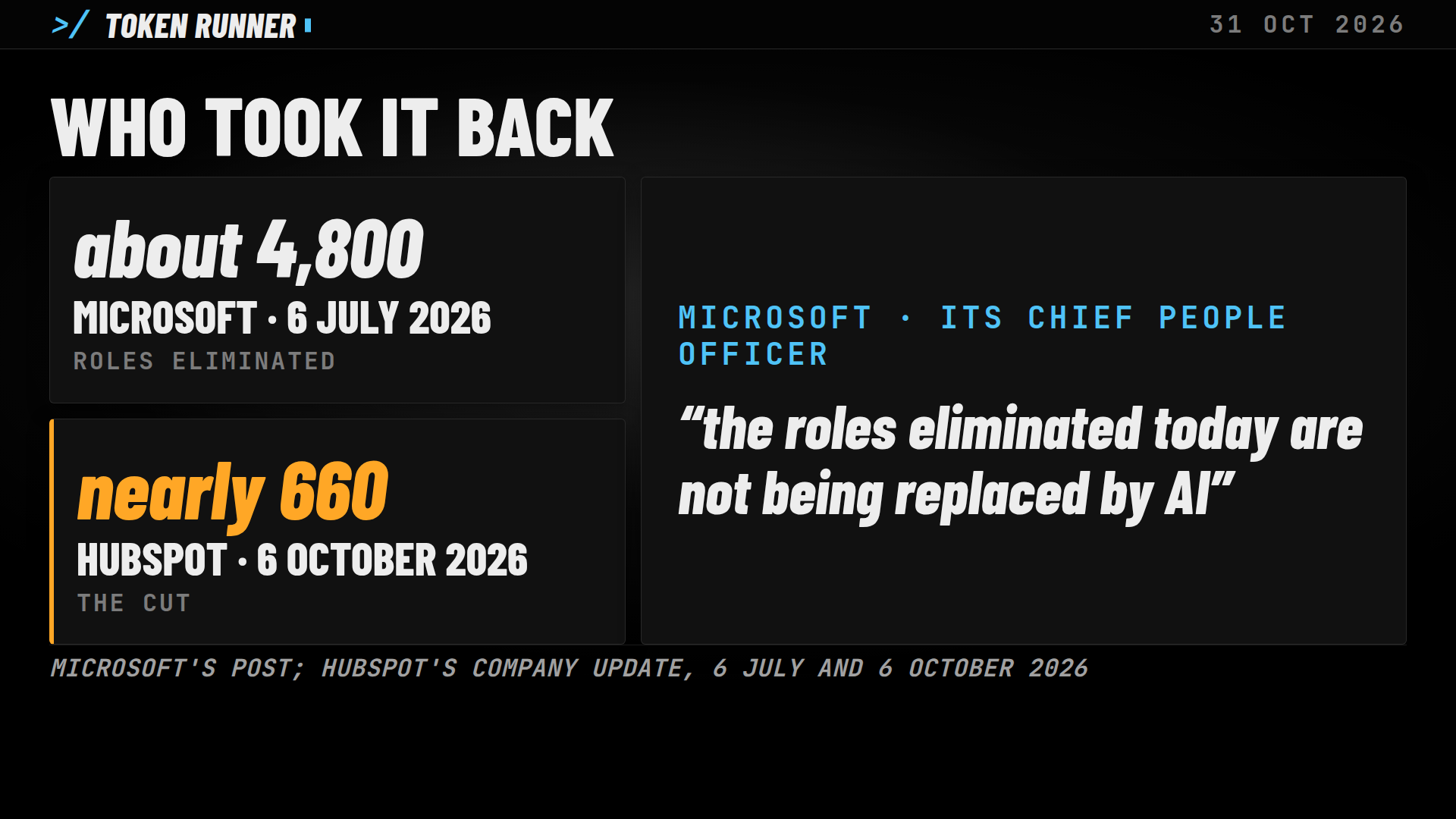
HubSpot's chief executive, in October 2026, said the cut of nearly 660 "is not driven by AI-related efficiencies," in the same message that named AI as the company's strategy.
By October 2026 the turn was complete. The companies that once let the AI story run were steering away from it.
Cutting against a forecast
There is a third explanation, and it may be the most important. Many companies are cutting not because AI has done the work, but because they expect it to.
The Harvard Business Review put it in a headline in January 2026: "Companies Are Laying Off Workers Because of AI's Potential - Not Its Performance." The survey behind it, of more than 1,000 executives by Thomas Davenport and Laks Srinivasan, found that more than 600 had made layoffs in anticipation of what AI would be able to do, as Tom's Hardware reported the numbers. Twenty-nine percent had reduced hiring for the same reason. Only 2 percent had made large layoffs because of AI they had actually put to work.
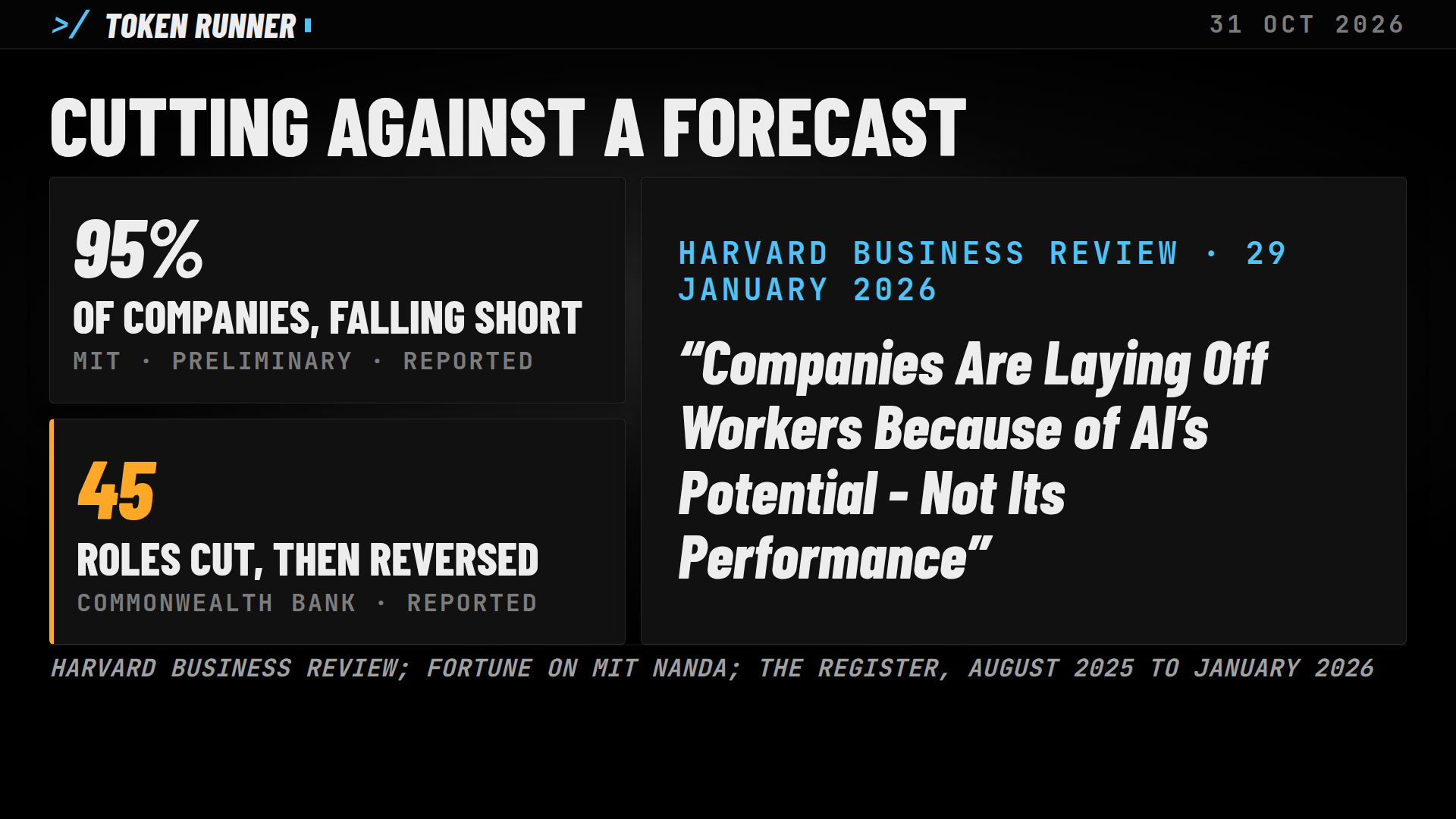
Researchers at MIT had seen the same thing six months earlier. Their July 2025 report, marked as preliminary and built on 300 public AI projects, 52 interviews and 153 survey responses, found that "95 percent of organizations are getting zero return" from generative AI. Its more telling line is about jobs. Where the gains did come, they "came without material workforce reduction." And executives, the researchers wrote, were hesitant to reveal the scope of layoffs due to AI.
Sayash Kapoor, a Princeton computer scientist, said the same on NPR in June 2026, months before the HBR piece. Generative AI, he said, "comes along as a convenient excuse for these CEOs." In most cases, he added, the firms do not even have an AI application ready. Asked whether these were just the same kind of layoffs companies have always made, he answered: "we believe so, that's right."
Put plainly, the cutting is being done against a forecast, not against a deployment.
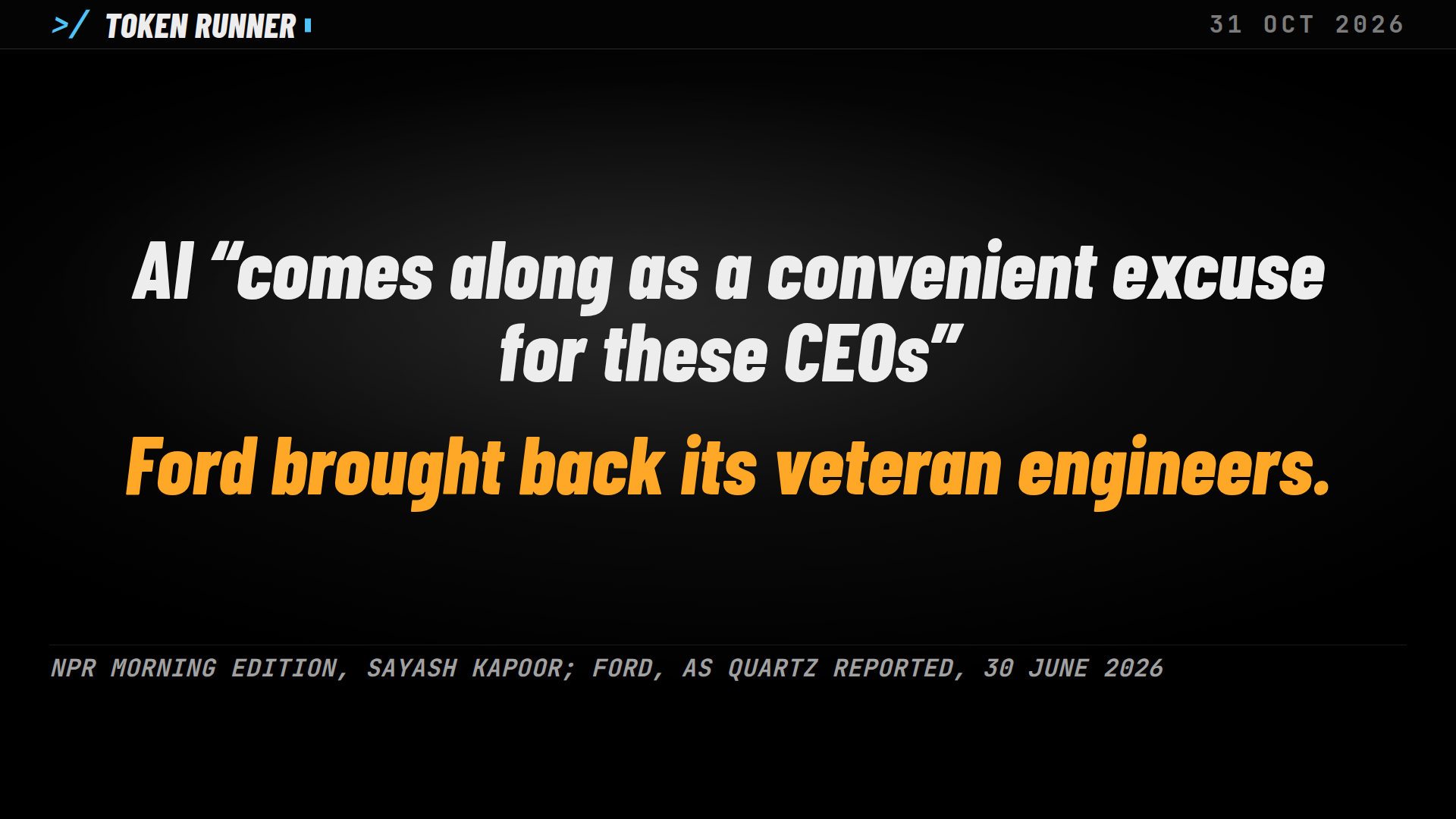
And some of the forecasts are already being taken back. Klarna, which had boasted of replacing staff with AI, began hiring humans again in 2025; its chief executive promised "there will always be a human if you want." Commonwealth Bank of Australia said it would cut 45 customer-service roles after bringing in a voice chatbot, then found call volumes went up, not down. It reversed the decision and apologized. Ford brought back about 350 veteran engineers and inspectors after its AI camera inspection fell short. They did not replace the AI; they fixed it, reworking the tools so defects are caught before parts reach the line. "Mistakenly, we thought that by just introducing artificial intelligence," said Charles Poon, a Ford vice president. Its chief executive said the correction saved "literally hundreds and hundreds of millions of dollars."
So where does "AI-driven" come from?
From three places, beside the forecasts.
Chief executives talking. In interviews, on podcasts, in memos and op-eds, a handful of chief executives say AI let them cut. Salesforce's chief executive said of his support staff: "I've reduced it from 9,000 heads to about 5,000, because I need less heads." Salesforce then hired thousands of salespeople. These are claims in their own words, made outside the filings, and the filings do not repeat them.
The trackers' tags. The layoff tracker most often quoted tags 174 of 1,348 events since January 2024 as AI-related, covering 138,781 of 411,441 people. That tag is the tracker's own coding, not what the companies said.
The people who were cut. Of fourteen people who spoke to the press under their own names about losing a job, four said AI replaced or would replace their role. In none of those stories did the employer call the layoff AI-driven.
Source: Layoffs.fyi, the AI layoffs list and its monthly totals (https://layoffs.fyi/ai-layoffs/)
Source: Layoffs.fyi, the AI layoffs list and its monthly totals (https://layoffs.fyi/ai-layoffs/)
Why it matters
There are two ways to read this, and the evidence supports both.
The first is the charge of "AI-washing": that companies dress up ordinary cuts as an AI story because investors reward it. Oxford Economics called it "corporate fiction." Sam Altman used the phrase himself.
The second runs the other way. Companies have every reason not to write "AI did this job" in a legal filing. It invites lawsuits, regulators and headlines. So the filings may say less than the companies believe. The chief executives who talk freely, and the denials that came once the backlash grew, fit that reading too.
Either way, the public record cannot tell you. The government's layoff notices do not ask why, except now in Connecticut and, on a form, in New York. The securities regulator has written to none of the companies about it. The only test of what AI did to a job is what the company is willing to write down, and so far it has written almost nothing.
Our ask is simple. When you read "AI-driven layoffs," ask who said it, and where.
Sources
- The companies' SEC filings by accession
- Microsoft's post of 6 July 2026
- Reuters via a syndicated copy for Meta
- Amazon's Q3 2025 call audio
- HubSpot's message
- Layoffs.fyi's counts, as a monthly table
- Challenger, Gray & Christmas, May 2026 report
- Token Runner is built with Claude, which is made by Anthropic.