Follow One Dollar
Modern AI venture accounting is the ultimate financial illusion—where tech giants like Amazon, Microsoft, and Nvidia invest billions in AI startups, watch those same dollars immediately bounce back as guaranteed cloud revenue, and leave the obvious conflict of interest unsaid in their SEC disclosures, begging the question: if these investments are genuinely arm's-length deals, why does every single dollar seem to know its way back home?
Money out
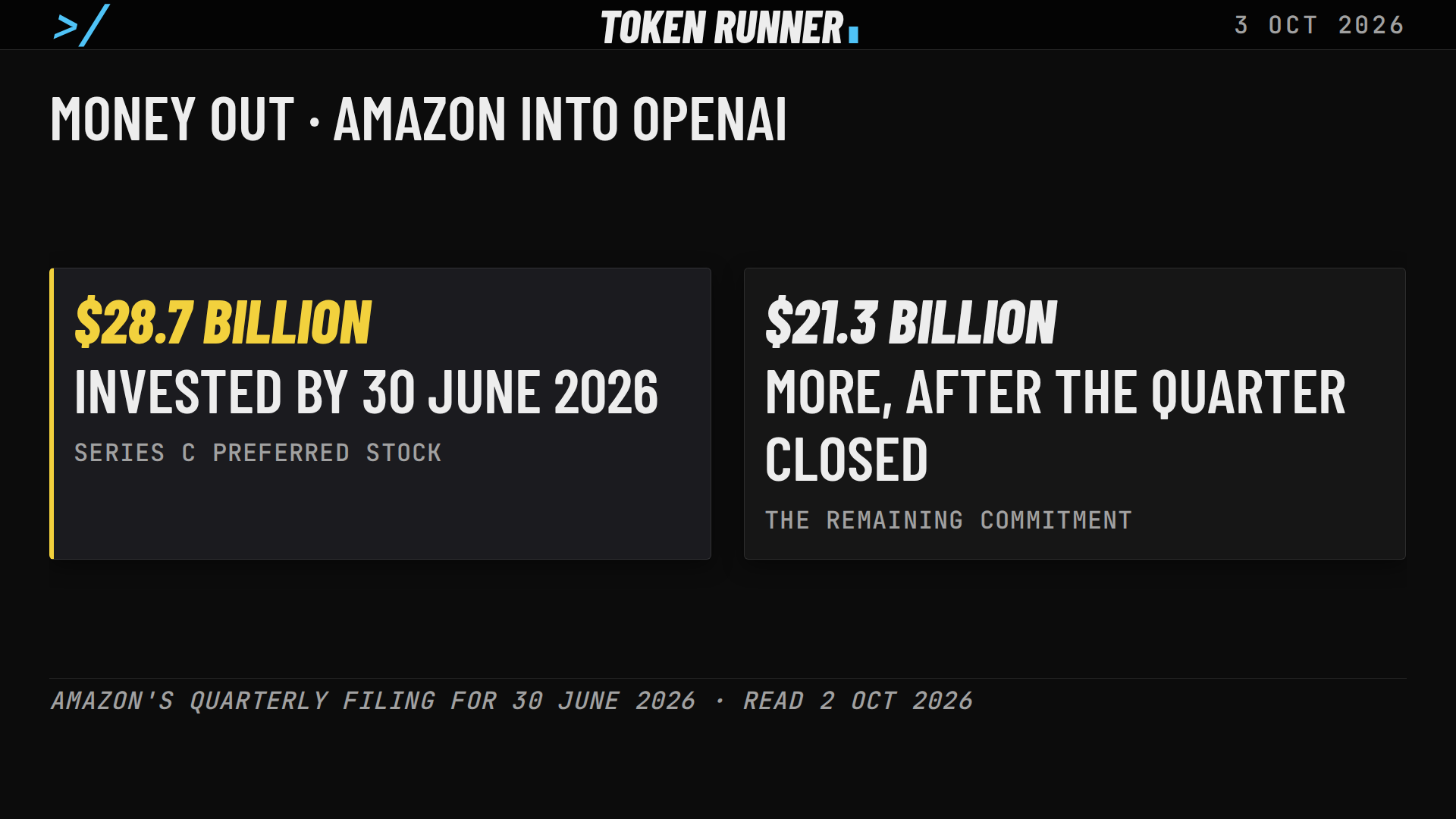
By 30 June 2026 Amazon had put $28.7 billion of cash into OpenAI's preferred stock: $15.0 billion in the first quarter of the year and $13.7 billion in the second, by its own quarterly filing. The whole commitment is $50 billion, and a later note in the same filing, dated 31 July, says the remaining $21.3 billion was invested after the quarter closed; it does not give the day. This is cash invested. It is not a valuation and it is not a gain. It is also only half of what the filing's paragraph on OpenAI describes, because the paragraph does not begin with the investment. It begins with what OpenAI agreed to buy.
Money back
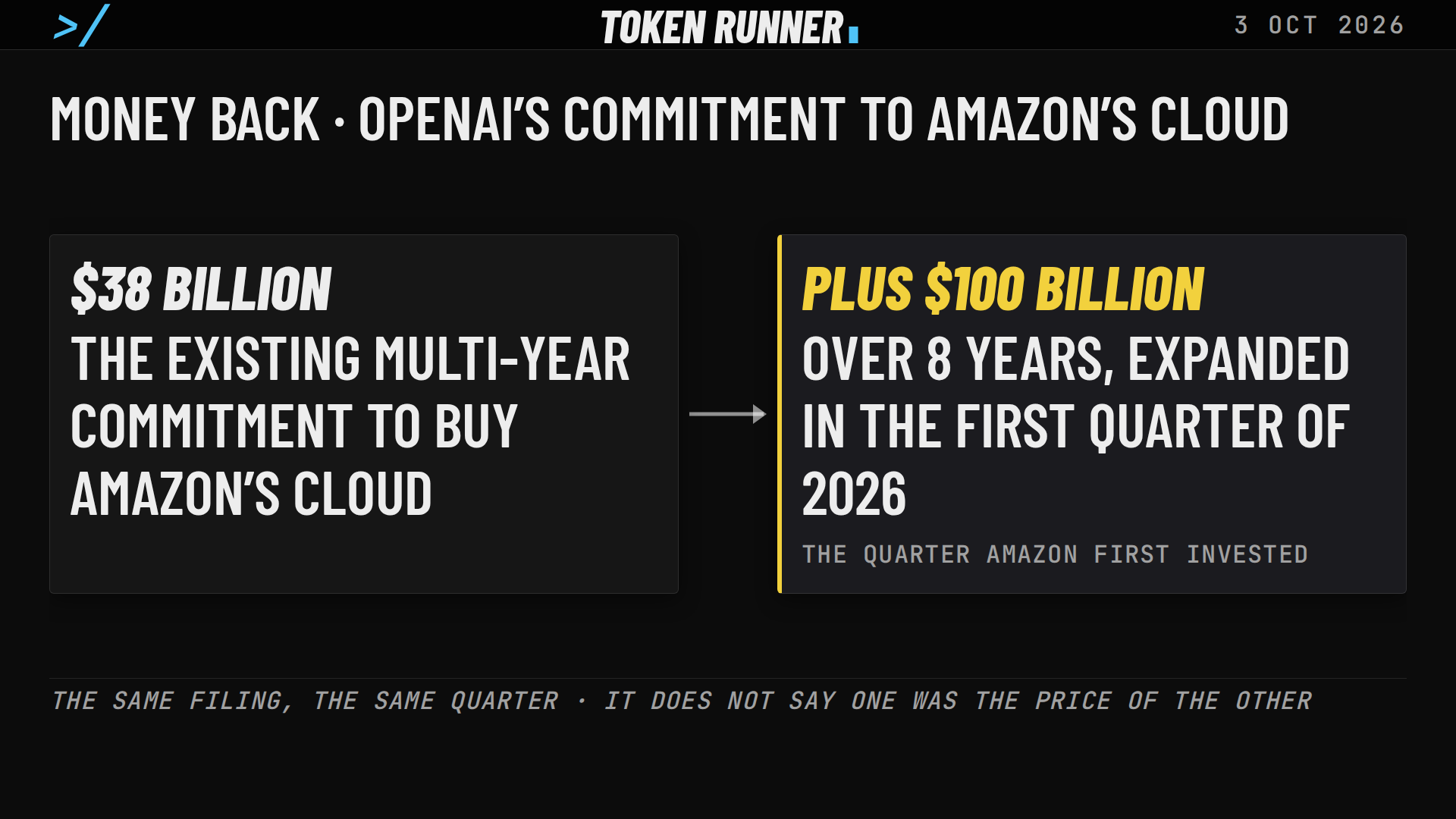
In the first quarter of 2026, Amazon's filing says, OpenAI's existing commitment to buy Amazon's cloud, $38 billion, was expanded by $100 billion over eight years. Added together that is $138 billion; the sum is Token Runner's, the two numbers are Amazon's. The paragraph opens "In Q1 2026" with that commercial arrangement and goes straight on: "We also invested $15.0 billion". So Amazon's own account sets the commitment to buy and the investment side by side, in the same quarter. It does not say that one was a condition of the other, or the price of it. And a commitment over eight years is a promise to buy, not revenue received. It becomes revenue only as the cloud is used.
The same shape
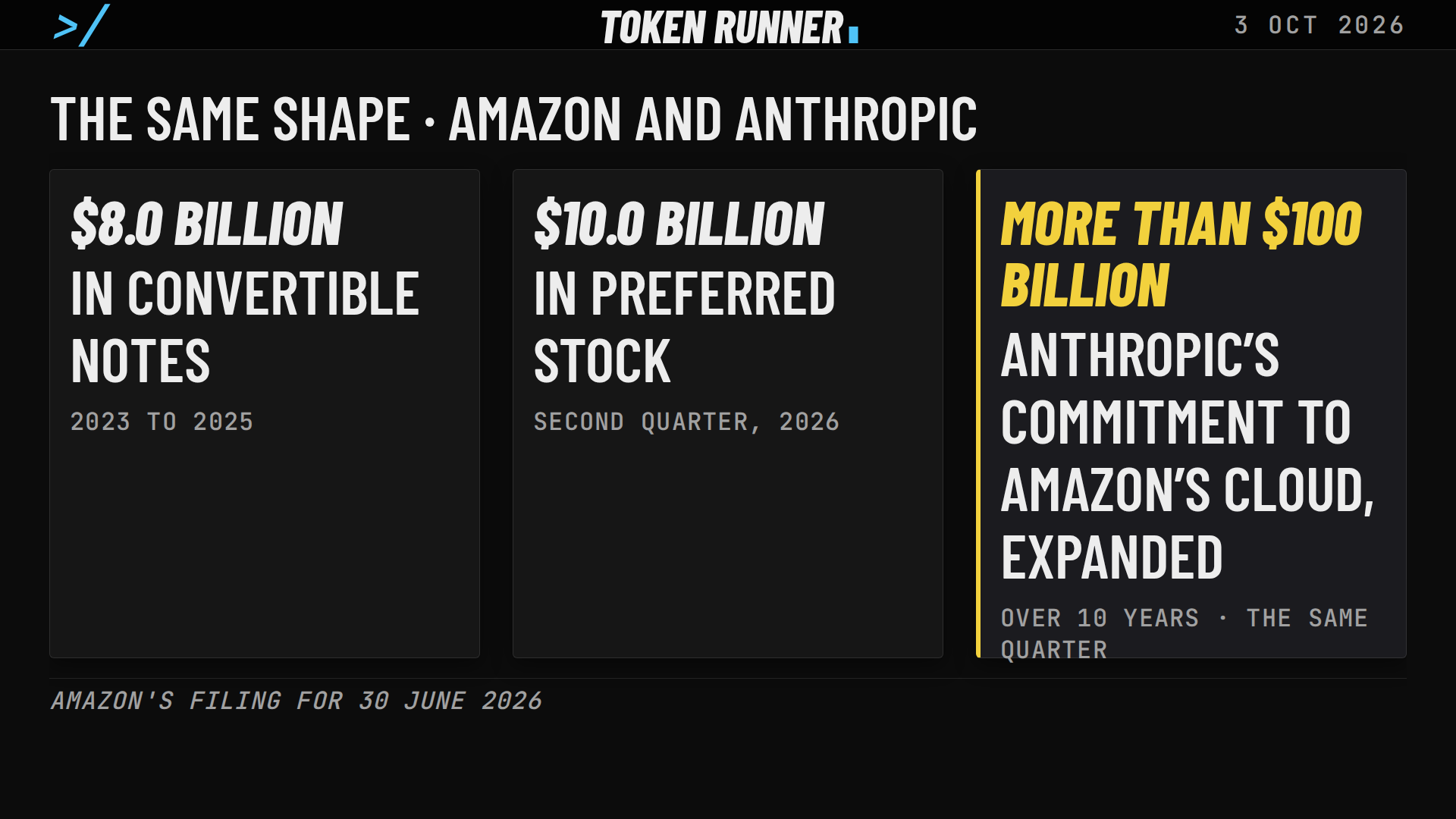
The same shape appears with the other lab. From 2023 to 2025 Amazon paid $8.0 billion into Anthropic as convertible notes. In the second quarter of 2026 it invested $10.0 billion more in preferred stock, which the filing describes elsewhere as $5.0 billion in one series of shares and $5.0 billion in another. In that same quarter Anthropic's commitment to buy Amazon's cloud was expanded by more than $100 billion over ten years. Again the two stand in one quarter of one filing, and again the filing draws no line from one to the other. What Amazon paid and what it says the holding is worth are different things: the notes it bought for $8.0 billion were carried at $97.9 billion by June 2026.
One contract
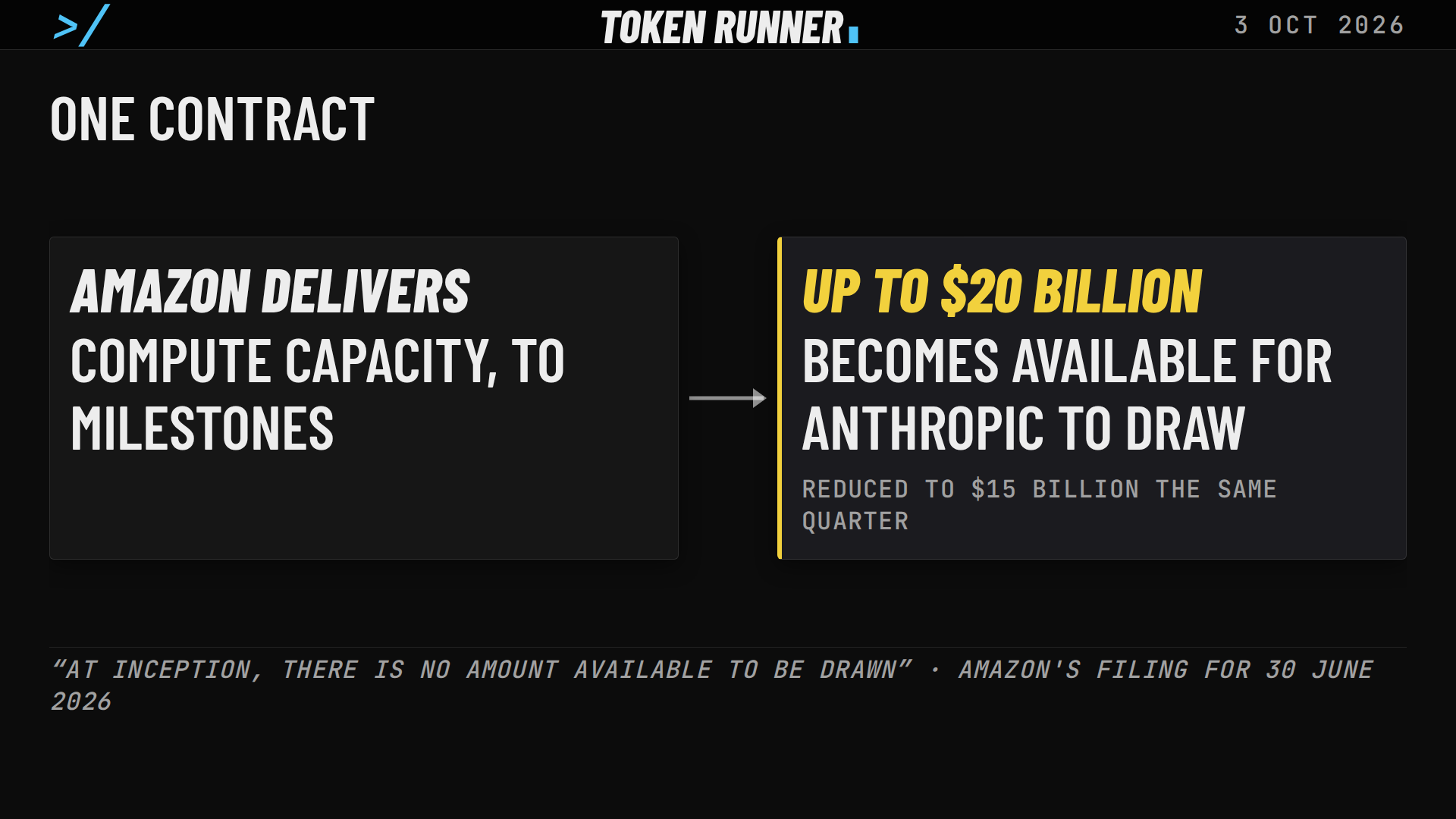
One contract in the filing closes the circle on a single page. Amazon agreed to make available to Anthropic a credit facility "not to exceed $20.0 billion". At the start, the filing says, "there is no amount available to be drawn"; amounts become available as Amazon reaches milestones in delivering computing capacity to Anthropic. So the supplier's delivery unlocks the supplier's own loan to its customer. In the same quarter Amazon used an option to take $5.0 billion as shares instead, which reduced the amount available to $15.0 billion. The two numbers belong together. It is a facility, undrawn at the start, and not money lent.
The gain on paper
Then there is the gain. In the second quarter of 2026 Amazon recorded $50.5 billion of upward adjustments to its private holdings, primarily its Anthropic preferred stock, which the filing ties to observable changes in price at Anthropic's funding rounds. The quarter before, the figure was $12.3 billion; for the half year, $62.8 billion. Amazon's other income for the quarter was $53.4 billion, primarily from its Anthropic holdings, and it booked $15.9 billion of tax on those gains in the half year. By 30 June it carried its Anthropic notes at $97.9 billion and its preferred shares at $92.5 billion, up from $45.8 billion and $14.8 billion six months earlier.
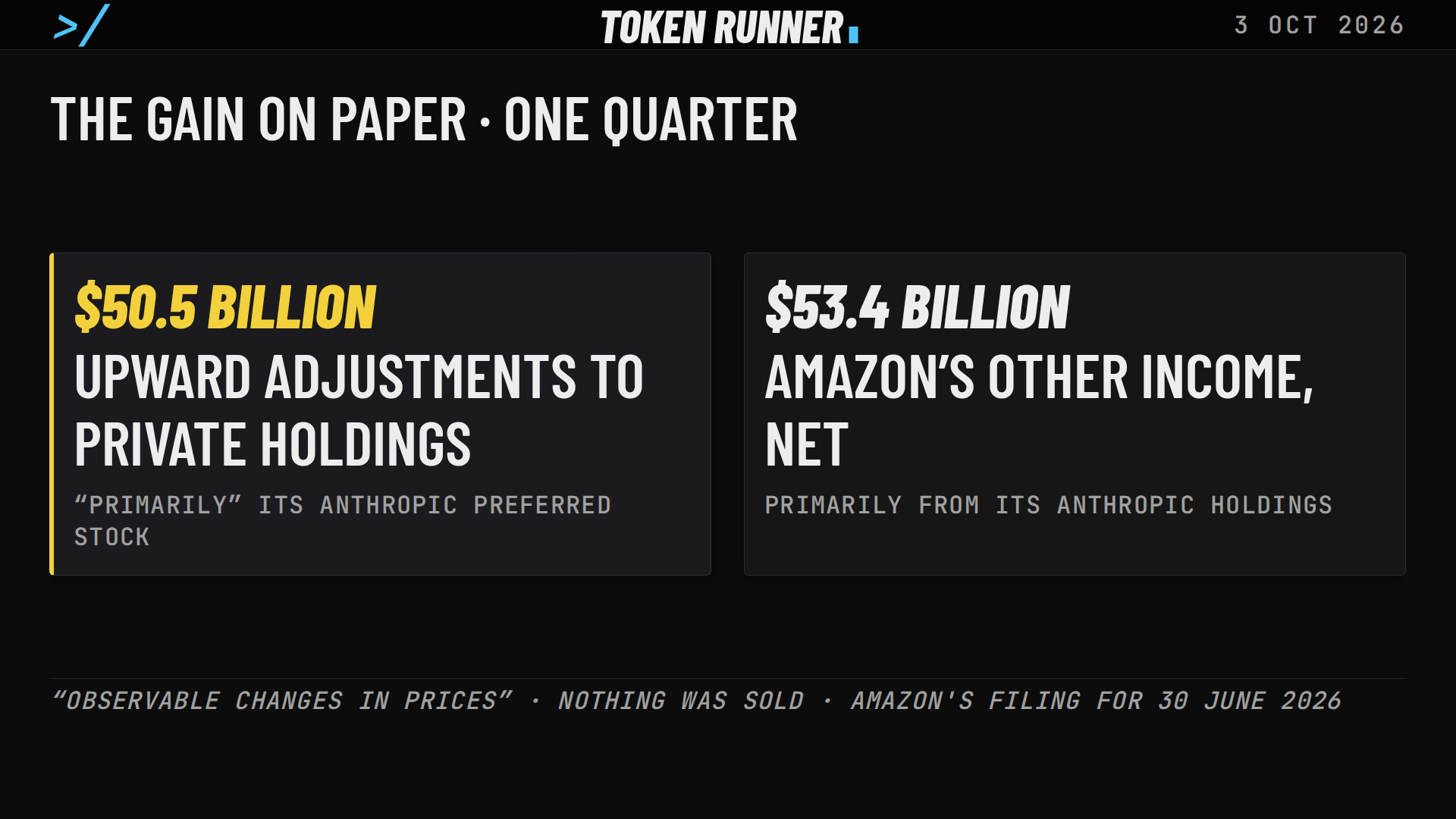
These are Amazon's own estimates of the value of a private company, which the filing calls "inherently more complex due to the lack of readily available market data". They are changes in price, counted in income. Nothing was sold.
Microsoft and OpenAI
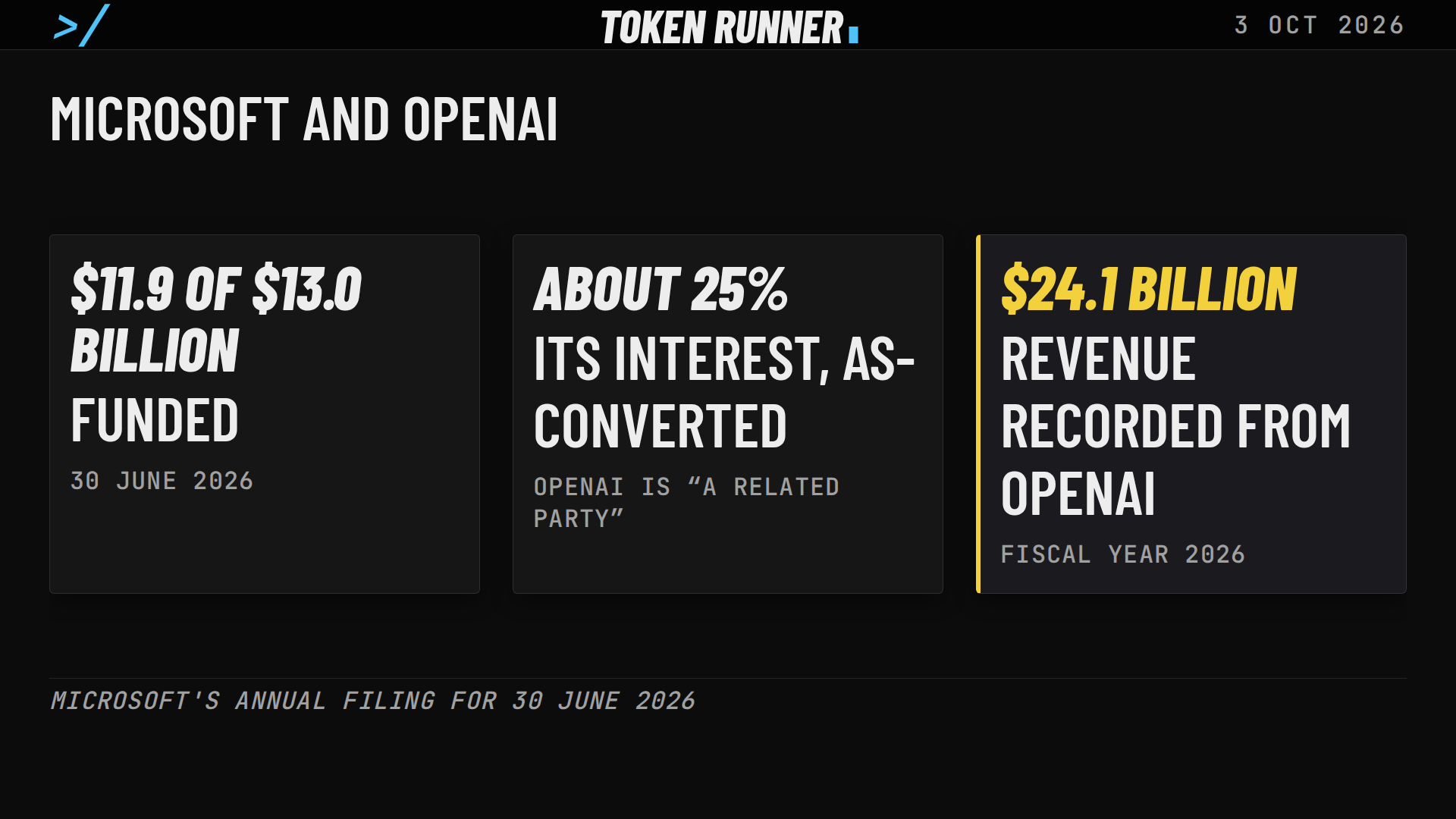
Microsoft's version is the plainest, because the money has already come back as revenue. It has funded $11.9 billion of a $13.0 billion commitment to OpenAI and holds about 25 per cent of it on an as-converted basis; its accounts class OpenAI as a related party, an accounting term that carries no accusation. In the year to June 2026 it recorded $24.1 billion of revenue from OpenAI and was owed $6.0 billion more. That is money recognised, not a promise, though it includes revenue-sharing payments and is not all cloud rent. The funding runs from 2019 and the revenue is one year's, so the two do not make a ratio. The stake itself produced $6.5 billion of net gains that year, mainly a dilution gain from OpenAI's restructuring, after net losses of $4.8 billion and $1.5 billion in the two years before.
The chip makers
The chip makers have their own instruments. Nvidia reports $99 billion of equity investments in what it calls its ecosystem, with $25 billion more committed, at 26 July 2026; the passage read does not list the companies. In August 2026 it entered into guarantees of up to $105 billion on behalf of a customer, an affiliate of OpenAI: credit support for lease and power payments on an Ohio campus of about 4.25 gigawatts, where, in the filing's words, "the site will exclusively host NVIDIA AI infrastructure, subject to limited exceptions". The guarantees are capped, pay only if the tenant defaults, and end if OpenAI earns a satisfactory credit rating.
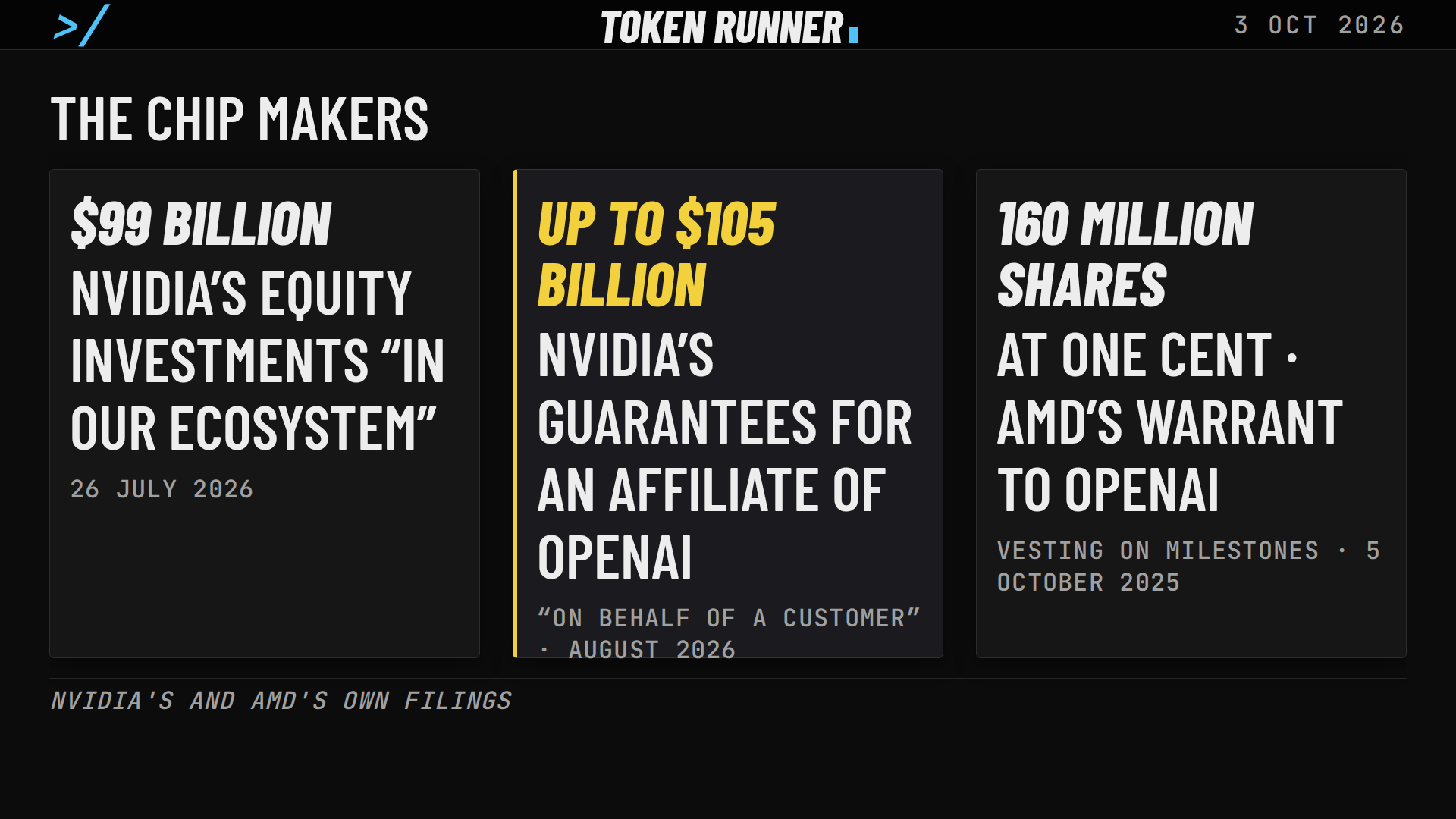
Nothing has been paid under them. AMD went another way: on 5 October 2025 it issued OpenAI a warrant for up to 160 million AMD shares at one cent each, vesting as OpenAI buys its chips and as AMD's share price reaches set targets. It later gave Meta a warrant of the same kind.
The renter
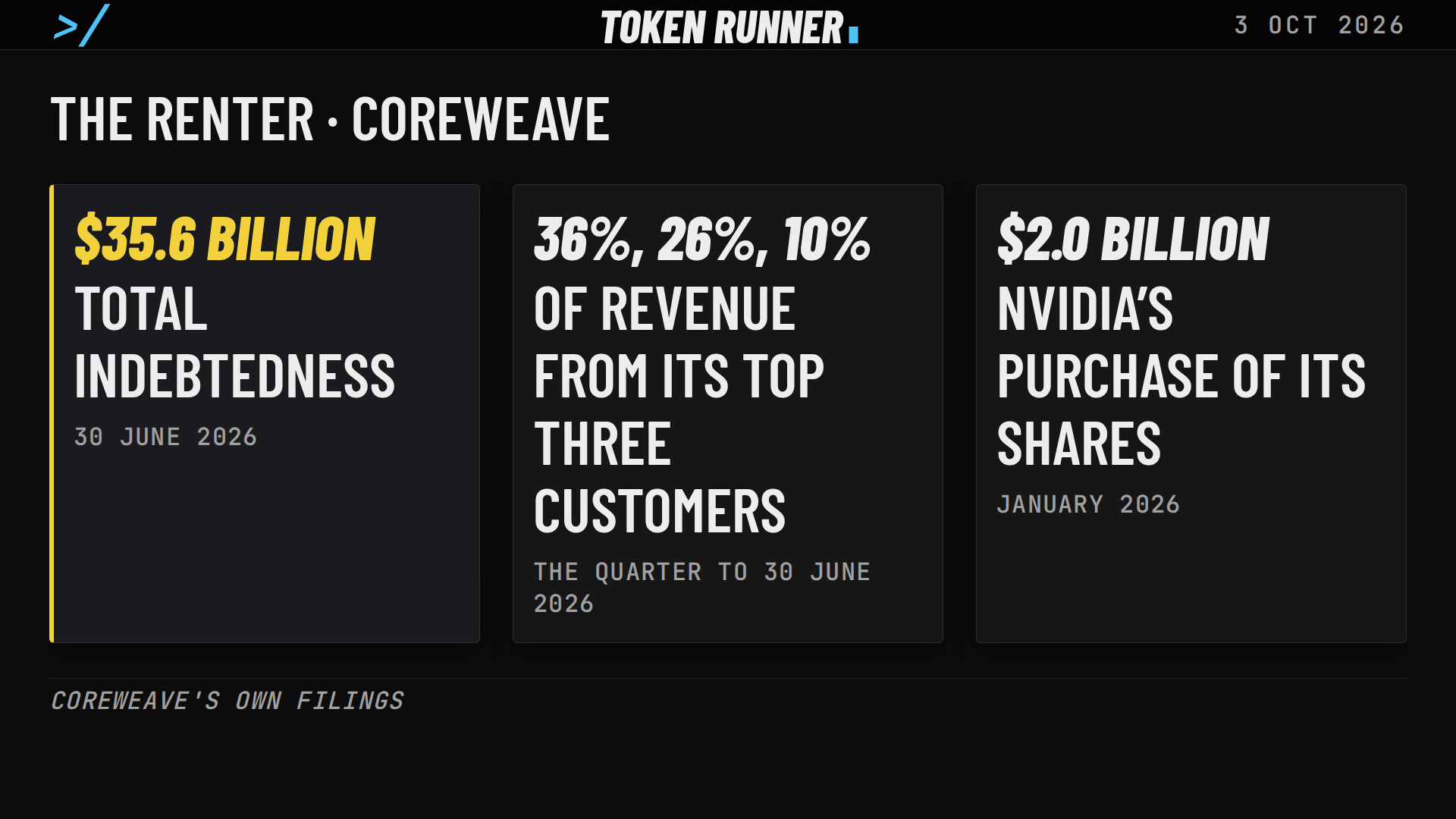
CoreWeave rents out Nvidia's chips; its filing says "all of the GPUs used in our infrastructure today are NVIDIA GPUs". It carried $35.6 billion of debt at 30 June 2026, on revenue of $2.6 billion for the quarter. Its three largest customers were 36, 26 and 10 per cent of that revenue, 72 per cent together, and a year earlier one customer alone was 71 per cent; the filing does not name them in that passage, though it names Microsoft, OpenAI and Meta elsewhere as significant customers. In January 2026 Nvidia bought $2.0 billion of CoreWeave's shares. Under one order of September 2025, OpenAI committed to pay CoreWeave up to about $6.5 billion through May 2031. So the chip maker owns part of the renter, the renter runs only the chip maker's chips, and the lab the chip maker guarantees is among the renter's significant customers.
The order books
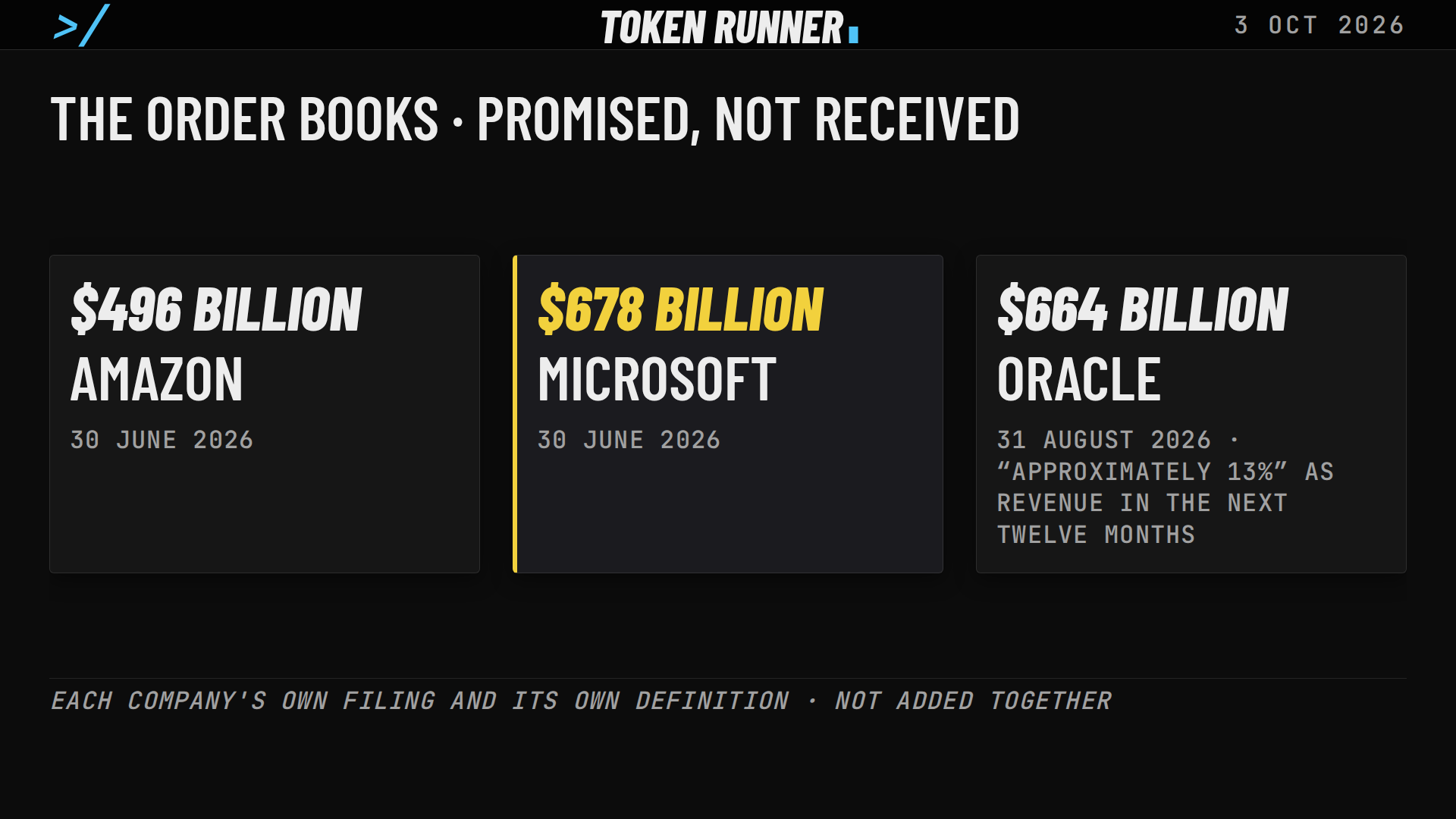
The promises pile up in the order books. Amazon reports about $496 billion of commitments signed and not yet recognised as revenue, mostly cloud. Microsoft reports $678 billion, up 84 per cent in a year. Oracle reports $664 billion at 31 August 2026 and says it expects approximately 13 per cent of it as revenue in the next twelve months. These are every customer's contracts, not one lab's: Amazon's filing does not say what share is OpenAI's or Anthropic's, and Oracle's does not name OpenAI at all. They are not added together here, because each company defines its own measure. Alphabet shows the paper side from a fourth direction: it wrote up its private holdings by $77.5 billion in the second quarter of 2026, gains that it says "primarily consist of our investment in a private company", which it does not name.
What is being spent
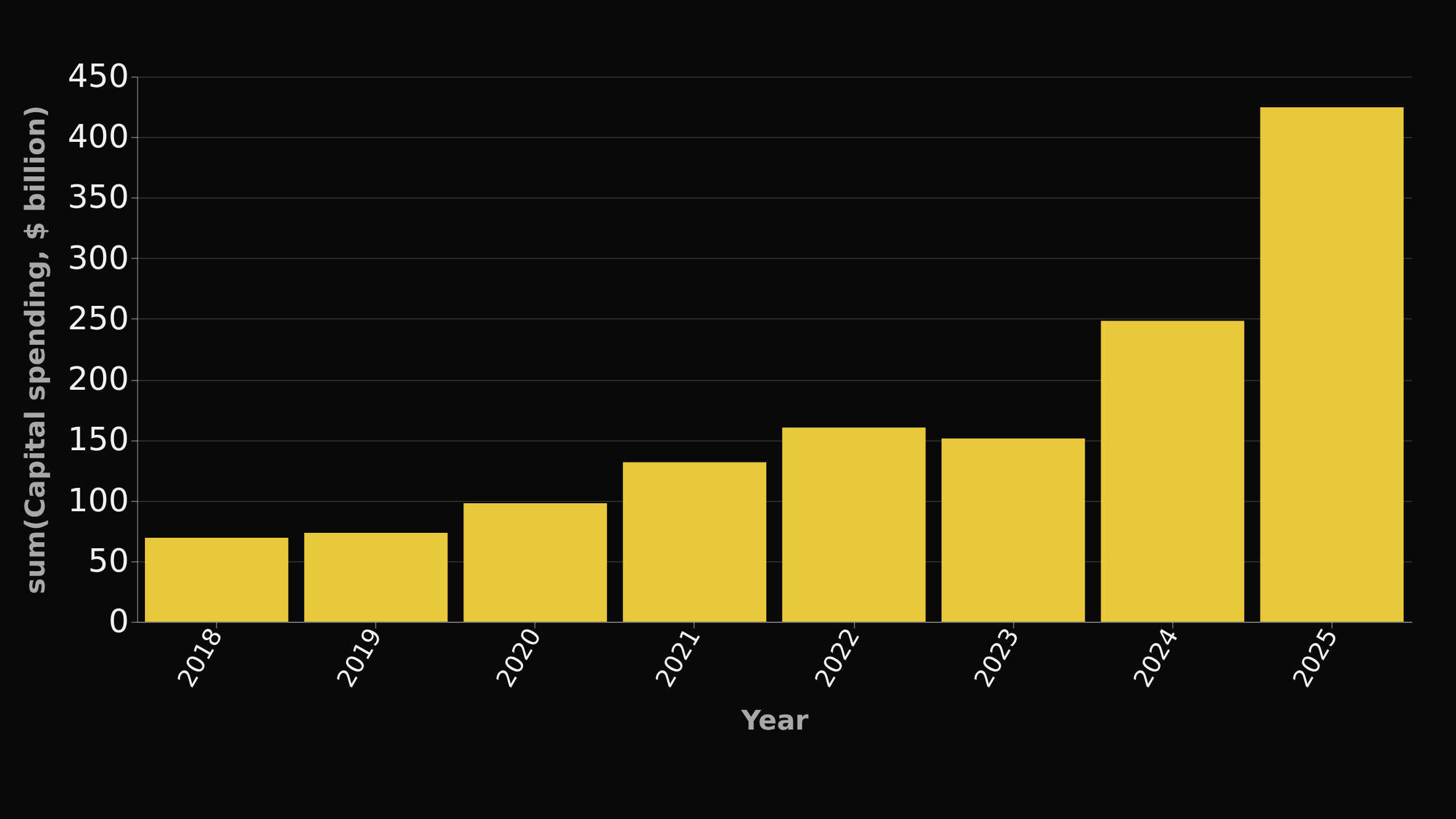
Behind the promises is spending that is real. In 2025 the seven cloud companies Token Runner tracks spent $424.6 billion on plant and equipment, each in its own filed year: Amazon $131.8 billion, Alphabet $91.4 billion, Meta $69.7 billion, Microsoft $64.6 billion, Oracle $55.7 billion, CoreWeave $10.3 billion and IBM $1.1 billion. In 2018 six of them spent $69.2 billion; CoreWeave joins the count in 2023, so the years before and after are not quite like for like. It did not rise every year: $160.2 billion in 2022, $151.2 billion in 2023, then $248.2 billion in 2024. And it is capital spending on everything, as filed, not on AI alone. Token Runner's collection of 9 October 2026 gives the same yearly figures as the one the film was made with.
An accountant's test
Is this a circular sale, the kind that made Qwest reverse its revenue in 2001? AccountingTools, a publisher for the accounting trade, put the Amazon and Anthropic arrangement to that test in an episode called "Circular Sales" and answered: "Based only on public information, no." Anthropic needs the computing, Amazon supplies a real service, and the service is not sold back to Amazon as the same item. But it frames the open question exactly: "Are the investment and purchasing commitments so economically linked that some portion of the reported revenue should be viewed as funded by the vendor rather than earned from an independent customer relationship?" Without the contracts, it says, "no outside observer can make a definitive accounting conclusion"; the deal "sits in a gray zone". One of the questions it asks, whether further money depends on the computing, is the one the facility above answers in part.
The conversation
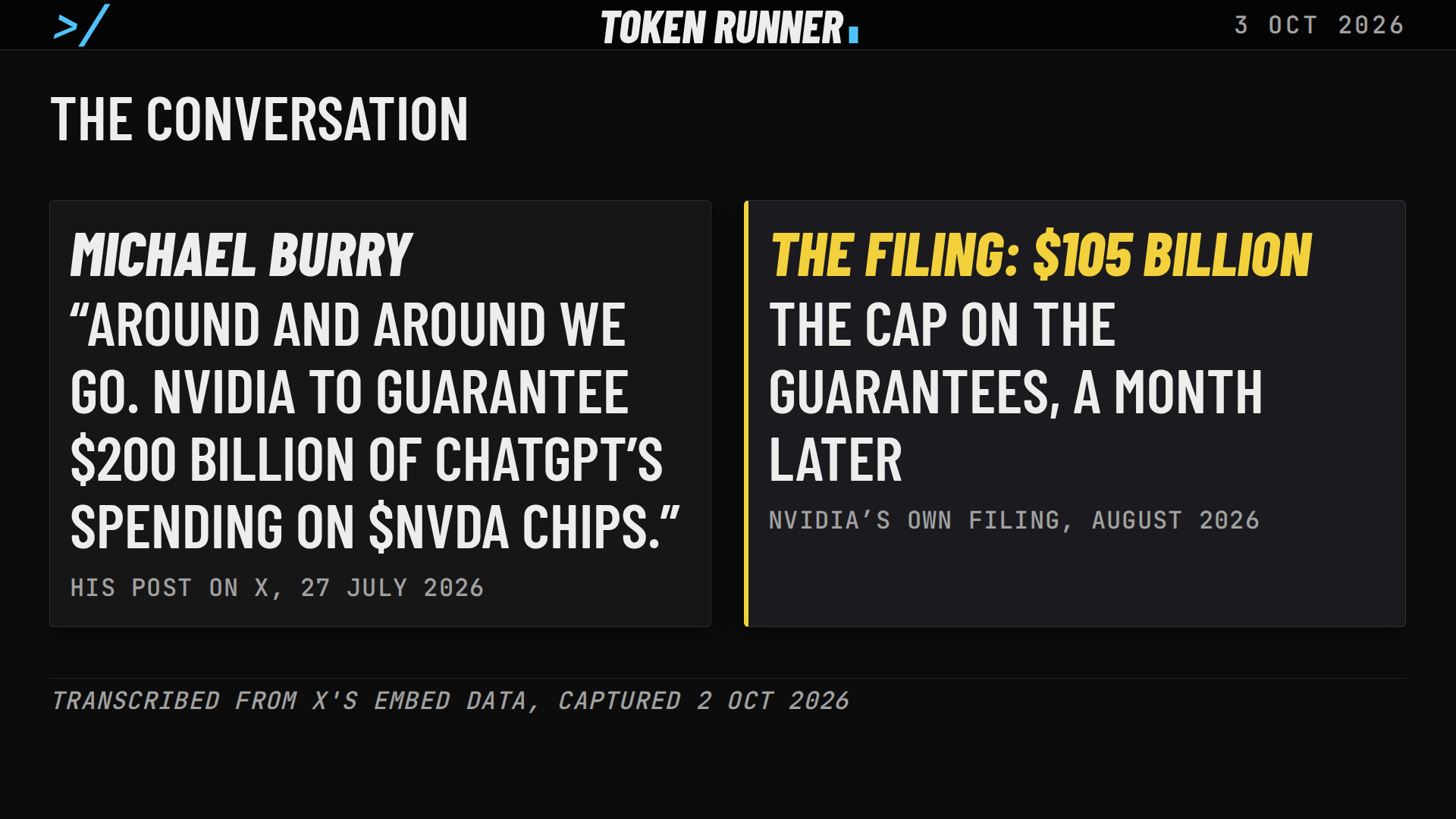
The loop has not gone unnoticed. On 27 July 2026 Michael Burry posted on X: "Around and around we go. Nvidia to guarantee $200 billion of ChatGPT’s spending on $NVDA chips." Nvidia's filing, a month later, caps the guarantees at up to $105 billion, with an option over a further 3.8 gigawatts. The post and the filing are set side by side here because the phrase names the shape and the filing gives the number. Where they differ, the filed number is the one this article uses.
Money out, money back, a gain on paper
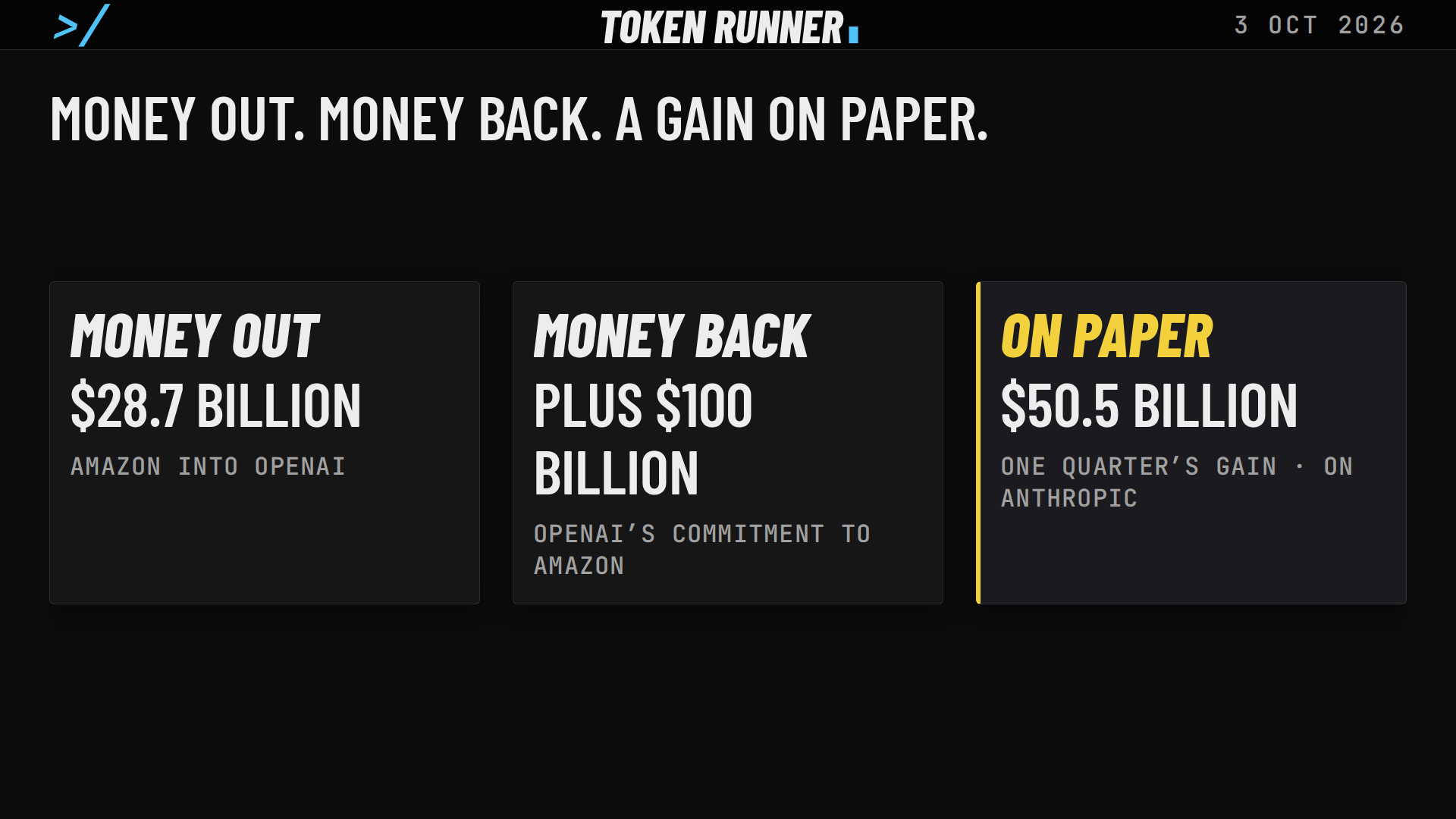
Money out: $28.7 billion, Amazon into OpenAI by June, and $50 billion in all. Money back: $38 billion expanded by $100 billion, OpenAI's commitment to Amazon's cloud. And on the other lab, on paper: $50.5 billion, one quarter's gain. Microsoft has the one line where the promise has already become sales: $24.1 billion in a year from a company it part-owns. Each line is in a company's own filing, and none of the filings says that one was the price of the other. What to watch is which of the promises becomes revenue, what the gains on paper do if a funding round is priced lower, and whether a guarantee is ever called.
Sources
- AMAZON COM INC, Form 10-Q for the period ended 2026-06-30, filed with the U.S. Securities and Exchange Commission on 2026-07-31, accession 0001018724-26-000026: https://www.sec.gov/Archives/edgar/data/1018724/000101872426000026/amzn-20260630.htm
- MICROSOFT CORP, Form 10-K for the period ended 2026-06-30, filed with the U.S. Securities and Exchange Commission on 2026-07-29, accession 0001193125-26-323660: https://www.sec.gov/Archives/edgar/data/789019/000119312526323660/msft-20260630.htm
- NVIDIA CORP, Form 10-Q for the period ended 2026-07-26, filed with the U.S. Securities and Exchange Commission on 2026-08-26, accession 0001045810-26-000075: https://www.sec.gov/Archives/edgar/data/1045810/000104581026000075/nvda-20260726.htm
- ADVANCED MICRO DEVICES INC, Form 8-K for the period ended 2025-10-05, filed with the U.S. Securities and Exchange Commission on 2025-10-06, accession 0001193125-25-230895: https://www.sec.gov/Archives/edgar/data/2488/000119312525230895/d28189d8k.htm
- CoreWeave, Inc., Form 10-Q for the period ended 2026-06-30, filed with the U.S. Securities and Exchange Commission on 2026-08-12, accession 0001769628-26-000366: https://www.sec.gov/Archives/edgar/data/1769628/000176962826000366/crwv-20260630.htm
- ORACLE CORP, Form 10-Q for the period ended 2026-08-31, filed with the U.S. Securities and Exchange Commission on 2026-09-11, accession 0001193125-26-389274: https://www.sec.gov/Archives/edgar/data/1341439/000119312526389274/orcl-20260831.htm
- ALPHABET INC, Form 10-Q for the period ended 2026-06-30, filed with the U.S. Securities and Exchange Commission, as read on 2 October 2026
- Token Runner's table of capital spending by company and year, from the Securities and Exchange Commission's company facts (annual reports); collections of 2 October and 9 October 2026
- Michael Burry (@michaeljburry), a post on X, 27 July 2026: https://x.com/michaeljburry/status/2081534064176050663
- AccountingTools, 'Circular Sales (#395)', a podcast episode and its transcript, read 10 October 2026: https://www.accountingtools.com/podcast-blog/395