AI: How Long Does a Chip Last?
Amazon, Microsoft, Alphabet, Meta and Oracle each tell the regulator how long they assume a server lasts. Four lengthened it. Amazon lengthened it and then, for a subset of its servers, shortened it to five years. Each change is in the company's own filing, some with a reason given and, for most, its own estimate of what it was worth.
Their own filings
A company that buys a server does not charge its whole cost against one year's profit. It spreads the cost over the years it expects the machine to be useful, and that yearly slice is depreciation. The longer the assumed life, the smaller each year's slice and the larger that year's profit; nothing about the machine or the cash paid for it changes. Amazon, Microsoft, Alphabet, Meta and Oracle each state the assumption in their filings with the Securities and Exchange Commission, and each has changed it since 2020. Their filings were read for this article one by one. Five companies gave five answers, and there is no average across them worth printing.
The four that lengthened
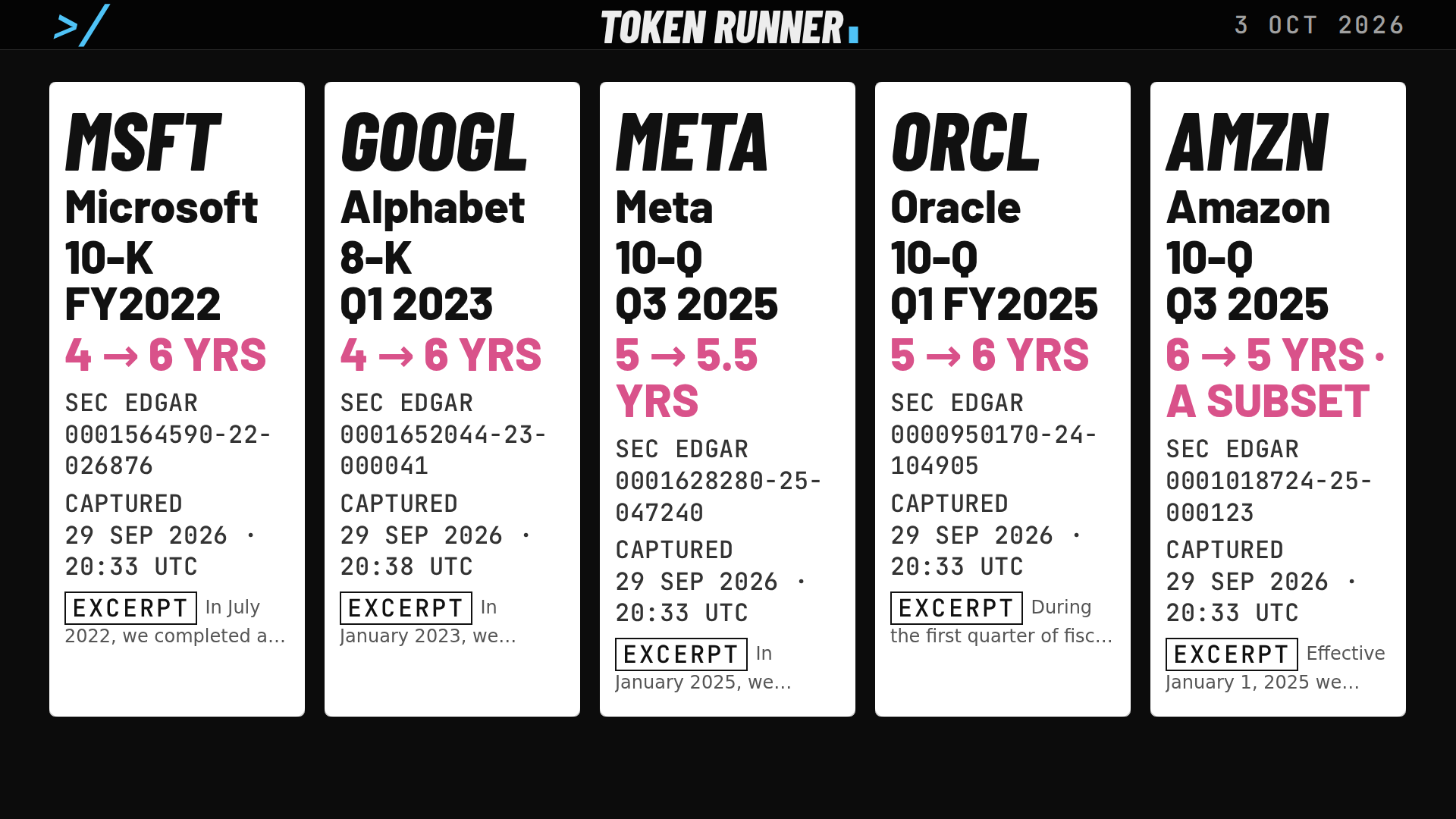
Microsoft went from three years to four from July 2020, then from four to six from July 2022, and estimated that the second change would add $3.7 billion to its operating income in fiscal 2023. Alphabet went from three years to four from 2021 and from four to six from 2023. In February 2023 it expected about $3.4 billion less depreciation that year on the servers it already had; its annual report put the effect for the year, on more assets, at $3.9 billion. Meta lengthened the life of selected groups of its servers from three years to four in several years up to 2021. In 2022 most of its servers went to four and a half years and then to five, and from 2025 it assumes five and a half for most of them, worth $2.92 billion less depreciation that year. Oracle went from five years to six from its fiscal 2025; its operating expenses in the first quarter under the change were $197 million lower.
The one that went back
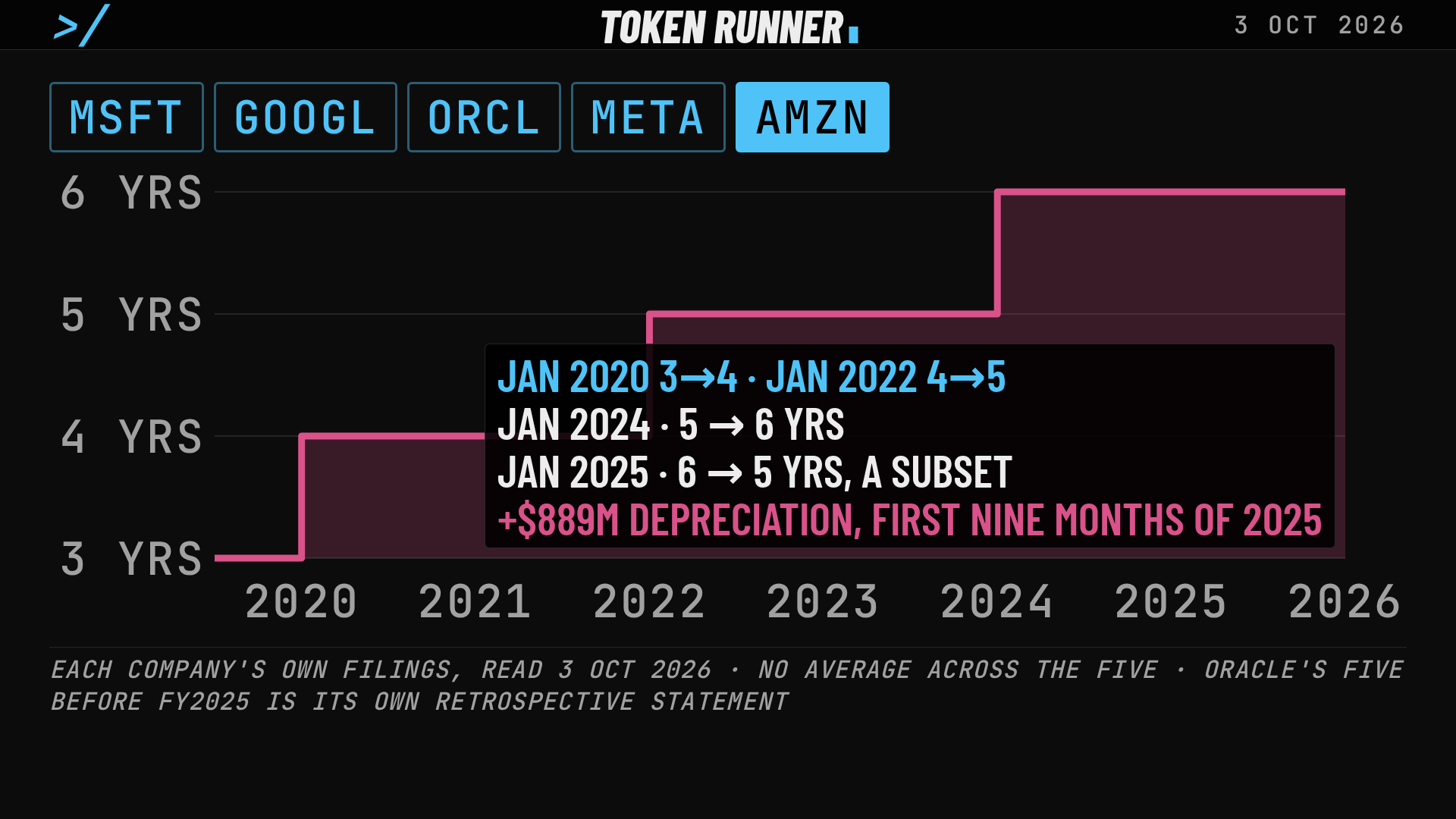
Amazon moved first. It went from three years to four in January 2020, from four to five in January 2022 and from five to six in January 2024. Then, from January 2025, it went back from six years to five for a subset of its servers. That cost it $889 million more depreciation in the first nine months of 2025, $392 million of it in the third quarter alone. It is a subset, not the fleet, and it should never be averaged in as the life of Amazon's servers. But it is the only step downward among the five.
Two reasons, in their own words
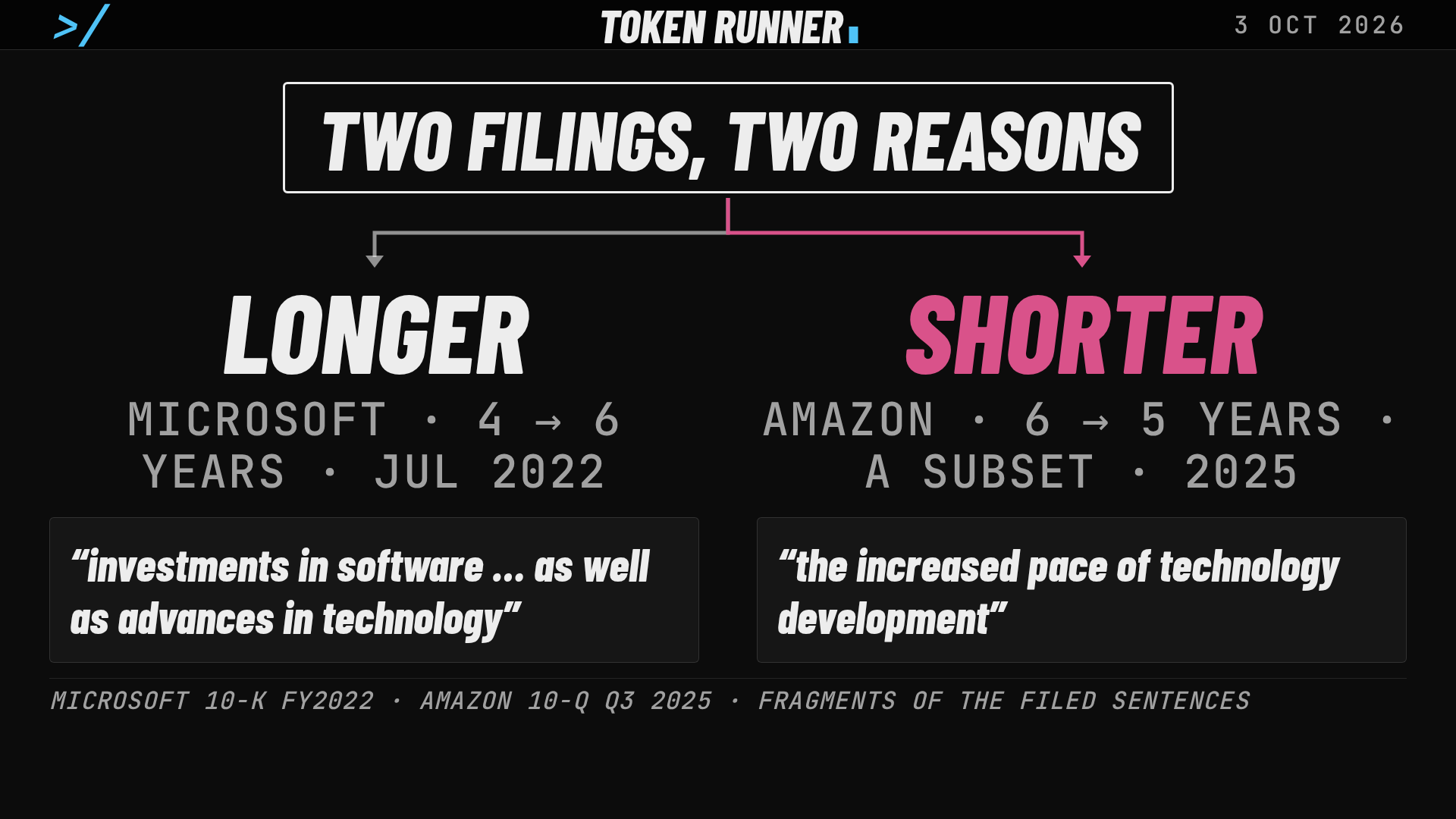
Two of the filings give reasons, and they point opposite ways. In its report for the year to 30 June 2022, Microsoft explained the longer life: "Due to investments in software that increased efficiencies in how we operate our server and network equipment, as well as advances in technology". There are two reasons in that sentence, and the second should not be quoted alone. In its report for the quarter to 30 September 2025, Amazon explained the shorter one: "The shorter useful lives are due to the increased pace of technology development, particularly in the area of artificial intelligence and machine learning." So advances in technology were a reason to keep a server longer in 2022, and the pace of technology was a reason to retire one sooner in 2025.
What the five spent
The assumption matters more each year because the sums it is applied to have grown. Added together by Token Runner, the five spent $71.0 billion on plant and equipment in their own filed year 2019 and $413.2 billion in 2025; for Microsoft and Oracle these are fiscal years. Amazon went from $16.9 billion to $131.8 billion, Alphabet from $23.5 billion to $91.4 billion, Meta from $15.1 billion to $69.7 billion, Microsoft from $13.9 billion to $64.6 billion and Oracle from $1.6 billion to $55.7 billion. This is capital spending on everything, as filed: buildings, land and networks as well as servers, and not spending on AI alone.
What the five took in
Revenue grew too, but more slowly. Amazon's went from $280.5 billion in 2019 to $716.9 billion in 2025, Alphabet's from $161.9 billion to $402.8 billion, Microsoft's from $125.8 billion to $281.7 billion, Meta's from $70.7 billion to $201.0 billion and Oracle's from $39.1 billion to $67.4 billion. Added together, that is $678.0 billion and $1,669.8 billion. Set the spending against it: in 2019 the five spent about 10 cents on plant and equipment for each dollar they took in, and in 2025 about 25 cents. The sums and the division are Token Runner's; the figures divided are each company's own.
What they wrote off
Depreciation is where the spending arrives in the profit, a slice at a time, and it is filed under a different heading by each company, so it is not added across the five here. Company by company, 2019 against 2025: Amazon, depreciation and amortization, $21.8 billion and $65.8 billion; Microsoft $9.7 billion and $22.0 billion; Meta, depreciation and amortization, $5.7 billion and $18.6 billion; Oracle $1.4 billion and $7.6 billion. For Alphabet Token Runner holds $21.1 billion for 2025 and no figure for 2019, and the chart draws no line where there is none. The spending of 2024 and 2025 has mostly still to pass through these lines, at whatever life each company assumes.
One voice
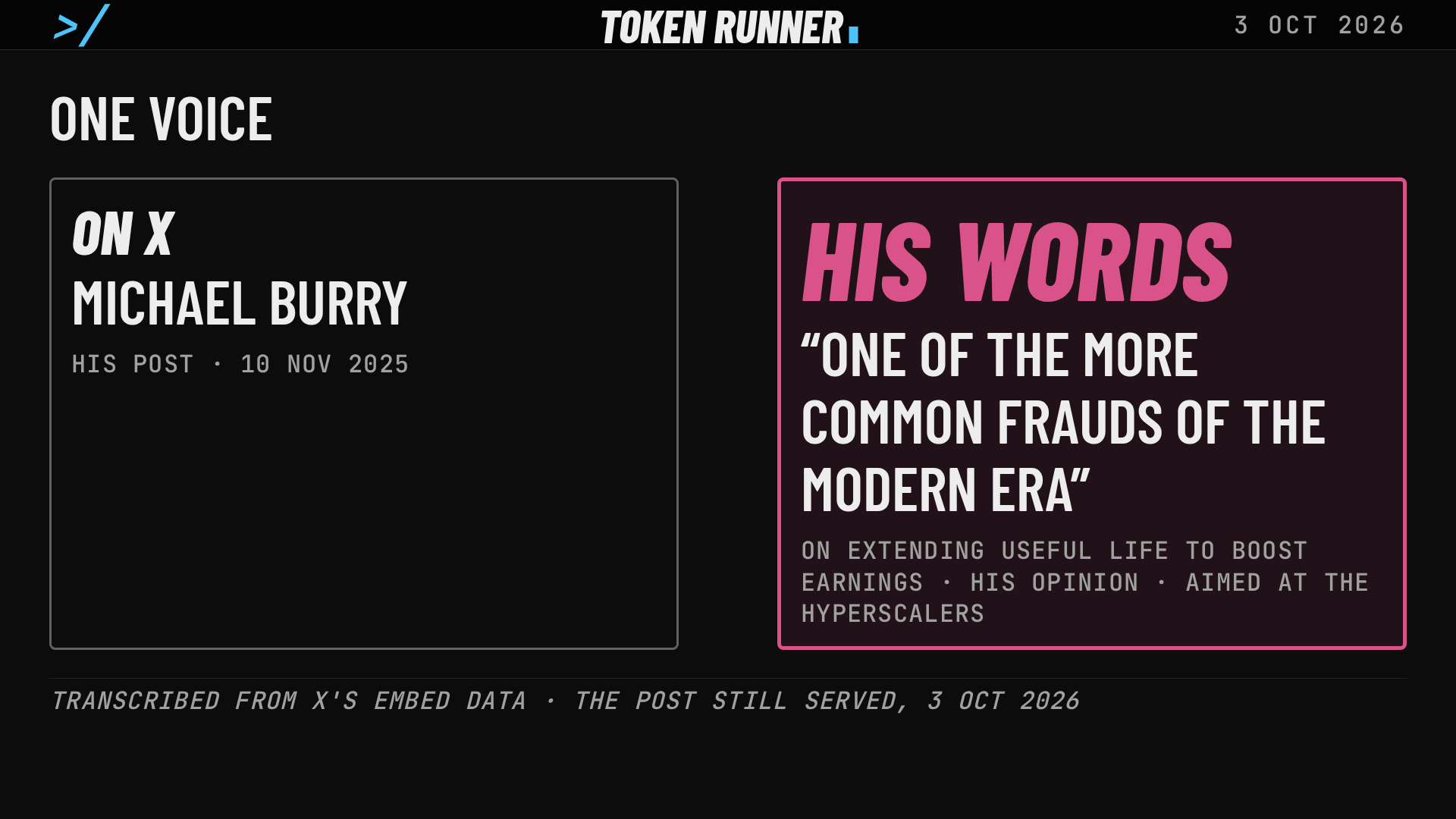
Not everyone reads the longer lives as housekeeping. On 10 November 2025 Michael Burry, on X, called understating depreciation by extending the useful life of assets "one of the more common frauds of the modern era", and said "this is exactly what all the hyperscalers have done"; the same post names Oracle and Meta. That is his opinion, in his name. The filings above show the changes he means and, for most, the company's own estimate of what each was worth. They do not show that any of the assumed lives is wrong.
Intel: a longer life, then charges
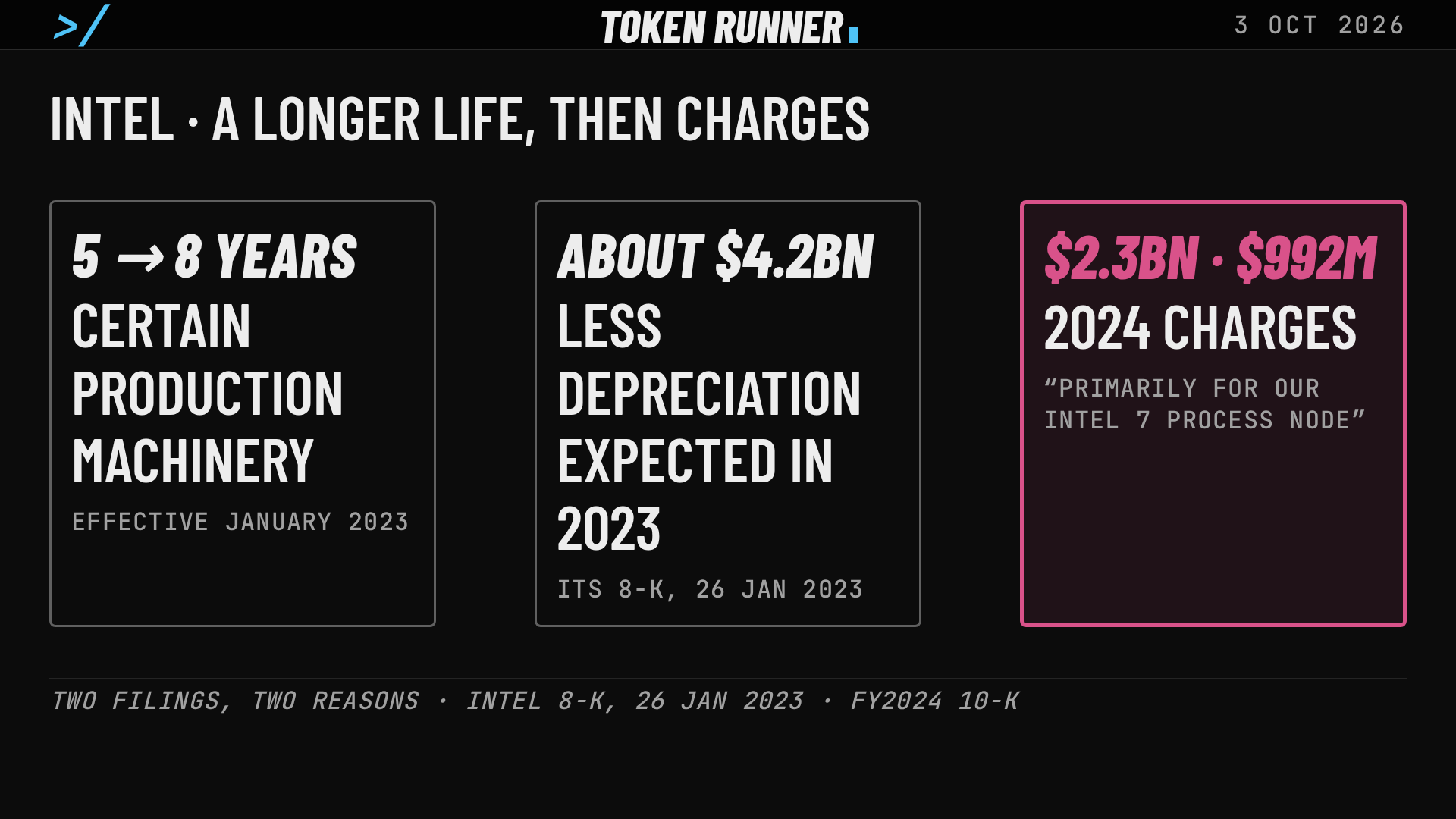
Intel offers a case from outside the five, and a caution about reading too much into one. It lengthened the assumed life of certain production machinery from five years to eight, effective January 2023, and expected about $4.2 billion less depreciation that year. In 2024 it recorded $2.3 billion of impairments and $992 million of accelerated depreciation for manufacturing assets, primarily for its Intel 7 process node, which it said exceeded its capacity requirements. That is its own reason for the charges. The filing does not tie them to the 2023 change, and neither does this article: the two are set beside each other, not one because of the other.
Five companies, five answers
Five companies changed how long they assume a server lasts, each in its own filing, some with a reason given. Four lengthened it. Amazon lengthened it three times and then shortened it for a subset, and said why. Over the same years the five went from spending $71.0 billion a year on plant and equipment to $413.2 billion. What to watch is the next filing from each: whether the assumed life moves again, which way, and what the company says it was worth.
Sources
- Microsoft Form 10-K, fiscal year ended 30 June 2022: https://www.sec.gov/Archives/edgar/data/789019/000156459022026876/msft-10k_20220630.htm
- Alphabet Form 8-K, 25 April 2023, Exhibit 99.1 (Q1 2023 results): https://www.sec.gov/Archives/edgar/data/1652044/000165204423000041/googexhibit991q12023.htm
- Meta Platforms Form 10-K, fiscal year 2025: https://www.sec.gov/Archives/edgar/data/1326801/000162828026003942/meta-20251231.htm
- Amazon Form 10-Q, quarter ended 30 September 2025: https://www.sec.gov/Archives/edgar/data/1018724/000101872425000123/amzn-20250930.htm
- Microsoft Form 10-K, fiscal year ended 30 June 2020: https://www.sec.gov/Archives/edgar/data/789019/000156459020034944/msft-10k_20200630.htm
- Alphabet Form 10-K, fiscal year 2020: https://www.sec.gov/Archives/edgar/data/1652044/000165204421000010/goog-20201231.htm
- Alphabet Form 8-K, 2 February 2023, Exhibit 99.1 (Q4 2022 results): https://www.sec.gov/Archives/edgar/data/1652044/000165204423000013/googexhibit991q42022.htm
- Alphabet Form 10-K, fiscal year 2023: https://www.sec.gov/Archives/edgar/data/1652044/000165204424000022/goog-20231231.htm
- Meta Platforms Form 10-K, fiscal year 2021: https://www.sec.gov/Archives/edgar/data/1326801/000132680122000018/fb-20211231.htm
- Meta Platforms Form 10-K, fiscal year 2022: https://www.sec.gov/Archives/edgar/data/1326801/000132680123000013/meta-20221231.htm
- Oracle Form 10-Q, quarter ended 31 August 2024 (Q1 fiscal 2025): https://www.sec.gov/Archives/edgar/data/1341439/000095017024104905/orcl-20240831.htm
- Amazon Form 10-K, fiscal year 2019: https://www.sec.gov/Archives/edgar/data/1018724/000101872420000004/amzn-20191231x10k.htm
- Amazon Form 10-K, fiscal year 2021: https://www.sec.gov/Archives/edgar/data/1018724/000101872422000005/amzn-20211231.htm
- Amazon Form 10-K, fiscal year 2023: https://www.sec.gov/Archives/edgar/data/1018724/000101872424000008/amzn-20231231.htm
- Michael Burry (@michaeljburry; display name 'Cassandra Unchained'), post on X, 10 November 2025: https://x.com/michaeljburry/status/1987918650104283372
- Intel Form 8-K, 26 January 2023, Exhibit 99.1 (Q4 2022 earnings release): https://www.sec.gov/Archives/edgar/data/50863/000005086323000005/q422_earningsrelease.htm
- Intel Form 10-K, fiscal year 2024: https://www.sec.gov/Archives/edgar/data/50863/000005086325000009/intc-20241228.htm
- Token Runner's tables of capital spending, revenue and depreciation by company and year, from the Securities and Exchange Commission's company facts (annual reports); collections of 2 October and 9 October 2026