The Voight-Kampff TestWhen the Machines Caught Fire and No One Gave a F#ck
On the surface, the story of 13–19 November 2026 is a story of apathy. A router flooded the busiest airspace in the world, and the change record that would explain it is still not public. A classified network went yellow — orange, as it turns out — and the agency said "scheduled maintenance." Banks showed the wrong balance and called it a bug. A theme park's pool alarm went by email and fifteen people went to hospital.
Nobody gave a fuck. That is the first reading, and the record supports it: no investigation was opened on the aviation side until the Secretary said he was working to determine whether there had been incompetence; the count of affected water utilities moved from "more than 30" to ~36 to 100+ across twelve states and nobody has published the mechanism that moved it; the state's own retrospective is behind a bot wall.
The week nobody owned
The official lines came back calm: routine maintenance, a technical failure, nothing coordinated.
But look at the same week from the inside and the opposite is true. Everyone was caring, fiercely, about something — a budget, a narrative, a procurement, a perimeter, a share of the blame. The aviation regulator got a $50.1 billion request. A member of Congress got a CISA-funding argument. An extortion crew got a brand. An insurer got a loss class to reprice. A vendor got a reputational problem to manage. The Secretary got a word — incompetence — that pointed at his contractor rather than his department.
The twist is this: the apathy was real, and so was the care. They were aimed at different objects. Nobody was defending the coupling point — the single router, the single patch, the single email alias that each turned a local fault into a national event — because nobody owned it. Everybody was defending their own turf, at the exact moment the turf was on fire.
This is the Voight-Kampff test applied to an institution: not are you a machine, but can you feel anything outside your own perimeter. On the record of this week, the answer is: intensely, and only there.
The instrument's rule. Every stop on the field is a receipt; nothing gains weight without a dated check against a named source. A label says how sure the record is, never how loud the claim was, and a gap is drawn as a gap. The film's chip for a checked figure is FACT; this page's label is VERIFIED — the same check under two names, neither translated into the other.
One. The week, as a list
The week, by date. 26–27 July: intrusions at Minnesota's municipal water systems (Two). Friday 13 November: the FAA ground stop (Three); a Microsoft 365 outage of 20+ hours; a Chase display bug — a software bug, the bank said, while the Zelle network operator said its network stayed up (VERIFIED); the chlorine injuries at Phantasialand (Five); and FBI FLASH-20261113-001, issued the same day (Eight). Saturday 14th: Duffy's briefing (Three) and the first sight of the ask (Six), as airlines resume. Sunday 15th: the unspent-funds headline (Six). Monday 16th: the Optimizely compromise, below. Tuesday 17th: the NSA degradation begins (Four), Apple has an outage, the request is formalised (Six) and the DNI speaks (Nine).
Source and method
Source: ThousandEyes (Cisco) weekly counts, via Network World.
How it is sourced: Every bar is a weekly count ThousandEyes published via Network World (REPORTED); the rank and the 12-week median are Token Runner's arithmetic on those counts (FACT).
Unit: outage events per week · highlighted: 9–15 Nov, 419 events, 20th of 46 weeks · lighter: the 12 weeks before, median 532.5
Network outage events ThousandEyes logged worldwide each week from 29 December 2025 to 15 November 2026, as Network World prints them. The week of 9 to 15 November, when Microsoft 365 and the FAA failed, logged 419: 20th of 46 weeks, and below the 532.5 median of the 12 weeks before it. The highest week, 31 August to 6 September, logged 687.
The table, its licence and its date.
Cite this: Token Runner, “Network outage events worldwide, week by week, 2026”, tokenrunner.ai/voight-kampff/ built 20 November 2026. CC BY 4.0.
The rows
| Week number | Week beginning | Network outage events worldwide per week | Period |
|---|---|---|---|
| 1 | 01 · 29 Dec | 199 | earlier weeks |
| 2 | 02 · 5 Jan | 255 | earlier weeks |
| 3 | 03 · 12 Jan | 263 | earlier weeks |
| 4 | 04 · 19 Jan | 236 | earlier weeks |
| 5 | 05 · 26 Jan | 314 | earlier weeks |
| 6 | 06 · 2 Feb | 264 | earlier weeks |
| 7 | 07 · 9 Feb | 247 | earlier weeks |
| 8 | 08 · 16 Feb | 239 | earlier weeks |
| 9 | 09 · 23 Feb | 386 | earlier weeks |
| 10 | 10 · 2 Mar | 304 | earlier weeks |
| 11 | 11 · 9 Mar | 272 | earlier weeks |
| 12 | 12 · 16 Mar | 277 | earlier weeks |
| 13 | 13 · 23 Mar | 325 | earlier weeks |
| 14 | 14 · 30 Mar | 240 | earlier weeks |
| 15 | 15 · 6 Apr | 250 | earlier weeks |
| 16 | 16 · 13 Apr | 240 | earlier weeks |
| 17 | 17 · 20 Apr | 264 | earlier weeks |
| 18 | 18 · 27 Apr | 298 | earlier weeks |
| 19 | 19 · 4 May | 285 | earlier weeks |
| 20 | 20 · 11 May | 415 | earlier weeks |
| 21 | 21 · 18 May | 313 | earlier weeks |
| 22 | 22 · 25 May | 286 | earlier weeks |
| 23 | 23 · 1 Jun | 483 | earlier weeks |
| 24 | 24 · 8 Jun | 528 | earlier weeks |
| 25 | 25 · 15 Jun | 411 | earlier weeks |
| 26 | 26 · 22 Jun | 516 | earlier weeks |
| 27 | 27 · 29 Jun | 443 | earlier weeks |
| 28 | 28 · 6 Jul | 509 | earlier weeks |
| 29 | 29 · 13 Jul | 587 | earlier weeks |
| 30 | 30 · 20 Jul | 610 | earlier weeks |
| 31 | 31 · 27 Jul | 514 | earlier weeks |
| 32 | 32 · 3 Aug | 502 | earlier weeks |
| 33 | 33 · 10 Aug | 546 | earlier weeks |
| 34 | 34 · 17 Aug | 534 | 12 weeks before |
| 35 | 35 · 24 Aug | 649 | 12 weeks before |
| 36 | 36 · 31 Aug | 687 | 12 weeks before |
| 37 | 37 · 7 Sep | 539 | 12 weeks before |
| 38 | 38 · 14 Sep | 531 | 12 weeks before |
| 39 | 39 · 21 Sep | 559 | 12 weeks before |
| 40 | 40 · 28 Sep | 303 | 12 weeks before |
| 41 | 41 · 5 Oct | 310 | 12 weeks before |
| 42 | 42 · 12 Oct | 387 | 12 weeks before |
| 43 | 43 · 19 Oct | 459 | 12 weeks before |
| 44 | 44 · 26 Oct | 601 | 12 weeks before |
| 45 | 45 · 2 Nov | 450 | 12 weeks before |
| 46 | 46 · 9 Nov | 419 | outage week |
All 46 rows the chart drew.
Wednesday 18th: the House hearing (Seven), the FAA's router pause (Three) and the PHP headlines (Four). Thursday 19th: the NSA's third day, and the Shenzhen trilateral at APEC (Ten).
Read the list as weather. Each line is independently explicable; together they are a density event. The density is the SIGNAL. It is not proof of a shared hand, and the record never finds one. The base-rate chart, reprinted from The week the systems blinked, sets 9–15 November against every week of 2026 by the count of network outage events. By that count the week sat mid-year, not at the top; what made it dense was which systems failed, not how many.
The sixth failure is the web itself. On 16 November, a shared script altered once through a vendor's signup flow reached the visitors of many large sites — the BBC, Zoom and Equifax among them. None of them was hacked: the flaw sat in the vendor's signup flow, not in their servers. Report URI, a detection service, found 188 modified snippets at 178 organisations out of 1,611 distinct snippets checked; the vendor's exposure window ran 07:51 to 22:24 UTC — about 14 hours 33 minutes from first malicious write to removal from the last affected project.
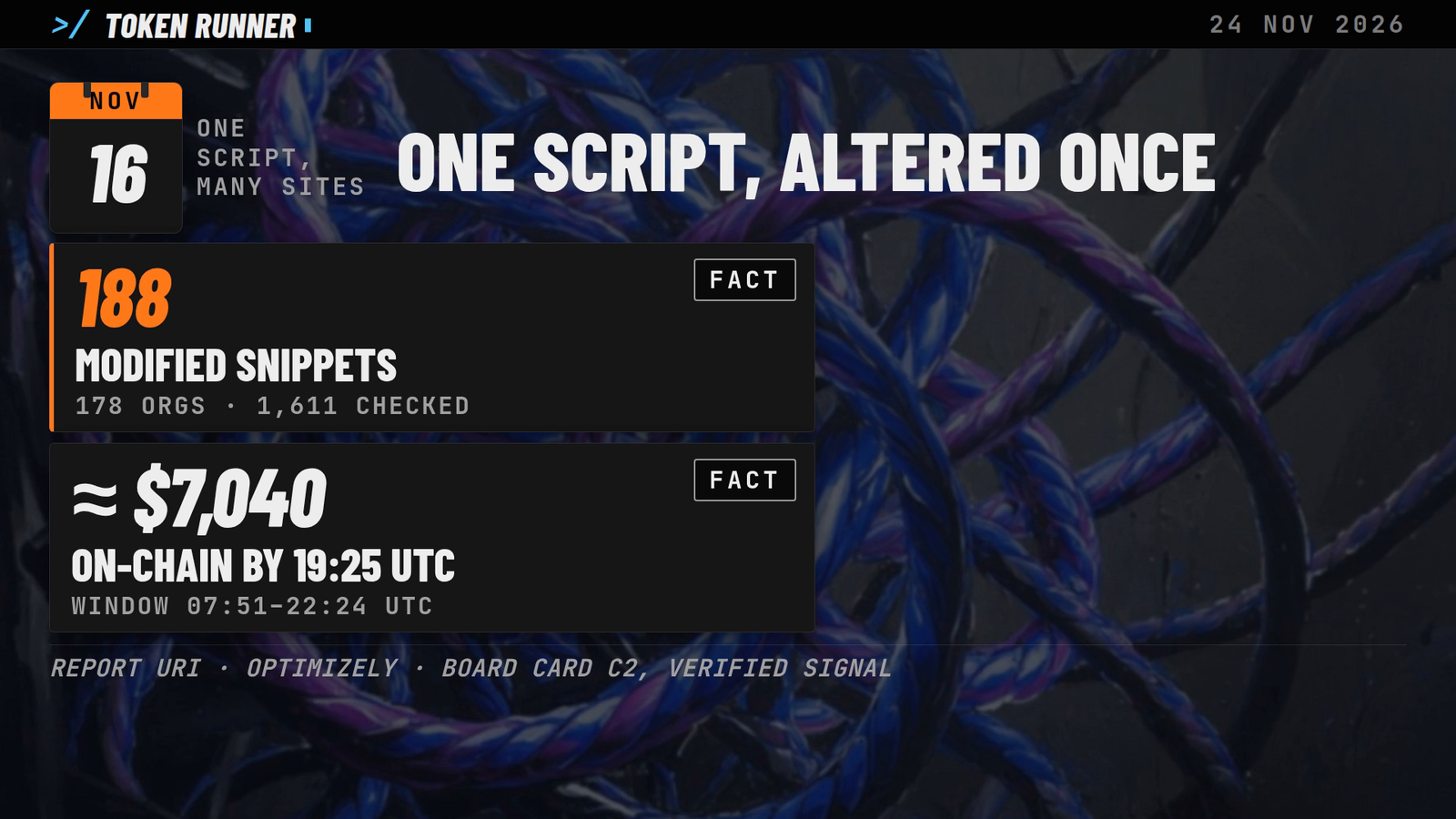
Optimizely, the vendor, attributes the intrusion to a signup-flow flaw that allowed user impersonation, found no customer-password theft, and says customers' own servers were not breached by this path. On-chain receipts to attacker-linked wallets reached about US$7,040 by 19:25 UTC that day. Card theft, the number of successful iOS infections and visitor losses are unknown, and drawn as a gap. VERIFIED (vendor incident report, detector analysis).
Two. Water: thirty victims or thirty findings
The first bucket of the record is water, and the number is the story before the mechanism is.
Minnesota's municipal utilities were reached through internet-exposed PLC and HMI control interfaces — equipment families named as Rockwell, Schneider, Siemens, with operator screens and setpoints reachable from the open internet. Plymouth, South St. Paul, Maple Plain, Braham. Braham's administrator said operating controls were shut down and the tower could not be filled for over an hour; Plymouth and South St. Paul switched to manual; Maple Plain declared a local emergency. No confirmed loss of water service, and no contamination event established. REPORTED (state and utility statements).
Outside Minnesota the record has two narrower cases. Nine Michigan systems were reported in local coverage citing state confirmation, and EGLE told CBS that operators addressed the issues, that the systems ran safely, and that no public-health impacts were known (REPORTED). North Clayton County, Georgia reported reduced pressure on 27 July, restored service within hours, and lifted its precautionary notice after testing (VERIFIED).
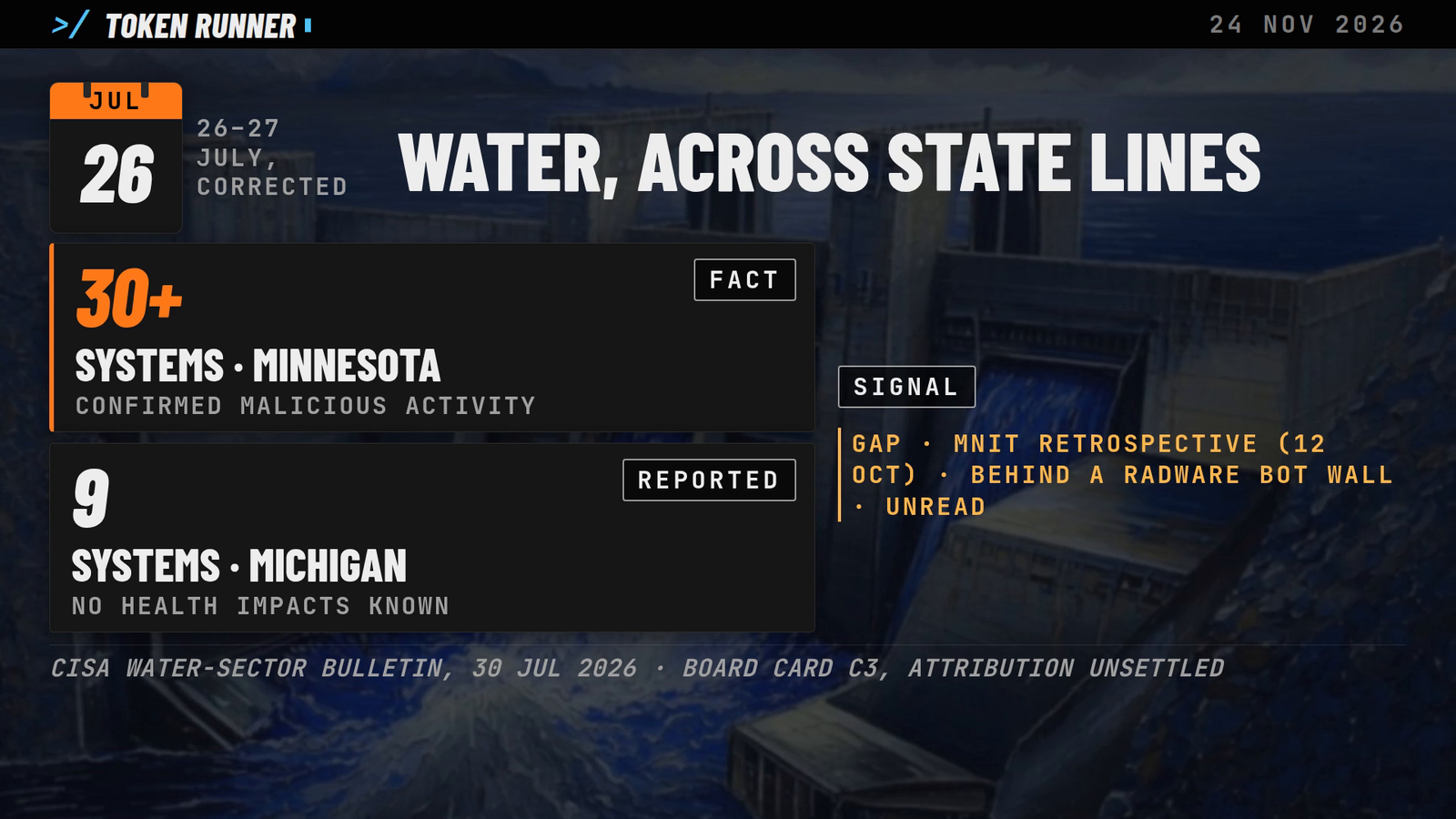
Then the count moved: "more than 30" in late July → ~36 attributed to MNIT's CISO → 100+ systems across twelve states in CISA's 26 August advisory. The mechanism that grew the count has never been published. The state's 12 October retrospective is behind a Radware bot wall — the document that would explain the moving window is the one document nobody outside can read. (The research intake for this page said November; the record says 26–27 July, and the record wins.)
GAP — No chart for the count's movement: the three counts have no frozen data series behind them, only reporting, and this page will not draw a line through press figures. The gap is the point.
The honest reading is a third thing: one exposure class, one scan window, an unknown number of hands. A scanner does not target, it encounters. Thirty findings from one scan looks exactly like thirty victims of one operation — and the public record contains no common command-and-control address, payload, credential or operator identity that would tell them apart. Both the "one actor" claim and the "thirty coincidences" claim are unsupported. PATTERN, and a gap.
The attribution is CLAIM, preliminary, and eroding. There was an Iran-linked preliminary assessment; there was also CISA's 30 July water-sector bulletin, in the same window, describing manual operations and boil notices and carrying no attribution; and the strongest fact against the story is that the sourcing behind it does not hold still — WIRED reported a WaterISAC communication describing the campaign, and WaterISAC said it made no attribution assessment itself. Four months on, no final attribution has been published. If the assessment had hardened, it would likely have surfaced.
Three. Aviation: the router that ate the airspace
This is the case where the record changed most, and where the correction matters most.
The first version of the story, written the same week, carried an official statement to the effect that a formal investigation was unnecessary. That line is withdrawn. On 14 November the Secretary of Transportation briefed the mechanism himself, and Bloomberg (via Yahoo Finance) carried it:
"L3Harris was replacing a copper line with fiber at a remote Federal Aviation Administration site Friday when a router flooded other routers with more than 1,000 connection attempts every four to five seconds, disrupting communications with aircraft and some radar feeds, Duffy said during a briefing… 'So what we're working to determine was whether we had incompetence,' Duffy said… 'We haven't determined what the fault was.'"
The site was El Dorado, Arkansas. The work was part of the copper-to-fibre programme — L3Harris's own statement says more than 70% of the relevant network had been converted, and a router installed as part of that work is the focus. The router-vs-copper contradiction is therefore resolved, and it resolves in a specific way: the work was copper→fibre; the failure was a router emitting a flood. Both press accounts were right about their own layer. What remains unresolved is narrower: was the flood a misconfigured device, a defective device, or a device reacting to something on the network? That is the change-control document, and it is not public.
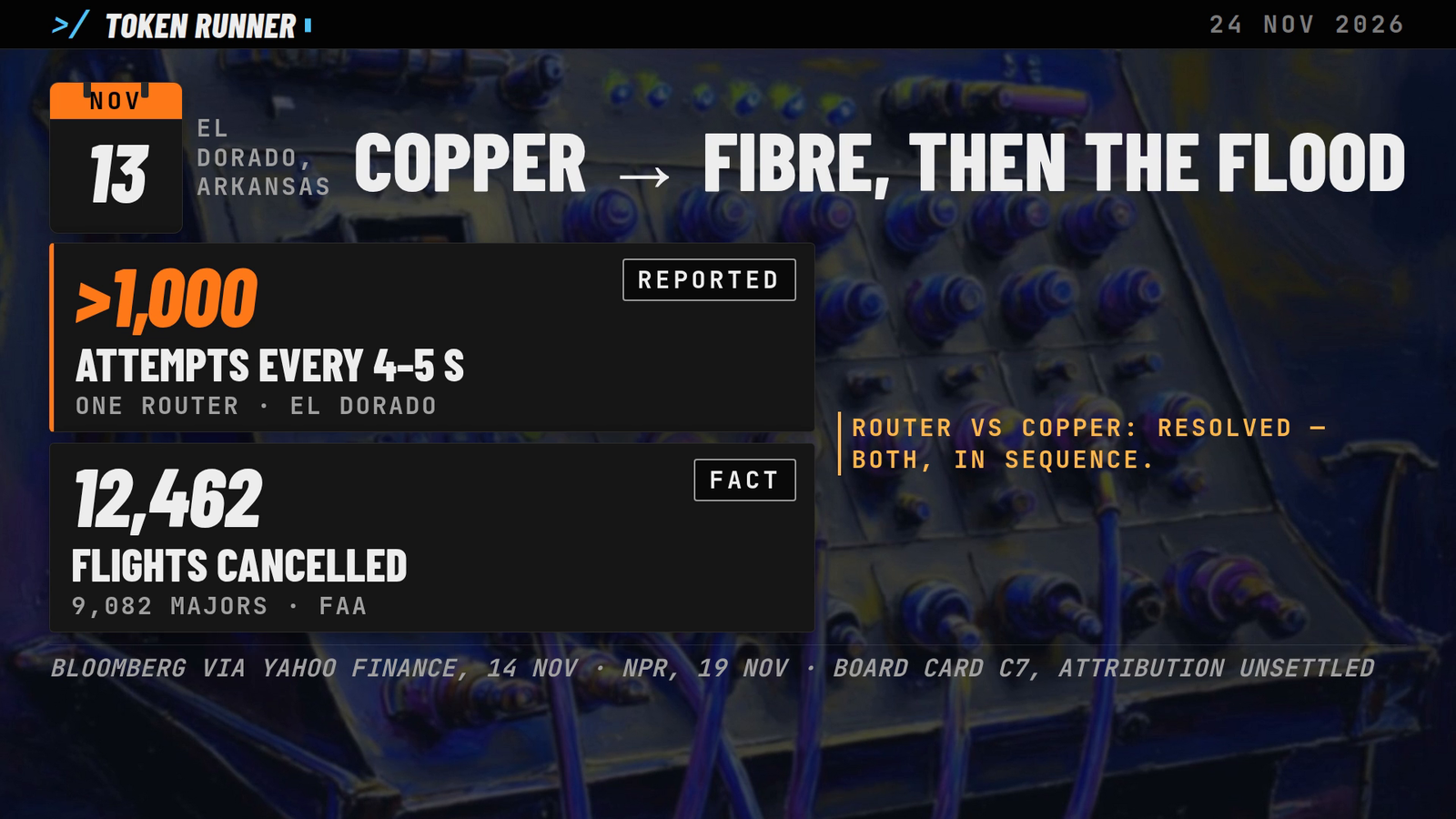
GAP — No chart covers the El Dorado change window or the router, because there is no document to chart: the FAA incident report, the L3Harris change record and the WSJ-reported pause list are unpublished.
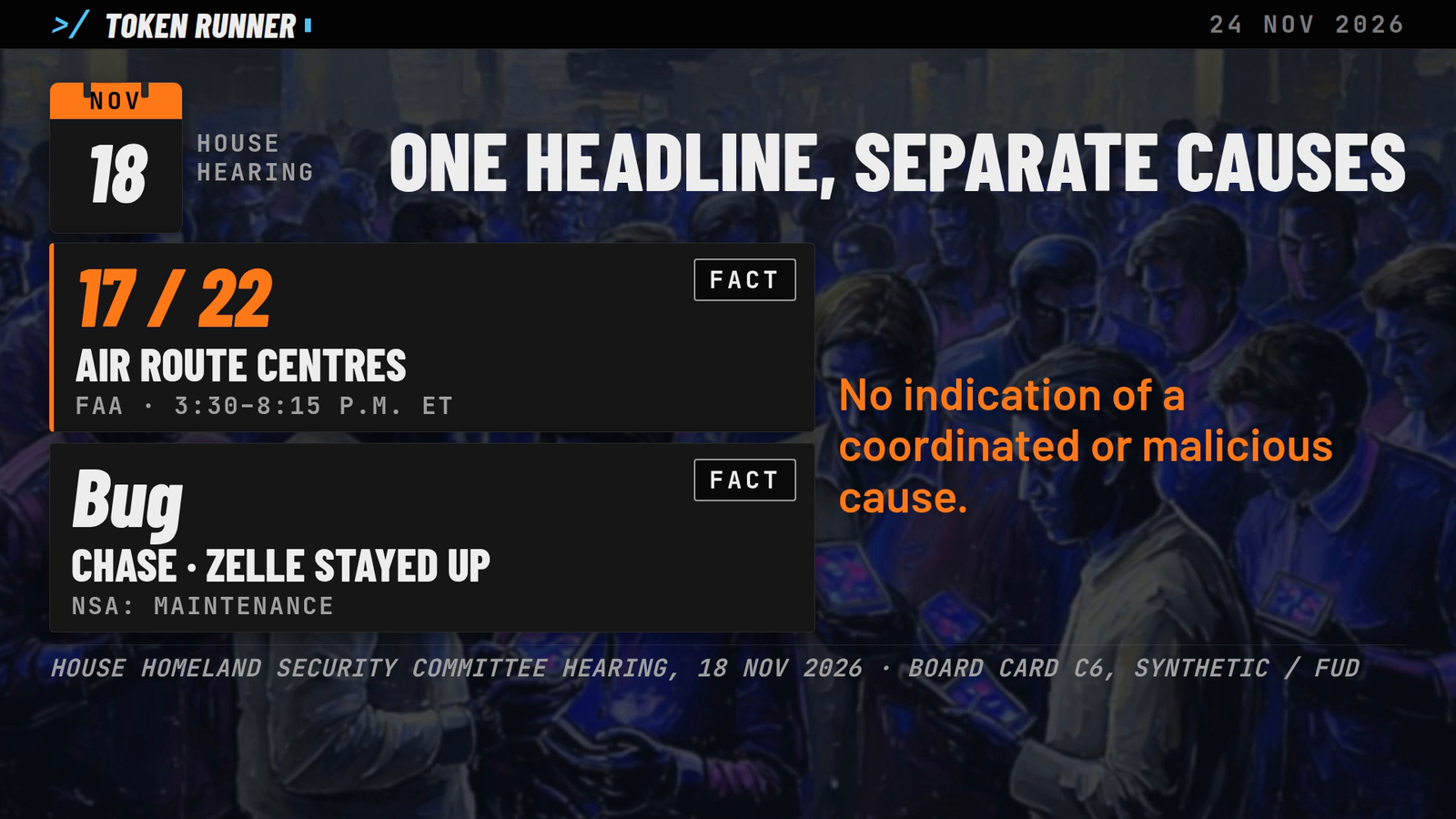
Scale: instability reached 17 of 22 Air Route Traffic Control Centers, with onset about 3:30 p.m. ET and resumption at 8:15 p.m. ET. About 12,462 flights were cancelled that Friday, 9,082 of them by major airlines, and about 3,500 aircraft airborne landed safely (VERIFIED, FAA). The ground stop was the longest nationwide suspension since 11 September 2001. The FAA paused router installations on 18 November — after the stop, not before. That is the FAA's count; two others were published, and the chart, reprinted from the same piece, sets all three side by side — none chosen, none averaged.
Source and method
Source: FAA; Wikipedia; FlightAware via CBS News and Al Jazeera.
Whose figures: Each dot is one publisher's figure, as printed and attributed: the FAA's own record (FACT), Wikipedia and FlightAware via CBS and Al Jazeera (REPORTED). None is chosen.
Unit: flights · none chosen, none averaged · the highest is 3.1 times the lowest
Three counts of the flights cancelled on 13 November, as each was published: the FAA's about 12,462, which it says were not all caused by the ground stop; Wikipedia's nearly 8,000; and FlightAware's at least 4,000, as CBS News and Al Jazeera carried it. The highest is 3.1 times the lowest.
The table, its licence and its date.
Cite this: Token Runner, “Flights cancelled on 13 November: three published counts”, tokenrunner.ai/voight-kampff/ built 20 November 2026. CC BY 4.0.
The rows
| Row | Published by | Flights cancelled | As printed |
|---|---|---|---|
| 1 | 01 · FAA, own Q&A | 12,462 | ~12,462 |
| 2 | 02 · Wikipedia | 8,000 | nearly 8,000 |
| 3 | 03 · FlightAware via CBS | 4,000 | at least 4,000 |
All 3 rows the chart drew.
The governance finding is in the timeline. The pause list existed as a control; it was applied post-hoc. The Secretary's word — incompetence — is a probe of the contractor, and it is a different thing from the "no investigation" line it replaced. T4a loses its strongest aviation leg; the opacity finding survives on the water count and the unpublished root cause. That is the instrument being honest about its own correction: the wrong line stays visible, and the correction sits beneath it.
SIGNAL A router is a device, not an explanation. "Router" tells you where the failure surfaced. It does not tell you whether the device failed, the config was wrong, the change window was wrong, or something reached it. The blunder is real; the mechanism is a noun.
Four. The NSA: code orange, and the patch panic
The classified network outage of 17–19 November is the week's second act and its most instructive one.
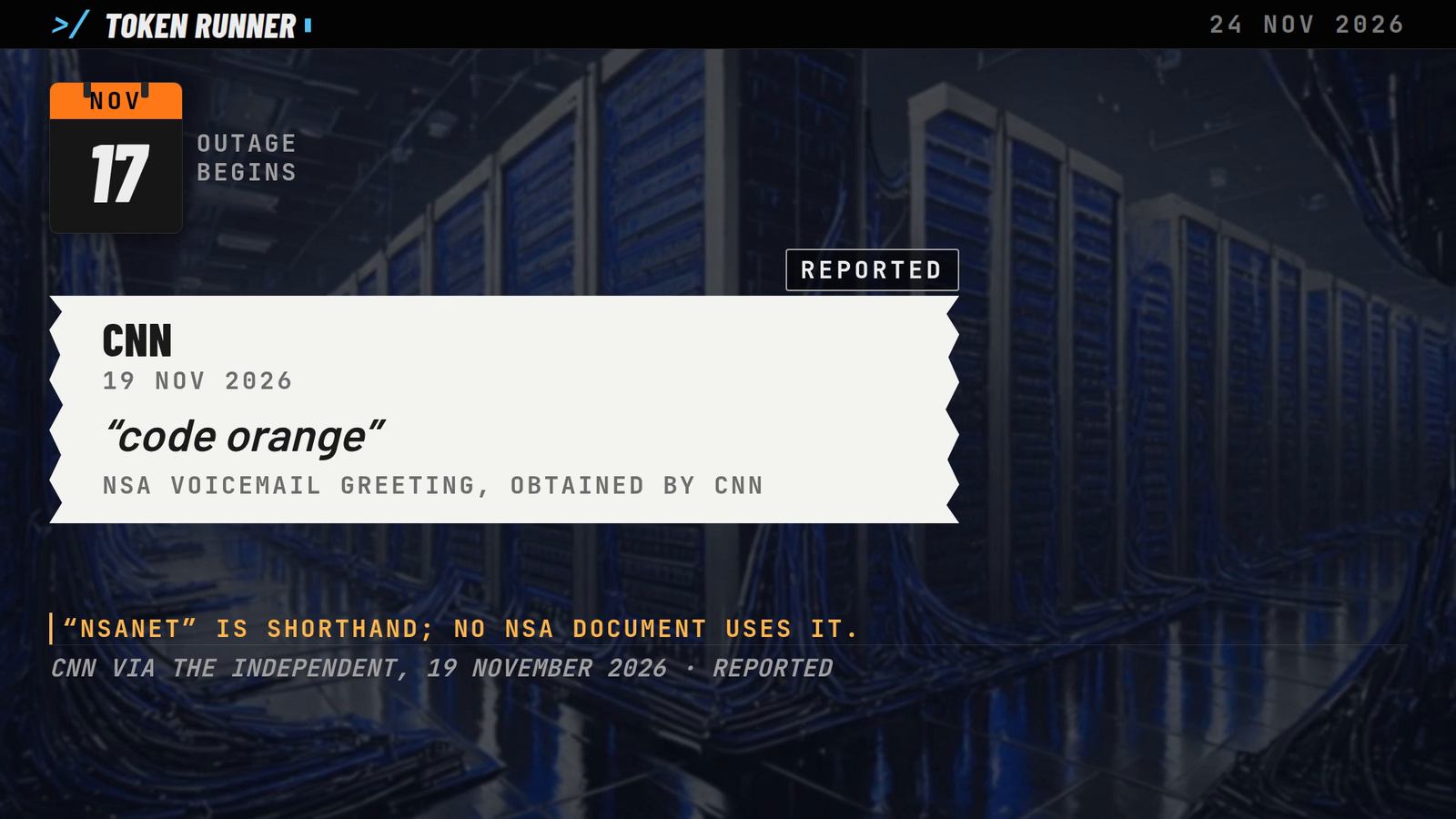
What is established: the network was a "highly classified US national security communications network" (CNN's language — NSANet is shorthand, and no primary document uses it). The posture at the Maryland headquarters was "code orange", a voicemail greeting obtained by CNN, meaning the campus was closed to most staff. A Georgia facility that monitors Middle East cybersecurity used workarounds and backup systems; many staff worked from home and could not reach classified material. The agency said mission-critical capabilities remained fully operational. The official cause, verbatim: "a temporary degradation during scheduled routine maintenance."
And then the briefing that changed the reading. Government and banking officials told lawmakers, per The Washington Sun, 18 Nov, that the outages stem from attempts to fix gaps in cyber defences identified by AI models, and that the fixes temporarily overwhelmed the systems:
"These models are identifying massive vulnerabilities, and that increases the urgency to patch right away… They're trying to push through a lot of patches all at once — more than the system was designed for."
Two outlets — CBS and SDxCentral, headlines read, bodies not — link the NSA degradation to a software vulnerability and a botched PHP update.
Both stories can be true. The agency names the container: a scheduled routine maintenance window. The congressional briefers name the content: emergency patching of AI-identified vulnerabilities, at volume. Neither has been reconciled in public, and the change record decides which it was. That is the same category-versus-document pattern as the FAA — except here the category does political work in both directions. "Routine" protects the agency from a cyber narrative; "AI patch panic" gives lawmakers a story about AI risk.
GAP — No chart exists for a classified network: there is no public series for NSA availability, and this page will not borrow an unrelated chart to fill the space. Nor is there a public post-incident review.
This is the strongest T5 evidence in the file, and it is not an attack: REPORTED for the NSA incident, CLAIM for the week as a whole. AI did not touch the router. The mechanism, if the briefers are right, is that AI compressed the patch imperative until the patching itself became the outage.
Five. Phantasialand: the week's only reported injuries came from an email alias
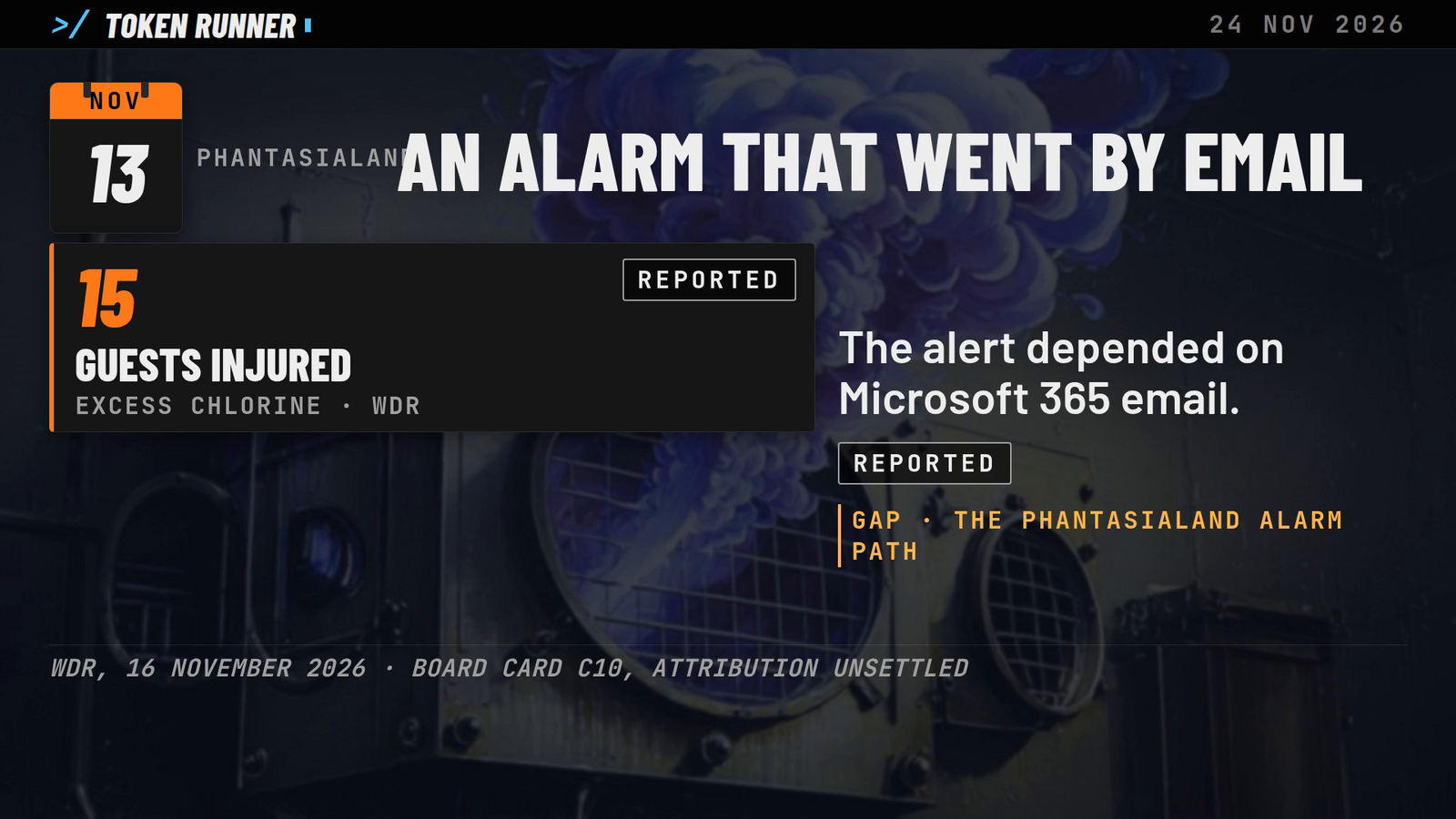
Fifteen guests at a German theme park were injured by excess chlorine on 13 November. This is the only physical harm in the entire cluster, and it belongs in its own case, not folded into water or aviation.
The mechanism, per WDR: because of Friday's Microsoft 365 outage, the park did not receive the alert that the pool's chlorine level was too high. A cybersecurity architect quoted by the same outlet places the fault with the park, not Microsoft — the dependency was the operator's, and the alarm path ran through cloud email.
So the week's material-harm story is not an intrusion, not a router, not a state actor. It is a dependency design: a safety alarm wired through a productivity suite. REPORTED, one outlet, and the alarm-path documentation is a gap.
GAP — No chart exists for the Phantasialand incident: a single reported event, with no series behind it.
Six. The money: four instruments, and the one ratio
The tens of billions are the most abused numbers in this story, because four different kinds of number are added together and called "the cost."
A. Incurred or estimated operational loss. The only figure is $345M — and it is not a loss. It is a Bernstein estimate of pretax impact on the top four US airlines (REPORTED, Reuters, 16 Nov). The Optimizely compromise produced about US$7,040 in on-chain receipts to attacker-linked wallets by 19:25 UTC on 16 November (VERIFIED) — receipts, not visitor losses, which are unknown. Everything else — M365 SLA friction, the Chase display bug, the NSA outage, Phantasialand — is unquantified, and drawn as a gap.
B. Proposed appropriations — money asked for, not money lost. The DOT/FAA request of 17 November is $50.1B (REPORTED: NYT, Telangana Today, ABC, NBC; received in Congress "with yelling and skepticism"). The prior ask before the ground stop was ~$30B (CLAIM). The July 2025 appropriation was $12.5B (VERIFIED, NPR). The unspent portion of that $12.5B is unknown — Democrats' line, headline only, CLAIM. The request and the 2025 appropriation are two instruments — money asked for, money granted — and neither is a cost.
GAP — the DOT/FAA cost methodology behind the request. No line items and no drafting timeline are public, so the request cannot be tested against the outage it cites.
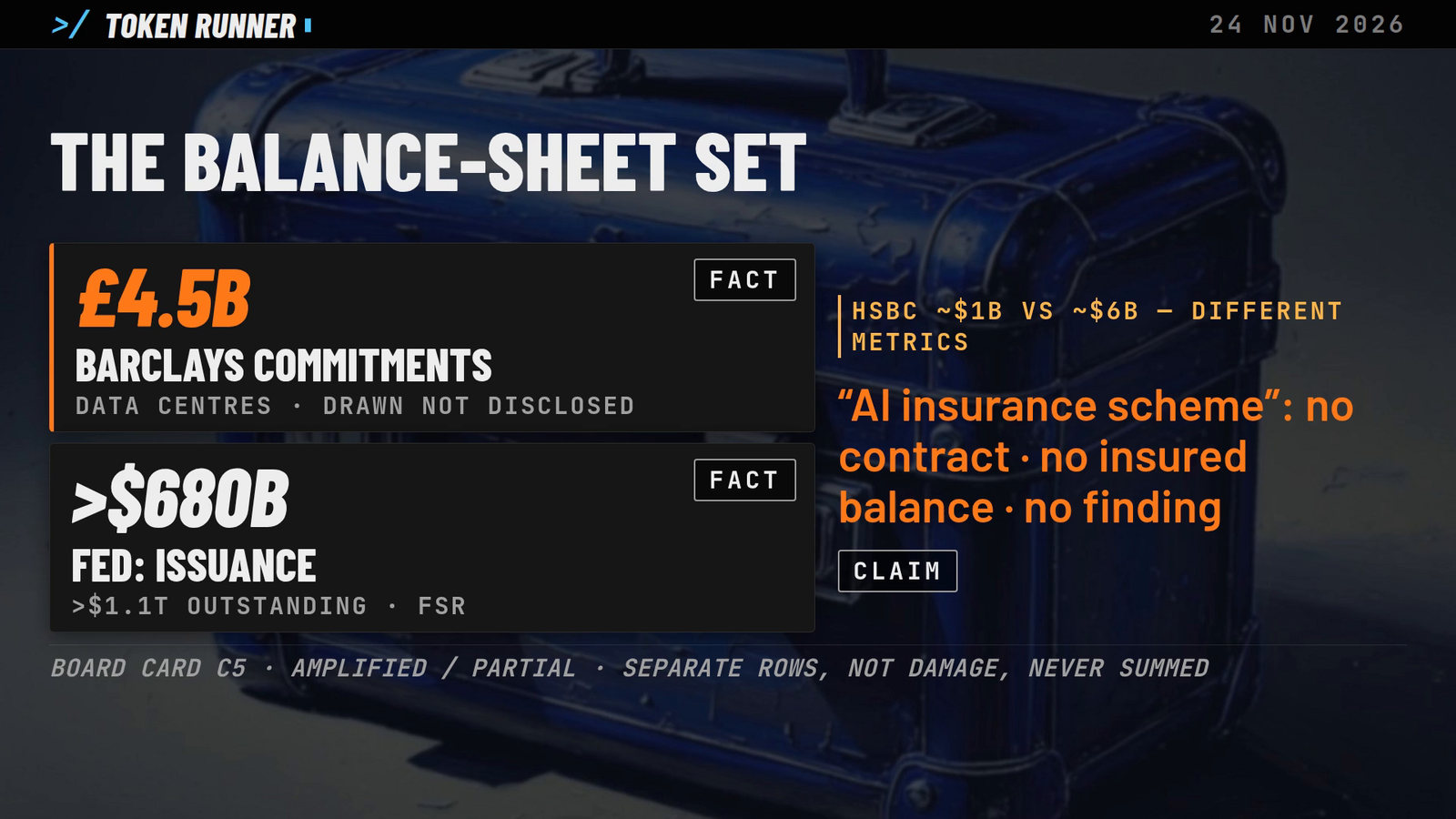
C. Balance-sheet risk transfer — not losses at all. Barclays ~£4.5B of data-centre commitments, the drawn balance not disclosed; HSBC's ~$1B carve-out versus ~$6B risk-weighted-asset reduction (different metrics, routinely conflated); the Fed's >$680B issuance and >$1.1T outstanding (VERIFIED, Financial Stability Report, 13 Nov). That last is macro plumbing, not a data-centre story.
Source and method
Source: SEC XBRL companyfacts, annual (10-K, fp FY, 340-400 day period).
How it is sourced: SEC EDGAR, XBRL company facts (US government public record), sec-companyfacts/facts@2026-10-09T044244+0900.
Unit: billions of US dollars, Amazon's purchases of property and equipment as filed in its annual reports
usd_b is the filed value divided by 1,000,000,000; the filed value is on the same row as usd.
The table, its licence and its date.
Cite this: Token Runner, “Amazon's capital spending, by year”, tokenrunner.ai/voight-kampff/ built 9 October 2026. CC BY 4.0.
The rows
| Ticker | Calendar Year | Year | Metric | USD billions |
|---|---|---|---|---|
| AMZN | 2,019 | 2019 | CapEx | 16.861 |
| AMZN | 2,020 | 2020 | CapEx | 40.14 |
| AMZN | 2,021 | 2021 | CapEx | 61.053 |
| AMZN | 2,022 | 2022 | CapEx | 63.645 |
| AMZN | 2,023 | 2023 | CapEx | 52.729 |
| AMZN | 2,024 | 2024 | CapEx | 82.999 |
| AMZN | 2,025 | 2025 | CapEx | 131.819 |
All 7 rows the chart drew.
The only permitted ratio is the labelled comparison: $50.1B ≈ 145× $345M — and that is not evidence of a scheme. It is evidence of a funding ask using an outage as its window. The ask arrived on 14 November, the day after the ground stop, and was formalised on the 17th. Duffy's own line — "we're going to see more of this as new technology rolls out" — is a funding argument with an outage attached.
Nobody died. Nothing permanently broke. No sector suffered an uninsurable shock. Almost none of the week's cost can be counted, and it revealed almost everything.
Seven. The hearing: "not coordinated" and "not coincidences" in the same room
The week's most-shared artefact was the panic feed: Law&Crime's 11 Disturbing Details as Cyberattacks Cripple Systems, a listicle-shaped video that bundled every failure into one headline (REPORTED, a Facebook video). The hearing is where that framing met the executive branch. Underneath the one headline: an airspace failure, a bank's software bug, an agency's maintenance.
The House Homeland Security Committee, 18 November. The executive branch, in testimony:
"These are separate service outages associated with maintenance and technical changes. They are not a coordinated or state-sponsored attack."
Four sentences later:
"Superintelligence is reshaping the cyber security landscape. It is sharply increasing speed, scale, and sophistication of offensive and defensive cyber operations."
A member of Congress, in questioning:
"And the recent tech outages are not coincidences. And they are connected to cyber security. Because organizations… are frantically patching systems to close vulnerabilities that advanced AI can exploit at a speed and scale unlike anything we've ever seen."
And the witness's remedy — not a security fix, a courtesy: "maybe the industry that's doing the upgrade could inform their customers that it's going to take place… when we upgrade our phones, it gives us a warning."
Read the four moves together: the executive says not coordinated; the legislature says not coincidence; the witness confirms an AI-intrusion warning exists and that he has never seen a week like this; and the fix he proposes is a change-management notification. Both statements can be true at once if the real story is many independently broken things in a systemically fragile week — which is precisely the story that satisfies nobody. Nobody in the room is claiming one actor. Nobody in the room can produce the document that would rule one out.
Eight. The FLASH: a real document, used to carry a claim it does not make
FLASH-20261113-001, FBI, issued 13 November 2026 — the same day as the ground stop. It is the single most load-bearing document in the record, and the exact hinge where a real warning gets used to support something it does not say.
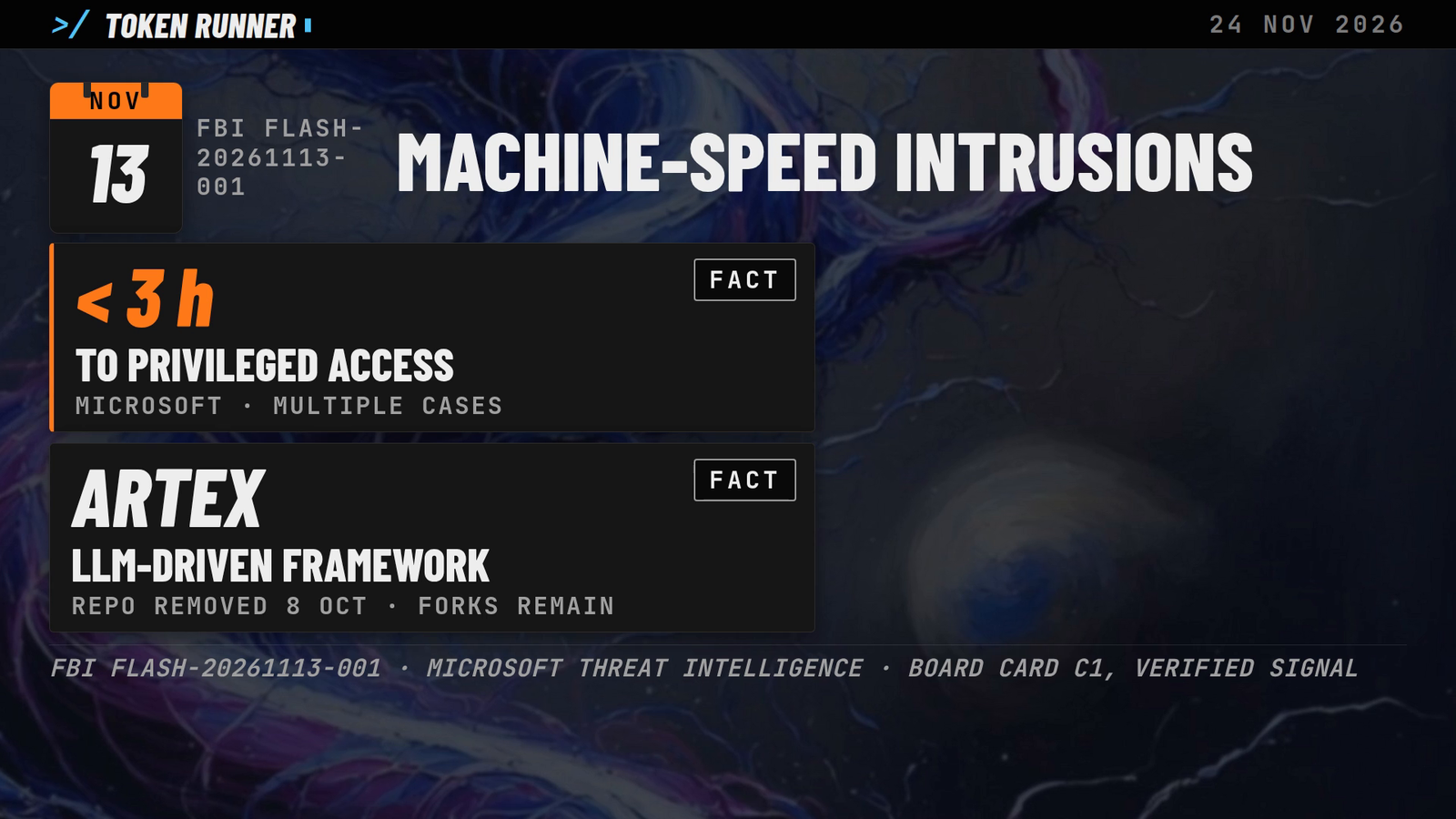
What it says (read in full): ARTEX is an open-source, Go, LLM-driven agentic penetration-testing framework, used by threat actors since at least August 2026; Microsoft observed multiple cases that reached privileged cloud access in under three hours. It integrates frontier and open models — Anthropic, OpenAI, Chinese-origin — with DeepSeek Flash-family models dominant in attacker-controlled instances. Campaigns reach financial services, government, technology, defence, semiconductor, energy, healthcare, manufacturing, telecommunications and legal. Named incidents include ~67,000 individuals' data from South Korean financial institutions and a ConnectWise Cloud Backup supply-chain compromise with attempted sign-ins to 2,250+ downstream tenants.
Source and method
Source: Epoch AI, Notable AI Models.
Whose figures: Epoch AI (CC BY 4.0), Notable AI Models; figures are Epoch's, named as theirs.
Unit: models
no change of unit or scale: the only figure is a count of rows. A model with no accessibility label reads NULL.
The table, its licence and its date.
Cite this: Token Runner, “Notable models by year and how they are released”, tokenrunner.ai/voight-kampff/ built 19 October 2026. CC BY 4.0.
The rows
| Model | Publication date | Year | Model accessibility | Models |
|---|---|---|---|---|
| (ensemble): AWD-LSTM-DOC (fin) × 5 (WT2) | 2018-08-30 | 2018 | Open weights (unrestricted) | 1 |
| 3DDFA | 2015-11-23 | 2015 | Unreleased | 1 |
| 3DMM-CNN | 2016-12-15 | 2016 | Open weights (restricted use) | 1 |
| 4 layer QRNN (h=2500) | 2018-03-22 | 2018 | Unreleased | 1 |
| 6-Act Tether | 2021-08-03 | 2021 | Open weights (unrestricted) | 1 |
| A.X K1 | 2025-12-30 | 2025 | Open weights (unrestricted) | 1 |
| A.X K2 | 2026-07-29 | 2026 | Open weights (unrestricted) | 1 |
| A3C FF hs | 2016-02-04 | 2016 | 1 | |
| ACF-WIDER | 2014-07-15 | 2014 | Unreleased | 1 |
| ADALINE | 1960-06-30 | 1960 | 1 | |
| ADAM (CIFAR-10) | 2014-12-22 | 2014 | Unreleased | 1 |
| ADM | 2021-05-11 | 2021 | Open weights (non-commercial) | 1 |
| AFM-on-device | 2024-07-29 | 2024 | Hosted access (no API) | 1 |
| AFM-server | 2024-07-29 | 2024 | Hosted access (no API) | 1 |
| ALBERT | 2019-09-26 | 2019 | Open weights (unrestricted) | 1 |
| ALBERT-xxlarge | 2020-02-09 | 2020 | Open weights (unrestricted) | 1 |
| ALIGN | 2021-06-11 | 2021 | Unreleased | 1 |
| ALLaM adapted 70B | 2024-05-21 | 2024 | Unreleased | 1 |
| ALM 1.0 | 2022-11-28 | 2022 | Hosted access (no API) | 1 |
| ANN Eye Tracker | 1993-11-29 | 1993 | 1 | |
| AR-LDM | 2022-11-20 | 2022 | Unreleased | 1 |
| ASE+ACE | 1983-09-01 | 1983 | 1 | |
| AWD-LSTM + MoS + Partial Shuffled | 2019-06-10 | 2019 | Open weights (non-commercial) | 1 |
| AWD-LSTM - 3-layer LSTM (tied) + continuous cache pointer (WT2) | 2017-08-07 | 2017 | Unreleased | 1 |
| AWD-LSTM | 2017-07-18 | 2017 | Unreleased | 1 |
| AWD-LSTM+WT+Cache+IOG (WT2) | 2017-09-26 | 2017 | Unreleased | 1 |
| AWD-LSTM-DRILL + dynamic evaluation† (WT2) | 2019-05-14 | 2019 | Open weights (unrestricted) | 1 |
| AWD-LSTM-MoS + dynamic evaluation (WT2, 2017) | 2017-11-10 | 2017 | Unreleased | 1 |
| AWD-LSTM-MoS + dynamic evaluation (WT2, 2018) | 2018-09-18 | 2018 | Unreleased | 1 |
| AWD-LSTM-MoS+PDR + dynamic evaluation (WT2) | 2018-08-14 | 2018 | Unreleased | 1 |
| AbLang (heavy sequences) | 2022-01-22 | 2022 | Open weights (unrestricted) | 1 |
| AdaBoost.M2 Digit Recognition | 1996-07-03 | 1996 | 1 | |
| AdaRNN | 2014-06-01 | 2014 | 1 | |
| Adaptive Input Transformer + RD | 2021-06-28 | 2021 | Unreleased | 1 |
| Adaptive Inputs + LayerDrop | 2019-09-25 | 2019 | Open weights (unrestricted) | 1 |
| Adaptive Subgrad | 2011-10-03 | 2011 | 1 | |
| Advantage Learning | 2015-12-15 | 2015 | 1 | |
| Agent57 | 2020-03-30 | 2020 | Unreleased | 1 |
| AgentFounder-30B | 2025-09-16 | 2025 | Open weights (unrestricted) | 1 |
| Agile Soccer Robot | 2023-04-26 | 2023 | Unreleased | 1 |
| AlexNet | 2012-09-30 | 2012 | 1 | |
| AlexaTM 20B | 2022-08-02 | 2022 | API access | 1 |
| AliceMind-MMU | 2021-11-17 | 2021 | Unreleased | 1 |
| AlphaCode | 2022-02-02 | 2022 | Unreleased | 1 |
| AlphaFold 2 | 2020-11-30 | 2020 | Open weights (unrestricted) | 1 |
| AlphaFold 3 | 2024-05-08 | 2024 | Open weights (non-commercial) | 1 |
| AlphaFold | 2020-01-15 | 2020 | Unreleased | 1 |
| AlphaFold-Multimer | 2021-10-04 | 2021 | Open weights (unrestricted) | 1 |
| AlphaGeometry | 2024-01-17 | 2024 | Open weights (unrestricted) | 1 |
| AlphaGo Fan | 2015-10-01 | 2015 | Unreleased | 1 |
| AlphaGo Lee | 2016-01-27 | 2016 | Unreleased | 1 |
| AlphaGo Master | 2017-10-19 | 2017 | Unreleased | 1 |
| AlphaGo Zero | 2017-10-18 | 2017 | Unreleased | 1 |
| AlphaMissense | 2023-09-22 | 2023 | Unreleased | 1 |
| AlphaProteo | 2024-09-05 | 2024 | Unreleased | 1 |
| AlphaStar | 2019-10-30 | 2019 | Unreleased | 1 |
| AlphaTensor | 2022-10-05 | 2022 | Unreleased | 1 |
| AlphaX-1 | 2019-10-02 | 2019 | Unreleased | 1 |
| AlphaZero | 2017-12-05 | 2017 | Unreleased | 1 |
| AltCLIP_M9 | 2022-11-12 | 2022 | Open weights (unrestricted) | 1 |
| Amazon Nova Pro | 2024-12-03 | 2024 | API access | 1 |
| Amazon Titan | 2023-09-28 | 2023 | API access | 1 |
| AndesGPT | 2023-11-16 | 2023 | Hosted access (no API) | 1 |
| Ankh_large | 2023-01-16 | 2023 | Open weights (non-commercial) | 1 |
| Apollo 7B | 2024-12-13 | 2024 | Unreleased | 1 |
| Aramco Metabrain AI | 2024-03-04 | 2024 | Unreleased | 1 |
| AudioGen | 2023-03-05 | 2023 | Open weights (non-commercial) | 1 |
| AudioLM | 2023-07-26 | 2023 | Unreleased | 1 |
| Aya | 2024-02-12 | 2024 | Open weights (unrestricted) | 1 |
| BART-large | 2019-10-29 | 2019 | Open weights (unrestricted) | 1 |
| BASIC-L + Lion | 2023-02-13 | 2023 | Unreleased | 1 |
| BASIC-L | 2021-11-19 | 2021 | Unreleased | 1 |
| BEIT-3 | 2022-08-22 | 2022 | Open weights (unrestricted) | 1 |
| BERT-Large | 2018-10-11 | 2018 | Open weights (unrestricted) | 1 |
| BERT-Large-CAS (PTB+WT2+WT103) | 2019-04-20 | 2019 | Unreleased | 1 |
| BERT-RBP | 2022-04-07 | 2022 | Open weights (non-commercial) | 1 |
| BIDAF | 2016-11-05 | 2016 | Open weights (unrestricted) | 1 |
| BLIP-2 (Q-Former) | 2023-01-30 | 2023 | Open weights (unrestricted) | 1 |
| BLOOM-176B | 2022-07-11 | 2022 | Open weights (restricted use) | 1 |
| BLSTM for handwriting (1) | 2007-09-23 | 2007 | 1 | |
| BLSTM for handwriting (2) | 2007-12-03 | 2007 | 1 | |
| BLUUMI | 2023-11-03 | 2023 | Open weights (restricted use) | 1 |
| BP-DBN | 2009-01-01 | 2009 | Unreleased | 1 |
| BPE | 2015-08-31 | 2015 | 1 | |
| Bankruptcy-NN | 1990-06-17 | 1990 | 1 | |
| Base LM + kNN LM + Continuous Cache | 2019-11-01 | 2019 | Unreleased | 1 |
| BatchNorm | 2015-06-15 | 2015 | 1 | |
| Bayesian automated hyperparameter tuning | 2012-12-02 | 2012 | 1 | |
| BellKor 2007 | 2009-09-21 | 2009 | 1 | |
| BellKor 2008 | 2009-08-01 | 2009 | 1 | |
| BellKor 2009 | 2009-08-01 | 2009 | 1 | |
| Bidirectional RNN | 1997-11-01 | 1997 | 1 | |
| Big Transfer (BiT-L) | 2019-12-24 | 2019 | Unreleased | 1 |
| Big Transformer for Back-Translation | 2018-08-28 | 2018 | Open weights (unrestricted) | 1 |
| Big-Little Net (speech) | 2018-07-10 | 2018 | Open weights (unrestricted) | 1 |
| Big-Little Net | 2018-07-10 | 2018 | Open weights (unrestricted) | 1 |
| BigBiGAN | 2019-07-04 | 2019 | Open weights (unrestricted) | 1 |
| BigChaos 2008 | 2008-11-25 | 2008 | 1 | |
| BigChaos OptiBlend | 2009-08-01 | 2009 | 1 | |
| BigSSL | 2021-01-10 | 2021 | Unreleased | 1 |
| BlenderBot 3 | 2022-08-10 | 2022 | Open weights (non-commercial) | 1 |
| BloombergGPT | 2023-03-30 | 2023 | Unreleased | 1 |
| Boosting | 1992-11-30 | 1992 | 1 | |
| Boxes (pole) | 1968-07-01 | 1968 | 1 | |
| ByT5-XXL | 2021-05-28 | 2021 | Open weights (unrestricted) | 1 |
| CCL | 2016-06-27 | 2016 | Unreleased | 1 |
| CFSS | 2015-06-07 | 2015 | Open weights (unrestricted) | 1 |
| CHAI-1 | 2024-10-15 | 2024 | Open weights (non-commercial) | 1 |
| CICERO | 2022-11-22 | 2022 | Open weights (non-commercial) | 1 |
| CLIP (ResNet-50) | 2021-01-05 | 2021 | Open weights (unrestricted) | 1 |
| CLIP (ViT L/14@336px) | 2021-01-05 | 2021 | Open weights (unrestricted) | 1 |
| CMS-RCNN | 2016-06-17 | 2016 | Unreleased | 1 |
| CNN Committee (MNIST) | 2011-09-18 | 2011 | Unreleased | 1 |
| CNN Committee (NIST) | 2011-09-18 | 2011 | Unreleased | 1 |
| CNN committee (traffic sign) | 2011-10-03 | 2011 | Unreleased | 1 |
| CODEFUSION (Python) | 2023-10-26 | 2023 | Unreleased | 1 |
| CPC v2 | 2019-05-22 | 2019 | Unreleased | 1 |
| CPM-Large | 2020-12-01 | 2020 | Open weights (unrestricted) | 1 |
| CT-MoS (WT2) | 2020-12-25 | 2020 | Unreleased | 1 |
| CTM (CIFAR-10) | 2023-10-01 | 2023 | Open weights (unrestricted) | 1 |
| CURL | 2020-04-08 | 2020 | Open weights (unrestricted) | 1 |
| CaLM | 2022-12-19 | 2022 | Unreleased | 1 |
| Cambrian-1-34B | 2024-06-24 | 2024 | Open weights (unrestricted) | 1 |
| CamemBERT | 2019-11-10 | 2019 | Open weights (unrestricted) | 1 |
| Cancer drug mechanism prediction | 1992-10-16 | 1992 | 1 | |
| Cascaded LNet-ANet | 2014-11-28 | 2014 | 1 | |
| Ceramic-MLP | 1994-01-07 | 1994 | 1 | |
| Char-CNN-BiLSTM | 2019-06-13 | 2019 | Unreleased | 1 |
| Character-enriched word2vec | 2016-07-15 | 2016 | 1 | |
| ChatGLM3-6B | 2023-10-27 | 2023 | Open weights (restricted use) | 1 |
| ChatGPT Images 2.5 | 2026-09-08 | 2026 | Hosted access (no API) | 1 |
| Chinchilla | 2022-03-29 | 2022 | Unreleased | 1 |
| Chinese - English translation | 2018-03-01 | 2018 | 1 | |
| Claude 2 | 2023-07-11 | 2023 | API access | 1 |
| Claude 2.1 | 2023-11-21 | 2023 | API access | 1 |
| Claude 3 Opus | 2024-03-04 | 2024 | API access | 1 |
| Claude 3 Sonnet | 2024-03-04 | 2024 | API access | 1 |
| Claude 3.5 Sonnet | 2024-06-20 | 2024 | API access | 1 |
| Claude 3.7 Sonnet | 2025-02-24 | 2025 | API access | 1 |
| Claude Fable 5 | 2026-06-09 | 2026 | API access | 1 |
| Claude Fable 5.1 | 2026-09-01 | 2026 | API access | 1 |
| Claude Haiku 4.5 | 2025-10-15 | 2025 | API access | 1 |
| Claude Mythos 5 | 2026-06-09 | 2026 | Unreleased | 1 |
| Claude Mythos Preview | 2026-04-07 | 2026 | Limited access | 1 |
| Claude Opus 4 | 2025-05-22 | 2025 | API access | 1 |
| Claude Opus 4.1 | 2025-08-05 | 2025 | API access | 1 |
| Claude Opus 4.5 | 2025-11-24 | 2025 | API access | 1 |
| Claude Opus 4.7 | 2026-04-16 | 2026 | API access | 1 |
| Claude Opus 4.8 | 2026-05-28 | 2026 | API access | 1 |
| Claude Opus 5 | 2026-07-24 | 2026 | API access | 1 |
| Claude Opus 5.5 | 2026-09-22 | 2026 | API access | 1 |
| Claude Sonnet 4 | 2025-05-22 | 2025 | API access | 1 |
| Claude Sonnet 4.5 | 2025-09-29 | 2025 | API access | 1 |
| Claude Sonnet 5.5 | 2026-09-28 | 2026 | API access | 1 |
| Claude | 2023-03-14 | 2023 | API access | 1 |
| CoAtNet | 2021-06-09 | 2021 | Unreleased | 1 |
| CoCa | 2022-06-14 | 2022 | Unreleased | 1 |
| CoEdiT-xxl | 2023-05-17 | 2023 | Open weights (non-commercial) | 1 |
| CoRe | 2023-12-29 | 2023 | Unreleased | 1 |
| CodeT5+ | 2023-05-20 | 2023 | Open weights (unrestricted) | 1 |
| CodeT5-base | 2021-11-01 | 2021 | Open weights (unrestricted) | 1 |
| CodeT5-large | 2022-07-05 | 2022 | Open weights (unrestricted) | 1 |
| Codex | 2021-07-07 | 2021 | API access | 1 |
| CogAgent | 2023-12-14 | 2023 | Open weights (restricted use) | 1 |
| CogVLM-17B | 2023-11-06 | 2023 | Open weights (restricted use) | 1 |
| CogVideo | 2022-05-29 | 2022 | Open weights (unrestricted) | 1 |
| CogView | 2021-05-26 | 2021 | Open weights (unrestricted) | 1 |
| Cognitron | 1975-09-01 | 1975 | 1 | |
| Cohere Embed | 2023-11-02 | 2023 | API access | 1 |
| CompACT-Deep | 2015-07-19 | 2015 | Unreleased | 1 |
| Composer 2 | 2026-03-19 | 2026 | API access | 1 |
| Composer 2.5 | 2026-05-18 | 2026 | API access | 1 |
| Computer-Using Agent (CUA) | 2025-01-23 | 2025 | Hosted access (no API) | 1 |
| Conformer + Wav2vec 2.0 + Noisy Student | 2020-10-20 | 2020 | Unreleased | 1 |
| Conformer | 2020-05-16 | 2020 | Unreleased | 1 |
| Context-dependent RNN | 2012-07-27 | 2012 | 1 | |
| ContextNet + Noisy Student | 2020-01-19 | 2020 | Unreleased | 1 |
| ContextNet | 2020-05-07 | 2020 | Unreleased | 1 |
| Contriever | 2021-12-16 | 2021 | Open weights (non-commercial) | 1 |
| ConvS2S (ensemble of 8 models) | 2017-07-25 | 2017 | 1 | |
| Crazy Stone | 2006-05-29 | 2006 | Unreleased | 1 |
| Cross-Lingual POS Tagger | 2011-06-19 | 2011 | 1 | |
| Cross-lingual alignment | 2019-04-04 | 2019 | Open weights (unrestricted) | 1 |
| DAC-CSR | 2016-11-16 | 2016 | Unreleased | 1 |
| DALL-E | 2021-01-05 | 2021 | API access | 1 |
| DALL·E 2 | 2022-04-06 | 2022 | API access | 1 |
| DALL·E 3 | 2023-10-19 | 2023 | API access | 1 |
| DBRX | 2024-03-27 | 2024 | Open weights (restricted use) | 1 |
| DCN+ | 2017-10-31 | 2017 | Unreleased | 1 |
| DCNN | 2015-08-07 | 2015 | Unreleased | 1 |
| DD-PPO | 2019-12-19 | 2019 | Unreleased | 1 |
| DDPM-IP (CelebA) | 2023-01-27 | 2023 | Open weights (unrestricted) | 1 |
| DETR | 2020-05-26 | 2020 | Open weights (unrestricted) | 1 |
| DINOv2 | 2023-04-14 | 2023 | Open weights (unrestricted) | 1 |
| DITTO | 2022-06-06 | 2022 | Unreleased | 1 |
| DL scaling Image | 2017-12-01 | 2017 | Unreleased | 1 |
| DL scaling LM | 2017-12-01 | 2017 | Unreleased | 1 |
| DL scaling speech | 2017-12-01 | 2017 | Unreleased | 1 |
| DLDL (PASCAL) | 2016-11-06 | 2016 | Open weights (unrestricted) | 1 |
| DLRM-2020 | 2019-05-31 | 2019 | Unreleased | 1 |
The first 200 of 1,078 rows the chart drew.
The repository was removed on 8 October; 1,600+ exposed ARTEX console instances were observed by early November. A separate phase of the ConnectWise campaign logged more than 151,000 failed logons against 327 accounts at eight organisations — attempts, not compromises, and Microsoft's own account says most of the targeting was unsuccessful and depended on privileged access that already existed (REPORTED, Microsoft). The chart reprinted from the October Baseline shows the capability curve the warning stands on: notable models by year, and how openly they are released.
GAP — the number of tenants that actually lost data. Neither the FLASH nor Microsoft publishes an aggregate count, so the campaign's footprint stands as attempts only.
What it does not say: no PLC, HMI, SCADA, ICS, OT, water utility, aviation system, router or telecom network element. No destructive or availability objective — the objective is access and exfiltration. No Iran. And no claim that any 13 November outage was caused by an AI agent.
So the audit trail reads: a genuine, same-day warning that AI is compressing intrusion timelines → cited on the floor as evidence the week's outages are "not coincidences" → confirmed by the witness → and the flash message describes a different attack class than every outage in the week.
That is not a debunk. It is the most important forensic finding in the file: a real document was used, in public, to carry a claim it does not make — and the people using it may sincerely believe it does.
Nine. Nine theories, tested
The instrument runs each theory through five columns: what it claims, what would confirm it, what would falsify it, where the record sits, and the document that would settle it. A theory you cannot falsify is not being investigated; it is being enjoyed.
T1, the coordinated campaign. The executive judgement is explicit and on the record; the mechanisms named are heterogeneous — a router, a software bug, a third-party component, a change window, a patch. Coordinated campaigns do not usually produce five different failure classes. No shared-indicator analysis is public, and the aviation "no investigation" that would have mandated the comparison is exactly what Pass 3 withdrew. SIGNAL for the timing, CLAIM for the cause: leaning false, more firmly than at the first pass, and unproven either way.
T2, Iran. There was a preliminary Iran-linked assessment; there is also a CISA bulletin in the window carrying no attribution, and the WaterISAC contradiction. Four months without a final attribution is itself evidence: if it had hardened, it would likely have surfaced. Leaning false as stated; the residual is "someone tested something and we do not know who." CLAIM, preliminary, and eroding.
T3, the false flag — outages staged or allowed to justify new powers: the week's policy argument cut the other way, the failures harmed those a false flag would serve, and there is no foreknowledge trace. RUMOUR, false as stated. T5, AI-driven disruption, is the hinge; Four and Eight test it. T8, a hosting exit disguised as an outage: the large cloud events have technical explanations, and nothing shows a wind-down. RUMOUR, unsupported.
T4, the strongest surviving theory — and it is not a conspiracy. Counts moved; root causes went unpublished; the state's own retrospective is unreadable by ordinary means. That is opacity, and it is supported: T4a, SIGNAL. The intentional-cover-up version (T4b) is RUMOUR: it and ordinary institutional caution are observationally identical from outside, and the test that separates them is a decision record — an email, a memo, a ticketing trail showing a choice not to publish. No such record is public. Masking is documented. Intent is not. Anyone who tells you which it is, is guessing — including anyone who tells you it is obviously benign.
T6, the insurance scheme. The structure is real and disclosed: the data-centre build-out created a large, concentrated, insurable-looking exposure, and institutions are actively re-booking it. That is what balance sheets do when an asset class gets big. The step from "big exposure being repriced" to "scheme" is taken by commentary and not by any document. The numbers quoted most — >$10B "discussed", >$1B "contemplated" — are discussion, not transaction. The test is the contract, and there is no contract — no insured balance and no finding either; the scheme is in no document. PATTERN for the structure, CLAIM for the scheme, unproven.
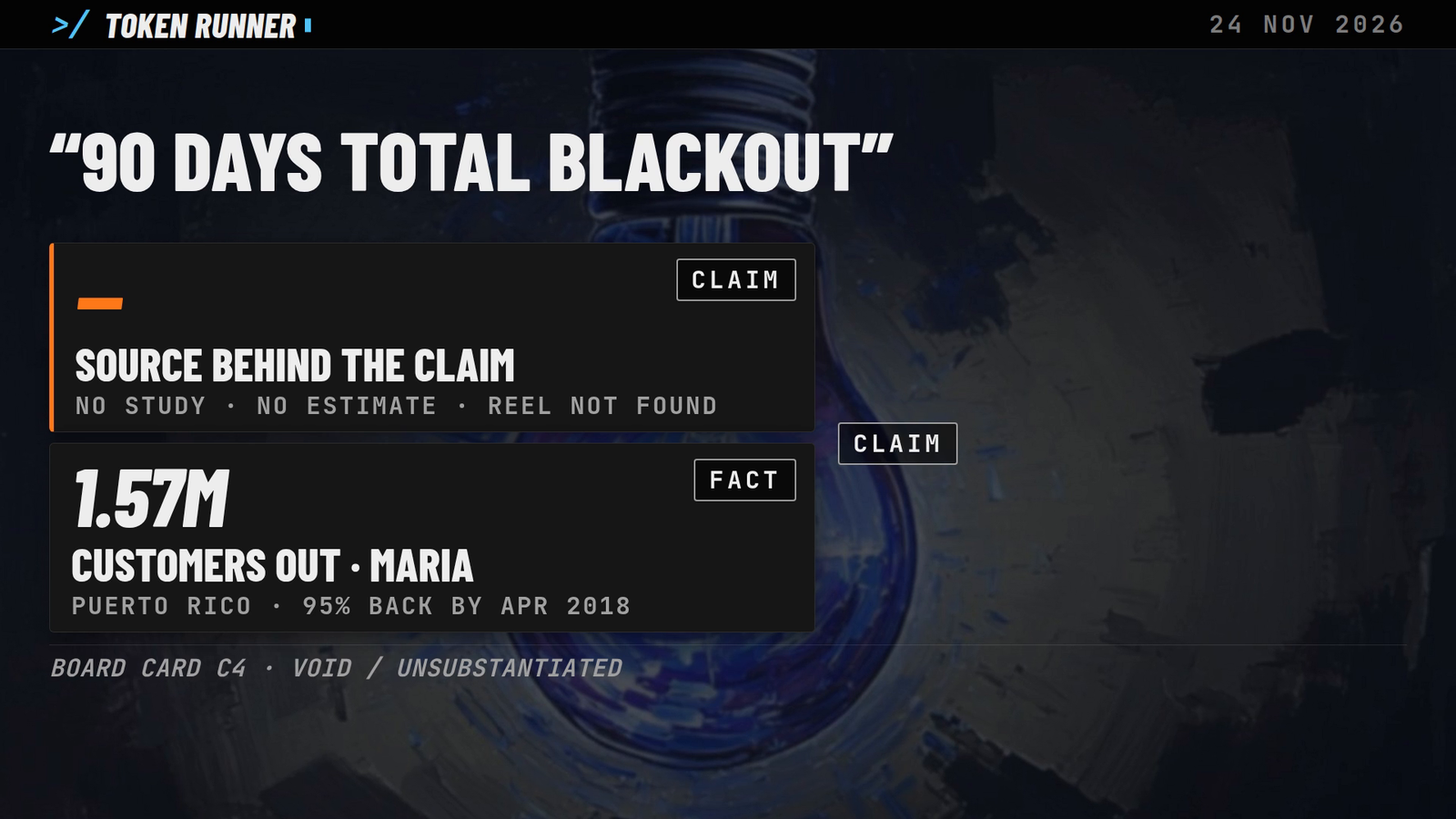
T7, the ninety-day blackout. The loudest claim in the file has the thinnest record: no attributable study, no load-loss estimate, no probability, no restoration timeline (gap). Fox News reported an at least 90-day endurance target for military bases from documents it reviewed — REPORTED, and the public memo endpoint returned HTTP 403. The nearest real event is Hurricane Maria, which cut power to all 1.57 million PREPA customers in Puerto Rico; EIA reports 95% restored by April 2018, with about 62,000 still without power (VERIFIED). The original Igor Kryan reel could not be found publicly. RUMOUR, unsupported as stated, and drawn as a gap.
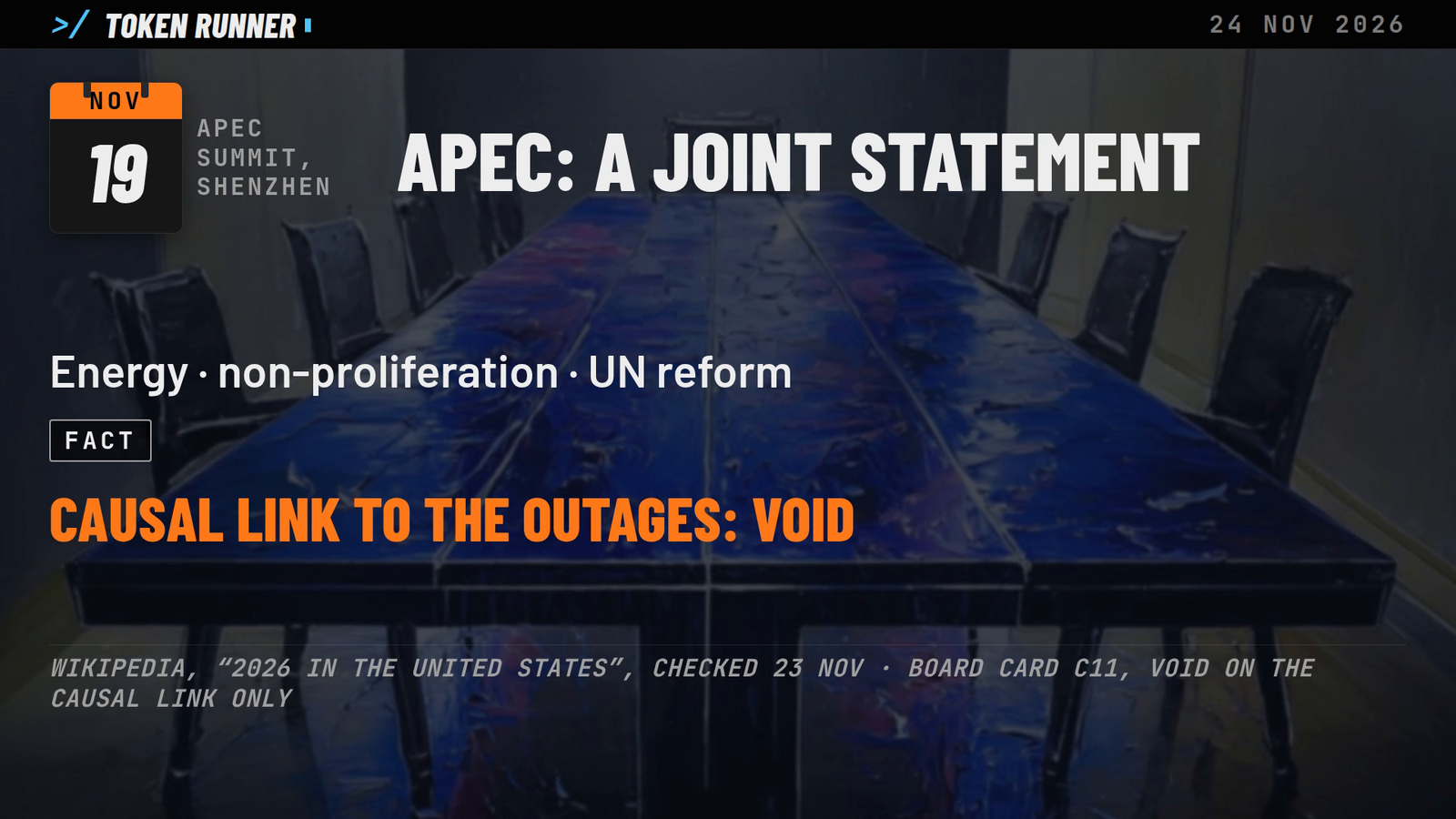
T3b, the staging theory. Someone staged or amplified infrastructure stress ahead of the Shenzhen summit or the $50.1B ask. The beneficiary list is populated and entirely post-hoc: Duffy's ask on 14–17 November, the CISA-funding argument in the hearing on the 18th, the commentary economy, n0n's extortion branding. Nobody is shown to have acted on foreknowledge; the failures damaged the institutions a staged crisis would serve; the summit produced a statement on energy, non-proliferation and UN reform — not a security instrument an infrastructure scare would sell. The theory is read through three columns. Trigger, any act before the failures: empty. Exploit, use made of them after: populated. Mask, anything hidden to protect a plan: untouched — what is masked is root causes and counts, and none of it serves staging. RUMOUR, structurally weak.
T9, the Russian grey-zone probe. The most sophisticated theory in the file, and it deserves its fair test. No Russian attribution anywhere: the FLASH names no state actor and describes financially motivated criminal use of an open-source tool; the water attribution points at Iran and is preliminary; the DNI, Jay Clayton, said on CNBC on 17 November, "This is not a cyber attack and this is not a coordinated effort by a nation state" (VERIFIED, quoted); the NSA calls it maintenance. Every observed failure has a mundane, self-inflicted mechanism — a broadcast/loop signature, an operations signature, a software signature. The theory requires every independent operator, contractor and agency to fail coincidentally in the same week and requires the adversary to leave no indicator. The competing explanation — correlated patch-panic plus legacy fragility — explains more with fewer assumptions. "Non-destructive" is not read as restraint: ground stops, a multi-day degradation and fifteen injuries are not non-destructive. Whether any IC or CISA cross-incident grey-zone brief preceded Shenzhen is not public — a gap, and the document that would test the theory. RUMOUR, with a structural objection.
Ten. The summit: every beneficiary appears after
On 19 November, during the APEC summit in Shenzhen, Trump, Xi Jinping and Putin held their first trilateral meeting and released a joint statement on energy supplies, nuclear non-proliferation and UN reform. (The record calls it a joint statement, not a "Heads of State Declaration", and the meeting was inside APEC, not a standalone summit.)
The timing is real: the classified network was on its third day of degradation; US aviation was still recovering; the money request was two days old. The causal arrow is absent. There is no document tying the summit agenda or the $50.1B request to an expected outage, no draft predating 13 November, no party that acted before the failures rather than after. Record the timing; refuse the arrow.
GAP — No chart exists for the summit: a diplomatic event, with no series behind it.
Eleven. What actually broke, and what it means
Nothing permanently broke. No one died in any US incident. Everything that broke came back or came under control — the named water systems within the day, the ground stop the same evening, the balances corrected. The classified network was still degraded on its third day when the week closed, and the record does not say when it was restored. The only physical injuries reported in the entire cluster came from a German theme park whose pool alarm depended on cloud email.
And yet the week revealed almost everything, because every system failed at its coupling point, and none of them had graceful degradation at that point.
- One router flood at a remote Arkansas site took the busiest airspace in the world offline. - One patch programme, compressed by an AI-driven vulnerability imperative, degraded a classified network for three days and sent staff home. - One email dependency injured fifteen people. - One scan window turned thirty findings into a national count with no published mechanism. - One balance-sheet bug showed customers the wrong number and let an extortion crew rent the news cycle.
The resilience was in the people and the fallbacks. The fragility was in the architecture. That is a SIGNAL about design, not about an adversary.
Source and method
Source: Monitoring Analytics, PJM's independent market monitor, its report of 28 July 2026, read at source 28 October 2026.
How it is sourced: The monitor's own table and its own estimates, said so; PJM disputes the cost reading.
Unit: MW
datacenter_mw is all data-centre MW in PJM's peak forecast for the delivery year; charges_bn and charges_pct are the monitor's estimate for 2028/29 only.
The table, its licence and its date.
Cite this: Token Runner, “Data-centre load in PJM's peak forecast, from the independent market monitor's table: 7,927 MW for 2025/26, 21,470 MW for 2028/29”, tokenrunner.ai/voight-kampff/ built 28 October 2026. CC BY 4.0.
The rows
| Item | Delivery year | Data-centre load in the peak forecast (MW) |
|---|---|---|
| 2025-26 | 2025/26 | 7,927 |
| 2026-27 | 2026/27 | 11,993 |
| 2027-28 | 2027/28 | 17,071 |
| 2028-29 | 2028/29 | 21,470 |
All 4 rows the chart drew.
In energy the coupling is load, not failure: the chart reprinted from Who Gets the Power Plant shows data-centre load in PJM's peak forecast as the independent market monitor tabled it.
Twelve. What the instrument refuses
It refuses to conclude that anyone engineered the outages. No document, no indicator, no foreknowledge trace.
It refuses to conclude that anyone intentionally concealed them. Masking is documented; intent is not.
It refuses to conclude that AI caused them. A real threat document exists; a real causal link does not — except, perhaps, in the one place the briefers describe, where the cure was the cause.
It refuses to conclude the grid is collapsing. The week's failures were restored or corrected one by one, which answers the version of the claim that described that week — and none of the forward-looking version, which nothing here tested.
It refuses to tell you what "the hacker channels really think." Reddit returned 403/404/302 on every route; the dark web was not accessed, by choice; the accessible chatter is commentators talking about the news plus one extortion crew riding it. The absence of a triumphant claims thread after a national ground stop is weak evidence against a state-level intrusion, and it is the kind of negative evidence that never makes a headline.
Put shortly, it refuses a forecast, a guess in a gap, a card without a dated check, and a sum that was never one number. The one chart from outside the week, reprinted from The Violations That Weren't, shows what it asks of a number instead: the penalty price with and without the trimmed limits, method beside figure. Leave the field the way the evidence leaves it.
Source and method
Source: Monitoring Analytics (PJM Independent Market Monitor), 2026 Quarterly State of the Market Report for PJM: January through September, published 12 Nov 2026.
Whose figures: The monitor's figures (S1, Table 3-60): the as-priced contribution and the monitor's own estimate at actual limits, attributed to the monitor.
Unit: $/MWh, Jan–Sep · *monitor's model estimate
The contribution of transmission constraint penalty factors to the real-time load-weighted average LMP, January–September of each year (FACTS F13). The estimate (dashed outline) is the monitor's sensitivity-factor calculation of that contribution with the lines' actual limits, not a redispatch and not an observed price (FACTS F18; S1-h); PJM disputes the method (F27).
The table, its licence and its date.
Cite this: Token Runner, “The penalty price, with and without the trimmed limits”, tokenrunner.ai/voight-kampff/ built 14 November 2026. CC BY 4.0.
The rows
| Period | As priced (PJM-reduced limits), $/MWh | Monitor's estimate at actual line limits (model output), $/MWh |
|---|---|---|
| 2025 (Jan–Sep) | 5.31 | 0.03 |
| 2026 (Jan–Sep) | 14.11 | 0.06 |
All 2 rows the chart drew.
Thirteen. The documents that would settle it
None of these requires access to anything criminal. All are ordinary accountability artefacts:
1. FAA incident report and change ticket for the 13 November work — what changed, who approved the window, the rollback plan. 2. L3Harris change record — router model, firmware, configuration, test plan, flood-control settings. 3. MNIT retrospective, 12 October — the document behind the bot wall. It explains the count and the window. 4. CISA advisory annexes — the indicators, and what "relying in part on AI" actually refers to. 5. WaterISAC communication — the original, not the denial. 6. Microsoft postmortem for the 20+ hour event. 7. Optimizely incident report — exploited or merely present.
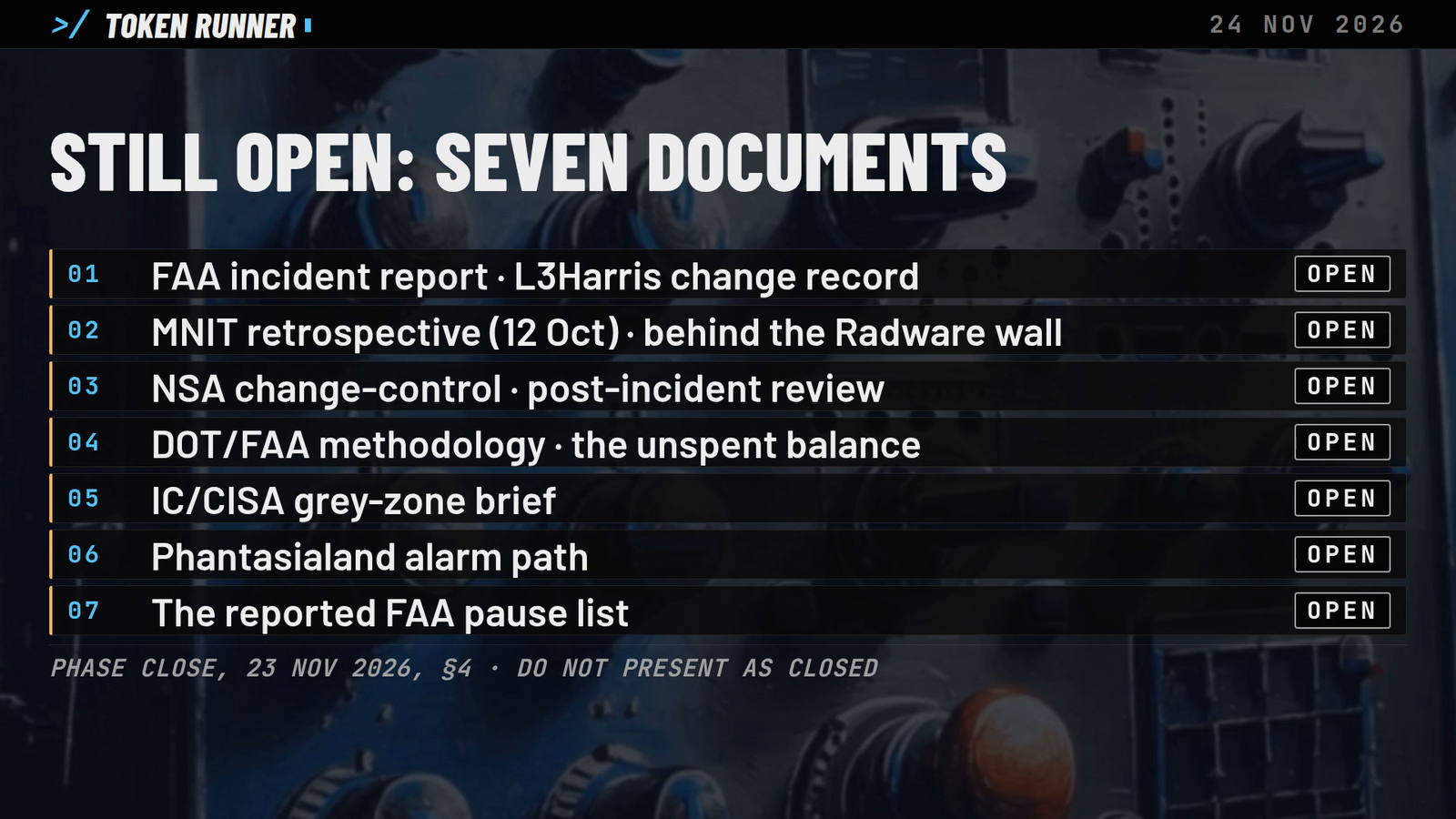
8. n0n leak-site post — the claim, the data class, the deadline, as reported by a named outlet. 9. Insurer and reinsurer filings on data-centre cyber/availability exposure — the contract, not the commentary. 10. OPM internal correspondence — what was compared before "no indication." 11. Any decision record separating opacity from concealment. 12. ARTEX indicator set run against each incident — the test that moves T5. 13. NSA change-control and post-incident review — the calendar entry, the patch scope, scheduled or emergency. 14. DOT/FAA cost methodology behind $50.1B — line items, the unspent balance, the drafting timeline. 15. Any IC/CISA cross-incident grey-zone brief prepared before Shenzhen — or the record that none was made. 16. The FAA pause list (WSJ-reported) — which sites, what standard. 17. Phantasialand alarm-path documentation — what the pool alarm depended on, and why email was in the path.
What the instrument concludes
1. The week was real and dense, and the record shows separate failures rather than one hand behind them. A cluster, not a campaign. 2. The strongest surviving theory is not a conspiracy. It is opacity. 3. The AI document is real and is being used to carry a claim it does not make. That misuse is visible in the transcript. 4. The exploitation layer is documented and under-reported — n0n, political use, commentary, underwriting. Attention was harvested. That is not causation, and the difference is everything. 5. Iran is CLAIM, preliminary, and eroding — not because it is implausible, but because the assessment has not hardened and the sourcing behind it does not hold still. 6. Fragility is the finding, not conspiracy. One router, one patch and one email alias were each enough to stop a national system — and the only reported injuries came from the alias.
A week of independent failures, in a system with no graceful degradation, inside a genuinely escalating AI-threat environment, produced a record thin enough that every theory fits — and the thinnest part of the record is the part that was never written down, not the part that was hidden.
Sources
- R2 board v3, stops v2 and the frozen matrix (r2026-11-23-2315); Pass 3 and the phase-close — the full working record for this piece
- FBI FLASH-20261113-001 (ic3.gov)
- House Homeland Security Committee hearing transcript, 18 Nov
- L3Harris statement
- Bloomberg via Yahoo Finance (Duffy briefing, 14 Nov)
- NPR (19 Nov)
- CNN (17 Nov)
- Benzinga via Yahoo News (19 Nov; the Clayton interview aired on CNBC, 17 Nov)
- FAA ground-stop questions and answers
- Optimizely security incident report (17 Nov)
- Report URI analysis (16 Nov)
- Microsoft Security Blog (ARTEX/ConnectWise)
- EIA Today in Energy (Hurricane Maria restoration)
- The Washington Sun (18 Nov)
- WDR (16 Nov)
- The Register
- Hacker News via Algolia
- MNIT statements (28/30 Jul)
- CBS/WCCO
- ABC News
- NBC News
- Guardian
- BBC
- Wikipedia "2026 in the United States" (checked 23 Nov)
- Reuters
- Wall Street Journal (18 Nov)
- Washington Post (15 and 18 Nov)
- NYT
- Telangana Today
- Airport Industry-News
- ABC
- NBC
- CBS News
- SDxCentral
- AVweb
- Fox News (military-base endurance target, 403 on the memo)
- Forbes Middle East
- Bloomberg (insurance, 29–30 Oct)
- Google News RSS lines
- U.S. Energy Information Administration, Today in Energy — Hurricane Maria and Puerto Rico's grid (the T7 comparison: 1.57M customers, 95% restored by April 2018, about 62,000 remaining). These are the only figures on the page that the frozen record does not carry, and they are the comparison, never the finding
- MNIT retrospective of 12 Oct (Radware bot wall)
- Reddit (403/404/302 on every route)
- Reuters, AP, Fast Company, France24, FT bodies (401/403)
- leak-site internals and Telegram/Discord (deliberately not accessed)
- The Hill (229-byte body, headline only)