Forty Points Apart
Asked whether artificial intelligence will have a positive impact on medical care over the next 20 years, 84% of the AI experts surveyed by Pew Research Center said it would. Among U.S. adults the share was 44%. Pew puts the distance at 40 percentage points. Both groups are more hopeful about medical care than about any other area they were asked about, so this is not a gap between hope and fear. It is a gap between a large expert majority and a public minority, on the public's own most hopeful answer.
The medical care gap
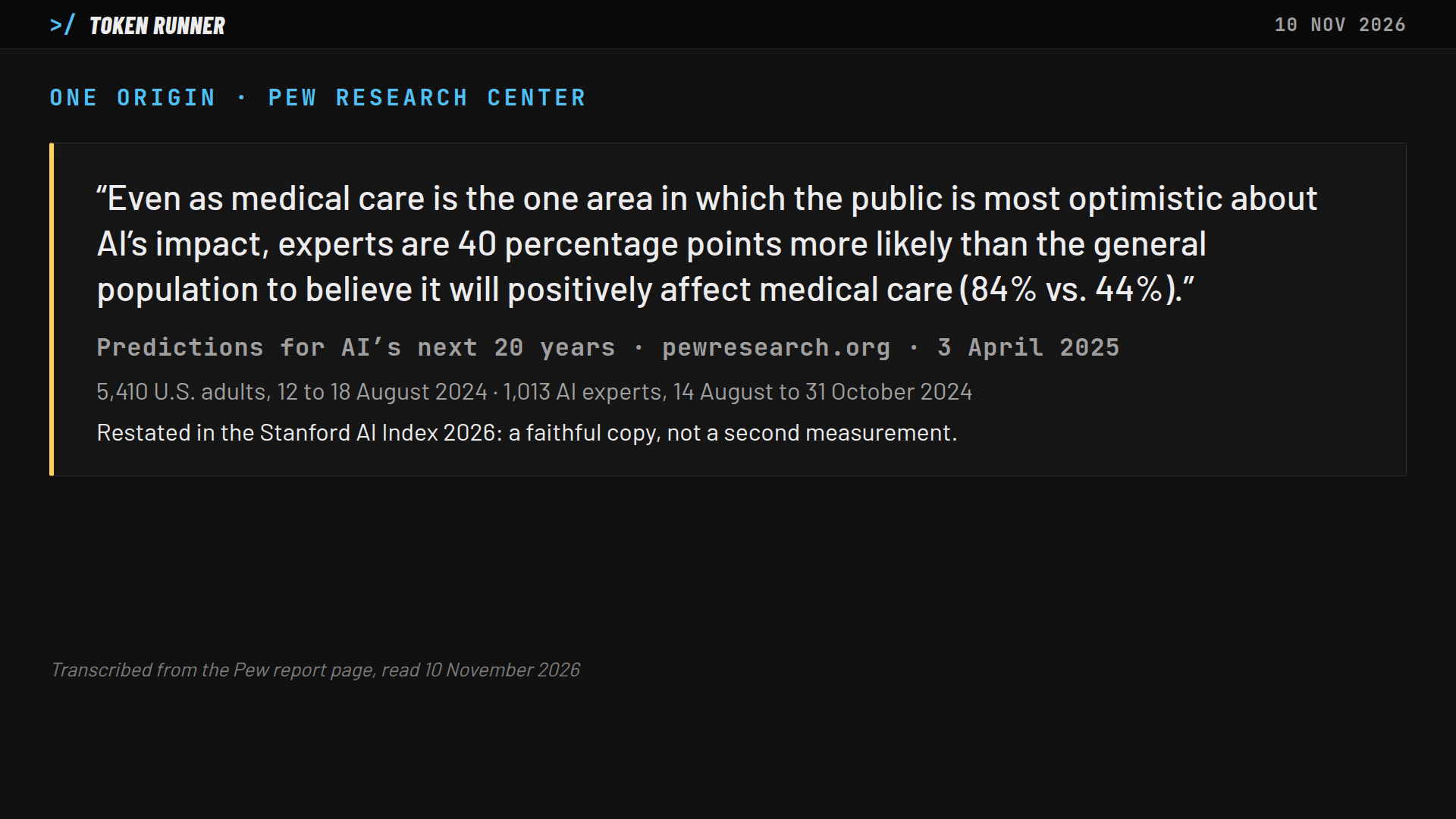
The number comes from one question put to two groups. Pew asked a national sample of U.S. adults, and separately a sample of AI experts, whether AI would have a very or somewhat positive impact on ten areas of American life over the next 20 years. On medical care, 84% of the experts and 44% of the adults expected a positive impact. Pew's own sentence holds both halves of the finding: medical care is "the one area in which the public is most optimistic about AI's impact," and yet experts are 40 percentage points more likely to believe it will positively affect medical care.
Medical care heads both lists. The experts' 84% is their highest share across the ten areas, and the public's 44% is theirs; no other public share rises above 24%, and no area reaches a public majority. The public is not against AI in medicine. Close to half expect it to help, more than in any other area. The rest did not choose a positive answer.
Source and method
Source: Pew Research, 2025, as published in Stanford HAI, AI Index Report 2026, figure 9.2.1.
Whose figures: The numbers are Pew Research, 2025; published by Stanford HAI in the AI Index Report 2026, figure 9.2.1. CC BY-ND 4.0, values copied exactly
Unit: per cent of respondents
copied exactly: the file holds a percentage as a whole number; typed as a number, nothing else.
The table, its licence and its date.
Cite this: Token Runner, “AI and medical care: experts 84%, public 44%”, tokenrunner.ai/society/forty-points-apart/ built 11 November 2026. CC BY 4.0.
The rows
| Area of society | Group surveyed | Share expecting a positive impact |
|---|---|---|
| Medical care | AI experts | 84 |
| Medical care | U.S. adults | 44 |
All 2 rows the chart drew.
Source and method
Source: Pew Research, 2025, as published in Stanford HAI, AI Index Report 2026, figure 9.2.1.
Whose figures: The numbers are Pew Research, 2025; published by Stanford HAI in the AI Index Report 2026, figure 9.2.1. CC BY-ND 4.0, values copied exactly
Unit: per cent of respondents
copied exactly: the file holds a percentage as a whole number; typed as a number, nothing else.
The table, its licence and its date.
Cite this: Token Runner, “The public's most hopeful answer is medical care, at 44%”, tokenrunner.ai/society/forty-points-apart/ built 11 November 2026. CC BY 4.0.
The rows
| Area of life | Group surveyed | Share expecting a positive impact |
|---|---|---|
| Arts and entertainment | U.S. adults | 20 |
| Elections | U.S. adults | 9 |
| How people do their jobs | U.S. adults | 23 |
| K-12 education | U.S. adults | 24 |
| Medical care | U.S. adults | 44 |
| Personal relationships | U.S. adults | 7 |
| The criminal justice system | U.S. adults | 19 |
| The economy | U.S. adults | 21 |
| The environment | U.S. adults | 20 |
| The news people get | U.S. adults | 10 |
All 10 rows the chart drew.
One origin
The figures have one origin. Pew Research Center fielded both surveys and published the results on 3 April 2025. Stanford's Institute for Human-Centered AI restates the pair in the public opinion chapter of its 2026 AI Index: "Similar divides appear for the economy (69% vs. 21%) and medical care (84% vs. 44%)." That is a reproduction, not a second measurement. The table behind this piece's charts was copied from the AI Index figure, and every pair in it agrees with Pew's own pages. The agreement shows the restatement is faithful. It does not corroborate the survey, because nobody else asked the question.
The gap across ten areas
In all ten areas Pew asked about, the expert share is higher than the public share. The two columns never cross.
The widest distance is on work itself: 73% of experts against 23% of the public expect a positive impact on how people do their jobs, a 50-point gap that has its own piece, The Fifty-Point Gap. The economy follows at 69% against 21%. K-12 education stands at 61% against 24%, and arts and entertainment at 48% against 20%.
Lower down, the gaps are generally narrower, and the expert shares are lower too. On the environment the shares are 36% and 20%; on the criminal justice system, 32% and 19%; on personal relationships, 22% and 7%; on the news people get, 18% and 10%. The order is not identical on the two sides. The experts rank jobs above the economy above schools; the public ranks schools above jobs above the economy. Medical care is first on both.
Source and method
Source: Pew Research, 2025, as published in Stanford HAI, AI Index Report 2026, figure 9.2.1.
Whose figures: The numbers are Pew Research, 2025; published by Stanford HAI in the AI Index Report 2026, figure 9.2.1. CC BY-ND 4.0, values copied exactly
Unit: per cent of respondents
copied exactly: the file holds a percentage as a whole number; typed as a number, nothing else.
The table, its licence and its date.
Cite this: Token Runner, “Experts are the more hopeful group in all ten areas”, tokenrunner.ai/society/forty-points-apart/ built 11 November 2026. CC BY 4.0.
The rows
| Area of life | Group surveyed | Share expecting a positive impact |
|---|---|---|
| Arts and entertainment | AI experts | 48 |
| Arts and entertainment | U.S. adults | 20 |
| Elections | AI experts | 11 |
| Elections | U.S. adults | 9 |
| How people do their jobs | AI experts | 73 |
| How people do their jobs | U.S. adults | 23 |
| K-12 education | AI experts | 61 |
| K-12 education | U.S. adults | 24 |
| Medical care | AI experts | 84 |
| Medical care | U.S. adults | 44 |
| Personal relationships | AI experts | 22 |
| Personal relationships | U.S. adults | 7 |
| The criminal justice system | AI experts | 32 |
| The criminal justice system | U.S. adults | 19 |
| The economy | AI experts | 69 |
| The economy | U.S. adults | 21 |
| The environment | AI experts | 36 |
| The environment | U.S. adults | 20 |
| The news people get | AI experts | 18 |
| The news people get | U.S. adults | 10 |
All 20 rows the chart drew.
The common ground
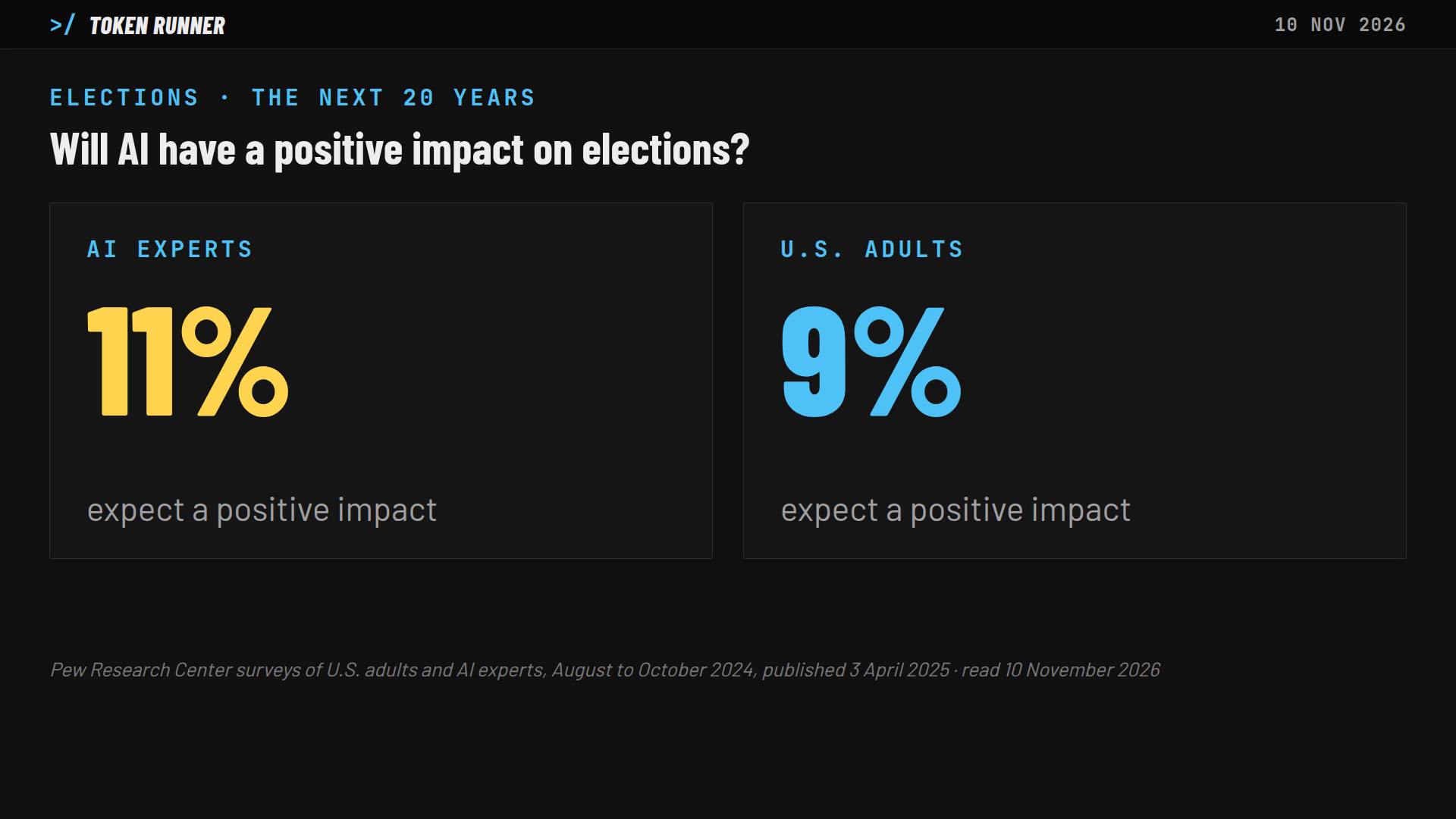
The two groups come closest where neither is hopeful. On elections, 11% of experts and 9% of the public expect AI to have a positive impact. Pew puts it the same way: only about one in ten U.S. adults and experts think AI will have a positive impact on elections.
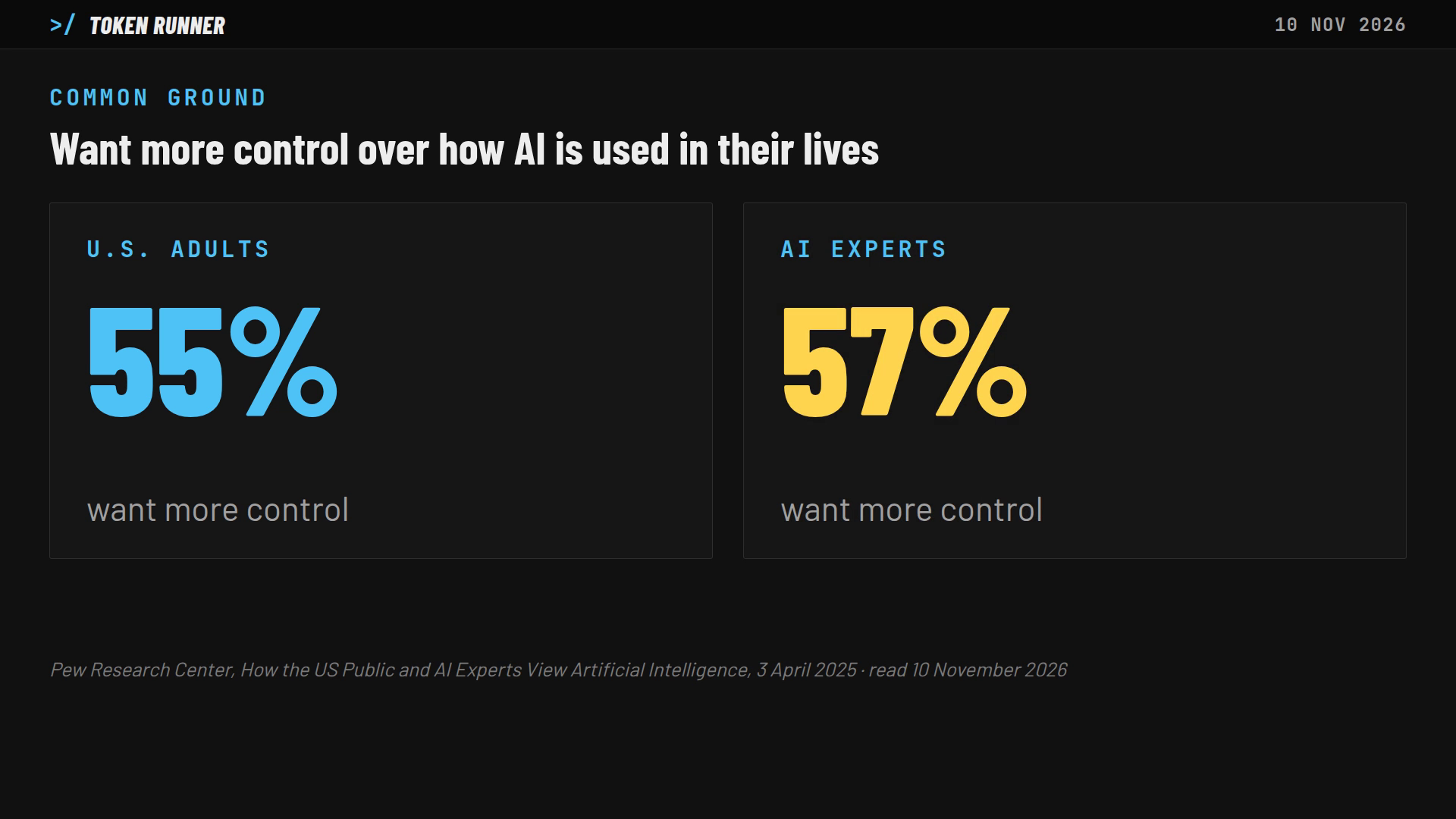
Agreement also shows up away from the impact question. More than half of U.S. adults, 55%, and a similar share of AI experts, 57%, want more control over how AI is used in their lives. 62% of adults and 53% of the experts surveyed have not too much or no confidence that the government will regulate AI effectively. And 66% of adults and 70% of experts are highly concerned about people getting inaccurate information from AI. On these questions the two groups sit close together; the wide gap is in what they expect AI to do.
The expert sample
One caution governs every figure above: the expert sample is partial, and Pew says so. To build it, Pew's researchers compiled a list of authors and presenters at 21 AI-related conferences held in 2023 or 2024, and surveyed 1,013 AI experts living in the United States from 14 August to 31 October 2024. Expert responses are unweighted and, in Pew's words, "only representative of the views of those who responded."
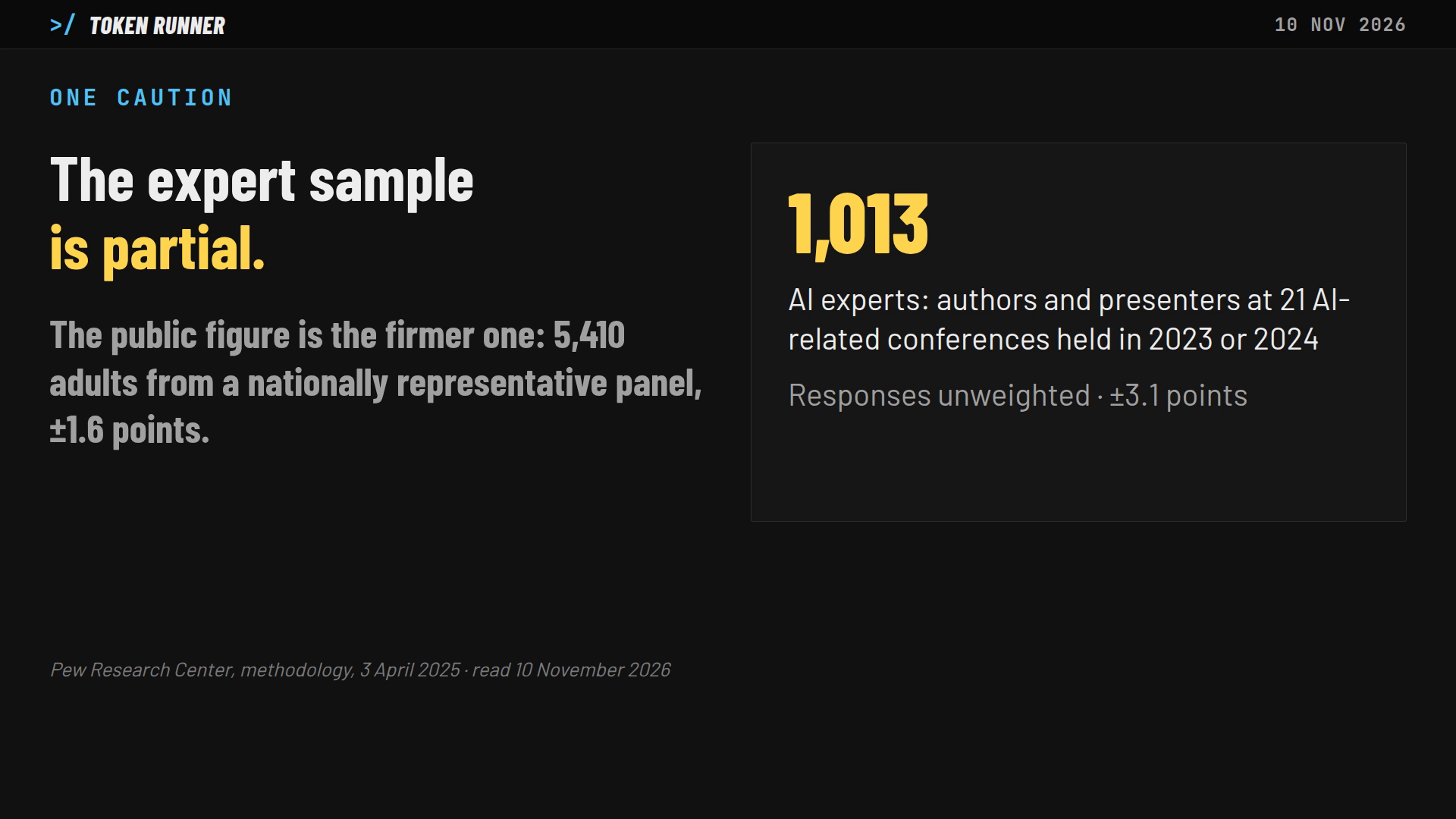
So the 84% is the view of those who responded from among people who publish and present at AI conferences: a population close to the technology and selected for engagement with it. It is not a random draw of everyone who builds or deploys AI, and it is not a measure of what AI will do for patients. The public figure is the firmer of the two: 5,410 adults surveyed from 12 to 18 August 2024, drawn from Pew's nationally representative American Trends Panel, with a margin of sampling error of plus or minus 1.6 percentage points. For the expert sample Pew gives plus or minus 3.1 points.
The period matters too. Both surveys were in the field in the second half of 2024. This is a 2024 reading of opinion, reproduced in a 2026 report, and the public's view may have moved since.
What the number measures
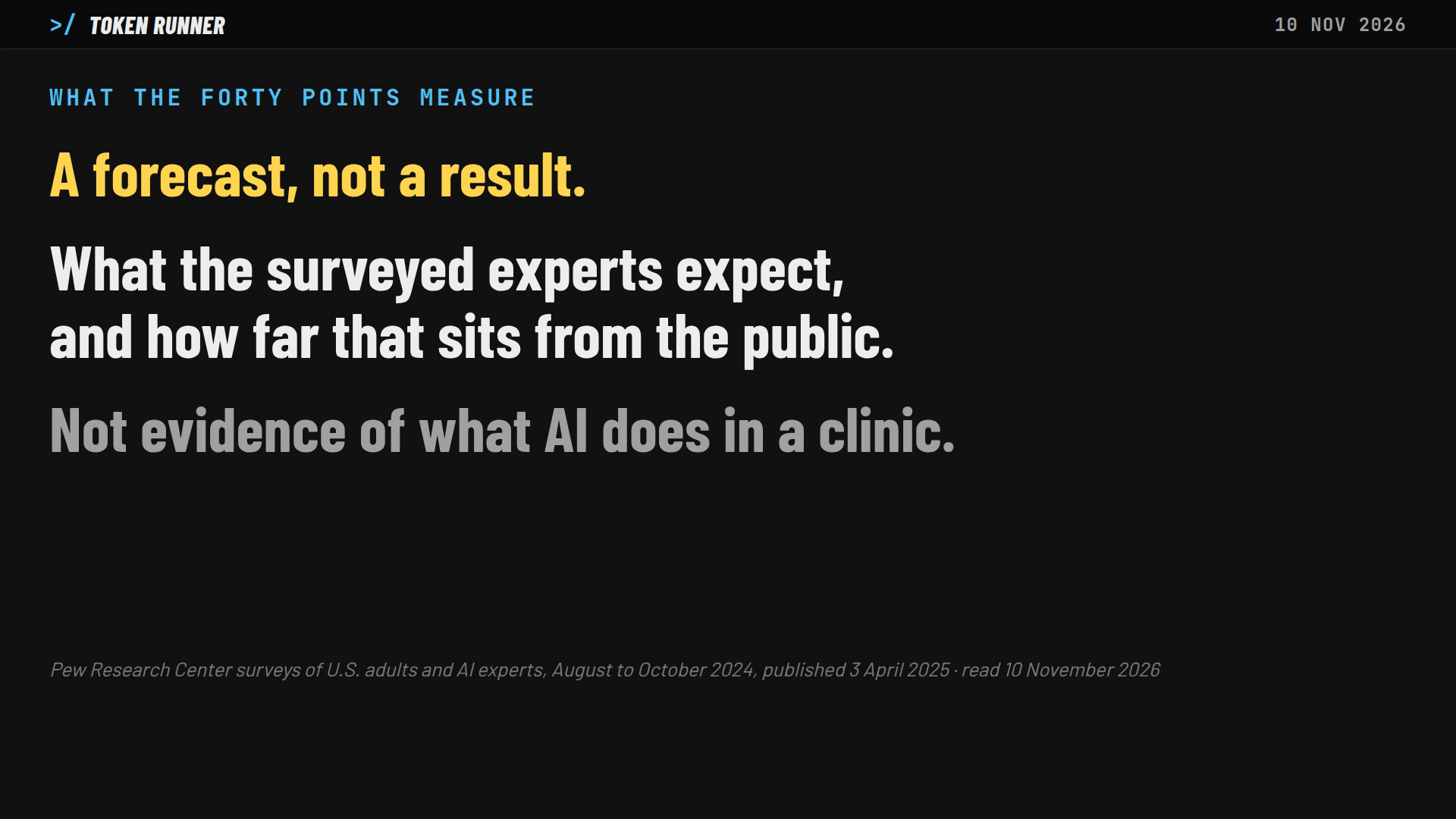
The 40-point gap measures two things at once. The first is an expectation: 84 of every 100 experts asked expect AI to have a positive impact on medical care. The survey did not ask which part of care, or what a positive impact would look like. The second is distance: how far the surveyed conference authors and presenters stand from the adults they are compared with.
Neither half is evidence about what AI does in a clinic. A forecast of benefit is not a measured benefit, and the gap lives in the forecast. A hospital that cites the experts' 84% as a reason to adopt a tool is citing an opinion about the future, gathered from respondents drawn from AI conference author and presenter lists, not a result from patients.
The exits
One exit is practical. Judge any medical use of AI on what it does for patients and for access, measured where it is used, and keep this survey out of the evidence column for whether it works.
Another runs through the rest of the same survey. The jobs answer, where the gap is widest, is told in The Fifty-Point Gap, and how the public's fear about jobs has moved since 2024 is followed in What people fear, and the words they use.
The third is a date to watch. Pew's April 2025 reports are the only paired reading of the two groups in this piece's sources. A comparable second wave would show whether the measured gap has changed as AI tools reach clinics and patients; until then this is one reading, taken in 2024, of two groups that were never sampled the same way.
Sources
- Pew Research Center, "How the US Public and AI Experts View Artificial Intelligence," 3 April 2025
- Pew Research Center, "Predictions for AI's next 20 years by the US public and AI experts," 3 April 2025
- Pew Research Center, methodology for the surveys of U.S. adults and AI experts, 3 April 2025
- Stanford HAI, "Public Opinion," The 2026 AI Index Report