The week the systems blinked
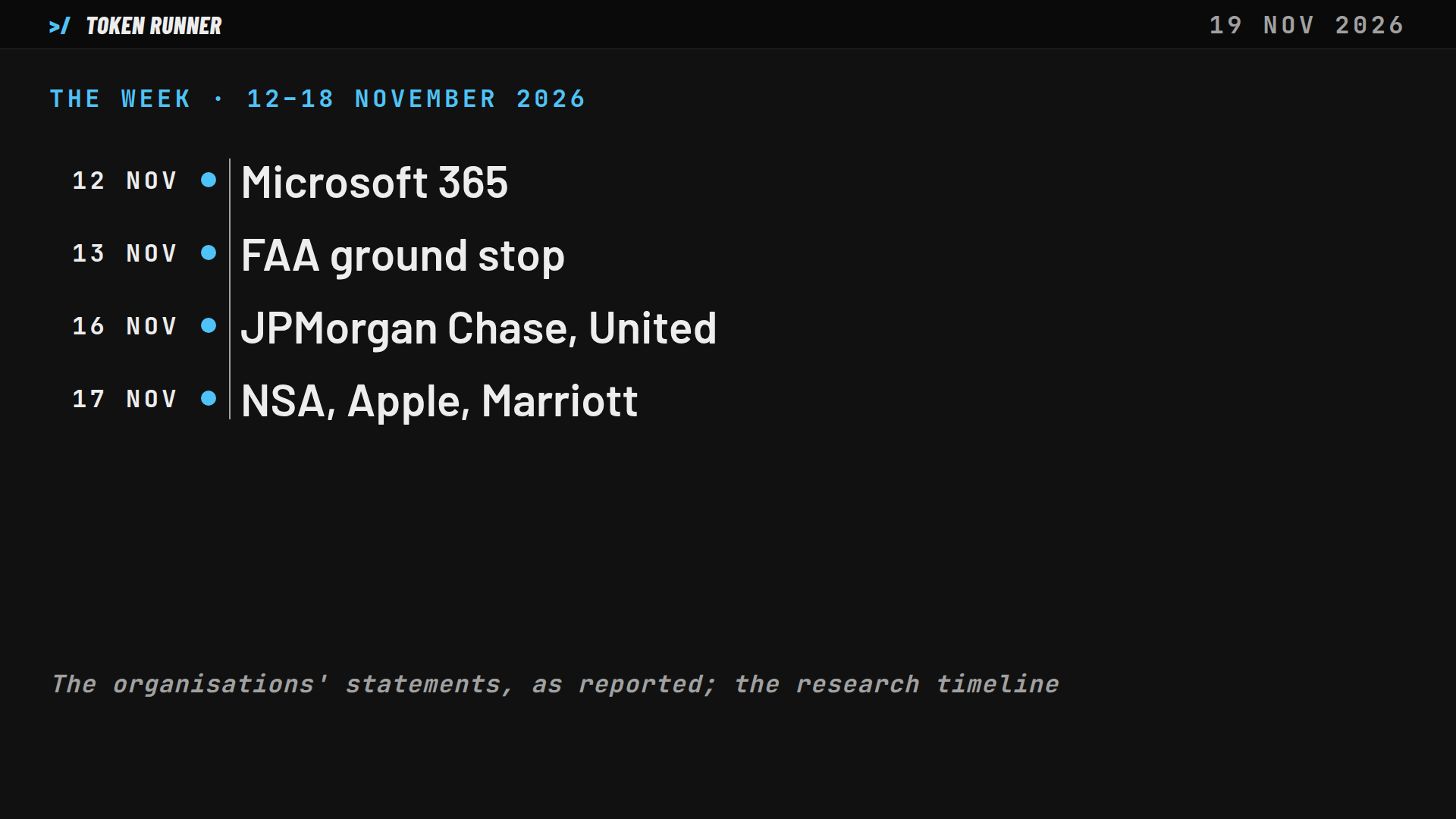
Seven failures in seven days hit Outlook, US air traffic, Chase, United, Apple, Marriott and a classified NSA network. Of the five organisations that gave a cause, four named something they had changed. No captured source names a shared vendor, network, payment rail or attacker. On the one public weekly count that covers part of the week, the network layer was ordinary. What spread fastest was the story.
The finding
Between Thursday 12 and Wednesday 18 November, seven organisations had failures the public could see [FACT, count]. Five published a cause [FACT, count]. Microsoft named a defect in a fix it began rolling out in July. The FAA named legacy equipment that destabilised while a contractor deployed a new router. Apple named "an internal update". The NSA named "scheduled routine maintenance". Chase named a software bug, without saying what triggered it [FACT that each said so].
United and Marriott have not given a cause [FACT, absence].
We looked for a shared vendor, cloud, fibre route, payment rail, sign-in provider or maintenance window. No captured source reports one [FACT that none was found; this is not proof of independence].
The base rate does not show an unusual week either. ThousandEyes counted 419 global network outage events in the week of 9–15 November [REPORTED]. That ranks 20th of the 46 weeks published this year and falls below the 532.5 median of the 12 weeks before it [FACT, arithmetic].
Our reading is that these were separate failures, mostly triggered by changes, arriving in a week when everyone was watching [PATTERN]. It is a reading, not a proof.
The ledger
Microsoft 365. Microsoft put its incident start at 1:26 p.m. ET on 12 November [REPORTED, via BleepingComputer]. CNBC said "shortly before 1 p.m." [REPORTED]. Microsoft reported "encouraging recovery progress" by about 10:30 a.m. Friday, 21 hours 4 minutes after its stated start [FACT, arithmetic], and full restoration on 14 November [REPORTED]. Published durations run from "more than 24 hours" (Epoch Times) to "approximately 48 hours" for Outlook (NBC) [REPORTED; unreconciled].
FAA. At about 3:30 p.m. ET on 13 November, "the FAA experienced a technical problem" [FACT, FAA record]. The nationwide ground stop was issued at 3:54 p.m. [REPORTED ×2] and traffic resumed at 8:15 p.m. [FACT, FAA record], so the stop lasted 4 hours 21 minutes [FACT, arithmetic]. The FAA says 17 of its 22 en route centres were affected and about 3,500 airborne aircraft landed safely [FACT, FAA record].
JPMorgan Chase. Errors were reported from about 11:30 a.m. ET on 16 November [REPORTED]. Chase said "Transactions are now posting normally" at about 6:30 p.m. [REPORTED]. Downdetector reports "neared 5,000" [REPORTED, Fortune].
United. United told CNN the outage "lasted about 30 minutes, with fewer than 150 flights impacted" [FACT that United said it]. AP reported "more than 90 minutes" [REPORTED].
NSA, Apple, Marriott. On 17 November the NSA said it "experienced temporary degradation during scheduled routine maintenance" [FACT that NSA said it]. A defense official told AP the classified NSANet was offline [REPORTED, anonymous]. No end time has been published [UNKNOWN]. Apple said "an internal update caused some outages this morning" [FACT that Apple said it]. Marriott said it "resolved a technical issue that affected sign-in capabilities" [FACT that Marriott said it].
The causes
Microsoft gave the fullest account. On 16 November Charles Lamanna, the executive in charge of Copilot, agents and platform, posted a three-part root cause on X. We hold his words as Computer Weekly, ITPro and the Epoch Times printed them; the post itself was not captured [REPORTED ×3].
The three parts were: (1) A fix deployed from July carried a latent defect, "lock contention inside an internal process", that froze gateway servers under load. "Our normal load testing did not detect the latent issue." (2) About 15 hours before the outage, Teams failed over onto the gateway that also serves Exchange Online. (3) Gateway capacity was already short: "nearly 14 percent" was out "due to an unrelated issue from the previous day".
“Our normal load testing did not detect the latent issue”
Computer Weekly, 16 Nov 2026, quoting Charles Lamanna's post on X (the post itself is not captured) · read 19 Nov 2026 (UTC), the gold capture
At the low point, "more than 80% of servers were unresponsive" [FACT that Microsoft's executive said it].
The FAA's account is as specific. Its "legacy equipment became unstable when data began flooding the FAA FTI network, at a rate of 1,000 connection attempts every 4 to 5 seconds" [FACT that the FAA said it]. It names two candidate sources: a radar site in Amarillo, Texas, and a radio site in El Dorado, Arkansas. At El Dorado its contractor L3Harris "had been doing work … including deployment of a new router". The FAA disabled the function on the originating Juniper routers and on "more than 60 other" Juniper routers [FACT that the FAA said it].
The accounts differ in their details. CNN wrote that the FAA "traced the problem to a single router in Arkansas"; the FAA's own page names two candidate sites [REPORTED vs FACT; open]. Transportation Secretary Sean Duffy described lines being moved "from an old copper wire to fiber" [REPORTED]. Asked whether modernisation caused the failure, the FAA said: "No, this is due to the legacy TDM system causing instabilities" [FACT that the FAA said it]. Both can be true: new work touched old equipment, and the old equipment failed.
Every denial in this piece is recorded as the fact that it was made, nothing more.
The base rate
No public count covers every kind of failure, so we used two partial ones.
ThousandEyes publishes weekly counts of network outage events through Network World. For 9–15 November it counted 419 globally and 282 in the US [REPORTED]. The US count was 21% above the previous week [REPORTED] but still below its own 12-week median of 324.5 [FACT, arithmetic]. The year's busiest week had 687 [REPORTED].
The limits matter. This count covers internet, cloud and edge networks, not bugs inside a bank. Only Microsoft and the FAA fall in a published week; the week of 16–18 November is not out yet.
Uptime Institute's 2026 outage survey supplies the second count. Among operators with a major network-related outage, 41% named configuration or change-management failure as a top cause, the most common answer [REPORTED, survey]. For IT and software outages, 53% named firmware or software faults and 51% configuration or change issues [REPORTED, survey]. Failures "are increasingly linked to complex interactions between systems", the report says.
By those surveys, changes that go wrong are the ordinary cause of outages, so a week of them is not in itself a sign of something new [PATTERN].
Source and method
Source: ThousandEyes (Cisco) weekly counts, via Network World.
How it is sourced: Every bar is a weekly count ThousandEyes published via Network World (REPORTED); the rank and the 12-week median are Token Runner's arithmetic on those counts (FACT).
Unit: outage events per week · highlighted: 9–15 Nov, 419 events, 20th of 46 weeks · lighter: the 12 weeks before, median 532.5
Network outage events ThousandEyes logged worldwide each week from 29 December 2025 to 15 November 2026, as Network World prints them. The week of 9 to 15 November, when Microsoft 365 and the FAA failed, logged 419: 20th of 46 weeks, and below the 532.5 median of the 12 weeks before it. The highest week, 31 August to 6 September, logged 687.
The table, its licence and its date.
Cite this: Token Runner, “Network outage events worldwide, week by week, 2026”, tokenrunner.ai/technology/outage-week/ built 20 November 2026. CC BY 4.0.
The rows
| Week number | Week beginning | Network outage events worldwide per week | Period |
|---|---|---|---|
| 1 | 01 · 29 Dec | 199 | earlier weeks |
| 2 | 02 · 5 Jan | 255 | earlier weeks |
| 3 | 03 · 12 Jan | 263 | earlier weeks |
| 4 | 04 · 19 Jan | 236 | earlier weeks |
| 5 | 05 · 26 Jan | 314 | earlier weeks |
| 6 | 06 · 2 Feb | 264 | earlier weeks |
| 7 | 07 · 9 Feb | 247 | earlier weeks |
| 8 | 08 · 16 Feb | 239 | earlier weeks |
| 9 | 09 · 23 Feb | 386 | earlier weeks |
| 10 | 10 · 2 Mar | 304 | earlier weeks |
| 11 | 11 · 9 Mar | 272 | earlier weeks |
| 12 | 12 · 16 Mar | 277 | earlier weeks |
| 13 | 13 · 23 Mar | 325 | earlier weeks |
| 14 | 14 · 30 Mar | 240 | earlier weeks |
| 15 | 15 · 6 Apr | 250 | earlier weeks |
| 16 | 16 · 13 Apr | 240 | earlier weeks |
| 17 | 17 · 20 Apr | 264 | earlier weeks |
| 18 | 18 · 27 Apr | 298 | earlier weeks |
| 19 | 19 · 4 May | 285 | earlier weeks |
| 20 | 20 · 11 May | 415 | earlier weeks |
| 21 | 21 · 18 May | 313 | earlier weeks |
| 22 | 22 · 25 May | 286 | earlier weeks |
| 23 | 23 · 1 Jun | 483 | earlier weeks |
| 24 | 24 · 8 Jun | 528 | earlier weeks |
| 25 | 25 · 15 Jun | 411 | earlier weeks |
| 26 | 26 · 22 Jun | 516 | earlier weeks |
| 27 | 27 · 29 Jun | 443 | earlier weeks |
| 28 | 28 · 6 Jul | 509 | earlier weeks |
| 29 | 29 · 13 Jul | 587 | earlier weeks |
| 30 | 30 · 20 Jul | 610 | earlier weeks |
| 31 | 31 · 27 Jul | 514 | earlier weeks |
| 32 | 32 · 3 Aug | 502 | earlier weeks |
| 33 | 33 · 10 Aug | 546 | earlier weeks |
| 34 | 34 · 17 Aug | 534 | 12 weeks before |
| 35 | 35 · 24 Aug | 649 | 12 weeks before |
| 36 | 36 · 31 Aug | 687 | 12 weeks before |
| 37 | 37 · 7 Sep | 539 | 12 weeks before |
| 38 | 38 · 14 Sep | 531 | 12 weeks before |
| 39 | 39 · 21 Sep | 559 | 12 weeks before |
| 40 | 40 · 28 Sep | 303 | 12 weeks before |
| 41 | 41 · 5 Oct | 310 | 12 weeks before |
| 42 | 42 · 12 Oct | 387 | 12 weeks before |
| 43 | 43 · 19 Oct | 459 | 12 weeks before |
| 44 | 44 · 26 Oct | 601 | 12 weeks before |
| 45 | 45 · 2 Nov | 450 | 12 weeks before |
| 46 | 46 · 9 Nov | 419 | outage week |
All 46 rows the chart drew.
The common thread
Officials offered one shared explanation, patching. On 17 November Director of National Intelligence Jay Clayton told AP: "Many people are patching their systems … It is time for an upgrade across our digital infrastructure" [FACT that he said it]. On Fox Business, as quoted by CNN, he said patching "has caused some of these systems to not come back up". CNN linked the patches to PHP vulnerabilities that AI tools had helped exploit. We have not verified that link [REPORTED, single outlet].
Senator Mark Warner said the evidence "points toward legitimate efforts to secure our systems, not malicious activity". Secretary of State Marco Rubio said the incidents "are distinct, and they're different in their causation" [FACT that each said it].
Only part of the record fits. The NSA's maintenance, which two CBS sources called "routine system patching" [REPORTED], fits, and so does Apple's update. Microsoft's defect dates from July, and the FAA's trigger was a router deployment. Neither was a patch. A patch wave behind the whole cluster remains a hypothesis [CLAIM].
The SI remark
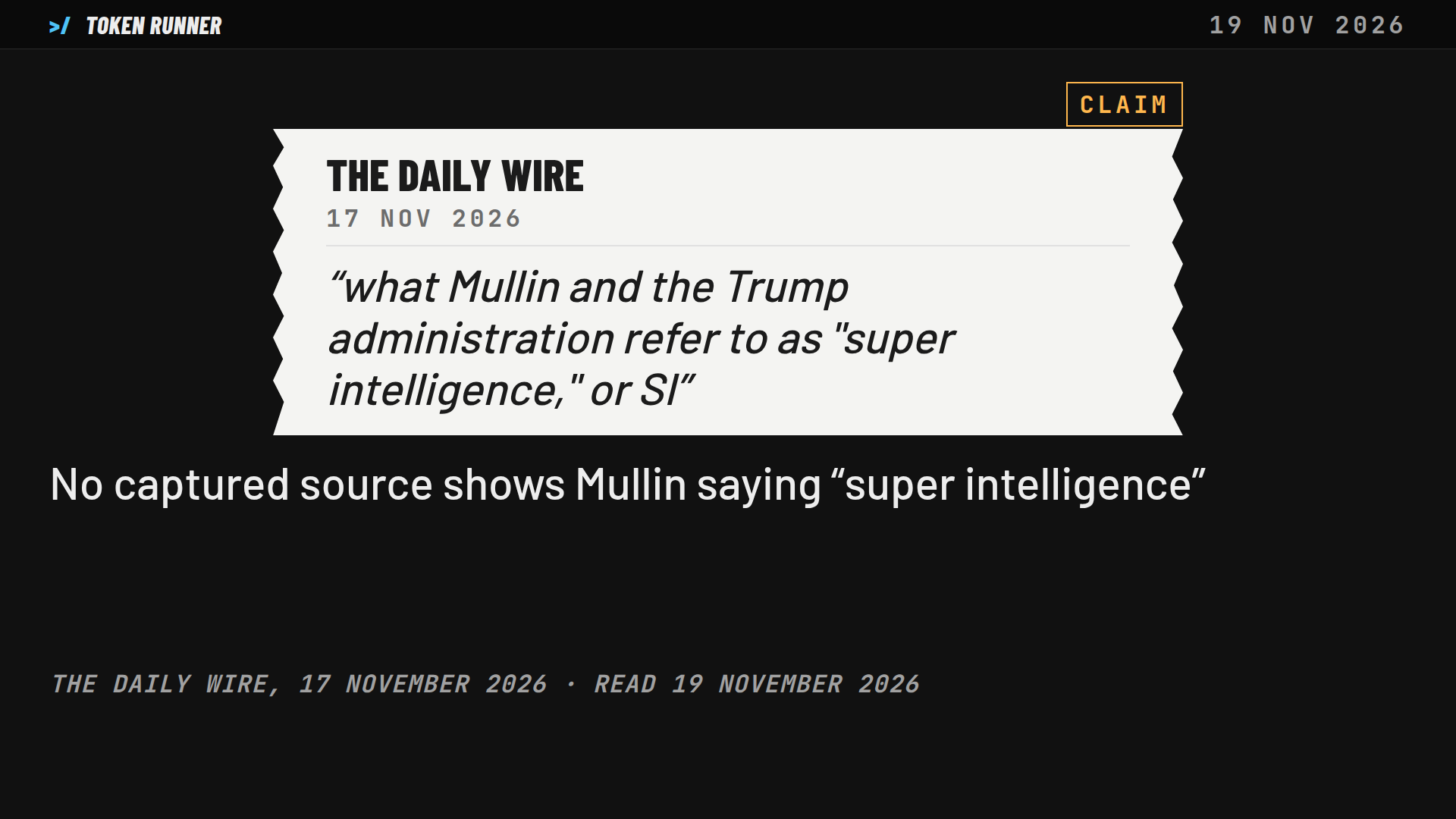
No captured quote has Homeland Security Secretary Markwayne Mullin saying "super intelligence". He says "SI".
The first instance is in DHS's own transcript of the 13 November White House briefing, and it is a denial: "We have seen zero evidence that this is a cyberattack or an SI attack" [FACT, DHS record].
On Fox News's *Hannity* on 16 November, Mullin said an unnamed tech contact had told him "I believe that it's the SI". The theory was that code that fixes itself had overrun old systems. In the same interview he put his certainty that this was not a cyberattack at "98%" [REPORTED ×2] and said "The homeland is secure" [REPORTED].
We did not obtain a Fox transcript, and the outlets disagree on his words. The Daily Wire has "systems to be overrun" where The Hill has "a system to be overran", and "footprints going in" where The Hill has "going out" [REPORTED; unreconciled].
The spelled-out "super intelligence" was supplied by the outlets. Fortune glossed SI as "the administration's preferred term for AI". The Epoch Times wrote that the President "has called" it that, without citing where [the attribution is a CLAIM].
By publication timestamps on 17 November, the carriers ran in this order [FACT, page metadata]: the Epoch Times, 12:42 UTC; The Hill via Yahoo, 15:01; the Daily Wire, 15:56; Newsmax via Yahoo, 16:41; Fortune, 17:00, headlined "…your bank account and airline tickets are under attack from rogue AI".
Each of these goes back to one unnamed person, relayed by Mullin [SIGNAL; single origin].
The SMART question
Suspicion that SMART, the FAA's new AI traffic-flow tool, caused the stop predates the stop. On 13 October, Representatives Rick Larsen and André Carson and 21 other House Democrats asked GAO to audit SMART [FACT, primary]. Their letter warned it could "hallucinate safety-critical information" [FACT that they wrote it]. The FAA expanded SMART to all 22 en route centres on 10 November [REPORTED ×2].
The FAA says flatly that SMART was not the cause: "SMART is a data aggregator, and it does not feed information into the air traffic control system" [FACT that the FAA said it]. Duffy called it "completely disconnected" [REPORTED].
We found no GAO response and no finding [UNKNOWN]. A request for an audit is not an audit. The letter came 31 days before the stop [FACT, arithmetic]: the stop did not create the question, it revived it.
The plumbing
Payments. Zelle does not fail as a single unit. AP reports it is owned by Early Warning Services, which is owned by banks including Bank of America, Capital One, JPMorgan Chase, PNC, Truist, U.S. Bank and Wells Fargo [REPORTED]. Early Warning's own page says it "became wholly bank-owned" and "launched the Zelle® network" [FACT].
On 16 November Zelle said "Zelle is not down". Capital One said it "has not been impacted". U.S. Bank said its systems were "not directly impacted" [FACT that each said it]. Customers elsewhere saw delays on transfers with Chase on the other side. The lead sheet's ripple to Capital One is not supported.
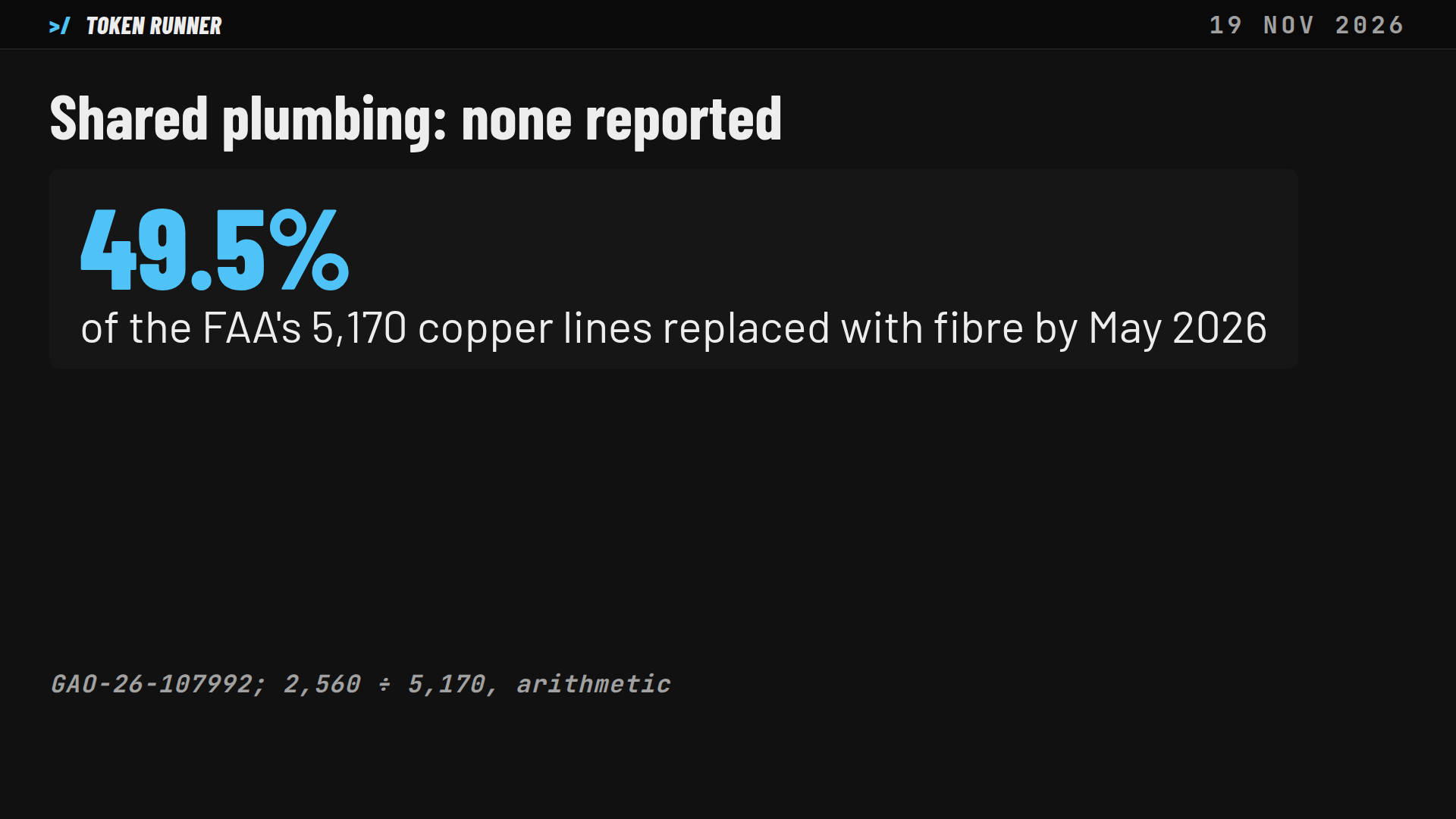
Air traffic. GAO reports that the FTI network links about 5,000 FAA facilities and says: "Copper cables are from the 1960s." [FACT]. As of May 2026, 2,560 of 5,170 copper lines had been replaced, or 49.5% [FACT, arithmetic], with a target of December 2028 [FACT]. On FAA ratings GAO first reported in 2024, 51 of 138 systems were unsustainable and 54 potentially so, 76.1% together [FACT, arithmetic].
Enterprise software. Microsoft runs "two independent and heterogenous network gateway systems" for resilience [FACT that it said so]. On 12 November a failover between them loaded a gateway already short of capacity. When one vendor carries the email and chat of so many organisations, one latent bug reaches all of them at once. We sourced no market-share figures, so we give none.
The open questions
The strongest case against our reading is time. United and Marriott have given no cause, and the NSA has given no end time. Bloomberg's NSA report and ThousandEyes's own Microsoft analysis refused our requests. A hidden shared dependency, such as a library, a certificate or an update channel, is not ruled out [UNKNOWN]. All we can say is that none has been reported.
The figures disagree, and we publish the variation rather than choose.
FAA cancellations: about 12,462 (the FAA, which says "not all" were caused by the stop), "nearly 8,000" (Wikipedia), "at least 4,000" (FlightAware via CBS). The highest is 3.1 times the lowest [FACT, arithmetic].
The lead sheet's 20,000 appears in no source we found.
United's outage: 30 minutes (United), more than 90 (AP), about 100 (AeroTime), a 3.3-fold spread [FACT, arithmetic].
NSA status: CNN reported "code yellow", then "code orange"; CBS reported "Code Gray" for staggered arrivals. They may be measuring different things [open].
Source and method
Source: FAA; Wikipedia; FlightAware via CBS News and Al Jazeera.
Whose figures: Each dot is one publisher's figure, as printed and attributed: the FAA's own record (FACT), Wikipedia and FlightAware via CBS and Al Jazeera (REPORTED). None is chosen.
Unit: flights · none chosen, none averaged · the highest is 3.1 times the lowest
Three counts of the flights cancelled on 13 November, as each was published: the FAA's about 12,462, which it says were not all caused by the ground stop; Wikipedia's nearly 8,000; and FlightAware's at least 4,000, as CBS News and Al Jazeera carried it. The highest is 3.1 times the lowest.
The table, its licence and its date.
Cite this: Token Runner, “Flights cancelled on 13 November: three published counts”, tokenrunner.ai/technology/outage-week/ built 20 November 2026. CC BY 4.0.
The rows
| Row | Published by | Flights cancelled | As printed |
|---|---|---|---|
| 1 | 01 · FAA, own Q&A | 12,462 | ~12,462 |
| 2 | 02 · Wikipedia | 8,000 | nearly 8,000 |
| 3 | 03 · FlightAware via CBS | 4,000 | at least 4,000 |
All 3 rows the chart drew.
Sources
- FACT — FAA, "Nationwide Ground Stop: Questions and Answers", 15 Nov 2026
- FACT — DHS, ICYMI: Secretary Mullin and Secretary Duffy address nationwide FAA ground stop, 13 Nov 2026
- FACT — DHS, Secretary page, current
- FACT — DHS, Markwayne Mullin person page, current
- FACT — House Transportation & Infrastructure Committee Democrats, press release (letter to GAO), 13 Oct 2026
- FACT — GAO, GAO-26-107992 (testimony/report on FAA ATC modernisation), 14 Sep 2026
- FACT — Uptime Institute, *Annual Outage Analysis 2026* (PDF), 2026
- FACT — Uptime Institute press release, 2026
- FACT — Early Warning Services, About, current
- REPORTED — CNBC, 2026-11-12
- REPORTED — CNN Business (live), 2026-11-13
- REPORTED — Al Jazeera, 2026-11-13
- REPORTED — ABC News, 2026-11-14
- REPORTED — CNBC, 2026-11-13
- REPORTED — Al Jazeera, 2026-11-13
- REPORTED — CNBC, 2026-11-16
- REPORTED — NBC News, 2026-11-16
- REPORTED — AP via PBS NewsHour, 2026-11-16
- REPORTED — CNN, 2026-11-16
- REPORTED — AP via ABC News, 2026-11-17
- REPORTED — NBC Philadelphia, 2026-11-17
- REPORTED — azfamily (Gray TV), 2026-11-17
- REPORTED — CNN, 2026-11-17
- REPORTED — CBS News, 2026-11-17
- REPORTED — AP via SecurityWeek, 2026-11-17
- REPORTED — AP via Federal News Network, 2026-11-17
- REPORTED — Yahoo News (syndicated), 2026-11-18
- REPORTED — CNBC, 2026-11-17
- REPORTED — CNBC video page, 2026-11-17
- REPORTED — Fortune, 2026-11-17
- REPORTED — AP via Yahoo, 2026-11-14
- REPORTED — BleepingComputer, 2026-11-12
- REPORTED — Computer Weekly, 2026-11-16
- REPORTED — ITPro, 2026-11-16
- REPORTED — Network World (ThousandEyes weekly data), 2026-11-17
- REPORTED — AeroTime, 2026-11-16/17
- REPORTED — TechRepublic, 2026-11-17
- REPORTED — Quartz, 2026-11-16
- REPORTED — Computer Weekly, 2025-03-06
- CLAIM — The Daily Wire, 2026-11-17
- CLAIM — The Hill via Yahoo, 2026-11-17
- CLAIM — Newsmax via Yahoo, 2026-11-17
- CLAIM — Yahoo (citing NBC), 2026-11-17
- CLAIM — The Epoch Times, 2026-11-18
- CLAIM — The Epoch Times, 2026-11-17
- CLAIM — The Epoch Times, 2026-11-16
- CLAIM — The National News Desk (Sinclair), 2026-11-17
- CLAIM — Deseret News, 2026-11-18
- REPORTED — Wikipedia, "2026 Microsoft outage"
- REPORTED — Wikipedia, "2026 FAA nationwide ground stop"
- Built only from pages captured on 19 November 2026 and read from disk. Organisations' own records come first: the FAA's Q&A, DHS's transcript, the House T&I Democrats' release, GAO-26-107992, Uptime Institute's Annual Outage Analysis 2026, and Early Warning's own page. Company statements are as printed by AP, CNBC, CNN, NBC, CBS, Computer Weekly and others. Weekly counts are ThousandEyes data via Network World, 17 Nov 2026; medians, ranks and durations are our arithmetic. Wikipedia served only as a pointer to sources. Bloomberg, the Washington Times, KXAN, Fast Company, the Washington Post, the ThousandEyes blog and the UK Treasury Committee refused access. No one was contacted. Times are US Eastern unless marked. Not captured, named: the X posts of Charles Lamanna (Microsoft, 16 Nov 2026; his words via Computer Weekly, ITPro and The Epoch Times), Amazon (via CNBC) and Google/Gmail (via NBC Philadelphia); Microsoft 365 post-incident review MO1550821; a Fox News transcript of Hannity, 16 Nov 2026.